


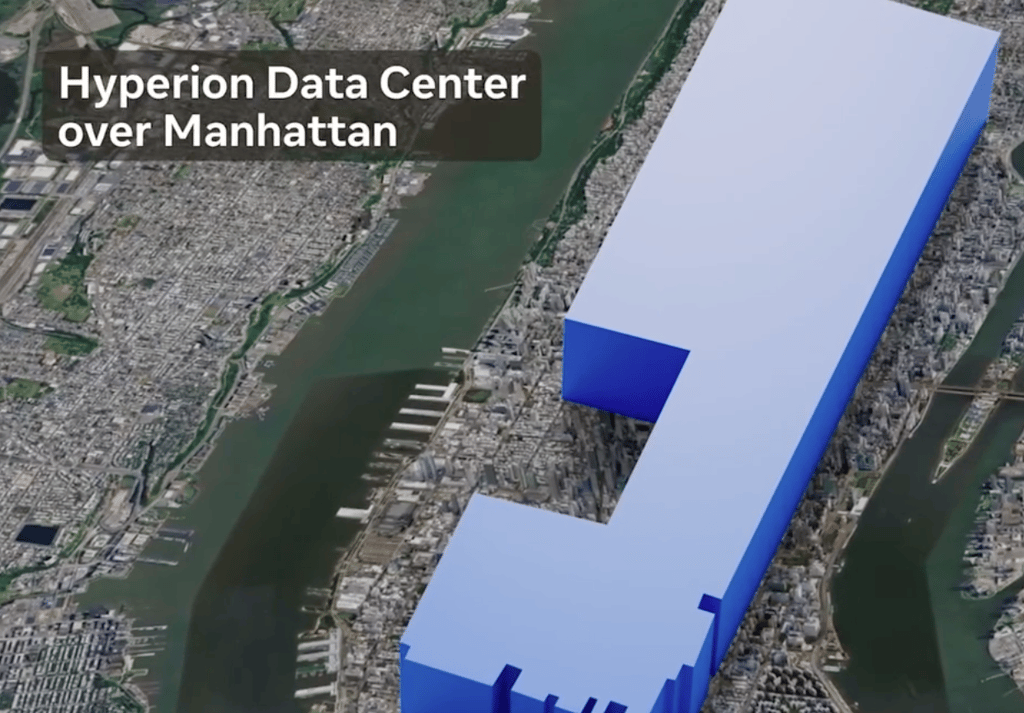
Meta is going to “invest hundreds of billions of dollars” to deliver superintelligence, an artificial intelligence system that outperforms humans. CEO Mark Zuckerberg said that the company is building two massive data centres that will supply the necessary computational power for this goal.
These data centres, named Prometheus and Hyperion, will produce multiple gigawatts of energy for training and running the superintelligent system. Prometheus will be based in New Albany, Ohio, and is expected to come online in 2026. Hyperion will be built in Louisiana and is anticipated to be online by 2030, according to the BBC.
“We’re building multiple more titan clusters as well,” Zuckerberg wrote in a series of posts on Threads. “Just one of these covers a significant part of the footprint of Manhattan.” For reference, Manhattan has an area of 59 km2.
He went on to say that Hyperion “will be able to scale up to 5GW over several years,” positioning it among the largest data centres in the world. Currently, the largest individual facility by capacity is the China Telecom Inner Mongolia Park, which has a capacity of approximately 0.15 GW.
Many of Meta’s competitors have multi-gigawatt sites planned, including Oracle, Google, OpenAI, and Amazon. TechRepublic recently reported that Shark Tank’s Kevin O’Leary is building the world’s largest AI data center in Canada.
Large-scale data centres pose environmental and community risks
One gigawatt of energy can provide electricity to roughly 750,000 homes, and large-scale data centres have been known to cause power outages due to the pressure they place on the grid. They also strain water supplies and increase air pollution, resulting in pushback from those living in their vicinity.
One of Meta’s data centres in Newton County, Georgia, accounts for approximately 10% of the area’s total daily water usage, according to The New York Times. Residents are now dealing with water pressure issues caused by sediment buildup and have had to cover mitigation costs out of pocket; they’re also struggling to sell their houses to relocate.
A spokesperson for the company managing Meta’s data centre park told the NYT that the cause of the problems is unknown and that the timing of the water issues coinciding with the facility’s construction could just be a coincidence.
Companies applying to build new facilities in Newton County are requesting as much as 6 million gallons of water a day, more than the county’s entire daily use. Still, the solution isn’t as straightforward as simply rejecting the requests, as they can bring in millions of dollars in tax revenue. Even trying to regulate data centres is difficult because operators are notoriously poor at disclosing their water and energy usage.
More about data centers
- Stargate Norway: OpenAI’s First AI Data Center in Europe
- AI Data Centers’ Soaring Energy Use: Who Pays for Higher Utilities Costs?
- China’s Submerged AI Data Center Could ‘Influence Global Sustainable Computing’
- Google to Power Data Centers With Nuclear Energy by 2030 in First-Of-A-Kind’ Agreement
Zuckerberg is determined to boost Meta’s AI standing
Although Meta has been pursuing AI since approximately 2013, the company has not seen much success in the post-ChatGPT era, struggling to keep pace with the likes of OpenAI and Google.
Missteps include open-sourcing its models, which allowed DeepSeek to use them to create more advanced and cost-effective derivatives. Its latest Llama models have underperformed, its AI chatbots have earned a seedy reputation, and top engineers have been leaving the company.
In recent months, Zuckerberg has been investing heavily in the issue to try to turn things around. He has built a new AI research division, dubbed Meta Superintelligence Labs. He was reportedly offering $100 million signing bonuses to persuade engineers to jump ship from rivals like OpenAI and Google DeepMind to support this venture.
It will be led by Alexandr Wang, the founder of data-labelling startup Scale AI, as well as former GitHub CEO Nat Friedman. Rumour has it that Zuckerberg also secured Apple’s top AI executive, Ruoming Pang, with a compensation package worth over $200 million. One of the group’s first major points of discussion was abandoning Meta’s powerful open-source model, Behemoth, in favour of a closed-source alternative that can’t be pinched, according to the NYT.
“Meta Superintelligence Labs will have industry-leading levels of compute and by far the greatest compute per researcher,” Zuckerberg wrote on Threads.
Can Meta’s billions buy it the lead in the superintelligence race?
OpenAI CEO Sam Altman, whose company is also pursuing superintelligence, suggested that Meta isn’t truly committed to its superintelligence ambitions, remarking that the company would eventually move on to “their next flavor of the week.” After all, Meta began life as Facebook and still maintains an almost too strong grip on the social media landscape, while also incurring around $60 billion in losses by investing in metaverse-related technology.
However, in Zuckerberg’s memo announcing who made it in to Meta Superintelligence Labs, he said that Meta is “uniquely positioned” to deliver superintelligence, as it has enough cash to acquire the significant compute resources required, a track record of delivering products to billions of people, experience in AI hardware such as smart glasses, and a company structure that allows it to take big swings.
In his Threads posts, Zuckerberg reiterated that “we have the capital from our business to do this.” Meta made more than $160 billion in revenue in 2024, largely from online advertising on its social media platforms.
As Meta pours billions into giant AI clusters, a new report warns that the energy demands of AI have reached unsustainable levels.