


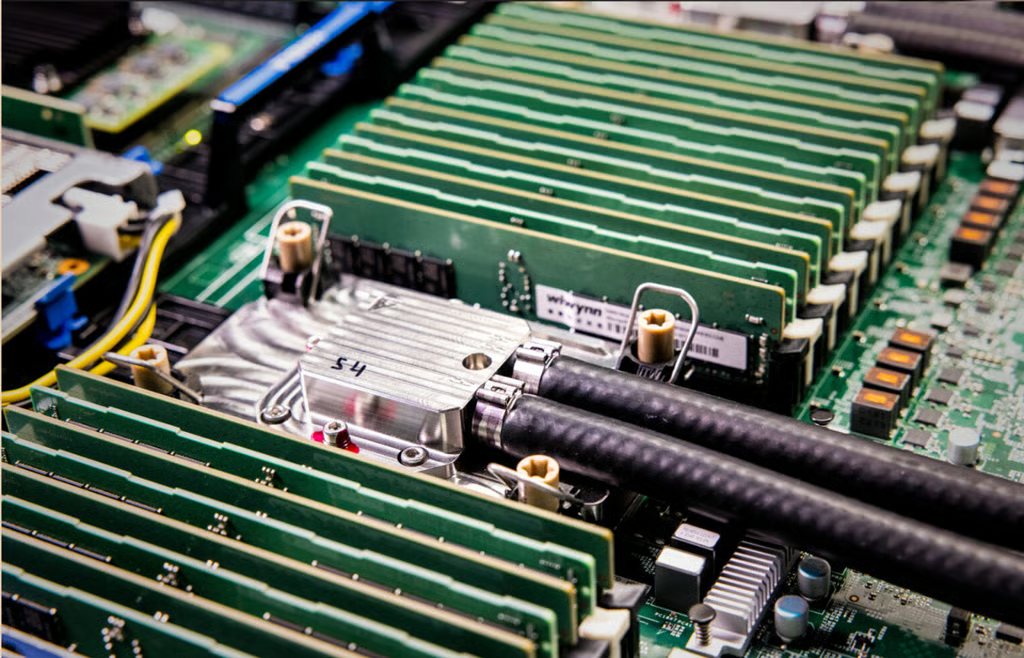
AI’s heat problem may have met its match. Microsoft says it has successfully tested a microfluidic cooling system that removes heat “three times better than cold plates” inside next-generation AI chips.
The company revealed the breakthrough as part of its data center research, showing how liquid channels etched directly into silicon could keep servers cooler, denser, and faster. Microsoft said the new system marks a step toward more sustainable and scalable AI infrastructure.
Coolant inside the chip itself
Microsoft describes microfluidics as a necessary leap beyond today’s cold plate systems, which struggle to keep pace with increasingly power-hungry AI chips. Without new methods, company engineers warn, data centers could hit a thermal ceiling in as little as five years.
In its first round of tests, the technology cut temperature spikes on GPUs by up to 65% and delivered cooling performance significantly higher than conventional systems. The results, according to Microsoft, point to a future where servers can be packed tighter and run harder without sacrificing reliability.
“Microfluidics would allow for more power-dense designs that will enable more features that customers care about and give better performance in a smaller amount of space,” said Judy Priest, corporate vice president and chief technical officer of Cloud Operations and Innovation at Microsoft.
Bio-inspired design modeled on leaf veins and wings
To make the system practical, Microsoft drew inspiration from patterns found in nature. Working with Swiss startup Corintis, engineers used AI to design microchannels that resemble the veins of a leaf or the wings of a butterfly. The branching layout moves coolant more evenly across a chip’s hottest points.
Unlike simple straight channels, these bio-inspired grooves help the liquid flow where it’s needed most, preventing heat from building up in specific areas. The design is as fine as a strand of human hair, requiring precision to avoid cracks or blockages in the silicon.
“Systems thinking is crucial when developing a technology like microfluidics,” noted Husam Alissa, director of systems technology in Microsoft’s Cloud Operations and Innovation group.
Cutting power use and easing strain on grids
Aside from performance gains, Microsoft says the cooling advance could change how its data centers manage energy. Because the system removes heat directly at the chip, the coolant doesn’t need to be chilled as much, reducing the overall energy required for cooling.
That efficiency translates into lower operating costs and eases stress on nearby energy grids, a growing concern as AI expansion drives up electricity demand.
Breaking heat barriers for the future of AI data centers
The project sits alongside Microsoft’s $30 billion quarterly investment and its custom Cobalt and Maia chips. The company states that it will collaborate with fabrication partners to integrate microfluidics into production and embed the system in future generations of its hardware.
The advance could also enable entirely new chip designs, including stacked 3D architectures that have been held back by heat so far. By moving coolant closer to where power is consumed, Microsoft argues, data centers could shrink their footprint while handling ever-larger AI models.
“We want microfluidics to become something everybody does, not just something we do,” said Jim Kleewein, technical fellow at Microsoft 365 Core Management.
Beyond cooling breakthroughs, Microsoft is also backing its AI ambitions with one of the largest infrastructure pledges ever made in the UK.