


Scientists used to spend months hand-tuning lasers. MIT built a robot that does it unsupervised in half an hour.
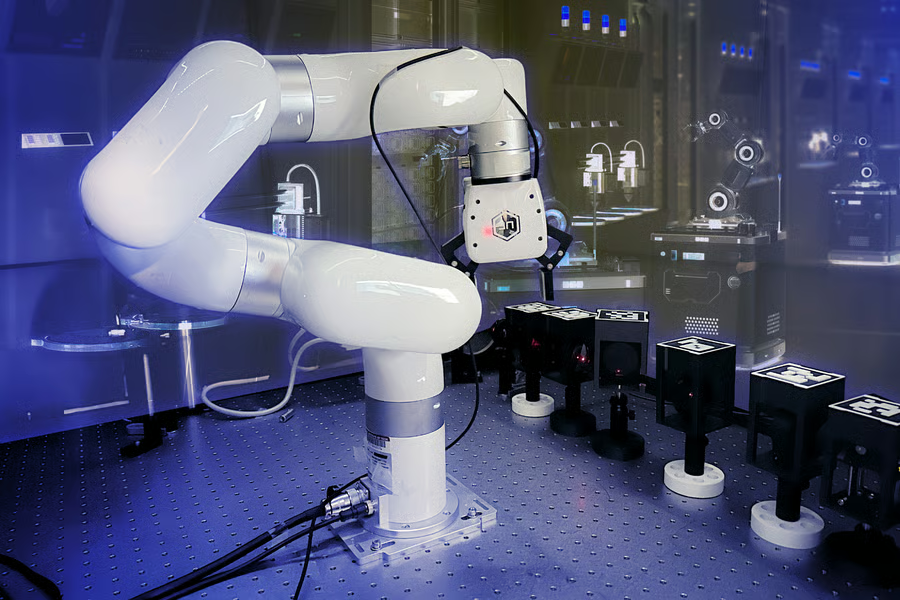
MIT researchers have developed a reconfigurable robotic optics lab that can assemble, align, monitor, and dismantle precision experiments with minimal human intervention. The system is designed to tackle one of the slowest parts of optics research: physically arranging mirrors, lenses and other components and repeatedly adjusting them until light behaves exactly as required.
The robot demonstrated its capabilities by building a tabletop laser cavity from randomly positioned components. It completed 50 maneuvers in about 30 minutes and produced a functioning laser.
“We start with randomly placed components. At the end, we have a fully functioning laser that the robot has built,” Sachin Vaidya, a postdoc in MIT’s Research Laboratory of Electronics, said, according to MIT News.
How the robotic lab works
The setup uses a seven-joint robotic arm mounted beside a metallic tabletop. Mirrors, lenses and other optical components sit in custom 3D-printed housings that carry QR codes describing each component’s type, dimensions and capabilities.
Magnetic bases keep the components stable after placement. A Wi-Fi-enabled motorized adjustment tool then makes fine changes to optical mounts, allowing the robot to tune components with micron-scale precision. Two overhead cameras provide the system with a view of the workspace, while software handles component recognition, movement planning, and collision avoidance.
The robot can also recover from disruptions. When researchers deliberately moved components, the system automatically realigned the setup to maintain the laser’s intensity.
“Even tiny vibrations or temperature changes can degrade an optics experiment,” Vaidya said. “An autonomous lab could continuously monitor its own performance and repair the alignment before valuable data is lost.”
Why the approach could change lab work
The important part is not simply that a robot can build a laser. It is that MIT is combining physical assembly, precision adjustment, and self-correction into a single system.
That could shift automation from helping with individual steps to handling an entire experimental cycle. Scientists could spend less time repeatedly rebuilding setups and more time deciding which experiments to run.
“There are many things this could enable,” MIT physics professor Marin Soljacic said, according to MIT News. “A robot isn’t going to get bored. It can work 365 days a year, 24 hours a day, on very boring things. That will free up so much creativity and time for scientists to then push theories and see what we can do. Science could progress much faster.”
More must-read AI coverage
- SS&C Intralinks DealCentre AI vs. Datasite: Which platform is built for the future of dealmaking?
- SS&C Intralinks FundCentre AI vs. Juniper Square: Which platform better supports modern private markets fund managers?
- Why Data, Not Models, Determines AI Success
- The Rise of the AI-Native Factory: How Physical AI Is Transforming Manufacturing
What it means for industry and users
The technology could eventually speed prototype testing for cameras, displays, solar cells and AR/VR goggles. MIT researchers are already using the system to study carbon-capture materials by exposing them to controlled light.
The longer-term plan is more ambitious: MIT is developing cloud-based access that could allow researchers to remotely submit experimental protocols to robotic labs.
The direct impact for users is still some distance away. But faster optics research could eventually contribute to improvements in technologies people encounter daily, from displays and cameras to sensors and solar equipment.
The limits still matter
For now, MIT’s system remains a tabletop research prototype, not a general-purpose autonomous laboratory. Researchers are still working to improve its sensing, maneuverability, and usable workspace, while plans for remote access would add another layer of technical complexity.
The team plans to present the system at the Intelligent Robots and Systems conference later this month. The next test will be whether the approach can move beyond tightly controlled optics setups and reliably handle a wider range of experiments, components and unexpected conditions.
If it can, the more consequential shift may not be robots replacing scientists at the lab bench. It could be scientists handing repetitive experimental setup and maintenance to machines while spending more of their time deciding which questions are worth testing.
Also read: For another look at where autonomous robotics is heading, see how 2,056 humanoid robots competed in Beijing’s World Robot Games, including challenges designed to test real-world industrial skills.