
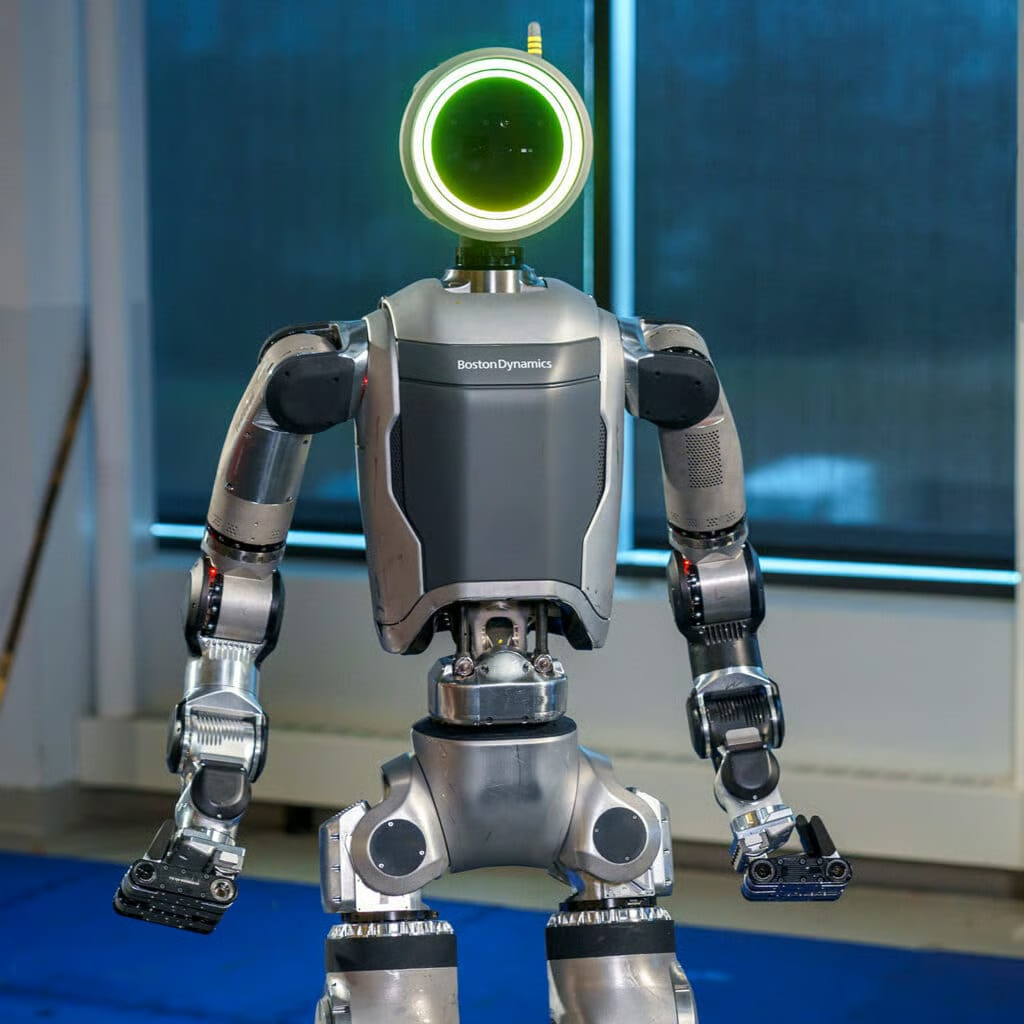


Boston Dynamics’ Atlas humanoid robot doesn’t just know when it needs a break. It can swap its own battery and get back to work.
The production version of Atlas can autonomously return to a battery station, replace a depleted battery in under three minutes, and resume working without a person performing the swap, according to Boston Dynamics’ Atlas specifications. The feature is part of the company’s effort to turn Atlas from an impressive demonstration machine into an industrial robot capable of operating across long shifts.
The battery swap sounds like a small engineering detail. But it could help solve one of the least glamorous and most important problems facing humanoid robots: downtime.
Atlas is being built to keep working
Boston Dynamics says Atlas gets roughly four hours of battery life during typical use and around two hours during heavy lifting.
Context: A conventional recharge takes about 90 minutes. Rather than sitting idle, Atlas can swap batteries autonomously in less than three minutes. That could allow companies to keep a robot operating across multiple shifts with much less human intervention. In its breakdown of the production Atlas, Boston Dynamics describes the robot as being designed with continuous industrial operation in mind.
The robot stands about 6 feet 2 inches tall and weighs roughly 198 pounds. According to its specifications, Atlas can handle sustained loads of about 66 pounds and briefly lift as much as 110 pounds.
Its hardware also includes tactile sensing in its hands and a camera system that provides a 360-degree view of its surroundings. Those capabilities are aimed less at robot acrobatics and more at the repetitive lifting, moving, and material-handling jobs common in industrial environments.
From viral robot videos to factory work
For years, Atlas was best known for videos showing robots jumping, running obstacle courses, dancing, and performing movements that looked suspiciously athletic for a machine.
Boston Dynamics is now trying to make Atlas useful when nobody is filming. The company unveiled the production version of Atlas at CES 2026 and said its initial 2026 deployments were already committed. Early Atlas fleets are going to Hyundai Motor Group’s Robot Metaplant Application Center and Google DeepMind, where the companies will continue developing and training the platform.
That does not mean humanoid robots are about to flood factory floors overnight. Hyundai’s robotics roadmap calls for Atlas to begin performing validated manufacturing tasks at its Georgia Metaplant in 2028, beginning with parts sequencing. More complex assembly work is targeted for 2030.
Hyundai has also laid out plans to build production capacity for as many as 30,000 robots annually by 2028.
AI could turn physical skills into software
The hardware is only part of the equation.
Boston Dynamics is working with Google DeepMind on research that aims to integrate Gemini Robotics foundation models with Atlas and expand the humanoid robot’s ability to perform industrial tasks. The companies announced the AI partnership at CES 2026, saying the research will explore how advanced AI models can strengthen Atlas’ cognitive capabilities alongside its existing physical abilities.
Another part of Boston Dynamics’ approach could have even broader implications: skills learned by one robot can be shared with others. According to the Atlas specifications, once one Atlas learns a new task, that functionality can be deployed across the fleet. That begins to make robotic behavior look a little more like software.
Instead of programming every robot individually to perform every movement, developers could train and validate a new behavior and then distribute that capability across other Atlas robots.
Why this matters
A robot changing its own battery matters because it removes another human dependency from the equation.
Performing useful work is only one part of industrial automation. Machines also need to recharge, recover from interruptions, handle changing conditions, and undergo maintenance. The more of those tasks a robot can handle autonomously, the closer it gets to becoming a system that can operate for long periods without constant supervision.
Battery swapping could be especially important for humanoid robots because stopping for a lengthy recharge cuts directly into the economic argument for using them in warehouses or factories.
Boston Dynamics is designing other parts of Atlas around the same principle. The company says the robot’s limbs can be replaced in the field in under five minutes, while onsite maintenance teams can be trained to service robot fleets.
Still, self-swapping batteries do not answer the biggest questions surrounding humanoid robots. Companies will ultimately care about whether machines such as Atlas can perform useful tasks reliably, safely, repeatedly, and cheaply enough to justify deploying them at scale.
A three-minute battery swap solves only one piece of that puzzle. But it points toward a future in which humanoid robots do more than perform impressive physical feats. They may increasingly be expected to handle the mundane work of keeping themselves on the job, too.
Also read: Boston Dynamics isn’t alone in racing to put humanoid robots to work: Tesla plans to ramp up Optimus production ahead of a major expansion in 2027.