


Microsoft and NVIDIA are deepening their collaboration to advance artificial intelligence, unveiling new technologies designed to enhance AI performance and scalability. Their latest efforts focus on integrating NVIDIA’s cutting-edge Blackwell architecture with Microsoft Azure, expanding AI capabilities for business and developers. From high-performance virtual machines to AI deployment tools, the partnership aims to accelerate innovation across industries, shaping the future of enterprise AI.
Integrating NVIDIA Blackwell with Azure AI
“Our partnership with Azure and the introduction of the NVIDIA Blackwell platform represent a significant leap forward. The NVIDIA GB200 NVL72, with its unparalleled performance and connectivity, tackles the most complex AI workloads, enabling businesses to innovate faster and more securely,” said Ian Buck, vice president of Hyperscale and HPC with NVIDIA.
Microsoft recently announced the launch of the Azure ND GB200 V6, a new virtual machine (VM) series that incorporates NVIDIA technology. The VM series includes NVIDIA Quantum InfiniBand networking and the NVIDIA GB200 NVL72, a liquid-cooled supercomputer meant specifically for high-performance AI workloads.
The new VM series joins the current line of Microsoft VMs that already use NVIDIA GPUs, specifically the H100 and H200. Microsoft also plans to release a line of VMs supported by NVIDIA’s Blackwell Ultra GPUs, which are expected to launch later this year.
More must-read AI coverage
- SS&C Intralinks DealCentre AI vs. Datasite: Which platform is built for the future of dealmaking?
- SS&C Intralinks FundCentre AI vs. Juniper Square: Which platform better supports modern private markets fund managers?
- Why Data, Not Models, Determines AI Success
- The Rise of the AI-Native Factory: How Physical AI Is Transforming Manufacturing
Adding NVIDIA NIM to Azure AI Foundry
Microsoft and NVIDIA have contributed to the advancement of agentic AI. As part of this effort, the two companies have introduced NVIDIA Inference Microservices, or NVIDIA NIM, within Azure AI Foundry. NVIDIA NIM consists of pre-packaged, optimized containers designed to streamline the deployment of generative AI tools and AI agents.
Epic, a major player in electronic health records, already plans to utilize NVIDIA NIM and Azure AI Foundry to their fullest extent. The company aims to enhance patient care, improve clinician efficiency, and perform AI-driven research into new medical breakthroughs and processes.
Microsoft and NVIDIA are also working to optimize the performance of various language models for the Azure AI Foundry. This includes the recently optimized Meta Llama models, which are now available to developers already using Azure AI Foundry.
Accelerating AI innovations across the board
In addition to these developments, Microsoft and NVIDIA announced plans to help accelerate AI innovations for other companies. The partners have made several recent additions to the Azure marketplace, including:
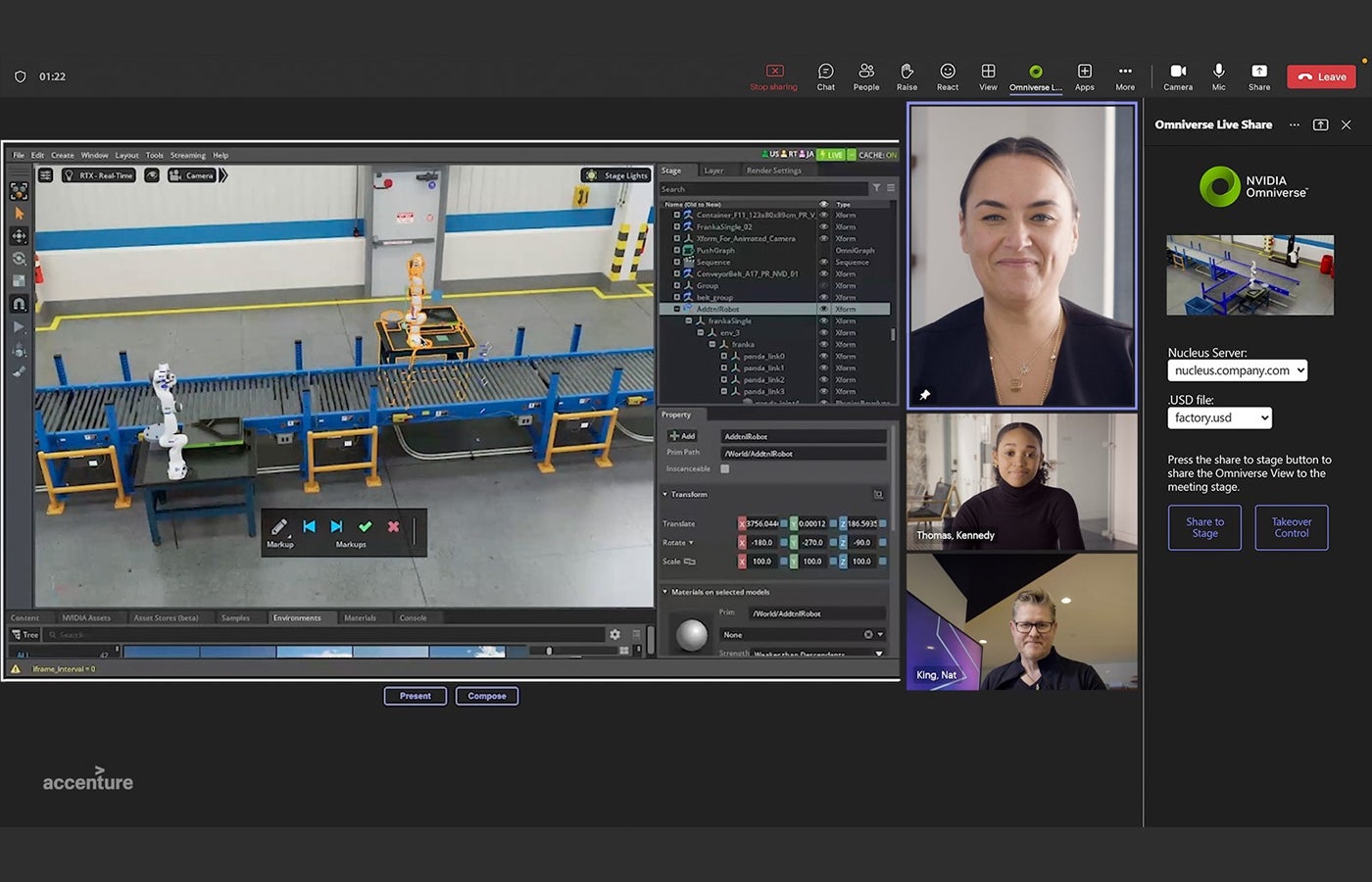
- NVIDIA Omniverse.
- NVIDIA Isaac Sim virtual workstations.
- Omniverse Kit App Streaming.
These additions, primarily aimed at AI developers, support the creation of robotics simulations, digital twins, and other AI-driven applications.