
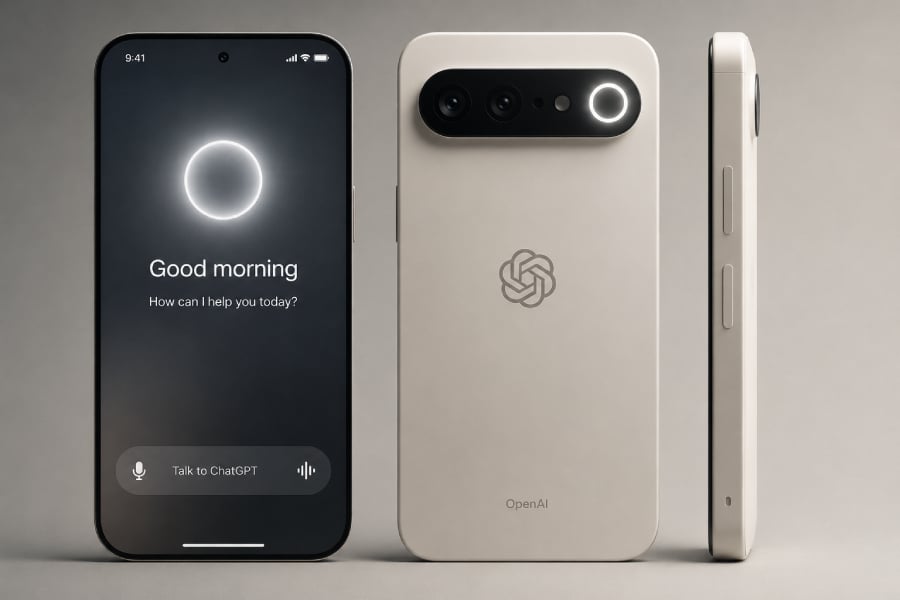


OpenAI is reportedly accelerating development of an AI agent phone, aiming to mass-produce it by the first half of next year.
News of an apparent OpenAI smartphone was first reported last month by industry analyst Ming-Chi Kuo, who gave a 2028 mass production timeline. This accelerated timetable would shorten that by six to 18 months, with the main drivers being to support its public-offering narrative and to secure a foothold in the AI agent phone market.
The device will reportedly have an image signal processor that enables the phone to perceive more through the camera. If this is the headline specification, as Kuo claims, it may mean the device will have a slightly different form factor from the average smartphone, with always-on camera modes to better interact with ChatGPT. According to the report, there will be two AI processors onboard to handle vision and language.
Kuo also revealed that OpenAI is working with MediaTek and Qualcomm on chip supply, with an early preference for MediaTek. Luxshare Precision Industry is expected to be the exclusive manufacturing partner. Luxshare is primarily a manufacturer of Apple products.
“Potential drivers [of the accelerated timeline] include supporting a year-end IPO narrative and intensifying competition in AI agent phones,” said Kuo. “If development stays on track, combined 2027–2028 shipments could reach around 30 million units.”
More must-read AI coverage
- SS&C Intralinks DealCentre AI vs. Datasite: Which platform is built for the future of dealmaking?
- SS&C Intralinks FundCentre AI vs. Juniper Square: Which platform better supports modern private markets fund managers?
- Why Data, Not Models, Determines AI Success
- The Rise of the AI-Native Factory: How Physical AI Is Transforming Manufacturing
Sticking with the old form factor
There have been several rumors about OpenAI’s hardware device over the past few months.
Some suggested it could be a pendant attached to clothing, with a small camera capable of real-world sensing and holding conversations with the user. This could still be the case with the latest rumor, but in a larger package. Other rumors said OpenAI was looking at building a smart speaker, in the same vein as Amazon Alexa and Apple HomePod.
Choosing a smartphone brings Jony Ive, who is heading the hardware device’s production, back to his old wheelhouse. Ive led Apple’s product design for decades and was the lead voice on the design of the iPhone from its debut. OpenAI acquired Ive’s design firm, io, for $6.5 billion after working with the designer for several months. He said last year that the OpenAI device would “make people happy”.
OpenAI may be more adamant about a smartphone after Apple chose Gemini over it for Siri. Apple Intelligence included the ability to ask ChatGPT and pull up responses in-app, but this is likely to switch to Gemini in the iOS 27 update coming this summer. While Apple may open up its AI system in a way similar to search, it looks set to fully control the experience.
For a company that has already launched a web browser, OpenAI appears unhappy with the restrictions imposed by operating systems, device manufacturers, and other tech gatekeepers. Having its own smartphone would provide more control, but it only has to look at Amazon’s Fire Phone and the HTC First with Facebook Home to see that a popular app does not always translate into a popular hardware device.
There are plenty of “AI-powered” hardware devices hitting the market, from smartphones made by Samsung, Google, Xiaomi, and others, to smart glasses from Meta.
Apple also has an accelerated timeline for its wearables, which may include smart glasses, a pendant, and AirPods.