


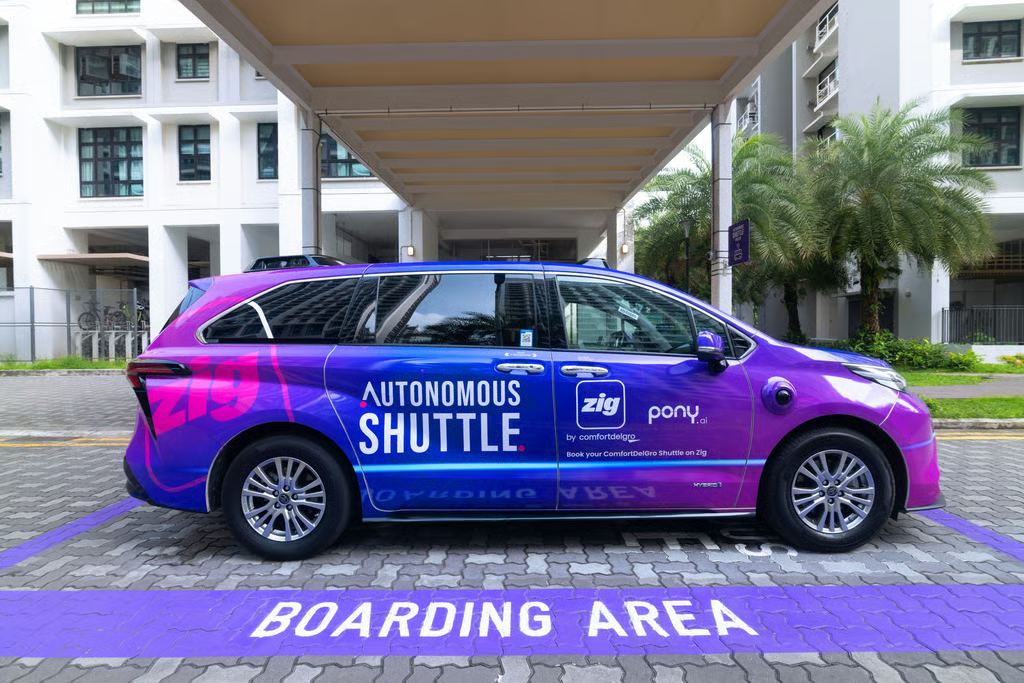
Singapore’s robotaxi rollout is moving from invite-only rides to app booking, with Pony.ai and ComfortDelGro opening their Punggol autonomous mobility service through Zig.
The launch gives APAC transport agencies and enterprise technology teams a live deployment pattern built around fixed routes, a local fleet operator, consumer app access, regulator oversight, and integration with Singapore’s public transit network.
Singapore tests robotaxis through a controlled transit model
Pony.ai and ComfortDelGro opened public booking for the Punggol service on June 22. Residents and visitors can use ComfortDelGro’s Zig app to book a Zig-branded autonomous vehicle on a route in northern Punggol.
The fixed-route service links residential areas with Punggol Coast MRT station, Punggol Coast Mall, One Punggol, Oasis Terrace, and Punggol Plaza. It functions as first- and last-mile transport inside Singapore’s transit network, not as a broad ride-hailing replacement.
ComfortDelGro provides the consumer app, local operating structure, fleet branding, and passenger-facing service layer, while Pony.ai supplies the autonomous driving technology. The transport operator said rides are currently free and can be booked through Zig or BookingSG.
The rollout still requires careful safety framing. Singapore’s Land Transport Authority previously said safety operators will continue to be onboard during full passenger service, so the launch should not be described as fully driverless unless that is separately confirmed for this stage.
Pony.ai is not the only Chinese autonomous vehicle company in Singapore’s Punggol program. LTA said Grab-operated shuttle routes using WeRide’s platform opened for public rides on April 1, 2026, with free rides before planned revenue service.
The operating challenge extends beyond route navigation. Operators also have to manage mapping, fleet telemetry, safety monitoring, incident response, agent app integrations, data governance, and runtime visibility once automated systems are active.
Those requirements put AV rollouts in the same infrastructure category as other edge AI deployments, where a unified platform approach can affect monitoring, reliability, and operational control.
Pony.ai’s overseas scale remains unproven
Pony.ai’s financial results add context without proving overseas scale. The company reported $34.3 million in Q1 2026 revenue, up 145% year over year, while its net loss widened to $53.5 million.
The company also raised its year-end fleet target to more than 3,500 robotaxis, up from 3,000. Most disclosed commercial activity remains concentrated in China, and Pony.ai has not broken out Singapore revenue separately.
The Punggol launch shows how Pony.ai can work through a local transport operator in a tightly regulated Southeast Asian market. It does not yet show whether the model can produce meaningful recurring revenue outside China.
Pony.ai has also pointed to overseas activity in Croatia, Qatar, Singapore, South Korea, and Dubai. Public access, safety supervision, fare collection, and commercial scale can vary by market, so those deployments should not be treated as equivalent.
The next test is whether Punggol expands beyond a limited route or appears in Pony.ai’s overseas revenue disclosures. Until then, Singapore is best read as a regulated APAC deployment model, not proof of mass-market robotaxi economics.
Read more: Ford’s AI quality setback shows why human oversight still matters in real-world automation.