


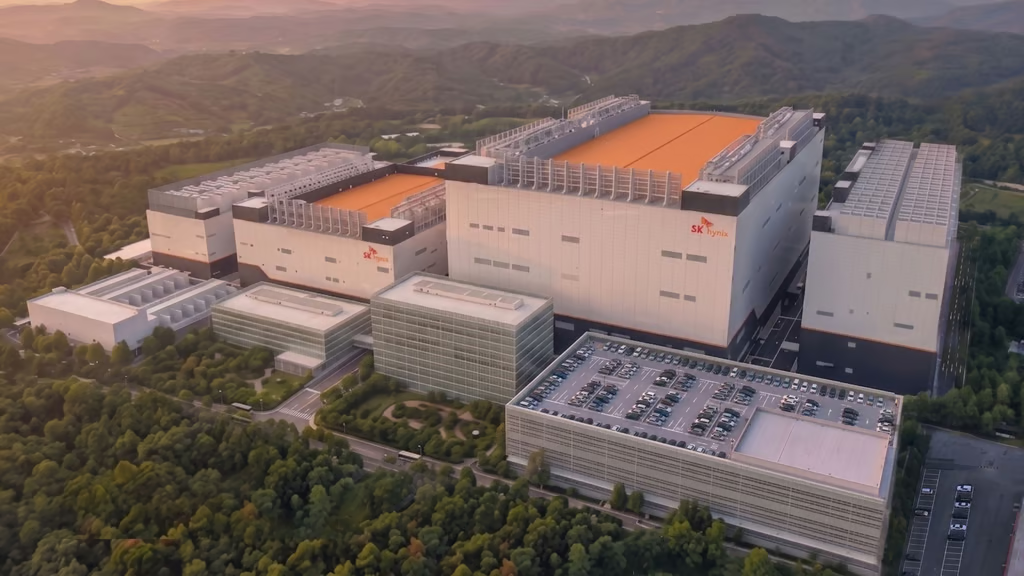
AI’s memory hunger is pushing SK hynix into a massive expansion, with the chipmaker committing about $38.1 billion to two new factories in South Korea.
SK hynix said its board approved 54.3 trillion won (approx. $38.1 billion) for two new semiconductor fabrication plants, as demand for memory chips used in AI infrastructure continues to climb.
The company will spend 35.2 trillion won (approx. $24.8 billion) on the Y2 fab in Yongin and 19.1 trillion won (approx. $13.5 billion) on the M17 facility in Cheongju. The investment is part of SK hynix’s longer-term plan to expand production capacity as AI data centers consume increasing amounts of advanced memory.
Market research firm Omdia expects global demand for both DRAM and NAND memory to grow at a compound annual rate of 19% from last year through 2030, according to SK hynix. The company said the investment followed a detailed review of market demand.
HBM and NAND take center stage
The Yongin Y2 facility will focus on DRAM, including high-bandwidth memory (HBM), which is critical to AI accelerators and data center systems. Construction is scheduled to begin in July 2027, with the first cleanroom expected to open in June 2029.
On the other hand, the Cheongju M17 fab will manufacture NAND memory, which is increasingly being used in enterprise solid-state drives and AI infrastructure. Construction is expected to begin in February 2027, with the first cleanroom targeted for December 2028.
SK hynix selected Cheongju partly because its existing M11, M12 and M15 fabs provide established power and water infrastructure, allowing the company to build out production more quickly. The company is also accelerating development of its Yongin Semiconductor Cluster. It plans to complete four fabs there by 2033, 12 years earlier than the original 2045 target.
A bet on a longer AI boom
The scale and timing of the investment suggest that SK hynix expects the AI-driven memory surge to be a long-term shift rather than a short-lived cycle.
That is a significant bet. The new fabs will not add substantial capacity immediately, meaning they are unlikely to ease the current supply pressure. Counterpoint Research’s Neil Shah told CNBC that the expansion is intended to serve demand from 2029 onward, while memory prices could remain elevated through 2028 if demand continues to outpace planned capacity.
At the same time, SK hynix faces growing competition. Samsung reclaimed the top position in the DRAM market during the second quarter, according to Counterpoint Research, while Samsung, Micron and China’s CXMT are also expanding capacity.
SK hynix said it plans to build the facilities according to its master schedule but add cleanroom space and production equipment progressively as customer demand develops.
What it means for AI and consumers
For AI companies, the expansion should eventually provide more capacity for HBM and other advanced memory products. That could help chipmakers and data center operators secure the components needed to expand AI computing infrastructure.
For consumers, however, the near-term picture is less encouraging. Strong AI data center demand is directing investment and manufacturing resources toward higher-value memory products, while new capacity will take years to arrive. That could keep pressure on memory prices for PCs, smartphones, and other electronics.
Read more: SK hynix Fuels Trillion-Dollar AI Memory Chip Rally in Asia-Pacific examines how surging AI memory demand has boosted SK hynix and other semiconductor companies across the region.