
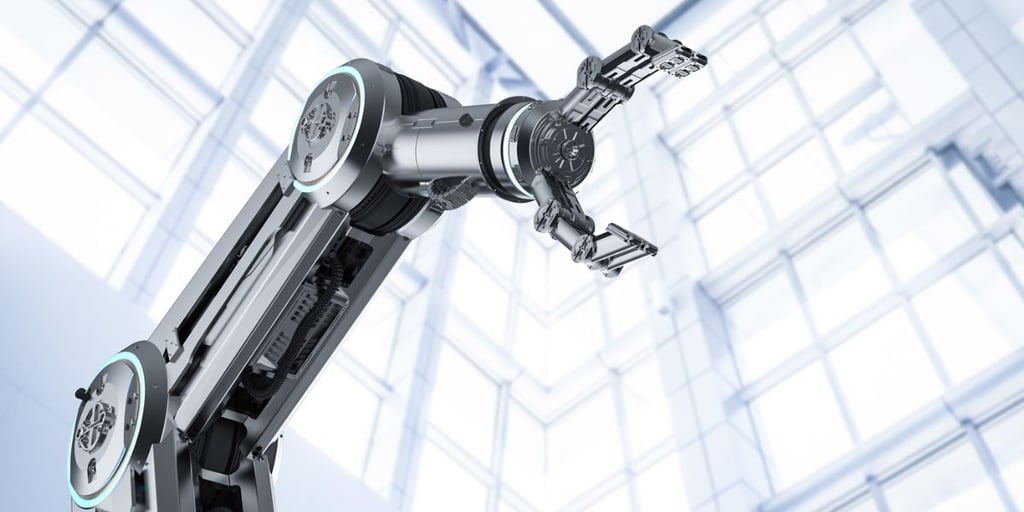


SoftBank has struck a definitive deal to acquire ABB’s robotics business for $5.375 billion, doubling down on founder Masayoshi Son’s drive to fuse advanced AI with industrial robots.
The transaction — approved by SoftBank’s board — remains subject to regulatory clearance in the EU, China and the US, with closing targeted for mid-to-late 2026, the companies and multiple reports said.
“SoftBank’s next frontier is physical AI. Together with ABB Robotics, we will unite world-class technology and talent under our shared vision to fuse artificial super intelligence and robotics — driving a groundbreaking evolution that will propel humanity forward,” said Son.
Under the structure, ABB will carve out its robotics division into a new holding company, with SoftBank acquiring 100% of the shares. The unit — best known for industrial robotic arms used across automotive and electronics factories — counts roughly 7,000 employees worldwide and generated $2.28 billion in 2024 revenue. The deal value eclipses estimates floated earlier this year when ABB weighed a sale as an alternative to an IPO.
The move marks a sharp pivot from ABB’s April plan to spin off the robotics arm as a separately listed company in 2026. That listing has now been scrapped as part of the sale,
SoftBank will pair ABB Robotics’ platform and global footprint with its existing stakes in firms such as AutoStore, Agile Robots, and Skild AI to accelerate innovation toward “artificial super intelligence.”
Market and stakeholder reaction in ABB’s home region was swift. Swedish press noted that Investor AB, ABB’s largest shareholder, backed the sale as a “good home” for the division, even as a Stockholm listing fades.
The acquisition is SoftBank’s most consequential robotics wager since its earlier, mixed forays (including Pepper and the brief ownership of Boston Dynamics). It comes amid a broader industry race to embed generative AI into industrial automation, where ABB has been touting more autonomous, software-driven systems.
In August, Intel revealed it was getting a $2 billion injection from SoftBank. The two tech giants said this is a demonstration of their commitment to investing in semiconductors in the U.S.