
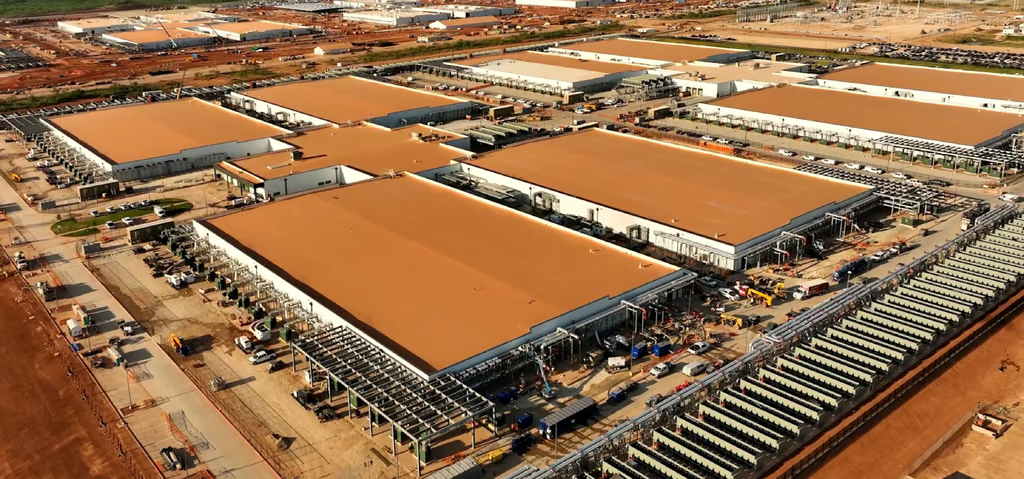


OpenAI is building five more data centers in the United States as part of the Stargate project. These data centers will be located in Texas, New Mexico, Ohio, and an unspecified site in the Midwest, bringing the project’s total capacity to nearly 7 GW.
What is Stargate?
Announced by President Donald Trump in January, Stargate is a $500 billion generative AI infrastructure venture, led by OpenAI, Oracle, Japanese telecoms giant SoftBank, and MGX, an investment firm based in the United Arab Emirates. OpenAI intends to operate the data centers, while Oracle provides server infrastructure and leasing, SoftBank handles capital investment, and Nvidia supplies many of the chips.
The plan is for Stargate to reach an overall capacity of 10 GW by the end of 2028, and OpenAI says that the five data centers put the project ahead of schedule. Three of them are being developed by Oracle as part of its commitment to provide 4.5 GW of computing power to the Stargate initiative, which will be located in Shackelford County in Texas, Doña Ana County in New Mexico, and in the Midwest.
Oracle also plans to expand the flagship Stargate site in Abilene, Texas, by 600 MW, raising the total capacity of its contributions to over 5.5 GW, and creating 25,000 onsite jobs as well as tens of thousands elsewhere in the US. OpenAI says that early training and inference workloads have already started at the existing facilities in Abilene, which is being kitted out by Nvidia GB200 racks.
The two other new sites announced today are being developed by OpenAI and SoftBank, which will offer 1.5 GW of capacity in 18 months, but have the potential to scale to multiple gigawatts over time. These will be situated in Lordstown, Ohio, and Milam County, Texas, with the former having already broken ground.
Over $400 billion has been put towards Stargate so far, through the five new sites, the Abilene site, and various projects with cloud company CoreWeave. OpenAI has indicated that additional US sites will be announced, pushing total investment beyond the initially pledged $500 billion. There are also plans for international Stargate facilities in Norway, the UK, Japan, the UAE, and India.
Stargate has struggled to get off the ground due to several factors, including uncertainty about Trump’s tariffs, which could significantly increase the cost of server racks, chips, and cooling systems. In early August, Bloomberg reported that funds had been raised to meet the project’s initial $500 billion budget.
More about data centers
- Stargate Norway: OpenAI’s First AI Data Center in Europe
- AI Data Centers’ Soaring Energy Use: Who Pays for Higher Utilities Costs?
- China’s Submerged AI Data Center Could ‘Influence Global Sustainable Computing’
- Google to Power Data Centers With Nuclear Energy by 2030 in First-Of-A-Kind’ Agreement
The rationale behind OpenAI’s relentless expansion efforts
“AI can only fulfill its promise if we build the compute to power it,” Sam Altman said in a statement accompanying the announcement of the five new Stargate sites. “That compute is the key to ensuring everyone can benefit from AI and to unlocking future breakthroughs.”
Indeed, a few hours before the announcement of the five sites, Altman published a blog post that elaborated on the rationale behind OpenAI’s relentless expansion. “Maybe with 10 gigawatts of compute, AI can figure out how to cure cancer. Or with 10 gigawatts of compute, AI can figure out how to provide customized tutoring to every student on earth,” he said.
“If we are limited by compute, we’ll have to choose which one to prioritize; no one wants to make that choice, so let’s go build.” Altman added that OpenAI aims to produce a gigawatt of new AI infrastructure every week within a few years’ time.
On Monday, Nvidia pledged to invest up to $100 billion in OpenAI, and, in turn, the AI startup will use as many as five million Nvidia GPUs to deploy at least 10 GW of new compute infrastructure.