


August keeps TIOBE’s top 10 in the same order, yet several races inside it remain active.
Java is closing in on C++, C is the lone top-five language with a positive annual rating change, and Rust faces close pressure at No. 10. TIOBE CEO Paul Jansen turns his attention to MATLAB’s continued decline.
The TIOBE Programming Community Index tracks programming language popularity using search results related to skilled engineers, courses, and third-party vendors.
Python leads as C gains over the year
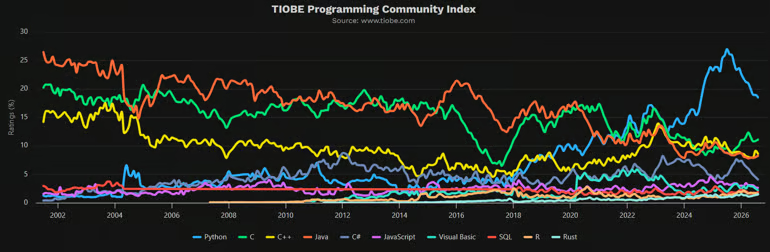
Python records 18.53% at No. 1, with C next at 11.10%. Python remains well ahead of every other language despite a 7.61-point decline in its rating from August 2025.
C has moved in a different direction over the annual period. Its rating is up 2.07 points, making it the only language among the current top five to post a year-over-year increase. C also ranks one place higher than it did last August, when C++ occupied No. 2.
Just 0.37 points separate C++ and Java
C++ takes No. 3 at 8.62%, followed by Java at 8.25%. Just 0.37 percentage points separate the pair, making No. 3 one of the more open spots near the front of the ranking.
C# occupies No. 5 at 4.09%, followed by JavaScript at 2.63% and Visual Basic at 2.18%. A sizable drop from Java to C# divides the first four languages from the rest of the upper tier, even with no changes in rank this month.
SQL, R, and Rust complete the top 10
SQL takes No. 8 at 1.88%, R follows at No. 9 with 1.56%, and Rust records 1.45% at No. 10. All three have climbed in rank over the past year; SQL from No. 12, R from No. 14, and Rust from No. 18.
Rust has made the largest jump of the three, gaining eight places since August last year. Its final top-10 slot is still closely contested, however, with Delphi/Object Pascal at No. 11 on 1.37%. Only 0.08 percentage points stand between them, so No. 10 could change hands quickly.
MATLAB drops to No. 25
MATLAB ranks No. 25 at 0.71%, putting it outside the top 20 for the first time in more than 10 years. Jansen expects the decline to last, citing the language’s paid licensing model as one disadvantage in a field dominated by free alternatives. He notes that Delphi is currently the only language inside the top 20 that still requires a paid license.
Jansen also says MATLAB has evolved more slowly than languages such as Python, C++, and Rust, which continue to add newer features and programming approaches. A return to the top 20 would now require MATLAB to recover at least five places from its ranking this month.
More News: Nearly a third of UK manufacturers report cyber incidents affecting either their own operations or their supply chains.