



Python remains comfortably ahead in February, but the composition of the top 10 is shifting. Its lead is still substantial, yet its share has pulled back from last summer’s high, while more narrowly focused languages are picking up incremental gains.
The TIOBE Programming Community Index tracks the popularity of programming languages using search engine data.
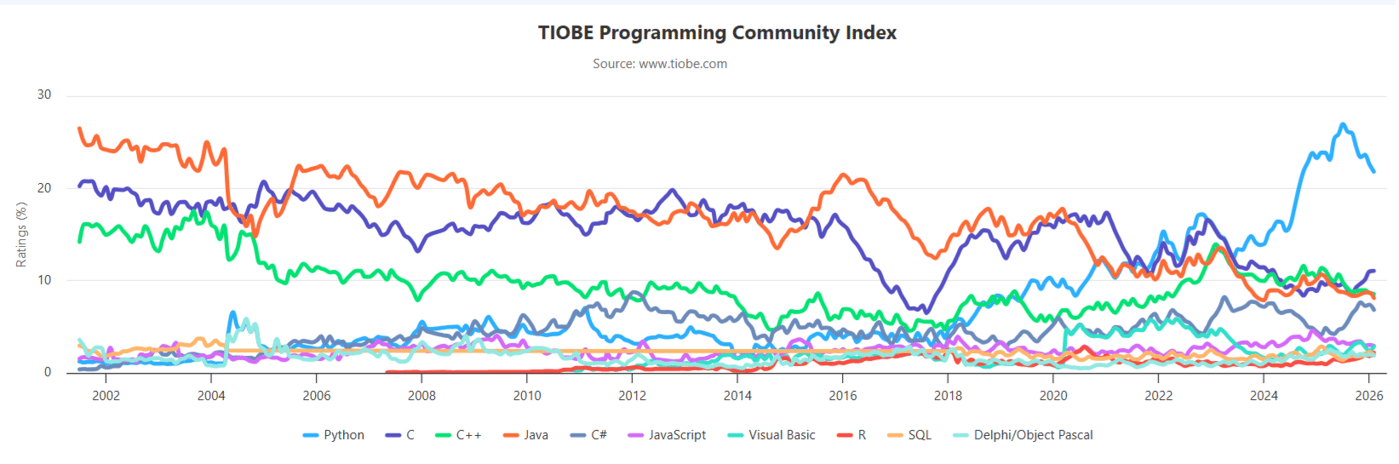
Python remains out front, but off its peak
Python leads the index at 21.81%, keeping a margin of more than 10 percentage points over its nearest competitor. Even so, that figure sits well below its July 2025 high of 26.98%, marking a gradual comedown after an extended surge.
TIOBE CEO Paul Jansen has noted that Python’s broad reach makes it sensitive to gains by more specialized tools. As languages built for statistics or systems work strengthen, they tend to draw small but measurable slices from Python’s wide footprint. February’s numbers suggest exactly that kind of redistribution instead of any dramatic reversal at the top.
C strengthens its grip on second
C climbs to 11.05%, reinforcing its position as the clear runner-up. The increase widens the distance between C and the closely packed group behind it.
C++ posts 8.55% and Java lands at 8.12%, both edging downward this month. C#, by contrast, rises to 6.83%, continuing the momentum that earned it TIOBE’s Programming Language of the Year 2025 distinction. Jansen has previously highlighted C’s durability in embedded and performance-driven environments, calling it “simple, fast, and extremely well suited” to those domains — a description that continues to hold true given its steady performance.
Must-read developer coverage
- What Powers Your Databases? Take This DZone Survey Today!
- Microsoft’s Historic 6502 BASIC Code is Now Open Source
- TIOBE Index: Top 10 Most Popular Programming Languages
- TechRepublic Exclusive: AWS Says Entry-Level Workers Need ‘Curiosity’ In the Age of AI
The middle tier holds, with targeted gains below
JavaScript registers 2.92%, followed closely by Visual Basic at 2.85%. Neither sees dramatic movement, keeping the center of the table largely intact.
R advances to 2.19%, sustaining its place in the top 10. Jansen has said R “fits statisticians and data scientists like a glove,” and its continued visibility underscores ongoing demand for specialized analytical tooling. SQL appears at 1.93%, while Delphi/Object Pascal rounds out the list at 1.88%, highlighting the staying power of long-established ecosystems.
A subtle redistribution beneath the leader
February does not signal an impending change at the top. Python’s lead remains decisive. What stands out instead is the incremental strengthening of languages built for specific domains, alongside C’s continued second-place standing.
If that pattern continues, the coming months may bring further tightening among the contenders beneath Python, driven less by dramatic swings and more by steady, targeted growth.
Apple has moved to contain a critical vulnerability, urging users to install updates after confirming exploitation in targeted campaigns.