



Python begins 2026 much as it ended 2025: far out in front. While its rating softens slightly, the distance separating it from the rest of the field remains decisive. As a result, attention once again shifts to the tightly grouped languages competing behind it.
The TIOBE Programming Community Index tracks the popularity of programming languages using search engine data.
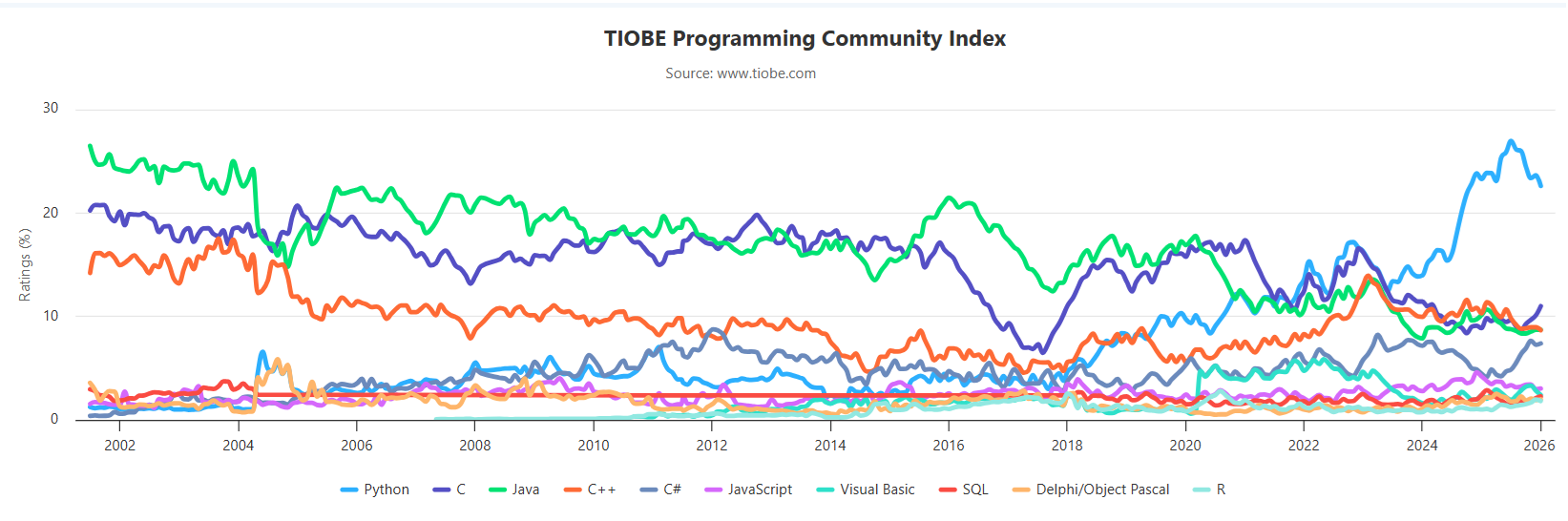
Measured movement across the upper tier
Python posts 22.61%, dipping modestly from December but staying firmly alone at the top.
The more telling movement comes below, where C climbs to 10.99%, extending its advantage over the rest of the chase group. TIOBE CEO Paul Jansen attributes C’s resilience to its continued importance in embedded systems, describing it as “simple, fast, and extremely well suited” to that growing market.
Behind it, Java moves into third place at 8.71%, edging past C++ as the latter slips to 8.67%. Jansen has noted that while C++ continues to evolve rapidly, some of its newer concepts have yet to see broad adoption, leaving room for periodic reversals.
C# continues its steady rise at 7.39%, closing out a strong year that earned it TIOBE’s Programming Language of the Year 2025.
Must-read developer coverage
- What Powers Your Databases? Take This DZone Survey Today!
- Microsoft’s Historic 6502 BASIC Code is Now Open Source
- TIOBE Index: Top 10 Most Popular Programming Languages
- TechRepublic Exclusive: AWS Says Entry-Level Workers Need ‘Curiosity’ In the Age of AI
Middle rankings remain predictable
JavaScript holds sixth at 3.03%, maintaining the gradual cooling trend seen throughout last year. Visual Basic edges up to seventh at 2.41%, benefiting more from compression below than from any major gain of its own. Compared with the churn elsewhere, this part of the table remains the most stable.
Lower-tier rotation continues
SQL stays in eighth at 2.27%, showing only minor movement. Delphi/Object Pascal returns to the top 10 at 1.98%, reclaiming ninth after slipping out in December. R holds tenth at 1.82%, extending the renewed interest Jansen links to sustained demand for statistical and analytical tooling, noting that R “fits statisticians and data scientists like a glove.”
Early indications for 2026
While January’s index does not point to an imminent reshuffle at the top, it reinforces several longer-running patterns. Python’s lead remains intact, C starts the year with renewed separation from the rest of the field, and the balance among Java, C++, and C# continues to adjust in small but persistent steps.
Looking further ahead, Jansen flags potential movement outside the top 10 as well. He suggests that TypeScript is well-positioned to finally break into the top 20 in 2026, while Zig, which climbed sharply in 2025, could advance into the top 30.
Jansen also notes that Rust reached an all-time high at #13 this month, underscoring that pressure continues to build just beyond the top tier even as the upper rankings remain relatively stable.
Nvidia introduced the Vera Rubin platform at CES 2026, claiming major efficiency gains for inference and mixture-of-experts workloads.