


Key takeaways:
- monday.com is the best task management software because it combines customizable workflows with easy-to-scan task tracking.
- ClickUp breaks complex deliverables into nested subtasks, while Asana keeps shared tasks updated across projects so teams can track the same work with fewer duplicate records.
- Choose task management software based on how well it supports your team’s recurring workflows, including task ownership, dependencies, collaboration, and progress tracking.
| monday | Best for visual task tracking | ||
| Jira | Best for sprint management | ||
| ClickUp | Best for detailed task organization | ||
| Asana | Best for cross-team task coordination | ||
| Wrike | Best for approval-based workflows | ||
| Smartsheet | Best for spreadsheet-style task planning | ||
| Trello | Best for Kanban task management | ||
| Notion | Best for connected tasks and notes | ||
| Todoist | Best for personal task planning |
Why you should trust TechRepublic
I’ve spent the past four years testing nearly 20 task management platforms, and some of them have become part of my workflow. Writing dozens of PM software guides for businesses of all sizes taught me what individuals and teams need from these tools beyond the marketing pitch. I also build custom scoring rubrics for each review to ensure fairness and that selected platforms get evaluated on the same criteria.
Marianne Sison
Senior Staff Writer for Project Management
- My methodology
- 1. monday work management: Best visual task tracking
- 2. Jira: Best for sprint management
- 3. ClickUp: Best for detailed task organization
- 4. Asana: Best collaborative workflow management
- 5. Wrike: Best for approval-based workflows
- 6. Smartsheet: Best for spreadsheet-style task planning
- 7. Trello: Best for Kanban task management
- 8. Notion: Best for connected tasks & notes
- 9. Todoist: Best for personal task planning
- Do you need task management software or project management software?
- What type of task management software does your team need?
- How to choose the best task management software
- FAQs
My methodology
To ensure a balanced evaluation of the best task management software, I created a scoring rubric that measures each platform across pricing, features, usability, support, and overall product quality.
General features (25%): I looked at core task management features like dependencies, recurring tasks, automation, project templates, collaboration tools, and workflow views. I also considered how well each platform handled different project structures through Kanban boards, timelines, calendars, dashboards, and workload tracking.
Pricing (20%): I evaluated pricing based on free plan availability, monthly per-user costs, AI feature access, and total cost of ownership. Platforms scored higher when pricing was upfront and did not require expensive upgrades to unlock core functionality.
Advanced and niche features (20%): For advanced features, I reviewed AI automation, reporting tools, integrations, portfolio management, and resource planning capabilities. Higher scores went to platforms that supported predictive reporting, advanced automation, and enterprise-level integrations.
Expert score (15%): My expert score combined hands-on testing, feature depth, pricing value, third-party review averages, and overall research accessibility. I also factored in how well each platform performed across different team sizes, workflows, and operational needs.
Support (10%): I assessed customer support through available support channels, educational resources, community engagement, and security controls. Platforms performed better when they offered responsive support, active communities, strong onboarding materials, and enterprise-grade security features.
Ease of use (10%): I focused heavily on how easy it is for users to learn, customize, and navigate the platform. Higher ratings went to tools that balanced advanced customization with intuitive navigation.
1. monday work management: Best visual task tracking
My rating: 4.93 / 5
Why I chose monday Work Management
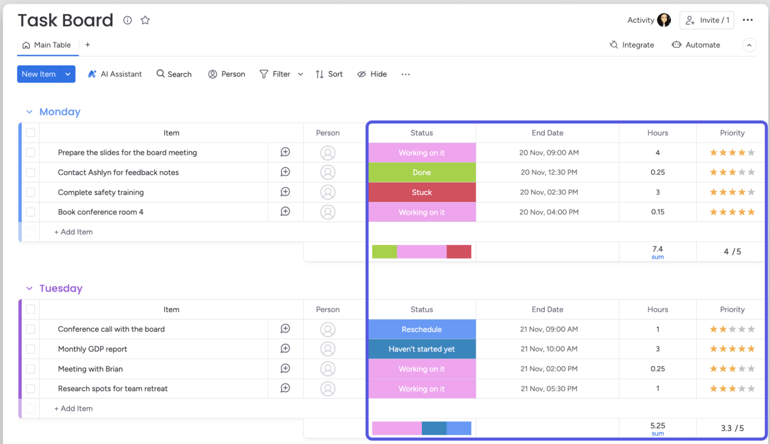
monday Work Management stands out as my top choice because it makes task status easy to identify at a glance. While visual boards are common among project tools, they tend to get cluttered once projects grows. With monday, the interface remains intuitive and color-coded statuses and custom columns make overdue or blocked tasks easier to spot.
Another strength is the drag-and-drop functionality and grid-style boards. As a first-time user, I adapted quickly because the interaction feels similar to spreadsheet apps, but with more advanced project tracking. The dashboards uses widgets that display workload distribution, project progress, budget tracking, and timeline health in real time.
One limitation is that monday.com reserves its Workload view for Pro and Enterprise plans, so teams on lower tiers cannot use its built-in capacity view. For teams that need workload tracking on lower-tier plans, ClickUp is an alternative, since its Workload view is available on Free Forever and Unlimited with usage limits, then becomes unlimited on Business.
| Pros | Cons |
|---|---|
| ✅Flexible column system for custom fields ✅Multi-step automation actions ✅Save any board as a custom template | ❌Seat block model forces small teams to pay for “zombie seats” ❌Essential task management features are paywalled ❌Initial admin setup can be overwhelming |
monday pricing
- Free: Up to 2 users — Includes 3 boards, task tracking, basic column types
- Basic: $9/user/month — Adds unlimited boards and items, unlimited viewers, dashboard, file storage
- Standard: $12/user/month — Adds timeline and Gantt views, calendar view, basic automation, integrations
- Pro: $19/user/month — Adds time tracking, private boards for task control, advanced automation limits, formula columns
- Enterprise: Custom pricing — Adds advanced permissions, enterprise-scale task dashboards, audit logs, higher automation and integration limits
Standout features
- Organize your task list via drag-and-drop functionality
- Share files, tag teammates, and leave comments within each task.
- Use a timer or add a time range to record and track task durations.
- Add text, formulas, links, and the address of a specific location within columns.
2. Jira: Best for sprint management

My rating: 4.87 / 5
Why I chose Jira
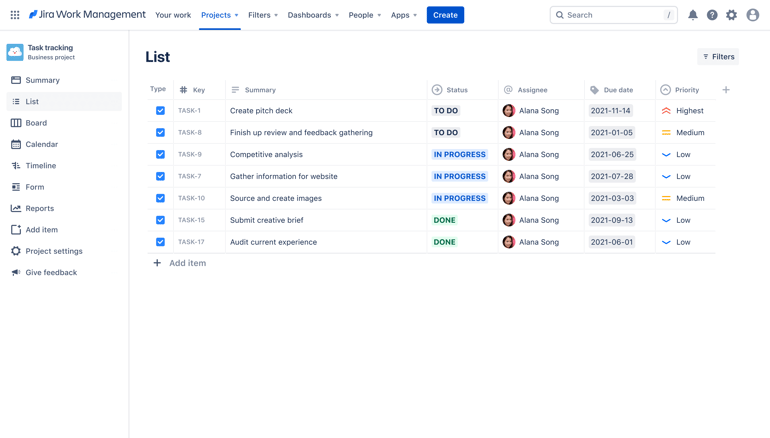
Jira works best for sprint management because the platform is designed specifically for Scrum and Agile workflows. From backlog grooming to sprint retrospectives, everything exists within the same workspace, which makes managing Agile projects more efficient for dev teams.
For sprint planning, teams can easily prioritize backlog items through drag-and-drop boards, estimate workloads using story points, and assign tasks based on team capacity. I can also apply automations for issue transitions, sprint closures, blocker notifications, and workflow updates.
Another reason I prefer Jira over many competitors is its reporting tools. Burndown charts and velocity reports update automatically, which makes it easier for me to detect scope creep or uneven workload. I also have the option to integrate the platform with Confluence to connect sprint tasks with sprint documentation, meeting notes, and project requirements.
Jira can be harder for non-technical teams to learn, especially when configuring workflows, permissions, and work types. monday.com is a suitable alternative for teams that prefer a more visual interface, with customizable boards, templates, and multiple task views that are easier to set up and navigate.
| Pros | Cons |
|---|---|
| ✅Connects with 3,000+ apps ✅Comprehensive Agile reports ✅Deploy pre-configured boards, fields, and workflows instantly. | ❌Customization makes workflows hard to manage ❌Requires knowledge in Agile workflows ❌Steep price jump between plans |
Jira pricing
- Free: Up to 10 users — Includes unlimited tasks, board/backlog/timeline views, reporting dashboards
- Standard: $9.05/user/month — Adds user roles, guest access, and AI features
- Premium: $18.30/user/month — Adds cross-team roadmaps, dependencies, custom issue hierarchy, and unlimited storage
- Enterprise: Contact sales — Adds unlimited automation rule runs, up to 150 sites, and analytics
Standout features
- Assign story points to backlog items to assess effort and complexity.
- Control what users can see and how they access specific issue types or projects.
- Set a dedicated forum to discuss and review completed features with other developers.
- Access a variety of Agile reports such as velocity charts, release burndown, and sprint reports.
3. ClickUp: Best for detailed task organization

My rating: 4.66 / 5
Why I chose ClickUp
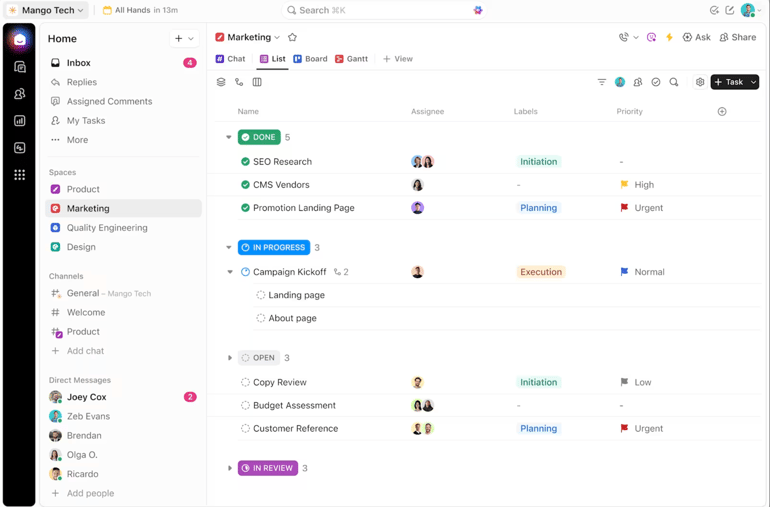
ClickUp’s strongest use case lies in its hierarchy system. I can organize work through nested categories such as Workspaces, Spaces, Folders, Lists, Tasks, and Subtasks. In my experience, this setup works especially well for large workspaces because I can separate projects by department, client, workflow, or business function without adding visual clutter.
I often use subtasks and nested subtasks to break large projects into action items, which makes task ownership and progress tracking much easier. Within each task, I can customize details by adding priorities, tags, due dates, assignees, dependencies, and custom fields based on my workflow. Comments, attachments, and documents are within the same work item, so my team spends less time searching for project context.
ClickUp’s extensive customization can make setup feel more complex for teams that only need straightforward task tracking. Todoist is a simpler alternative, with a checklist-style interface for organizing tasks and recurring work.
| Pros | Cons |
|---|---|
| ✅Over 15 project views ✅Hierarchical task structure ✅Generate tasks with contextual-AI | ❌Portfolio capabilities could be better ❌Requires in-depth training for effective use ❌Can feel overwhelming due to the sheer number of features |
ClickUp pricing
- Free Forever: — Includes unlimited tasks, multiple task views (list, board), basic task statuses, task comments, mentions
- Unlimited: $7/user/month — Adds Gantt charts, time tracking, custom fields, resource management
- Business: $12/user/month — Adds sprint points, advanced automation, workload management, time tracking, task dependencies
- Enterprise: Custom pricing — Adds advanced permissions, custom roles, enterprise-scale task management controls
Standout features
- Assign tasks to a team or multiple people for shared responsibilities.
- Write your task descriptions with the help of ClickUp’s AI agents
- See the running log of task activity, such as comments and task updates.
- Divide work items into subtasks and nested subtasks.
4. Asana: Best collaborative workflow management

My rating: 4.56 / 5
Why I chose Asana
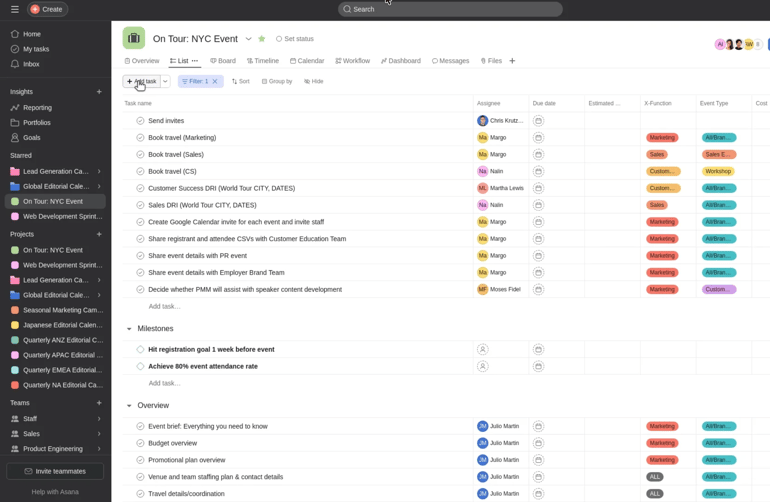
Most project management tools rely heavily on third-party integrations for team communication, but Asana integrates collaboration into the platform rather than treating it as a separate feature.
I can add collaborators manually or use @mentions when specific people need to see an update, discussion, or task change. For quick acknowledgment, likes and appreciations let users recognize contributions or mark progress. Asana also supports multi-homing, which allows one task to appear in multiple projects so different teams can track the same work without creating duplicate tasks.
The Inbox has become my go-to feature because it stores all my notifications, mentions, task assignments, and project updates, which matters when I’m managing several boards at once. The filters let me sort updates by task, collaborator, or project, so I’m not stuck scrolling through every notification.
When it comes to real-time messaging, Asana relies mainly on task comments and project updates for communication. Teams that want team chat within their task management platform may prefer ClickUp. ClickUp Chat supports channels and direct messages, where users can create tasks directly from conversations or connect existing tasks to messages
| Pros | Cons |
|---|---|
| ✅Update multiple templates simultaneously ✅Convert files into tasks ✅Clean and less intimidating interface | ❌Monthly plans are significantly pricier than market averages ❌Lacks real-time customer support ❌Leans toward traditional project management |
Asana pricing
- Personal: 2 users — Includes unlimited tasks, list/board/calendar views, status updates, and unlimited storage (100MB/file)
- Starter: $10.99/user/month — Adds timeline and Gantt views, forms, custom fields, unlimited automations, AI credits, workflow builder
- Advanced: $24.99/user/month — Adds portfolios, goal tracking (OKRs), time tracking, formulas, and approval workflows
- Enterprise: Custom pricing— Adds workload management, capacity planning, and admin controls
Standout features
- Update a single task across multiple projects and sync changes automatically.
- Get a personalized view of all your tasks in one place.
- Save time with ready-made task templates built for specific use cases.
- Set task dependencies and notify assignees when work is unblocked.
5. Wrike: Best for approval-based workflows

My rating: 4.44 / 5
Why I chose Wrike
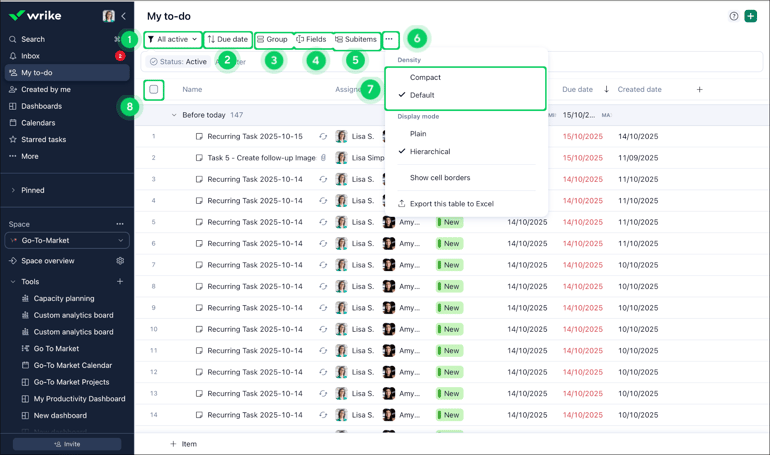
Wrike is a good choice for approval-based workflows because task reviews can happen within tasks, folders, and projects. Teams can assign approvers, set due dates, and use request forms to route submissions to different reviewers. Visual proofing also keeps comments attached to the asset under review, while approval histories record reviewer decisions for reference.
Beyond approvals, Wrike offers interactive Gantt charts, customizable workflows, request forms, dashboards, and workload management. Its cross-tagging capability also lets the same work appear in multiple locations, which helps different teams track shared projects without duplicating tasks. Wrike also supports more than 400 integrations for teams that need to connect project work with other business applications.
Scaling with Wrike can become expensive because the Team plan costs $10 per user per month, while Business jumps to $25 per user per month when billed annually. If you need a lower-cost option as your team grows, ClickUp offers its Unlimited plan for $7 per user per month and Business for $12 per user per month.
| Pros | Cons |
|---|---|
| ✅Specialized templates for tasks & folders ✅Generate tasks from emails/project data ✅Supports four types of task dependencies | ❌Plan upgrade is necessary for full functionality ❌Steep learning curve ❌Strict user limits on lower-priced plans |
Wrike pricing
- Free: Unlimited users — Includes task management, folder hierarchy, board/table view, custom views
- Team: $10/user/month — Adds Gantt charts, dashboards, basic AI features
- Business: $25/user/month — Adds resource management, AI agents, forms, workflow automation
- Pinnacle: Custom pricing — Adds budgeting, advanced security
- Apex: Custom pricing — Adds bi-directional integrations, Wrike Sync, enterprise-scale automations with Wrike Integrate
Standout features
- Assign the required number of effort to complete a task
- Get a weekly summary of the tasks you worked on, along with the time spent on each one.
- Enable one task to exist across multiple teams or workflows through cross-tagging
- Create a Wrike task without leaving a Slack channel
6. Smartsheet: Best for spreadsheet-style task planning

My rating: 4.39 / 5
Why I chose Smartsheet
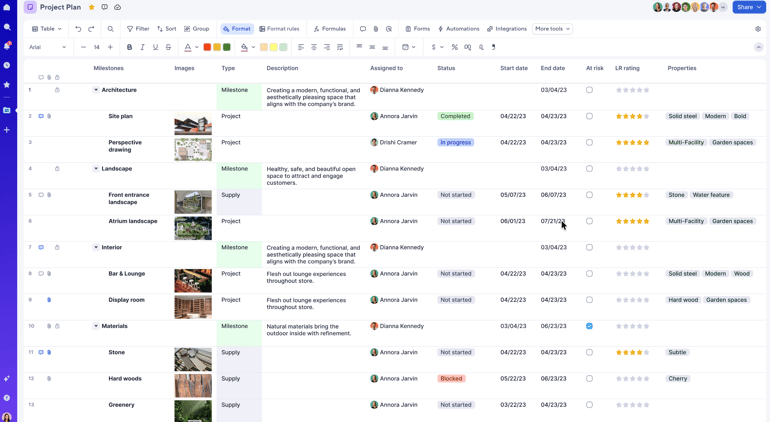
For teams accustomed to spreadsheets, Smartsheet offers a familiar way to plan and track tasks through its Grid view. Rows can represent tasks, while columns capture details such as owners, dates, and status. Parent-child relationships also let teams break larger work into smaller items, with dependency data rolling up to parent rows.
Smartsheet includes Gantt, board, calendar, and timeline views that use the same project data. Reports can pull information from multiple sheets, while dashboards summarize project status for stakeholders. Automations can also assign work, update fields, or send reminders based on predefined conditions.
Smartsheet can become cumbersome for teams that need to manage many detailed subtasks because task hierarchy is primarily created through parent and child rows. Asana is an alternative for teams that prefer dedicated task and subtask records, since subtasks can be expanded, filtered by assignee, and filtered by due date within the task interface.
| Pros | Cons |
|---|---|
| ✅Rich library of spreadsheet templates ✅Formula-based conditional logic ✅Highly adaptable for various workflows | ❌Advanced workflows often require extra training ❌Can be complex to use for non-spreadsheet users ❌No workload view |
Smartsheet pricing
- Pro: $9/user/month — Includes rich formulas, Gantt/board/calendar views, unlimited sheets and reports
- Business: $19/user/month — Adds timeline view, workload tracking, unlimited automations
- Enterprise: Custom pricing — Adds scenario planning, AI formulas and charts, project portfolios
- Advanced Work Management: Custom pricing — Adds Control Center for portfolio scaling, Dynamic View for granular sharing, Data Shuttle sync
Standout features
- Set up automation rules for auto-assigning tasks and sending reminders
- Automatically adjust timelines when the task sequence changes
- Customize forms to standardize how other users submit task requests
- Link data across several sheets through rich formulas
7. Trello: Best for Kanban task management

My rating: 4.33 / 5
Why I chose Trello
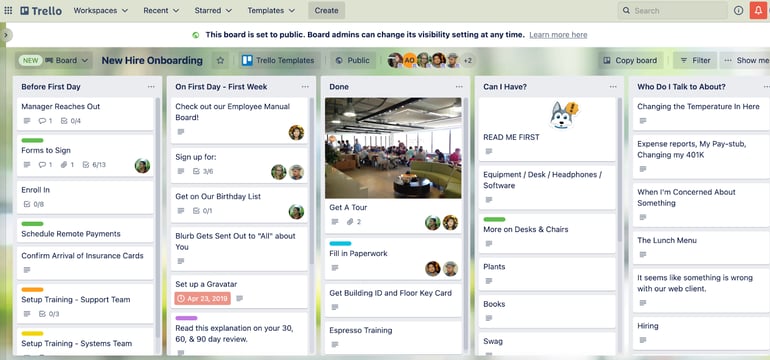
Trello is a natural choice for Kanban task management because work is organized as cards that move across lists representing each workflow stage. Teams can see what is waiting, in progress, or completed from a single board, while labels, due dates, and assignees add context to each card. This visual approach works well for workflows where tasks move through a predictable sequence.
Outside the Kanban view, Trello includes built-in automation that can move cards, assign members, or respond to due dates based on predefined triggers. Custom Fields add project-specific information to cards, while calendar, timeline, table, and dashboard views give teams other ways to review the same work. Advanced checklists can also assign individual checklist items and give them separate due dates.
Trello becomes less convenient when projects require task dependencies, since it relies on workarounds such as linked cards and checklists rather than built-in dependency controls. Wrike is a better alternative for teams managing dependent tasks, as its Gantt chart supports four dependency types and automatically reschedules downstream tasks when predecessor dates change.
| Pros | Cons |
|---|---|
| ✅Ideal for lightweight task tracking ✅Excellent value for basic task lists ✅Intuitive drag-and-drop functionality | ❌Lacks advanced native dependencies functionality ❌Doesn’t support nested comments ❌Inability to apply global updates across all boards |
Trello pricing
- Free: Includes unlimited cards, unlimited Power-Ups per board, assignees, due dates,
- Standard: $5/user/month — Adds unlimited boards, advanced checklists, custom fields, card mirroring
- Premium: $10/user/month — Adds timeline/calendar/table/map views, AI features, board collections
- Enterprise: $17.50/user/month — Adds org-wide permissions and multi-board guests
Standout features
- Organize tasks into boards, lists, and cards to track progress across workflows.
- Add due dates, assignees, and checklists to manage task ownership and completion.
- Automate repetitive task actions with Butler automation rules.
- Customize task workflows with labels and card details for better tracking.
8. Notion: Best for connected tasks & notes

My rating: 4.30 / 5
Why I chose Notion
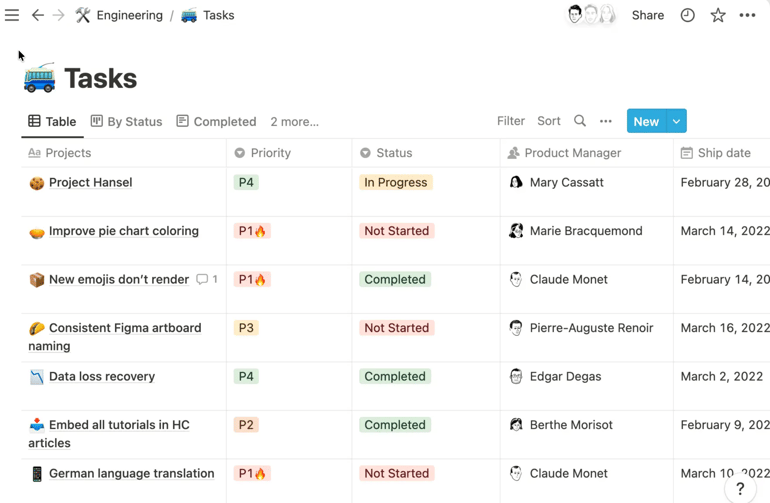
Notion’s database model sets it apart from task managers built primarily around lists and boards. Each database item can open as its own page, so a task can include meeting notes, links, images, or reference material alongside its status and due date. Relations also connect tasks to a project or document, which keeps the supporting information easy to access.
Notion also gives teams different ways to view tasks, such as lists, boards, or calendars. Its My Tasks view brings assigned work into one place, while linked databases let teams show the same task list on different pages and keep every copy updated automatically.
Managing tasks in Notion can become confusing when teams create separate databases for every project or client. Todoist is a simpler alternative for teams that want a dedicated task manager with shared projects and recurring tasks.
| Pros | Cons |
|---|---|
| ✅Excellent document-task integration ✅Extensive community templates for a range of use cases ✅Highly rated for flexibility | ❌Lacks out-of-the-box resource management ❌Doesn’t bundle AI features into its pricing ❌Lacks native project management tools |
Notion pricing
- Free: Includes databases (subtasks, dependencies, custom properties), Notion Calendar, 7-day page history, basic forms
- Plus: $10/user/month — Adds unlimited collaborative blocks, unlimited file uploads, 30-day page history, unlimited charts
- Business: $20/user/month — Adds AI features, database permissions, private teamspaces, 90-day page history, SAML SSO
- Enterprise: Custom pricing — Adds user provisioning (SCIM), advanced security and controls, audit logs, unlimited page history
Standout features
- Track tasks in customizable databases with views like list, board, and calendar.
- Assign tasks, set due dates, and manage status
- Create reusable task templates to standardize workflows across projects.
- Link related tasks and pages to connect related project work
9. Todoist: Best for personal task planning

My rating: 3.46 / 5
Why I chose Todoist
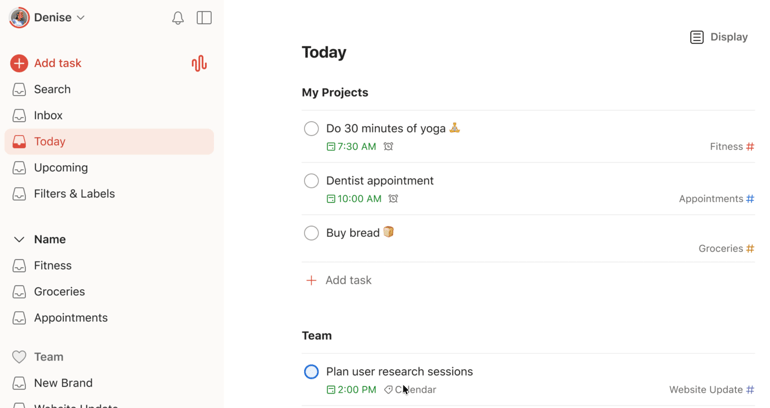
Todoist is a good choice for personal task planning because it makes it easy to capture tasks and organize what needs to happen today versus later. Natural-language input can turn phrases such as “every Monday” into recurring tasks automatically, while Today and Upcoming views give users a quick look at current and upcoming work.
As task lists get longer, filters and reminders help keep them manageable. Users can create filtered views based on due date, project, or priority, while reminders provide prompts for tasks that need to be completed at a specific time. Todoist also includes calendar views for users who prefer to plan work around their schedule.
Trello is an alternative for users who need to schedule tasks across several days, since task cards support start and due dates and can be mapped across a Timeline view.
| Pros | Cons |
|---|---|
| ✅Natural language input simplifies task creation ✅Setup doesn’t require technical expertise ✅Highly affordable for individual use | ❌Fewer template options and limited template support ❌AI functionality is insufficient for complex workflows ❌Lacks native Gantt charts |
Todoist pricing
- Beginner: — Includes 5 personal projects, task reminders, flexible list and board layouts, three filter views
- Pro: $5/user/month — Adds calendar layout, task duration, custom task reminders, 150 filter views
- Business: $8/user/month — Adds shared team workspace, activity logs, shared templates
Standout features
- Organize tasks into projects, sections, and subtasks to structure your workload.
- Set recurring due dates and task reminders
- Use priority levels to focus on the most important tasks first.
- View all assigned tasks in a unified Today or Upcoming view for better planning.
Do you need task management software or project management software?
Task management software is usually enough when the main goal is to assign work, set due dates, track priorities, and monitor completion. It works well for teams managing recurring requests or straightforward workflows where tasks can be handled independently.
Project management software becomes more appropriate when work depends on sequencing, shared resources, budgets, milestones, or changes that affect multiple parts of a project. These platforms typically add scheduling, dependency management, resource planning, and portfolio-level reporting.
| If you need to... | Consider |
|---|---|
| Assign tasks and track completion | Task management software |
| Manage recurring work and personal to-do lists | Task management software |
| Organize work by priority, assignee, or due date | Task management software |
| Coordinate tasks that depend on one another | Project management software |
| Track milestones, schedules, or project phases | Project management software |
| Manage workloads across several projects | Project management software |
| Monitor budgets, risks, or project progress | Project management software |
| Report across multiple projects or portfolios | Project management software |
Some platforms, including ClickUp, monday.com, Asana, and Wrike, support both use cases. The deciding factor is usually the complexity of the work: teams with independent tasks may only need task management features, while projects with dependencies, resource constraints, or cross-project reporting require project management capabilities.
What type of task management software does your team need?
The right type of task management software depends on who owns the work and whether tasks require handoffs, dependencies, or approvals. Individual users may only need lists and reminders, while larger teams may need workload planning, cross-project reporting, and permission controls.
Personal task management
Tools such as Todoist and Notion work well when one person owns most tasks and collaboration is occasional. They support deadlines, recurring tasks, and personal planning without requiring extensive workflow configuration or administrative controls.
Team task management
monday.com, Asana, and ClickUp are designed for teams where several people contribute to the same work. They support task assignments, dependencies, automations, and workload views that help managers see who owns each step and where work may be delayed.
Agile and software task management
Jira is designed for software and technical teams that organize work through backlogs, sprints, issues, and release cycles. It also supports development workflows where bugs, feature requests, and engineering tasks move through defined stages before release.
Cross-department workflow management
Wrike, monday.com, and Smartsheet support workflows where work passes between departments. A request might begin with sales, move to legal for approval, and then continue to finance or operations.
How to choose the best task management software
Choosing the best task management software involves factors like your team’s workflow, the complexity of your projects, and how much customization you actually need. Let’s take a look at what I focus on when evaluating these tools so you can find one that fits how you work.
- Match the tool to your workflow: I always start by identifying how my team actually operates, whether that’s sprints, Kanban, creative reviews, or simple to-do lists. Forcing a workflow into the wrong platform creates a learning curve, so I pick tools that support the process we already use rather than adapting our work to fit the software.
- Consider the features you need: Some teams thrive with flexible boards and minimal setup, while others need dependencies, custom fields, and strict permissions. Before committing to a platform, I think about whether my team benefits from core features or if the work requires deeper structure.
- Test collaboration features with your team: Task management goes beyond organizing work; it’s also about how the team coordinates around those tasks. I check whether comments, mentions, file sharing, and notifications actually support collaboration.
- Factor in integrations with your existing tools: I pay attention to whether the platform connects with an existing app stack, such as email, calendars, file storage, and messaging. Switching between disconnected tools wastes time, so native integrations or solid API support matter more than I initially thought.
- Start with a small-scale project during the trial period: I never evaluate task management software with fake data or hypothetical workflows. I run an actual project through the trial so I can see how it handles tasks, bottlenecks, and team activity before deciding whether it’s worth keeping long-term.
FAQs
What’s the difference between free and paid task management software?
Free task management software typically limits advanced features like automations, custom fields, timeline views, reporting, and integrations. Paid plans unlock workflow automation, guest access, priority support, and higher storage limits. Teams managing complex projects or requiring detailed analytics usually need paid plans, while individuals and small teams often function well on free tiers.
What is the best task management software for Agile and sprint planning?
Jira is the best task management software for Agile workflows because it was built specifically for Scrum and Kanban methodologies. It supports sprint planning, backlog management, burndown charts, velocity tracking, and story point estimation.
Which task management software is best for personal use?
Todoist is the best task management software for personal use because it supports natural language input, recurring tasks, and cross-platform sync without requiring team collaboration features. Notion works well for individuals who want tasks connected to notes and documentation. Both offer free tiers that cover most personal productivity needs.