


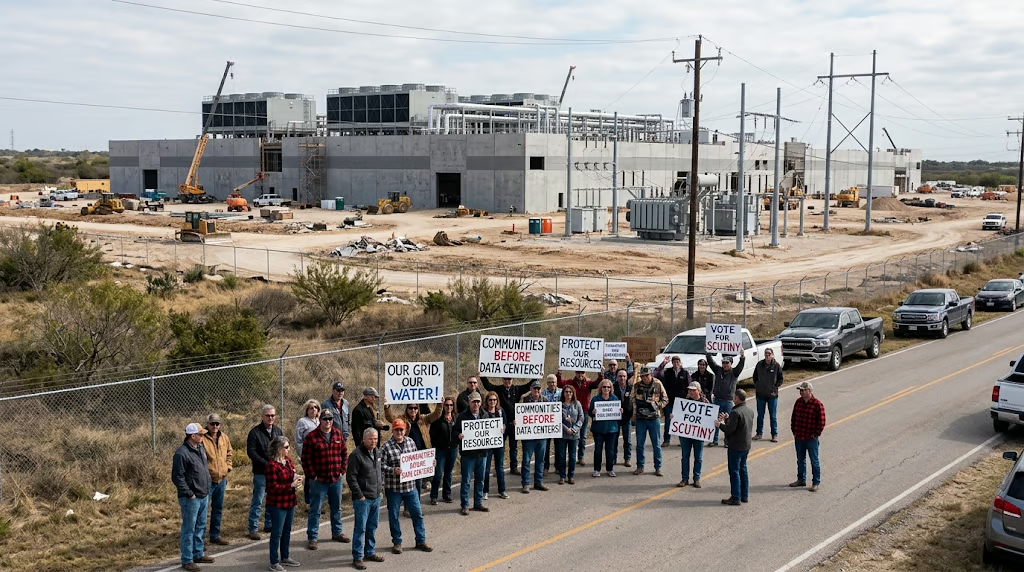
America’s AI data center boom is running into a growing political obstacle: voters who want more control over where massive computing facilities are built.
The Nov. 3 elections brought victories for candidates promising greater scrutiny of data center development, including Democrat Gina Hinojosa’s defeat of Republican Texas Gov. Greg Abbott. Communities across the country also supported measures intended to restrict or regulate new facilities.
For technology companies and businesses investing heavily in AI, the stakes extend beyond politics. Tougher permitting requirements, rising infrastructure costs, and potential construction delays could reshape where new computing capacity becomes available.
Texas election puts AI infrastructure plans at risk
Texas has become one of the country’s most important destinations for AI infrastructure investment, attracting developers seeking land, electricity, and space for enormous data center campuses.
However, the state’s electricity grid faces growing demand from proposed facilities, and concerns about the cost of supporting that expansion have become a political issue.
According to Bloomberg, Hinojosa called for an immediate moratorium on data center development during her campaign, citing concerns about electricity costs and water consumption.
Her election victory introduces uncertainty for companies planning major investments in the state.
Texas already has restrictions on some data center approvals
The push for tighter oversight did not begin with Hinojosa’s victory.
Under Abbott, Texas introduced temporary restrictions affecting certain data center approvals, including additional scrutiny of electricity grid connections and environmental permitting. Those measures were intended to address concerns about infrastructure capacity and resource consumption. However, they did not establish an unconditional statewide ban on all new data center construction.
Hinojosa has proposed going further. According to The Texas Tribune, she has called for maintaining a broader pause on approvals until lawmakers establish stronger protections for electricity customers, water supplies, and surrounding communities.
The distinction matters for developers. Existing restrictions affect certain projects and approvals, while a broader moratorium could introduce additional uncertainty for facilities still awaiting permission to proceed.
However, Hinojosa’s campaign proposal does not automatically become state policy. Any new restrictions would depend on the actions of the incoming administration and the legal authority available to implement them.
Why Texas matters to the AI industry
Texas hosts major data center developments and has attracted significant investment from companies seeking to expand AI computing infrastructure.
Changes to permitting requirements could therefore affect projects that have not yet secured the approvals or electricity connections necessary to begin construction.
Facilities already operating or under construction may face different requirements from projects still in the planning stages.
The broader concern is that restrictions in a major data center market could slow the addition of computing capacity at a time when technology companies are investing heavily in AI.
Data center opposition spreads beyond Texas
The debate extends well beyond Texas.
Across the country, concerns about data center development have become increasingly prominent in political discussions, particularly around electricity affordability, environmental impacts, and infrastructure costs.
The issue presents a difficult balancing act for state and local governments. Data centers can attract substantial investment, generate tax revenue, and create construction jobs. However, they also require significant electricity infrastructure and, depending on their cooling systems, can consume substantial amounts of water.
Communities are increasingly questioning whether the economic benefits justify those demands.
For policymakers, the challenge is determining how much responsibility developers should bear for the infrastructure needed to support their facilities. That could include requirements for developers to contribute more toward electricity grid upgrades, demonstrate sustainable water usage, or provide additional benefits to surrounding communities.
The political debate does not necessarily mean states will prohibit new construction.
Some governments may pursue temporary restrictions while establishing new requirements. Others could continue approving projects while imposing additional conditions.
For data center operators, the growing attention to these issues introduces another consideration when evaluating potential construction sites.
Voters back local restrictions on data center development
The backlash was particularly visible in local elections.
According to The Washington Post, voters across the country supported numerous measures intended to restrict or increase oversight of data center development.
However, the measures did not all have the same legal effect. Some communities approved binding restrictions, including zoning changes, development bans, or temporary moratoriums. Others supported advisory measures expressing opposition to data center development. Those votes can influence local officials without immediately changing the law.
In other cases, voters rejected proposals that would have eased data center construction. These distinctions are important because a vote against a development proposal does not necessarily mean an existing facility has been canceled or that all future construction is prohibited.
The opposition reflects several recurring concerns:
- Higher electricity bills: Residents worry that infrastructure upgrades and growing demand could increase utility costs.
- Water consumption: Cooling systems may place additional pressure on local water supplies, depending on their design.
- Grid reliability: Large concentrations of computing facilities can complicate electricity planning and increase demand for new generation capacity.
- Community impact: Residents question whether construction, land use, and tax incentives deliver sufficient local benefits.
The resistance also crosses party lines.
Republican and Democratic communities have raised similar concerns about the environmental and financial demands of data centers, even when their broader political priorities differ.
However, opposition is not universal. Some communities continue to welcome data centers because of their potential to generate tax revenue, attract investment, and create jobs.
The election results nevertheless suggest that developers may face greater pressure to demonstrate how their projects benefit surrounding communities.
Could the election slow America’s AI expansion?
The election results do not mean America’s AI data center construction boom is ending.
However, they introduce additional uncertainty for developers already confronting expensive equipment, limited electricity availability, and complicated construction schedules.
Restrictions could affect projects differently depending on their location, permitting status, and infrastructure requirements.
Some states may pursue temporary moratoriums while lawmakers establish new rules. Others could require developers to cover more of the costs associated with electricity infrastructure, water consumption, and environmental protections. Such measures could increase project expenses without permanently preventing construction.
The financial burden of AI infrastructure has already become a contentious issue.
As demand for computing capacity grows, utilities and regulators must determine how to finance the infrastructure needed to serve large data center customers. That includes questions about whether developers should pay for additional transmission equipment, electricity generation, and other upgrades required to support their facilities.
The debate reflects a broader challenge for the technology industry: determining how the costs of AI expansion should be divided between developers, utilities, and consumers.
If approvals take longer, developers may need to reconsider construction schedules, negotiate additional requirements, or evaluate alternative locations.
Projects that have already secured permits and electricity connections may face fewer immediate obstacles than developments still awaiting approvals.
The effects could extend beyond data center operators to equipment manufacturers, construction companies, utilities, and cloud providers supporting the expansion.
What does this mean for businesses investing in AI?
For enterprise IT leaders, the longer-term concern is whether restrictions on new data center construction could eventually affect the availability and cost of AI computing services.
There is no indication that the election results have immediately changed cloud pricing or disrupted existing services.
However, organizations increasingly rely on cloud providers to run AI applications, train specialized models, and support automated business processes.
Those services depend on facilities equipped with powerful processors, networking equipment, cooling systems, and reliable electricity supplies.
If planned facilities are delayed, providers could face additional challenges expanding capacity in certain regions.
| Delayed construction | Longer timelines for planned regional cloud and AI capacity |
| Higher infrastructure costs | Potential pressure on future cloud and AI service pricing |
| Stricter environmental requirements | Additional costs or conditions for new facilities |
| Geographic shifts | Providers may prioritize locations with available power and predictable permitting |
| Greater capacity uncertainty | More complicated planning for large AI deployments |
These outcomes are possibilities rather than confirmed changes to cloud pricing or service availability.
Existing cloud infrastructure is not automatically affected by restrictions on new construction. Providers may also be able to accommodate demand through facilities already operating or under development.
Nevertheless, businesses planning major AI deployments should pay attention to regional capacity commitments and the infrastructure assumptions underlying their technology strategies.
Enterprise IT leaders can take several practical steps:
- Review capacity commitments: Ask cloud providers about computing resources in regions critical to planned AI deployments.
- Evaluate regional alternatives: Determine whether workloads could operate elsewhere if preferred locations are constrained by capacity.
- Examine contract terms: Understand how providers address capacity limitations, pricing changes, and service availability.
- Monitor infrastructure developments: Track regulatory decisions that affect major data center projects supporting key technology vendors.
These precautions can help organizations plan without assuming that political opposition will necessarily cause service disruptions.
What happens next for the AI data center boom?
The next major test will come as elected officials begin translating campaign proposals into actual policies.
In Texas, developers will be watching for decisions affecting environmental permits, electricity infrastructure, and restrictions on new construction.
The incoming administration’s approach will help determine whether existing restrictions develop into a broader, longer-lasting moratorium. Other states and communities face similar questions about balancing economic development with electricity affordability, environmental protections, and local concerns.
The industry’s response will matter as well.
Developers could agree to finance more infrastructure, invest in dedicated electricity generation, adopt less water-intensive cooling technologies, or negotiate additional benefits for surrounding communities.
Such measures may help address opposition, although they could also increase the cost of building new facilities.
For technology companies, the challenge is increasingly about securing public and regulatory approval alongside the electricity, land, and financing required to expand computing capacity.
The AI boom still has substantial momentum. But its next phase may depend as much on winning support from local communities as securing the processors and power needed to build the next generation of data centers.
Related reading: As AI data centers face growing opposition on Earth, Nvidia is developing space-ready AI chips that could eventually help bring computing infrastructure into orbit.