


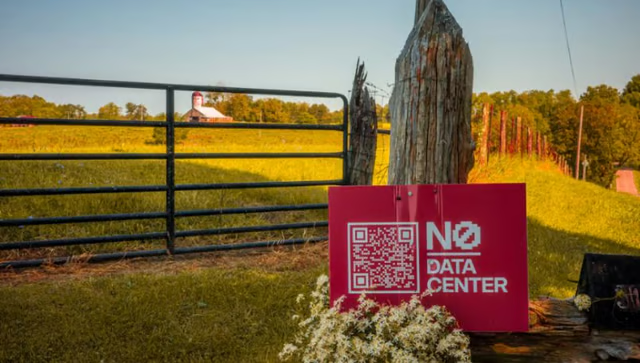
President Donald Trump wants data center companies to make an offer residents may find harder to refuse: a financial benefit from hosting the infrastructure powering the AI boom.
In an Oct. 21 Truth Social post, Trump urged data center operators to pay dividends to the communities hosting their facilities, arguing that financial agreements could help turn unpopular projects into more acceptable developments.
The proposal comes as communities increasingly question the electricity demands, water consumption and local costs associated with AI infrastructure. While Trump’s statement does not establish a nationwide payment requirement, it raises a larger question for the industry: Can sharing the economic benefits of data centers make it easier to build them?
Why communities are pushing back against data centers
The rapid expansion of AI infrastructure has intensified concerns about the resources needed to operate large data centers, particularly electricity and water.
While AI companies have tried to tout the benefits of these facilities, including permanent and temporary employment opportunities for residents, often running into the thousands, these efforts appear to have done little to quell opposition.
Already, some states have begun imposing restrictions and moratoriums on data center construction in response to residents’ demands. These decisions are beginning to slow the pace of data center buildouts. While the effects are still early, continued opposition could eventually slow the advancement of AI and other technologies that rely heavily on data centers.
Against this backdrop, US President Donald Trump has urged data center companies to make their projects more appealing to residents by offering them financial incentives.
In a Truth Social post cited by Reuters, Trump framed his recommendation as something he had observed, suggesting that if more data center operators adopted this approach, opposition to their projects could begin to wane.
“I have watched the process closely, and data centers that were highly unpopular in a certain area, have become extremely popular when a financial deal is struck,” he said.
Trump did not specify how the proposed dividends would work, who would qualify to receive them or whether payments would come directly from company profits. Those details would determine how much residents benefit and what the arrangements cost data center operators.
Financial compensation, however, may not resolve all the problems associated with data center construction.
Beyond making data centers popular, why paying dividends may matter
The financial dividends Trump is proposing could have implications beyond making data centers more popular with residents.
The first possibility is that sharing profits with communities could increase the cost of running AI services.
Data centers are already expensive to build and maintain. If companies have to allocate more of their revenue to community payments, their profits could shrink, potentially prompting them to raise AI subscription prices or pass some of the additional costs on to customers in other ways.
The second possibility is that financial incentives could make it easier for companies to secure approval for new facilities. If fewer projects are delayed or blocked, companies could expand their computing capacity faster, potentially reducing the cost of providing AI services over time.
However, neither outcome is guaranteed. A reduction in company profits does not automatically translate into higher AI prices, just as increased data center construction does not automatically make AI cheaper.
Another question is whether financial dividends would be large enough to shift public opinion meaningfully. If residents continue to face higher electricity bills, water shortages, noise, or other local problems, financial compensation alone may not be enough to secure their support.
More must-read AI coverage
- SS&C Intralinks DealCentre AI vs. Datasite: Which platform is built for the future of dealmaking?
- SS&C Intralinks FundCentre AI vs. Juniper Square: Which platform better supports modern private markets fund managers?
- Why Data, Not Models, Determines AI Success
- The Rise of the AI-Native Factory: How Physical AI Is Transforming Manufacturing
How community dividends could shape the future of AI
For AI companies and data center operators, the immediate question is whether financial agreements with host communities can become a practical way to reduce opposition and move projects forward.
Trump’s recommendation does not require companies to make such payments, and it remains unclear how widely operators will adopt the approach. Even where financial incentives are offered, developers will still need to address concerns about electricity, water and local infrastructure.
For businesses that depend on expanding AI computing capacity, the larger issue is whether data center developers can secure the community support and resources needed to keep construction moving. How companies handle those negotiations could become an increasingly important factor in where new AI infrastructure gets built.
Other news: The White House has launched a 120-day review of AI safety risks, focusing on cybersecurity, critical infrastructure, biosecurity, and AI model accountability.