


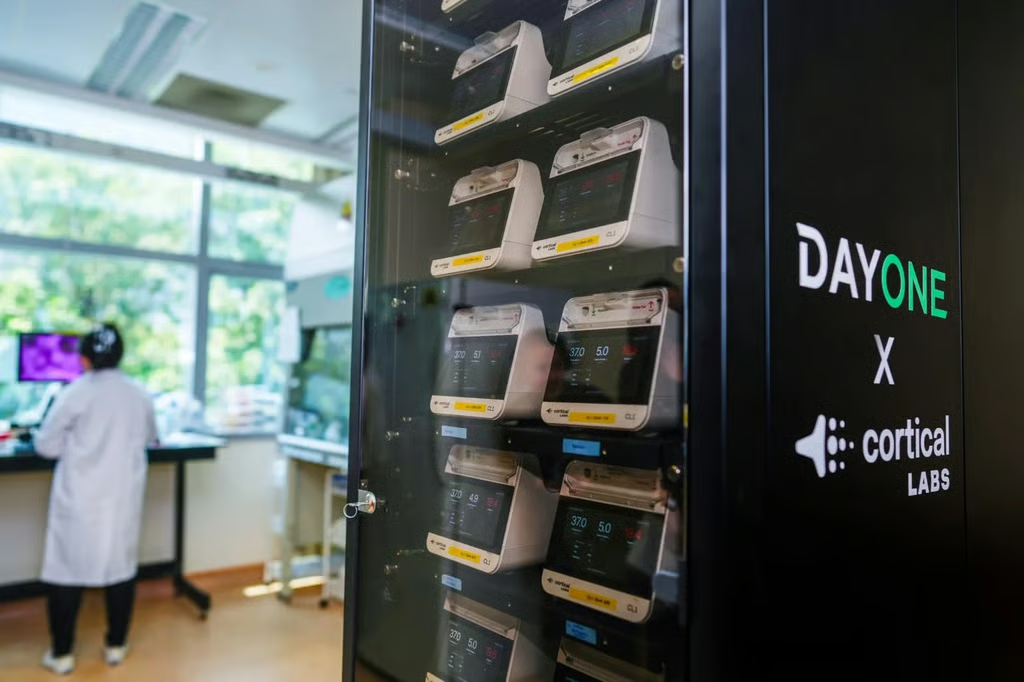
A server rack in Singapore is processing information with living human neurons.
NUS Medicine, data centre operator DayOne, and Melbourne-based Cortical Labs have deployed a 20-unit biological computing rack at the National University of Singapore’s Life Sciences Institute. The system went live July 16 and was formally unveiled Aug. 17 after an Aug. 6 demonstration for more than 80 guests.
The installation brings biological computing into a live research environment as Singapore expands data-centre capacity while tightening energy-efficiency requirements. NUS Medicine said the demonstration showed CL1 computing units, microelectrode-array integration, and real-time neural network activity, while The Straits Times reported details of the system’s operation and maintenance.
How the biological computing rack works
Each CL1 combines living human neurons with silicon hardware and a microelectrode interface. The neurons grow across a chip that sends and receives electrical impulses, while Cortical Labs’ software creates a digital environment through which neural activity can interact with software.
The biological component also requires life support. NUS technicians feed the cultures every three days, while the CL1 regulates their environment. Cortical Labs says the neurons can remain viable for up to six months.
NUS describes the deployment as the world’s first independently operated biologically integrated server rack. Cortical Labs’ earlier DishBrain research connected human and rodent neurons to a simulated game of Pong. A peer-reviewed 2022 study reported apparent learning under closed-loop feedback but did not demonstrate general intelligence or readiness for enterprise workloads.
NUS plans to explore drug discovery, neurological disease research, and biological modelling. Cortical Labs has also identified robotics, cybersecurity, and fraud detection as areas for further research.
Singapore tests another path to lower-power computing
Singapore is expanding data-centre capacity while tightening efficiency requirements. The Infocomm Media Development Authority says at least 200 MW of additional capacity will be made available, with potentially more supported by new green-energy pathways. Nearby, Johor’s rapid data-centre expansion is already encountering grid, water, and capacity constraints.
Lower energy use is central to biological computing’s appeal, but its practical advantage remains unproven. Denser AI systems are also increasing power and cooling demands across data-centre infrastructure. NUS and Cortical Labs have not published an equivalent-workload benchmark comparing the CL1’s useful computing performance with GPUs or other processors.
The International Energy Agency projects global data-centre electricity use will more than double from about 415 TWh in 2024 to about 945 TWh by 2030, with AI the largest driver of the increase.
The NUS system remains a research deployment, not an enterprise alternative to conventional AI hardware. NUS said in March that validation work was intended to lead to deployment inside a DayOne commercial data centre in Singapore. DayOne is also involved in a planned 360 MW AI data centre in Batam, highlighting the broader infrastructure buildout around Singapore.
Biological computing will need to demonstrate reliable workloads and measurable efficiency gains before it can move beyond research infrastructure.
Read more: The race to build regional computing capacity also raises questions about who controls the underlying AI stack, as Australia weighs greater investment in domestic AI infrastructure.