


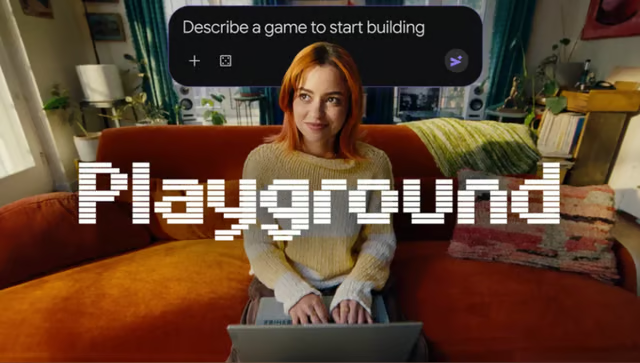
Google wants to turn a simple sentence into a playable video game, no coding required.
The company announced Playground on Wednesday, an experimental AI platform that lets users create browser-based games by describing their ideas in natural language. Instead of working with a traditional game engine, creators can use conversational prompts to build and modify their projects.
Powered by Google’s Gemini, Nano Banana and Lyria models, Playground supports 2D and 3D games, with options for single-player and certain multiplayer experiences. For now, the platform is available only to users aged 18 and older in the United States.
From prompts to playable games
Users can start with a blank project, modify starter prompts or get guided assistance as they develop a game.
Once a game is generated, creators can continue refining it through conversation, changing characters, environments, rules and physics without rebuilding everything from scratch. They can also upload images for use as game assets that match the project’s visual style.
Finished games can remain private, be shared through a link or be submitted to Playground’s Explore gallery, where others can discover and play them.
Games can include leaderboards, while Play Games profiles let users claim handles, rate games and follow creators. Google says published games go through safety screening based on its Community Guidelines, alongside user reporting.
That matters because making games dramatically easier could also mean making it dramatically easier to produce low-effort or derivative content. Google’s rules place responsibility on creators for what they publish, including restrictions around third-party intellectual property and attempts to bypass safety systems.
Unity could determine how far Playground goes
Google plans to integrate Unity Spark, which is currently being tested, with a closed beta planned soon.
Google says the integration will bring professional-level mechanics, high-fidelity 3D capabilities and the Unity runtime to Playground. That could give creators a path from quick AI-generated experiments toward more sophisticated games rather than leaving them with disposable browser toys.
AI can make the first version of a game much easier to produce, but making something genuinely enjoyable still depends on mechanics, pacing and iteration. Playground’s conversational editing model could make that iteration faster, while Unity Spark could provide the technical foundation for more ambitious projects.
More Google coverage
- New Google Search AI Mode is ‘Total Reimagining,’ Says CEO Sundar Pichai
- In Major Ruling, Judge Finds Google ‘Willfully Acquired and Maintained Monopoly Power’ Over Digital Ad Market
- Google’s Big Bet on Nuclear Energy: ‘The Race to Power AI-Driven Data Centers is Accelerating’
- Computer History Museum Releases Original AlexNet Code: Why It Matters
What Playground means for aspiring game creators
Playground creates another source of instantly accessible browser games that work across phones and computers. For aspiring creators, it removes much of the technical setup that has traditionally stood between an idea and a playable prototype.
There are limits, though. Playground is still an experiment, and game generation uses weekly tokens, with higher creation limits tied to Google One AI subscriptions.
It is also initially limited to US users aged 18 and older. For now, the bigger opportunity is experimentation: users can test ideas quickly without learning a game engine first. Whether those quick experiments can become polished games will depend heavily on how far Google and Unity take the platform.
The launch puts Google alongside platforms such as Roblox, which introduced its own natural-language game-building tools earlier this year.
But Playground’s combination of conversational creation, browser-based distribution and planned Unity integration gives Google a different angle: start with a prompt, then potentially grow the idea into something much more sophisticated.
Whether those experiments can become polished games will depend on the quality of the generated results, the tools available for refinement and Google’s future development of the platform.
Other news: Google has launched Nano Banana 2.1, bringing improved image editing, more consistent results across multiple edits, and a 50% reduction in image-generation costs for developers.