


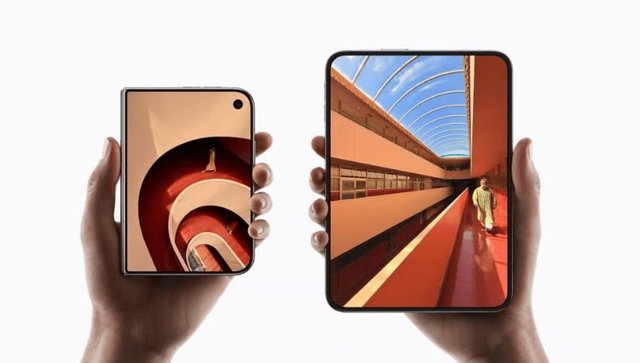
Apple’s $1,999 foldable iPhone is getting a more convenient way to unlock, but it’s not quite the Face ID experience users have come to expect.
According to Bloomberg, Apple has introduced a feature called Unlock with Front Camera in the second developer beta of iOS 27.3. It allows iPhone Duo owners to unlock their devices using facial recognition instead of relying entirely on the Touch ID fingerprint sensor.
However, this isn’t Apple’s familiar Face ID technology. The Duo lacks the TrueDepth camera system needed for 3D facial mapping, so the new feature relies on conventional camera-based facial recognition instead.
Touch ID still handles sensitive tasks
Apple has placed several restrictions on the new feature to limit its security exposure.
Users must first authenticate with Touch ID or a passcode before facial recognition becomes available. Touch ID is also required again after approximately 45 minutes of inactivity. More importantly, face unlock only handles access to the Lock Screen. Users must continue using Touch ID for Apple Pay transactions, password access and other sensitive authentication tasks.
Gizmodo reports that Apple told the publication the feature does not offer the same protections as Face ID or Touch ID. Apple also described its accuracy as comparable to Touch ID. The feature can be enabled under Settings, Touch ID & Passcode, and Unlock with Front Camera. It currently works with the camera on the outer display, not the inner screen.
Recognition accuracy does not necessarily mean equivalent protection against impersonation. That is why the new feature should be understood as a convenience option rather than a complete replacement for Apple’s existing biometric authentication systems.
Apple fixes another foldable frustration
The iOS 27.3 beta also introduces an option to lock the Duo automatically when users close its inner display. Previously, closing the foldable could leave content active on the outer screen, potentially triggering accidental touches and consuming battery power.
Users can now enable the behavior under Display & Brightness, although it is disabled by default.
A software fix cannot replace better hardware
Apple’s decision to bring facial recognition to the Duo is an important admission that convenience matters just as much as the novelty of its foldable design.
At nearly $2,000, the device faces higher expectations than an experimental first-generation product. Asking customers to return to fingerprint authentication after years of Face ID creates friction, particularly for people switching from newer iPhones.
The software workaround helps, but it also exposes a limitation Apple cannot completely solve through an update: the absence of dedicated facial recognition hardware. That leaves Apple with a longer-term engineering challenge. Bloomberg reports that the company is working on bringing proper Face ID to a future Duo model.
What this means for the iPhone Duo’s future
For current owners, the new feature offers a welcome convenience improvement, although those who rely on their phones for everyday work may prefer to wait for the public release of iOS 27.3 rather than install developer beta software.
The more interesting question is what this update says about Apple’s priorities. Instead of waiting for a future hardware revision, the company is using software to address an early criticism of its foldable. That approach could help improve the ownership experience between major product launches, particularly as Apple learns which compromises customers are willing to accept.
It also raises the stakes for the next generation of the Duo. Once Apple begins addressing first-generation complaints through software, attention naturally shifts to the shortcomings that require hardware changes. Future models will have to demonstrate that the foldable design can accommodate more of the features customers already expect, rather than asking them to make compromises for a different form factor.
For Apple, the longer-term challenge is turning the Duo from an impressive first-generation device into a foldable that feels as polished and practical as its conventional iPhones.
Other news: Google is bringing AI agents to its AdMob platform to help app developers automate ad integration, troubleshoot configuration issues, and manage monetization.