


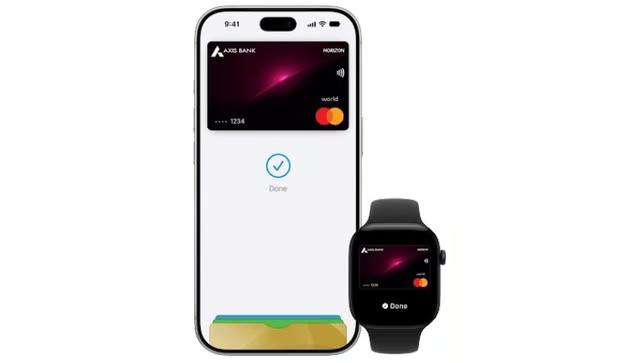
Apple Pay has finally arrived in India after years of delays, but the launch starts with a narrow group of eligible users.
The company rolled out Apple Pay in India on Wednesday across iPhone, iPad, and Apple Watch, with Mac support scheduled soon. The launch establishes Apple’s digital payment footprint in the world’s most populous nation, although the initial rollout remains tightly restricted to Axis Bank customers holding Visa or Mastercard credit cards.
“India is home to a dynamic and digitally savvy population that continues to embrace a cashless future while expecting the highest standards of security and privacy, and we’re so excited to bring Apple Pay to users in India today,” said Jennifer Bailey, Apple’s vice president of Apple Pay and Apple Wallet.
Narrow gateway to a massive market
Rather than launching nationwide across multiple lenders, Apple entered the market through an exclusive inaugural partnership with Axis Bank, the country’s third-largest private lender. According to central bank data reported by Reuters, Axis Bank accounts for 16.3 million credit cards out of 124 million nationwide.
The initial rollout leaves out major domestic players. Industry heavyweights like HDFC Bank, ICICI Bank, and SBI Card remain on the sidelines as commercial discussions continue. TechCrunch reported that Apple is seeking roughly 20 basis points per transaction, eating into the slim 40 to 50 basis points that make up standard payment economics. The service also excludes India’s homegrown RuPay network.
Despite the narrow card eligibility, merchant support is broad at launch. Consumers can use Apple Pay at millions of retail outlets and online services, including Zomato, Blinkit, Croma, and Reliance brands, facilitated through payment aggregators such as Pine Labs, Razorpay, and Paytm.
The friction behind the delay
Apple Pay’s arrival caps more than nine years of regulatory negotiations. India enacted stricter digital financial policies in recent years, including mandates governing recurring subscription billing and strict rules around biometric verification that previously clashed with Apple’s closed architecture.
Crucially, Apple Pay enters an arena overwhelmingly dominated by the government-backed Unified Payments Interface (UPI).
According to an IMF report, UPI accounts for more than 80% of India’s retail digital transaction volume, led by platforms like Walmart-owned PhonePe, Google Pay, and Paytm. Because Apple Pay currently functions exclusively on card networks rather than direct account-to-account UPI transfers, it is competing for a much smaller slice of everyday transactions.
Apple Pay enters a market built around UPI
Apple Pay is unlikely to displace UPI for everyday payments in the near term.
Google Pay, PhonePe and other UPI apps are already widely used for direct bank-to-bank transfers, including small purchases at merchants that accept QR-code payments. Apple Pay’s initial India launch instead centers on eligible credit cards and contactless terminals.
That gives Apple a different role in the market. Rather than replacing UPI, Apple Pay could appeal most to existing iPhone users who already rely on cards for retail, travel and online purchases and want those payments integrated into Apple Wallet.
Must-read Apple coverage
- Nearly 7 in 10 iPhone Owners Plan iPhone 17 Upgrade
- Apple Prepares AI-Powered Siri Upgrade With Google Search Integration
- Apple’s Xcode 26 Beta Now Supports GPT-5 and Claude
- Apple’s Vision Pro Adoption Stalled As Content Released ‘Drip by Drip’
How Indian consumers are affected
For everyday smartphone users, the impact depends entirely on their hardware and banking relationships:
- Faster checkout: Eligible users can make contactless payments in stores and use Apple Pay in supported apps and websites without manually entering card details each time.
- Card rewards remain: Axis Bank cardholders can continue earning applicable rewards, miles, or cash back when using eligible cards through Apple Pay.
- Limited eligibility at launch: Customers without supported Axis Bank credit cards, including debit card and RuPay users, cannot use Apple Pay initially. People who rely mainly on UPI will continue using separate UPI apps.
For most Indian consumers, UPI will remain the default payment method. Apple Pay’s early test is narrower: whether convenience and Wallet integration are enough to persuade eligible iPhone users to shift more card payments onto Apple’s platform.
Other APAC news: Taiwan is investing in a $217 million aerospace and drone industrial park in Chiayi as it builds a “non-red” supply chain designed to reduce reliance on Chinese components and expand domestic drone production.