


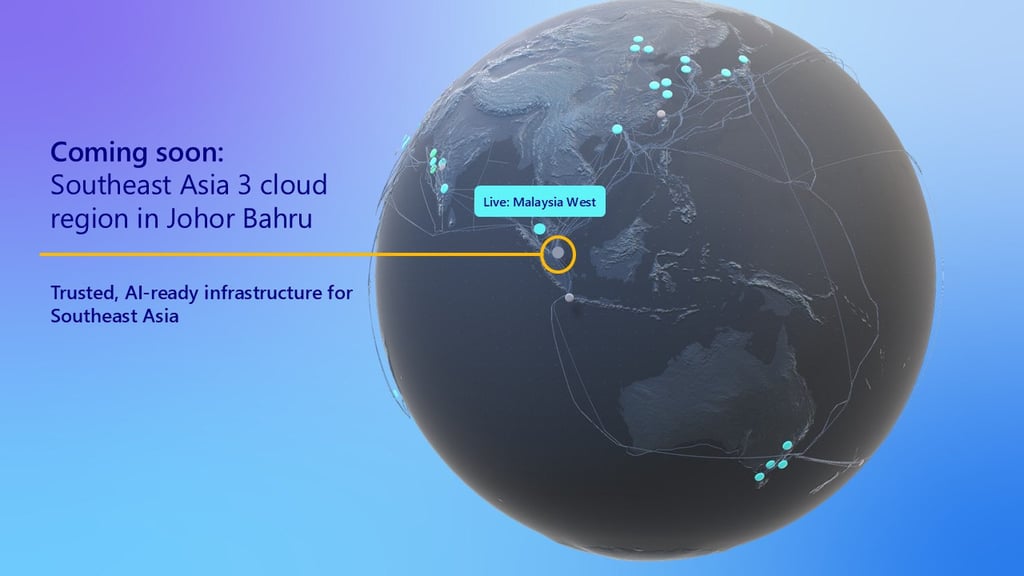
Malaysia already has three Azure availability zones, but all three sit within a single cloud region. That leaves businesses without a second domestic Azure region for disaster recovery.
Microsoft’s planned Southeast Asia 3 (SEA3) region in Johor Bahru could change that. Once operational, it would complement Malaysia West in Greater Kuala Lumpur, giving enterprises the option to maintain production and recovery infrastructure in two geographically separate Azure regions within Malaysia.
In a November 5, 2026, update, Microsoft outlined how the two regions could strengthen cloud resilience. However, SEA3 has not yet opened, and its disaster recovery capabilities will depend on supported services and customer configurations.
Johor expansion adds a second cloud region
Microsoft first detailed its Johor Bahru expansion in November 2025. The AI-ready region is expected to become Microsoft’s largest in Southeast Asia, expanding capacity for businesses operating in Malaysia and neighboring markets.
Malaysia West launched in May 2025 with three availability zones and nearly 200 generally available services. Microsoft’s Azure regions list identifies three planned zones for SEA3, although its opening date and initial service catalog remain unconfirmed.
Johor’s expanding data center market faces power and infrastructure constraints, underscoring the need to distinguish announced cloud capacity from infrastructure available for deployment.
Two regions offer more recovery options, not automatic failover
Availability zones protect against localized infrastructure failures. A second geographically separate region could also support recovery when disruptions affect an entire region.
Businesses could maintain standby infrastructure in SEA3 while running production workloads in Malaysia West. Alternatively, both regions could host active workloads, although either approach increases costs and operational complexity.
Microsoft’s Azure Site Recovery support matrix outlines requirements for replicating virtual machines between eligible regions. SEA3-specific service support remains unconfirmed, so architects cannot yet assume their existing recovery configurations will work there.
The company’s region-pair documentation lists SEA3 as paired with Malaysia West, while Malaysia West remains without a listed paired region. That asymmetric designation does not guarantee automatic failover.
Enterprises still need replication policies, network routing, and tested recovery procedures. Available disaster recovery services differ in their capabilities, making workload requirements and service selection important.
A domestic recovery region could simplify data residency planning for Malaysian businesses handling sensitive information. However, domestic hosting does not automatically satisfy the Personal Data Protection Act or sector-specific requirements. Organizations must still assess applicable cross-border data transfer requirements and other obligations.
Financial institutions also face cloud concentration risks. The UK’s oversight of major cloud providers illustrates growing regulatory scrutiny of shared infrastructure dependencies, although Malaysian requirements differ.
IT teams can identify workloads needing regional redundancy, establish recovery targets, and estimate failover costs before SEA3 launches. Whether the second region improves uptime will ultimately depend on which Azure services it supports and how thoroughly businesses test their recovery plans.
Read more: The October 2026 Google Cloud London outage disrupted banking and business services, illustrating the operational risks of regional cloud failures.