


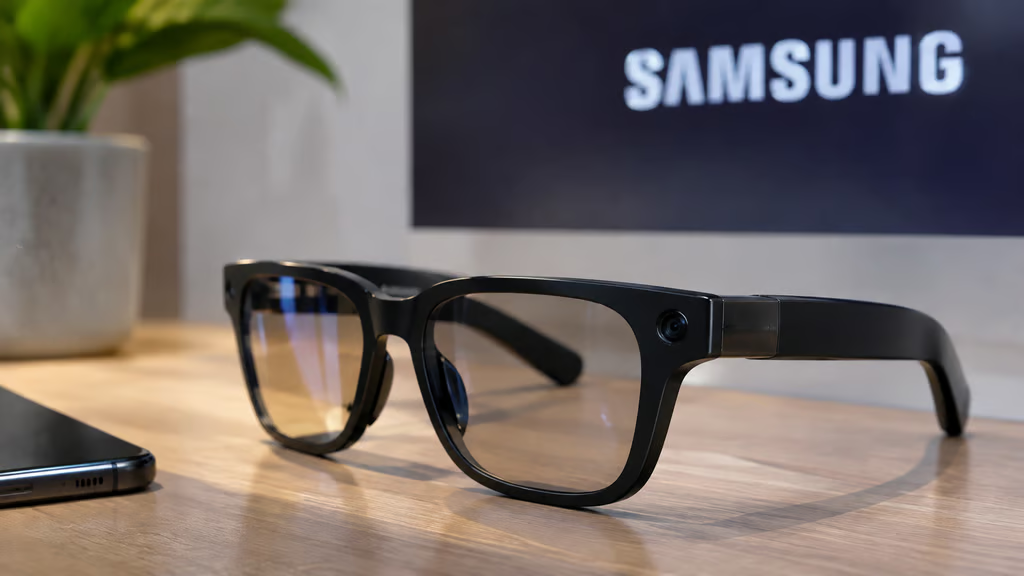
Samsung could soon challenge Meta in the AI smart glasses market, with reports suggesting its Gemini-powered eyewear may launch before Christmas.
According to South Korean publication Chosun Biz, Samsung is reportedly targeting a December release for its Samsung Intelligent Eyewear, an Android XR glasses. Rather than require users to reach for their phones when they need AI assistance, the device, which is positioned as an extension of users’ phones, could interact with Gemini via voice commands, while using its built-in camera to provide visual information.
The company has not officially confirmed the release date or pricing. However, the reported launch would give consumers another option in the growing AI eyewear market as technology companies explore ways to bring AI assistance beyond traditional screens.
A new launch window for expectant users
Samsung’s first Intelligent Eyewear has had a moving release window, with earlier reports pointing to a November debut. Now that we’re in November, new information has pushed its arrival forward by a month.
The latest timeline comes from South Korean publication Chosun Biz, which reported that Samsung had settled for a mid-December launch, just before Christmas. Per 9to5Google’s report, Samsung has yet to announce the launch date officially, so the December timeline remains subject to change.
The reported mid-December launch will initially cover the US and South Korea — Samsung’s home country. That leaves other major markets such as China, Japan, and Europe out of the first release. According to Chosun Biz, Samsung plans to assess initial demand and consumer reactions in the two markets before expanding access more widely in 2027.
The company’s pricing has also remained unsettled, with everyone currently relying on Samsung’s earlier position that the premium device will be reasonably priced. Both 9to5Google and Android Central estimated that the price would most likely exceed $300, which is the starting price for Meta’s Ray-Ban.
Capabilities of the Samsung Intelligent Eyewear
The eyewear is expected to feature Qualcomm’s Snapdragon AR1 Gen 1 processor, built-in speakers, and microphones. The device will run Google’s Android XR platform, with Gemini as the integrated AI assistant.
The camera will let users capture images and provide Gemini with visual data, while the microphone lets users send commands and the speakers deliver results. Other expected capabilities include AI-assisted translation, navigation, object recognition, and hands-free interaction with Google services.
Samsung also noted, via an earlier 9to5Google report, that the camera, like Meta’s, would include a privacy light, and the hardware can detect if the light is blocked. The company claims the device can last up to nine hours, and the case can supply an extra seven more full charges.
The device is being developed with Gentle Monster and Warby Parker, suggesting Samsung is emphasizing conventional eyewear styling alongside its technological features, even as the company once touted the device as a smartphone-specialist product.
What Samsung’s AI glasses could mean for everyday users
For consumers, Samsung’s entry into the smart glasses market could offer another way to access AI assistance without reaching for a smartphone, particularly for those using any Samsung Galaxy device.
Features such as voice-controlled Gemini, visual recognition, translation, and navigation could make everyday tasks more convenient for users who want hands-free access to information while moving around. Businesses could also use the technology in areas such as field operations, customer support, logistics, and workplace communication.
Employees could potentially use voice commands to retrieve information, translate conversations, or access visual assistance while performing tasks that would otherwise require them to consult a phone or computer. However, organizations need to consider the addition of compatible devices, since the glasses are positioned as an extension of a phone, not a complete replacement.
Organizations planning to use them would also need to consider how they will affect both employee privacy and organizational privacy, particularly given how real-time information is processed. Businesses would need clear policies governing recording, data access, and appropriate use before deploying AI-enabled eyewear.
With pricing, availability, and enterprise support still unconfirmed, Samsung’s reported December launch is best viewed as an opportunity to evaluate a new product category rather than an immediate purchasing decision.
In other smartphone news, OnePlus has launched the Ace 7 and Ace 7 Pro in China, featuring massive 9,000mAh batteries, built-in cooling fans, 185Hz gaming displays, and 100W fast charging, although international availability remains unconfirmed.