


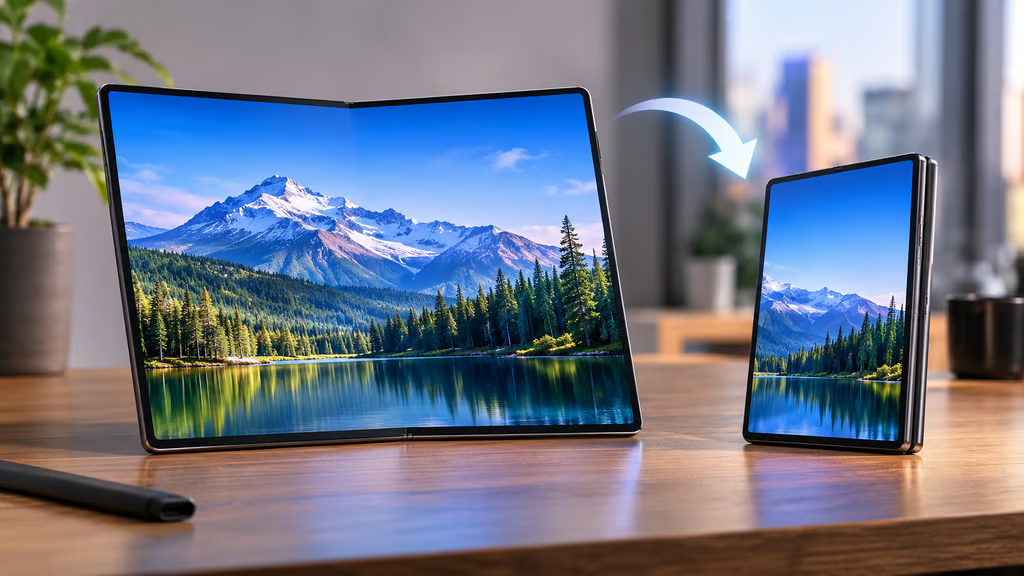
Samsung may be developing a 17-inch foldable tablet that could offer a desktop-sized display in a much smaller portable device.
According to tipster @kro_roe on X, the South Korean electronics manufacturer has begun developing a 17-inch tablet that can collapse into an 8-inch footprint. The leaker previously teased that a 17-inch folding tablet was undergoing internal testing across multiple prototypes, later updating followers that “Samsung has already started” on the hardware.
Samsung has not confirmed the project or disclosed specifications, pricing, or a release timeline. While some observers speculate that a commercial version could arrive in 2027 or later, there is no indication that the device will reach consumers.
How Samsung’s 17-inch foldable tablet could work
Turning a 17-inch panel down to an 8-inch tablet would require Samsung to address several engineering challenges, particularly hinge design, screen durability, and overall device thickness.
The first approach mirrors the Galaxy Z Fold series, using a large internal folding panel with a dedicated 8-inch external cover screen. This configuration protects the main screen from debris and impact, but adding an extra display layer substantially inflates production costs.
Another possibility is an outward-folding display that remains visible when the device is closed. Such a design could eliminate the need for a separate cover screen but leave more of the flexible panel exposed to scratches and other damage.
Neither configuration has been confirmed, and Samsung could ultimately pursue a different design if the project advances beyond internal development.
Beyond phone boundaries
Samsung has repeatedly demonstrated large bendable OLED concepts at global trade expos, including a 17-inch Galaxy Book prototype and crease-reducing panels shown off at CES 2026. Yet commercializing them has remained elusive; an earlier rumored tablet dubbed the Galaxy Z Tab vanished after initial reports in 2023.
The broader competitive backdrop may explain renewed momentum. Foldable notebooks such as Lenovo’s ThinkPad X1 Fold and Huawei’s $3,300 MateBook Fold have already explored large flexible screens. Meanwhile, Apple’s entry into the space with the iPhone Duo has altered sector dynamics, even as reports indicate Apple paused its own 20-inch foldable iPad Ultra over market conditions.
The desktop-tablet hybrid divide
This rumored tablet represents a fundamental pivot from “phone that gets bigger” to “workstation that packs small.” If Samsung packages this hardware with Android instead of a desktop operating system, it risks creating an expensive identity crisis.
However, the hardware would be only part of the equation. A display this large would need effective multitasking, flexible window management, and strong support for productivity applications to deliver meaningful advantages over existing tablets.
Samsung already offers desktop-style functionality through its DeX interface, but it remains unclear whether a potential 17-inch foldable would use Android, another operating system, or a different software configuration.
If Samsung brings the device to market, its ability to support professional workflows could prove just as important as the folding display itself.
What it means for buyers
For mobile professionals, a 17-inch folding tablet could finally solve the perennial dilemma of choosing between a heavy external travel monitor and a lightweight tablet. Creative workers and frequent flyers would gain an expansive digital drafting table or portable dual-page spread that easily slips into a commuter bag.
However, consumers should prepare for sticker shock. Large-panel foldables historically launch with pricing well past $2,500, and replacement costs for complex folding displays remain steep. Buyers also face significant durability questions, particularly if long-term usage involves continuous daily unfolding across a surface area this large.
Pricing could also be a significant obstacle. Large foldable devices have historically occupied the premium end of the market, and Samsung has not indicated how much its rumored tablet might cost.
For now, the project remains an unconfirmed development rather than an upcoming product. If Samsung moves forward, the biggest test will be whether the larger folding display offers enough practical benefits to justify the potential compromises in portability, durability, and price.
In other Samsung news, the company has begun rolling out One UI 9 to the Galaxy Tab S11 and S11 Ultra, starting in South Korea, with the Android 17 update bringing improvements to Samsung DeX, multitasking, privacy controls, and interface customization ahead of a wider international release.