Discussion Locked
Chris Mosby at myITforum.com
0 helpful
576 replies
Closed to new repliesThis discussion is closed. It stays readable, but it takes no new replies.
This is page 4 of the discussion. Read the opening post

After Hours
This is page 4 of the discussion. Read the opening post
by mozbe
Looks like we are in for some fun next year...
iDefense Exposes Sober Worm Variant Timed with Nazi Party’s 87th Anniversary
Widespread Worm is Scheduled to Launch Jan. 5, 2006
December 7, 2005
Reston, VA. - Dec. 7, 2005 - iDefense, cyber security intelligence provider and VeriSign company (Nasdaq: VRSN), reports that the next planned attack of 2005's most prolific e-mail worm family, Sober, is scheduled to start on Jan. 5, 2006 based on commands hard-coded within the worm. The attack date coincides with the 87th anniversary of the founding of the Nazi party. Additionally, the attack could have a significantly detrimental effect on Internet traffic, as e-mail servers are flooded with politically motivated spam e-mails from potentially tens of millions of e-mail addresses.
In addition to the Nazi party anniversary, the Jan. 5 trigger on the Sober variant appears to also be timed to coincide with a major German political convention meeting the next day, Jan. 6. In the past, VeriSign iDefense Security Intelligence Services has seen mass distribution of propaganda timed with political events to increase the worm's notoriety, and help to further circulate it.
"This discovery emphasizes the ever-present and often underestimated threat of 'hacktivism' - combining malicious code with political causes," said Joe Payne, Vice President, VeriSign iDefense Security Intelligence Services. "Exposing this latest variant required technical and geopolitical analysis that connected the dots to give enterprises and home users plenty of time to shore up their defenses."
The Sober family appears to be authored by a German speaker or group of German speakers, and is composed of nearly 30 variants dating to October 2003. Infected e-mails propagate as attachments with a social engineering component, enticing readers to open malicious files with messages using information on current events. Sober is also a bilingual worm, sending German-language messages to German e-mail addresses, and English-language messages to other addresses.
Read the rest of the article here: iDefense : About iDefense : News Center : Recent Releases.
by mozbe
Looks like we are in for some fun next year...
iDefense Exposes Sober Worm Variant Timed with Nazi Party’s 87th Anniversary
Widespread Worm is Scheduled to Launch Jan. 5, 2006
December 7, 2005
Reston, VA. - Dec. 7, 2005 - iDefense, cyber security intelligence provider and VeriSign company (Nasdaq: VRSN), reports that the next planned attack of 2005's most prolific e-mail worm family, Sober, is scheduled to start on Jan. 5, 2006 based on commands hard-coded within the worm. The attack date coincides with the 87th anniversary of the founding of the Nazi party. Additionally, the attack could have a significantly detrimental effect on Internet traffic, as e-mail servers are flooded with politically motivated spam e-mails from potentially tens of millions of e-mail addresses.
In addition to the Nazi party anniversary, the Jan. 5 trigger on the Sober variant appears to also be timed to coincide with a major German political convention meeting the next day, Jan. 6. In the past, VeriSign iDefense Security Intelligence Services has seen mass distribution of propaganda timed with political events to increase the worm's notoriety, and help to further circulate it.
"This discovery emphasizes the ever-present and often underestimated threat of 'hacktivism' - combining malicious code with political causes," said Joe Payne, Vice President, VeriSign iDefense Security Intelligence Services. "Exposing this latest variant required technical and geopolitical analysis that connected the dots to give enterprises and home users plenty of time to shore up their defenses."
The Sober family appears to be authored by a German speaker or group of German speakers, and is composed of nearly 30 variants dating to October 2003. Infected e-mails propagate as attachments with a social engineering component, enticing readers to open malicious files with messages using information on current events. Sober is also a bilingual worm, sending German-language messages to German e-mail addresses, and English-language messages to other addresses.
Read the rest of the article here: iDefense : About iDefense : News Center : Recent Releases.
by mozbe
Looks like we are in for some fun next year...
iDefense Exposes Sober Worm Variant Timed with Nazi Party’s 87th Anniversary
Widespread Worm is Scheduled to Launch Jan. 5, 2006
December 7, 2005
Reston, VA. - Dec. 7, 2005 - iDefense, cyber security intelligence provider and VeriSign company (Nasdaq: VRSN), reports that the next planned attack of 2005's most prolific e-mail worm family, Sober, is scheduled to start on Jan. 5, 2006 based on commands hard-coded within the worm. The attack date coincides with the 87th anniversary of the founding of the Nazi party. Additionally, the attack could have a significantly detrimental effect on Internet traffic, as e-mail servers are flooded with politically motivated spam e-mails from potentially tens of millions of e-mail addresses.
In addition to the Nazi party anniversary, the Jan. 5 trigger on the Sober variant appears to also be timed to coincide with a major German political convention meeting the next day, Jan. 6. In the past, VeriSign iDefense Security Intelligence Services has seen mass distribution of propaganda timed with political events to increase the worm's notoriety, and help to further circulate it.
"This discovery emphasizes the ever-present and often underestimated threat of 'hacktivism' - combining malicious code with political causes," said Joe Payne, Vice President, VeriSign iDefense Security Intelligence Services. "Exposing this latest variant required technical and geopolitical analysis that connected the dots to give enterprises and home users plenty of time to shore up their defenses."
The Sober family appears to be authored by a German speaker or group of German speakers, and is composed of nearly 30 variants dating to October 2003. Infected e-mails propagate as attachments with a social engineering component, enticing readers to open malicious files with messages using information on current events. Sober is also a bilingual worm, sending German-language messages to German e-mail addresses, and English-language messages to other addresses.
Read the rest of the article here: iDefense : About iDefense : News Center : Recent Releases.
by mozbe
Here is a good write up on this months patches on the ISC
SANS - Internet Storm Center - Cooperative Cyber Threat Monitor And Alert System.
Handler's Diary December 13th 2005
Microsoft December Patches (NEW)
Published: 2005-12-13,
Last Updated: 2005-12-13 20:05:29 UTC by Johannes Ullrich (Version: 5(click to highlight changes))
Greetings all,
It is Microsoft Patch Tuesday. Without any further ado.....Here are the Microsoft Security Bulletins.
MS05-054: Cumulative Security Update for Internet Explorer (905915)
This appears to be the long awaited IE patch which I had hoped would have come out a couple of weeks ago (see http://www.microsoft.com/technet/security/advisory/911302.mspx ). This update addresses the following vulnerabilities:
File Download Dialog Box Manipulation Vulnerability - CAN-2005-2829
HTTPS Proxy Vulnerability - CAN-2005-2830
COM Object Instantiation Memory Corruption Vulnerability - CAN-2005-2831
Mismatched Document Object Model Objects Memory Corruption Vulnerability - CAN-2005-1790
As this update addresses a number of problems, which do aggregate to a critical severity in all operating systems earlier then Windows 2003, the ISC is recommending that you patch this as soon as possible.
As we have been going through the documentation on this bulletin, we note that one there is a kill bit set for the First4Internet XCP uninstallation ActiveX control. For those that do not remember, First4Internet is the maker of the "Sony rootkit" related to digitial rights management. In the aftermath of this issue hitting the mainstream, an uninstaller was created using ActiveX controls which also had security vulnerabilities.
MS05-055: Vulnerability in Windows Kernel Could Allow Elevation of Privilege. (908523)
A vulnerability in the Asynchronous Procedure Call queue allows local users to escalate their privileges. A regular user (who has to be logged in first) could use this vulnerability to gain Administrator privileges.
Microsoft rates this vulnerability as "Important" as there is no direct remote vector to exploit this issue. However, coupled with an Internet Explorer vulnerability or similar issues, this could be used to gain Administrator privileges even if a user runs Internet Explorer as a less privileged user.
Note that remote exploit may be possible if user credentials are known.
MS05-011 Bulletin Update involving SMB
Microsoft update this bulletin to make technical staff aware of KB896427. It would appear that in some cases after patching with MS05-011, you would not be able to view the contents of subfolders on a network share in Windows XP. This is not necessarily a security issue, but may be critical for your organization.
MS05-050: Bulletin Update involving DirectX
Microsoft also updated this bulletin to advise of a revised version of this security update for Windows 2000 SP4, Windows XP SP1 and Windows 2003. Also, this may not be a super critical issue in general, but you should be aware of this release.
KB905648: Update for Outlook 2003 Junk Email Filter
As usual, Microsoft updated their Junk Email Filter for Outlook 2003 for December.
Malicious Software Removal Tool
Microsoft updated their Malicious Software Removal Tool again this month to include variants of IRCBot, Ryknos, and F4IRootkit. For more information on this, take a look at the malware sofware removal tool website.
by mozbe
Looks like we are in for some fun next year...
iDefense Exposes Sober Worm Variant Timed with Nazi Party’s 87th Anniversary
Widespread Worm is Scheduled to Launch Jan. 5, 2006
December 7, 2005
Reston, VA. - Dec. 7, 2005 - iDefense, cyber security intelligence provider and VeriSign company (Nasdaq: VRSN), reports that the next planned attack of 2005's most prolific e-mail worm family, Sober, is scheduled to start on Jan. 5, 2006 based on commands hard-coded within the worm. The attack date coincides with the 87th anniversary of the founding of the Nazi party. Additionally, the attack could have a significantly detrimental effect on Internet traffic, as e-mail servers are flooded with politically motivated spam e-mails from potentially tens of millions of e-mail addresses.
In addition to the Nazi party anniversary, the Jan. 5 trigger on the Sober variant appears to also be timed to coincide with a major German political convention meeting the next day, Jan. 6. In the past, VeriSign iDefense Security Intelligence Services has seen mass distribution of propaganda timed with political events to increase the worm's notoriety, and help to further circulate it.
"This discovery emphasizes the ever-present and often underestimated threat of 'hacktivism' - combining malicious code with political causes," said Joe Payne, Vice President, VeriSign iDefense Security Intelligence Services. "Exposing this latest variant required technical and geopolitical analysis that connected the dots to give enterprises and home users plenty of time to shore up their defenses."
The Sober family appears to be authored by a German speaker or group of German speakers, and is composed of nearly 30 variants dating to October 2003. Infected e-mails propagate as attachments with a social engineering component, enticing readers to open malicious files with messages using information on current events. Sober is also a bilingual worm, sending German-language messages to German e-mail addresses, and English-language messages to other addresses.
Read the rest of the article here: iDefense : About iDefense : News Center : Recent Releases.
by mozbe
Looks like we are in for some fun next year...
iDefense Exposes Sober Worm Variant Timed with Nazi Party’s 87th Anniversary
Widespread Worm is Scheduled to Launch Jan. 5, 2006
December 7, 2005
Reston, VA. - Dec. 7, 2005 - iDefense, cyber security intelligence provider and VeriSign company (Nasdaq: VRSN), reports that the next planned attack of 2005's most prolific e-mail worm family, Sober, is scheduled to start on Jan. 5, 2006 based on commands hard-coded within the worm. The attack date coincides with the 87th anniversary of the founding of the Nazi party. Additionally, the attack could have a significantly detrimental effect on Internet traffic, as e-mail servers are flooded with politically motivated spam e-mails from potentially tens of millions of e-mail addresses.
In addition to the Nazi party anniversary, the Jan. 5 trigger on the Sober variant appears to also be timed to coincide with a major German political convention meeting the next day, Jan. 6. In the past, VeriSign iDefense Security Intelligence Services has seen mass distribution of propaganda timed with political events to increase the worm's notoriety, and help to further circulate it.
"This discovery emphasizes the ever-present and often underestimated threat of 'hacktivism' - combining malicious code with political causes," said Joe Payne, Vice President, VeriSign iDefense Security Intelligence Services. "Exposing this latest variant required technical and geopolitical analysis that connected the dots to give enterprises and home users plenty of time to shore up their defenses."
The Sober family appears to be authored by a German speaker or group of German speakers, and is composed of nearly 30 variants dating to October 2003. Infected e-mails propagate as attachments with a social engineering component, enticing readers to open malicious files with messages using information on current events. Sober is also a bilingual worm, sending German-language messages to German e-mail addresses, and English-language messages to other addresses.
Read the rest of the article here: iDefense : About iDefense : News Center : Recent Releases.
by mozbe
Looks like we are in for some fun next year...
iDefense Exposes Sober Worm Variant Timed with Nazi Party’s 87th Anniversary
Widespread Worm is Scheduled to Launch Jan. 5, 2006
December 7, 2005
Reston, VA. - Dec. 7, 2005 - iDefense, cyber security intelligence provider and VeriSign company (Nasdaq: VRSN), reports that the next planned attack of 2005's most prolific e-mail worm family, Sober, is scheduled to start on Jan. 5, 2006 based on commands hard-coded within the worm. The attack date coincides with the 87th anniversary of the founding of the Nazi party. Additionally, the attack could have a significantly detrimental effect on Internet traffic, as e-mail servers are flooded with politically motivated spam e-mails from potentially tens of millions of e-mail addresses.
In addition to the Nazi party anniversary, the Jan. 5 trigger on the Sober variant appears to also be timed to coincide with a major German political convention meeting the next day, Jan. 6. In the past, VeriSign iDefense Security Intelligence Services has seen mass distribution of propaganda timed with political events to increase the worm's notoriety, and help to further circulate it.
"This discovery emphasizes the ever-present and often underestimated threat of 'hacktivism' - combining malicious code with political causes," said Joe Payne, Vice President, VeriSign iDefense Security Intelligence Services. "Exposing this latest variant required technical and geopolitical analysis that connected the dots to give enterprises and home users plenty of time to shore up their defenses."
The Sober family appears to be authored by a German speaker or group of German speakers, and is composed of nearly 30 variants dating to October 2003. Infected e-mails propagate as attachments with a social engineering component, enticing readers to open malicious files with messages using information on current events. Sober is also a bilingual worm, sending German-language messages to German e-mail addresses, and English-language messages to other addresses.
Read the rest of the article here: iDefense : About iDefense : News Center : Recent Releases.
by mozbe
Looks like we are in for some fun next year...
iDefense Exposes Sober Worm Variant Timed with Nazi Party’s 87th Anniversary
Widespread Worm is Scheduled to Launch Jan. 5, 2006
December 7, 2005
Reston, VA. - Dec. 7, 2005 - iDefense, cyber security intelligence provider and VeriSign company (Nasdaq: VRSN), reports that the next planned attack of 2005's most prolific e-mail worm family, Sober, is scheduled to start on Jan. 5, 2006 based on commands hard-coded within the worm. The attack date coincides with the 87th anniversary of the founding of the Nazi party. Additionally, the attack could have a significantly detrimental effect on Internet traffic, as e-mail servers are flooded with politically motivated spam e-mails from potentially tens of millions of e-mail addresses.
In addition to the Nazi party anniversary, the Jan. 5 trigger on the Sober variant appears to also be timed to coincide with a major German political convention meeting the next day, Jan. 6. In the past, VeriSign iDefense Security Intelligence Services has seen mass distribution of propaganda timed with political events to increase the worm's notoriety, and help to further circulate it.
"This discovery emphasizes the ever-present and often underestimated threat of 'hacktivism' - combining malicious code with political causes," said Joe Payne, Vice President, VeriSign iDefense Security Intelligence Services. "Exposing this latest variant required technical and geopolitical analysis that connected the dots to give enterprises and home users plenty of time to shore up their defenses."
The Sober family appears to be authored by a German speaker or group of German speakers, and is composed of nearly 30 variants dating to October 2003. Infected e-mails propagate as attachments with a social engineering component, enticing readers to open malicious files with messages using information on current events. Sober is also a bilingual worm, sending German-language messages to German e-mail addresses, and English-language messages to other addresses.
Read the rest of the article here: iDefense : About iDefense : News Center : Recent Releases.
by mozbe
Looks like we are in for some fun next year...
iDefense Exposes Sober Worm Variant Timed with Nazi Party’s 87th Anniversary
Widespread Worm is Scheduled to Launch Jan. 5, 2006
December 7, 2005
Reston, VA. - Dec. 7, 2005 - iDefense, cyber security intelligence provider and VeriSign company (Nasdaq: VRSN), reports that the next planned attack of 2005's most prolific e-mail worm family, Sober, is scheduled to start on Jan. 5, 2006 based on commands hard-coded within the worm. The attack date coincides with the 87th anniversary of the founding of the Nazi party. Additionally, the attack could have a significantly detrimental effect on Internet traffic, as e-mail servers are flooded with politically motivated spam e-mails from potentially tens of millions of e-mail addresses.
In addition to the Nazi party anniversary, the Jan. 5 trigger on the Sober variant appears to also be timed to coincide with a major German political convention meeting the next day, Jan. 6. In the past, VeriSign iDefense Security Intelligence Services has seen mass distribution of propaganda timed with political events to increase the worm's notoriety, and help to further circulate it.
"This discovery emphasizes the ever-present and often underestimated threat of 'hacktivism' - combining malicious code with political causes," said Joe Payne, Vice President, VeriSign iDefense Security Intelligence Services. "Exposing this latest variant required technical and geopolitical analysis that connected the dots to give enterprises and home users plenty of time to shore up their defenses."
The Sober family appears to be authored by a German speaker or group of German speakers, and is composed of nearly 30 variants dating to October 2003. Infected e-mails propagate as attachments with a social engineering component, enticing readers to open malicious files with messages using information on current events. Sober is also a bilingual worm, sending German-language messages to German e-mail addresses, and English-language messages to other addresses.
Read the rest of the article here: iDefense : About iDefense : News Center : Recent Releases.
by mozbe
Looks like we are in for some fun next year...
iDefense Exposes Sober Worm Variant Timed with Nazi Party’s 87th Anniversary
Widespread Worm is Scheduled to Launch Jan. 5, 2006
December 7, 2005
Reston, VA. - Dec. 7, 2005 - iDefense, cyber security intelligence provider and VeriSign company (Nasdaq: VRSN), reports that the next planned attack of 2005's most prolific e-mail worm family, Sober, is scheduled to start on Jan. 5, 2006 based on commands hard-coded within the worm. The attack date coincides with the 87th anniversary of the founding of the Nazi party. Additionally, the attack could have a significantly detrimental effect on Internet traffic, as e-mail servers are flooded with politically motivated spam e-mails from potentially tens of millions of e-mail addresses.
In addition to the Nazi party anniversary, the Jan. 5 trigger on the Sober variant appears to also be timed to coincide with a major German political convention meeting the next day, Jan. 6. In the past, VeriSign iDefense Security Intelligence Services has seen mass distribution of propaganda timed with political events to increase the worm's notoriety, and help to further circulate it.
"This discovery emphasizes the ever-present and often underestimated threat of 'hacktivism' - combining malicious code with political causes," said Joe Payne, Vice President, VeriSign iDefense Security Intelligence Services. "Exposing this latest variant required technical and geopolitical analysis that connected the dots to give enterprises and home users plenty of time to shore up their defenses."
The Sober family appears to be authored by a German speaker or group of German speakers, and is composed of nearly 30 variants dating to October 2003. Infected e-mails propagate as attachments with a social engineering component, enticing readers to open malicious files with messages using information on current events. Sober is also a bilingual worm, sending German-language messages to German e-mail addresses, and English-language messages to other addresses.
Read the rest of the article here: iDefense : About iDefense : News Center : Recent Releases.
by mozbe
Looks like we are in for some fun next year...
iDefense Exposes Sober Worm Variant Timed with Nazi Party’s 87th Anniversary
Widespread Worm is Scheduled to Launch Jan. 5, 2006
December 7, 2005
Reston, VA. - Dec. 7, 2005 - iDefense, cyber security intelligence provider and VeriSign company (Nasdaq: VRSN), reports that the next planned attack of 2005's most prolific e-mail worm family, Sober, is scheduled to start on Jan. 5, 2006 based on commands hard-coded within the worm. The attack date coincides with the 87th anniversary of the founding of the Nazi party. Additionally, the attack could have a significantly detrimental effect on Internet traffic, as e-mail servers are flooded with politically motivated spam e-mails from potentially tens of millions of e-mail addresses.
In addition to the Nazi party anniversary, the Jan. 5 trigger on the Sober variant appears to also be timed to coincide with a major German political convention meeting the next day, Jan. 6. In the past, VeriSign iDefense Security Intelligence Services has seen mass distribution of propaganda timed with political events to increase the worm's notoriety, and help to further circulate it.
"This discovery emphasizes the ever-present and often underestimated threat of 'hacktivism' - combining malicious code with political causes," said Joe Payne, Vice President, VeriSign iDefense Security Intelligence Services. "Exposing this latest variant required technical and geopolitical analysis that connected the dots to give enterprises and home users plenty of time to shore up their defenses."
The Sober family appears to be authored by a German speaker or group of German speakers, and is composed of nearly 30 variants dating to October 2003. Infected e-mails propagate as attachments with a social engineering component, enticing readers to open malicious files with messages using information on current events. Sober is also a bilingual worm, sending German-language messages to German e-mail addresses, and English-language messages to other addresses.
Read the rest of the article here: iDefense : About iDefense : News Center : Recent Releases.
by mozbe
Looks like we are in for some fun next year...
iDefense Exposes Sober Worm Variant Timed with Nazi Party’s 87th Anniversary
Widespread Worm is Scheduled to Launch Jan. 5, 2006
December 7, 2005
Reston, VA. - Dec. 7, 2005 - iDefense, cyber security intelligence provider and VeriSign company (Nasdaq: VRSN), reports that the next planned attack of 2005's most prolific e-mail worm family, Sober, is scheduled to start on Jan. 5, 2006 based on commands hard-coded within the worm. The attack date coincides with the 87th anniversary of the founding of the Nazi party. Additionally, the attack could have a significantly detrimental effect on Internet traffic, as e-mail servers are flooded with politically motivated spam e-mails from potentially tens of millions of e-mail addresses.
In addition to the Nazi party anniversary, the Jan. 5 trigger on the Sober variant appears to also be timed to coincide with a major German political convention meeting the next day, Jan. 6. In the past, VeriSign iDefense Security Intelligence Services has seen mass distribution of propaganda timed with political events to increase the worm's notoriety, and help to further circulate it.
"This discovery emphasizes the ever-present and often underestimated threat of 'hacktivism' - combining malicious code with political causes," said Joe Payne, Vice President, VeriSign iDefense Security Intelligence Services. "Exposing this latest variant required technical and geopolitical analysis that connected the dots to give enterprises and home users plenty of time to shore up their defenses."
The Sober family appears to be authored by a German speaker or group of German speakers, and is composed of nearly 30 variants dating to October 2003. Infected e-mails propagate as attachments with a social engineering component, enticing readers to open malicious files with messages using information on current events. Sober is also a bilingual worm, sending German-language messages to German e-mail addresses, and English-language messages to other addresses.
Read the rest of the article here: iDefense : About iDefense : News Center : Recent Releases.
by mozbe
Looks like we are in for some fun next year...
iDefense Exposes Sober Worm Variant Timed with Nazi Party’s 87th Anniversary
Widespread Worm is Scheduled to Launch Jan. 5, 2006
December 7, 2005
Reston, VA. - Dec. 7, 2005 - iDefense, cyber security intelligence provider and VeriSign company (Nasdaq: VRSN), reports that the next planned attack of 2005's most prolific e-mail worm family, Sober, is scheduled to start on Jan. 5, 2006 based on commands hard-coded within the worm. The attack date coincides with the 87th anniversary of the founding of the Nazi party. Additionally, the attack could have a significantly detrimental effect on Internet traffic, as e-mail servers are flooded with politically motivated spam e-mails from potentially tens of millions of e-mail addresses.
In addition to the Nazi party anniversary, the Jan. 5 trigger on the Sober variant appears to also be timed to coincide with a major German political convention meeting the next day, Jan. 6. In the past, VeriSign iDefense Security Intelligence Services has seen mass distribution of propaganda timed with political events to increase the worm's notoriety, and help to further circulate it.
"This discovery emphasizes the ever-present and often underestimated threat of 'hacktivism' - combining malicious code with political causes," said Joe Payne, Vice President, VeriSign iDefense Security Intelligence Services. "Exposing this latest variant required technical and geopolitical analysis that connected the dots to give enterprises and home users plenty of time to shore up their defenses."
The Sober family appears to be authored by a German speaker or group of German speakers, and is composed of nearly 30 variants dating to October 2003. Infected e-mails propagate as attachments with a social engineering component, enticing readers to open malicious files with messages using information on current events. Sober is also a bilingual worm, sending German-language messages to German e-mail addresses, and English-language messages to other addresses.
Read the rest of the article here: iDefense : About iDefense : News Center : Recent Releases.
by mozbe
Looks like we are in for some fun next year...
iDefense Exposes Sober Worm Variant Timed with Nazi Party’s 87th Anniversary
Widespread Worm is Scheduled to Launch Jan. 5, 2006
December 7, 2005
Reston, VA. - Dec. 7, 2005 - iDefense, cyber security intelligence provider and VeriSign company (Nasdaq: VRSN), reports that the next planned attack of 2005's most prolific e-mail worm family, Sober, is scheduled to start on Jan. 5, 2006 based on commands hard-coded within the worm. The attack date coincides with the 87th anniversary of the founding of the Nazi party. Additionally, the attack could have a significantly detrimental effect on Internet traffic, as e-mail servers are flooded with politically motivated spam e-mails from potentially tens of millions of e-mail addresses.
In addition to the Nazi party anniversary, the Jan. 5 trigger on the Sober variant appears to also be timed to coincide with a major German political convention meeting the next day, Jan. 6. In the past, VeriSign iDefense Security Intelligence Services has seen mass distribution of propaganda timed with political events to increase the worm's notoriety, and help to further circulate it.
"This discovery emphasizes the ever-present and often underestimated threat of 'hacktivism' - combining malicious code with political causes," said Joe Payne, Vice President, VeriSign iDefense Security Intelligence Services. "Exposing this latest variant required technical and geopolitical analysis that connected the dots to give enterprises and home users plenty of time to shore up their defenses."
The Sober family appears to be authored by a German speaker or group of German speakers, and is composed of nearly 30 variants dating to October 2003. Infected e-mails propagate as attachments with a social engineering component, enticing readers to open malicious files with messages using information on current events. Sober is also a bilingual worm, sending German-language messages to German e-mail addresses, and English-language messages to other addresses.
Read the rest of the article here: iDefense : About iDefense : News Center : Recent Releases.
by mozbe
Looks like we are in for some fun next year...
iDefense Exposes Sober Worm Variant Timed with Nazi Party’s 87th Anniversary
Widespread Worm is Scheduled to Launch Jan. 5, 2006
December 7, 2005
Reston, VA. - Dec. 7, 2005 - iDefense, cyber security intelligence provider and VeriSign company (Nasdaq: VRSN), reports that the next planned attack of 2005's most prolific e-mail worm family, Sober, is scheduled to start on Jan. 5, 2006 based on commands hard-coded within the worm. The attack date coincides with the 87th anniversary of the founding of the Nazi party. Additionally, the attack could have a significantly detrimental effect on Internet traffic, as e-mail servers are flooded with politically motivated spam e-mails from potentially tens of millions of e-mail addresses.
In addition to the Nazi party anniversary, the Jan. 5 trigger on the Sober variant appears to also be timed to coincide with a major German political convention meeting the next day, Jan. 6. In the past, VeriSign iDefense Security Intelligence Services has seen mass distribution of propaganda timed with political events to increase the worm's notoriety, and help to further circulate it.
"This discovery emphasizes the ever-present and often underestimated threat of 'hacktivism' - combining malicious code with political causes," said Joe Payne, Vice President, VeriSign iDefense Security Intelligence Services. "Exposing this latest variant required technical and geopolitical analysis that connected the dots to give enterprises and home users plenty of time to shore up their defenses."
The Sober family appears to be authored by a German speaker or group of German speakers, and is composed of nearly 30 variants dating to October 2003. Infected e-mails propagate as attachments with a social engineering component, enticing readers to open malicious files with messages using information on current events. Sober is also a bilingual worm, sending German-language messages to German e-mail addresses, and English-language messages to other addresses.
Read the rest of the article here: iDefense : About iDefense : News Center : Recent Releases.
by mozbe
Looks like we are in for some fun next year...
iDefense Exposes Sober Worm Variant Timed with Nazi Party’s 87th Anniversary
Widespread Worm is Scheduled to Launch Jan. 5, 2006
December 7, 2005
Reston, VA. - Dec. 7, 2005 - iDefense, cyber security intelligence provider and VeriSign company (Nasdaq: VRSN), reports that the next planned attack of 2005's most prolific e-mail worm family, Sober, is scheduled to start on Jan. 5, 2006 based on commands hard-coded within the worm. The attack date coincides with the 87th anniversary of the founding of the Nazi party. Additionally, the attack could have a significantly detrimental effect on Internet traffic, as e-mail servers are flooded with politically motivated spam e-mails from potentially tens of millions of e-mail addresses.
In addition to the Nazi party anniversary, the Jan. 5 trigger on the Sober variant appears to also be timed to coincide with a major German political convention meeting the next day, Jan. 6. In the past, VeriSign iDefense Security Intelligence Services has seen mass distribution of propaganda timed with political events to increase the worm's notoriety, and help to further circulate it.
"This discovery emphasizes the ever-present and often underestimated threat of 'hacktivism' - combining malicious code with political causes," said Joe Payne, Vice President, VeriSign iDefense Security Intelligence Services. "Exposing this latest variant required technical and geopolitical analysis that connected the dots to give enterprises and home users plenty of time to shore up their defenses."
The Sober family appears to be authored by a German speaker or group of German speakers, and is composed of nearly 30 variants dating to October 2003. Infected e-mails propagate as attachments with a social engineering component, enticing readers to open malicious files with messages using information on current events. Sober is also a bilingual worm, sending German-language messages to German e-mail addresses, and English-language messages to other addresses.
Read the rest of the article here: iDefense : About iDefense : News Center : Recent Releases.
by mozbe
Looks like we are in for some fun next year...
iDefense Exposes Sober Worm Variant Timed with Nazi Party’s 87th Anniversary
Widespread Worm is Scheduled to Launch Jan. 5, 2006
December 7, 2005
Reston, VA. - Dec. 7, 2005 - iDefense, cyber security intelligence provider and VeriSign company (Nasdaq: VRSN), reports that the next planned attack of 2005's most prolific e-mail worm family, Sober, is scheduled to start on Jan. 5, 2006 based on commands hard-coded within the worm. The attack date coincides with the 87th anniversary of the founding of the Nazi party. Additionally, the attack could have a significantly detrimental effect on Internet traffic, as e-mail servers are flooded with politically motivated spam e-mails from potentially tens of millions of e-mail addresses.
In addition to the Nazi party anniversary, the Jan. 5 trigger on the Sober variant appears to also be timed to coincide with a major German political convention meeting the next day, Jan. 6. In the past, VeriSign iDefense Security Intelligence Services has seen mass distribution of propaganda timed with political events to increase the worm's notoriety, and help to further circulate it.
"This discovery emphasizes the ever-present and often underestimated threat of 'hacktivism' - combining malicious code with political causes," said Joe Payne, Vice President, VeriSign iDefense Security Intelligence Services. "Exposing this latest variant required technical and geopolitical analysis that connected the dots to give enterprises and home users plenty of time to shore up their defenses."
The Sober family appears to be authored by a German speaker or group of German speakers, and is composed of nearly 30 variants dating to October 2003. Infected e-mails propagate as attachments with a social engineering component, enticing readers to open malicious files with messages using information on current events. Sober is also a bilingual worm, sending German-language messages to German e-mail addresses, and English-language messages to other addresses.
Read the rest of the article here: iDefense : About iDefense : News Center : Recent Releases.
by mozbe
Looks like we are in for some fun next year...
iDefense Exposes Sober Worm Variant Timed with Nazi Party’s 87th Anniversary
Widespread Worm is Scheduled to Launch Jan. 5, 2006
December 7, 2005
Reston, VA. - Dec. 7, 2005 - iDefense, cyber security intelligence provider and VeriSign company (Nasdaq: VRSN), reports that the next planned attack of 2005's most prolific e-mail worm family, Sober, is scheduled to start on Jan. 5, 2006 based on commands hard-coded within the worm. The attack date coincides with the 87th anniversary of the founding of the Nazi party. Additionally, the attack could have a significantly detrimental effect on Internet traffic, as e-mail servers are flooded with politically motivated spam e-mails from potentially tens of millions of e-mail addresses.
In addition to the Nazi party anniversary, the Jan. 5 trigger on the Sober variant appears to also be timed to coincide with a major German political convention meeting the next day, Jan. 6. In the past, VeriSign iDefense Security Intelligence Services has seen mass distribution of propaganda timed with political events to increase the worm's notoriety, and help to further circulate it.
"This discovery emphasizes the ever-present and often underestimated threat of 'hacktivism' - combining malicious code with political causes," said Joe Payne, Vice President, VeriSign iDefense Security Intelligence Services. "Exposing this latest variant required technical and geopolitical analysis that connected the dots to give enterprises and home users plenty of time to shore up their defenses."
The Sober family appears to be authored by a German speaker or group of German speakers, and is composed of nearly 30 variants dating to October 2003. Infected e-mails propagate as attachments with a social engineering component, enticing readers to open malicious files with messages using information on current events. Sober is also a bilingual worm, sending German-language messages to German e-mail addresses, and English-language messages to other addresses.
Read the rest of the article here: iDefense : About iDefense : News Center : Recent Releases.
by mozbe
Looks like we are in for some fun next year...
iDefense Exposes Sober Worm Variant Timed with Nazi Party’s 87th Anniversary
Widespread Worm is Scheduled to Launch Jan. 5, 2006
December 7, 2005
Reston, VA. - Dec. 7, 2005 - iDefense, cyber security intelligence provider and VeriSign company (Nasdaq: VRSN), reports that the next planned attack of 2005's most prolific e-mail worm family, Sober, is scheduled to start on Jan. 5, 2006 based on commands hard-coded within the worm. The attack date coincides with the 87th anniversary of the founding of the Nazi party. Additionally, the attack could have a significantly detrimental effect on Internet traffic, as e-mail servers are flooded with politically motivated spam e-mails from potentially tens of millions of e-mail addresses.
In addition to the Nazi party anniversary, the Jan. 5 trigger on the Sober variant appears to also be timed to coincide with a major German political convention meeting the next day, Jan. 6. In the past, VeriSign iDefense Security Intelligence Services has seen mass distribution of propaganda timed with political events to increase the worm's notoriety, and help to further circulate it.
"This discovery emphasizes the ever-present and often underestimated threat of 'hacktivism' - combining malicious code with political causes," said Joe Payne, Vice President, VeriSign iDefense Security Intelligence Services. "Exposing this latest variant required technical and geopolitical analysis that connected the dots to give enterprises and home users plenty of time to shore up their defenses."
The Sober family appears to be authored by a German speaker or group of German speakers, and is composed of nearly 30 variants dating to October 2003. Infected e-mails propagate as attachments with a social engineering component, enticing readers to open malicious files with messages using information on current events. Sober is also a bilingual worm, sending German-language messages to German e-mail addresses, and English-language messages to other addresses.
Read the rest of the article here: iDefense : About iDefense : News Center : Recent Releases.
by mozbe
SANS - Internet Storm Center - Cooperative Cyber Threat Monitor And Alert System.
Handler's Diary December 15th 2005
If MS05-054 doesn't apply correctly...
Published: 2005-12-15,
Last Updated: 2005-12-15 17:19:37 UTC by Daniel Wesemann (Version: 1)
Shinil Hong of SUNY Buffalo has sent us his analysis of problems encountered with the installation of MS05-054. Here's what Shinil found out: The cumulative Internet Explorer patch fails to install when ProgramFilesDir value in HKEY_LOCAL_MACHINE\Software\Microsoft\Windows\CurrentVersion registry key points to a manually changed drive letter that is different from the default %SystemDrive%\Program Files path (e.g. C:\Program Files). The U.S. distribution versions of Microsoft Windows Server 2003 and XP ship with MS Internet Explorer 6.0 installed by default in %SystemDrive%\Program Files\Internet Explorer\ directory. If the ProgramFilesDir registry value points to D:\Program Files, for example, while the actual program directory of MS Internet Explorer is C:\Program Files\Internet Explorer, the patch installer will attempt to update the empty D:\Program Files\Internet Explorer directory and fail eventually. For a solution, change the registry key back to the default while applying the update.
[Note: This problem description and resolution has not yet been verified by SANS ISC]
by mozbe
Vendor listings so far:
Symantec: Trojan.Lodear.E, W32.Beagle.CX@mm, Trojan.Lodear.F
McAfee: W32/Bagle.gen!D1511020
Trend Micro: TROJ_BAGLE.CD
Sophos: Troj/BagleDl-AN
Panda: Bagle.FU
SANS - Internet Storm Center - Cooperative Cyber Threat Monitor And Alert System.
Handler's Diary December 15th 2005
New Beagle on the war path (NEW)
Published: 2005-12-15,
Last Updated: 2005-12-15 17:42:39 UTC by Daniel Wesemann (Version: 1)
A new Beagle variant is making the rounds. It comes in an almost empty email, as a ZIP attachment containing the worm as an EXE. The attachment name, email subject and sole text content of the email all seem to be male or female surnames. Keep your eyes peeled, especially if your users are reading their mail over webmail, as it seems to take another couple of hours until the AV vendors have their patterns lined up.
by mozbe
Somehow this doesn’t surprise me, and I am glad that the truth is finally coming out.
I heard this quote in a trailer for that Clooney movie about the McCarthy era, and it rings so true now.
“We can not promote freedom abroad, if we abandon it at home.”
CNN.com - Report: Bush eased domestic spy rules after 9/11 - Dec 16, 2005.
Eavesdropping allowed without search warrants, NYT says
NEW YORK (AP) -- President Bush authorized the National Security Agency to eavesdrop on Americans and others inside the United States -- without getting search warrants -- following the Sept. 11 attacks, The New York Times reports.
The presidential order, which Bush signed in 2002, has allowed the agency to monitor the international phone calls and international e-mails of hundreds, and perhaps thousands, of people inside the United States, according to a story posted Thursday on the Times' Web site.
Before the new program began, the NSA typically limited its domestic surveillance to foreign embassies and missions and obtained court orders to do so. Under the post-Sept. 11 program, the NSA has eavesdropped, without warrants, on as many 500 people inside the United States at any given time. Overseas, 5,000 to 7,000 people suspected of terrorist ties are monitored at one time.
The Times said reporters interviewed nearly a dozen current and former administration officials about the program and granted them anonymity because of the classified nature of the program.
Government officials credited the new program with uncovering several terrorist plots, including one by Iyman Faris, an Ohio trucker who pleaded guilty in 2003 to supporting al Qaeda by planning to destroy the Brooklyn Bridge, the report said.
But some NSA officials were so concerned about the legality of the program that they refused to participate, the Times said. Questions about the legality of the program led the administration to temporarily suspend it last year and impose new restrictions.
Caroline Fredrickson, director of the Washington legislative office of the American Civil Liberties Union, said the group's initial reaction to the disclosure was "shock that the administration has gone so far in violating American civil liberties to the extent where it seems to be a violation of federal law."
Asked about the administration's contention that the eavesdropping has disrupted terrorist attacks, Fredrickson said the ACLU couldn't comment until it sees some evidence. "They've veiled these powers in secrecy so there's no way for Congress or any independent organizations to exercise any oversight."
The Bush administration had briefed congressional leaders about the program and notified the judge in charge of the Foreign Intelligence Surveillance Court, the secret Washington court that handles national security issues.
Aides to National Intelligence Director John Negroponte and West Virginia Sen. Jay Rockefeller, the top Democrat on the Senate Intelligence Committee, declined to comment Thursday night.
The Times said it delayed publication of the report for a year because the White House said it could jeopardize continuing investigations and alert would-be terrorists that they might be under scrutiny. The Times said it omitted information from the story that administration officials argued could be useful to terrorists.
by mozbe
Looks like we are in for some fun next year...
iDefense Exposes Sober Worm Variant Timed with Nazi Party’s 87th Anniversary
Widespread Worm is Scheduled to Launch Jan. 5, 2006
December 7, 2005
Reston, VA. - Dec. 7, 2005 - iDefense, cyber security intelligence provider and VeriSign company (Nasdaq: VRSN), reports that the next planned attack of 2005's most prolific e-mail worm family, Sober, is scheduled to start on Jan. 5, 2006 based on commands hard-coded within the worm. The attack date coincides with the 87th anniversary of the founding of the Nazi party. Additionally, the attack could have a significantly detrimental effect on Internet traffic, as e-mail servers are flooded with politically motivated spam e-mails from potentially tens of millions of e-mail addresses.
In addition to the Nazi party anniversary, the Jan. 5 trigger on the Sober variant appears to also be timed to coincide with a major German political convention meeting the next day, Jan. 6. In the past, VeriSign iDefense Security Intelligence Services has seen mass distribution of propaganda timed with political events to increase the worm's notoriety, and help to further circulate it.
"This discovery emphasizes the ever-present and often underestimated threat of 'hacktivism' - combining malicious code with political causes," said Joe Payne, Vice President, VeriSign iDefense Security Intelligence Services. "Exposing this latest variant required technical and geopolitical analysis that connected the dots to give enterprises and home users plenty of time to shore up their defenses."
The Sober family appears to be authored by a German speaker or group of German speakers, and is composed of nearly 30 variants dating to October 2003. Infected e-mails propagate as attachments with a social engineering component, enticing readers to open malicious files with messages using information on current events. Sober is also a bilingual worm, sending German-language messages to German e-mail addresses, and English-language messages to other addresses.
Read the rest of the article here: iDefense : About iDefense : News Center : Recent Releases.
by mozbe
F-Secure : News from the Lab - December of 2005.
| Who axed you? | Posted by Dan @ 16:41 GMT |
|
|

Stefan has spent a considerable amount of time lately here in the Anti-Spyware lab looking into SpyAxe. Downloaded and installed by Trojan-Downloader.Win32.Zlob, SpyAxe is nice enough to detect the Trojan that downloads it, but it won't disinfect it unless you pay for a SpyAxe license, $49.50 U.S. (plus a nonimal $2.95 transaction fee). I wouldn't dare pay for a licensed copy to verify that removal is actually done, but I have my doubts.
An annoyance at first, but there seems to have recently been a huge spike in the distribution of Zlob. We found a way to see how many unique registration IDs have been handed out by the site Zlob registers with. Most of the day, there seemed to be about 1,000 new infections per hour, but now that the U.S. is waking up & powering on their computers, that number has risen to about 2,500 infections per hour. I'd guess that we can expect to see many more variants to come.
We have published detection for today's variant, named Zlob.CY, in the 2005_12_16_02 update.
by mozbe
SANS - Internet Storm Center - Cooperative Cyber Threat Monitor And Alert System.
Handler's Diary December 16th 2005
Visualization of Dasher worm (NEW)
Published: 2005-12-16,
Last Updated: 2005-12-16 18:29:26 UTC by Kyle Haugsness (Version: 1)
The honeynet folks sent us a link to their research on the MSDTC exploit that is attacking TCP port 1025 (the Dasher worms). This is very interesting stuff, especially if you like statistical analysis:
http://www.philippinehoneynet.org/dataarchive.php?date=2005-12-13
by mozbe
by mozbe
Looks like we are in for some fun next year...
iDefense Exposes Sober Worm Variant Timed with Nazi Party’s 87th Anniversary
Widespread Worm is Scheduled to Launch Jan. 5, 2006
December 7, 2005
Reston, VA. - Dec. 7, 2005 - iDefense, cyber security intelligence provider and VeriSign company (Nasdaq: VRSN), reports that the next planned attack of 2005's most prolific e-mail worm family, Sober, is scheduled to start on Jan. 5, 2006 based on commands hard-coded within the worm. The attack date coincides with the 87th anniversary of the founding of the Nazi party. Additionally, the attack could have a significantly detrimental effect on Internet traffic, as e-mail servers are flooded with politically motivated spam e-mails from potentially tens of millions of e-mail addresses.
In addition to the Nazi party anniversary, the Jan. 5 trigger on the Sober variant appears to also be timed to coincide with a major German political convention meeting the next day, Jan. 6. In the past, VeriSign iDefense Security Intelligence Services has seen mass distribution of propaganda timed with political events to increase the worm's notoriety, and help to further circulate it.
"This discovery emphasizes the ever-present and often underestimated threat of 'hacktivism' - combining malicious code with political causes," said Joe Payne, Vice President, VeriSign iDefense Security Intelligence Services. "Exposing this latest variant required technical and geopolitical analysis that connected the dots to give enterprises and home users plenty of time to shore up their defenses."
The Sober family appears to be authored by a German speaker or group of German speakers, and is composed of nearly 30 variants dating to October 2003. Infected e-mails propagate as attachments with a social engineering component, enticing readers to open malicious files with messages using information on current events. Sober is also a bilingual worm, sending German-language messages to German e-mail addresses, and English-language messages to other addresses.
Read the rest of the article here: iDefense : About iDefense : News Center : Recent Releases.
by mozbe
Looks like we are in for some fun next year...
iDefense Exposes Sober Worm Variant Timed with Nazi Party’s 87th Anniversary
Widespread Worm is Scheduled to Launch Jan. 5, 2006
December 7, 2005
Reston, VA. - Dec. 7, 2005 - iDefense, cyber security intelligence provider and VeriSign company (Nasdaq: VRSN), reports that the next planned attack of 2005's most prolific e-mail worm family, Sober, is scheduled to start on Jan. 5, 2006 based on commands hard-coded within the worm. The attack date coincides with the 87th anniversary of the founding of the Nazi party. Additionally, the attack could have a significantly detrimental effect on Internet traffic, as e-mail servers are flooded with politically motivated spam e-mails from potentially tens of millions of e-mail addresses.
In addition to the Nazi party anniversary, the Jan. 5 trigger on the Sober variant appears to also be timed to coincide with a major German political convention meeting the next day, Jan. 6. In the past, VeriSign iDefense Security Intelligence Services has seen mass distribution of propaganda timed with political events to increase the worm's notoriety, and help to further circulate it.
"This discovery emphasizes the ever-present and often underestimated threat of 'hacktivism' - combining malicious code with political causes," said Joe Payne, Vice President, VeriSign iDefense Security Intelligence Services. "Exposing this latest variant required technical and geopolitical analysis that connected the dots to give enterprises and home users plenty of time to shore up their defenses."
The Sober family appears to be authored by a German speaker or group of German speakers, and is composed of nearly 30 variants dating to October 2003. Infected e-mails propagate as attachments with a social engineering component, enticing readers to open malicious files with messages using information on current events. Sober is also a bilingual worm, sending German-language messages to German e-mail addresses, and English-language messages to other addresses.
Read the rest of the article here: iDefense : About iDefense : News Center : Recent Releases.
by mozbe
Looks like we are in for some fun next year...
iDefense Exposes Sober Worm Variant Timed with Nazi Party’s 87th Anniversary
Widespread Worm is Scheduled to Launch Jan. 5, 2006
December 7, 2005
Reston, VA. - Dec. 7, 2005 - iDefense, cyber security intelligence provider and VeriSign company (Nasdaq: VRSN), reports that the next planned attack of 2005's most prolific e-mail worm family, Sober, is scheduled to start on Jan. 5, 2006 based on commands hard-coded within the worm. The attack date coincides with the 87th anniversary of the founding of the Nazi party. Additionally, the attack could have a significantly detrimental effect on Internet traffic, as e-mail servers are flooded with politically motivated spam e-mails from potentially tens of millions of e-mail addresses.
In addition to the Nazi party anniversary, the Jan. 5 trigger on the Sober variant appears to also be timed to coincide with a major German political convention meeting the next day, Jan. 6. In the past, VeriSign iDefense Security Intelligence Services has seen mass distribution of propaganda timed with political events to increase the worm's notoriety, and help to further circulate it.
"This discovery emphasizes the ever-present and often underestimated threat of 'hacktivism' - combining malicious code with political causes," said Joe Payne, Vice President, VeriSign iDefense Security Intelligence Services. "Exposing this latest variant required technical and geopolitical analysis that connected the dots to give enterprises and home users plenty of time to shore up their defenses."
The Sober family appears to be authored by a German speaker or group of German speakers, and is composed of nearly 30 variants dating to October 2003. Infected e-mails propagate as attachments with a social engineering component, enticing readers to open malicious files with messages using information on current events. Sober is also a bilingual worm, sending German-language messages to German e-mail addresses, and English-language messages to other addresses.
Read the rest of the article here: iDefense : About iDefense : News Center : Recent Releases.
by mozbe
Looks like we are in for some fun next year...
iDefense Exposes Sober Worm Variant Timed with Nazi Party’s 87th Anniversary
Widespread Worm is Scheduled to Launch Jan. 5, 2006
December 7, 2005
Reston, VA. - Dec. 7, 2005 - iDefense, cyber security intelligence provider and VeriSign company (Nasdaq: VRSN), reports that the next planned attack of 2005's most prolific e-mail worm family, Sober, is scheduled to start on Jan. 5, 2006 based on commands hard-coded within the worm. The attack date coincides with the 87th anniversary of the founding of the Nazi party. Additionally, the attack could have a significantly detrimental effect on Internet traffic, as e-mail servers are flooded with politically motivated spam e-mails from potentially tens of millions of e-mail addresses.
In addition to the Nazi party anniversary, the Jan. 5 trigger on the Sober variant appears to also be timed to coincide with a major German political convention meeting the next day, Jan. 6. In the past, VeriSign iDefense Security Intelligence Services has seen mass distribution of propaganda timed with political events to increase the worm's notoriety, and help to further circulate it.
"This discovery emphasizes the ever-present and often underestimated threat of 'hacktivism' - combining malicious code with political causes," said Joe Payne, Vice President, VeriSign iDefense Security Intelligence Services. "Exposing this latest variant required technical and geopolitical analysis that connected the dots to give enterprises and home users plenty of time to shore up their defenses."
The Sober family appears to be authored by a German speaker or group of German speakers, and is composed of nearly 30 variants dating to October 2003. Infected e-mails propagate as attachments with a social engineering component, enticing readers to open malicious files with messages using information on current events. Sober is also a bilingual worm, sending German-language messages to German e-mail addresses, and English-language messages to other addresses.
Read the rest of the article here: iDefense : About iDefense : News Center : Recent Releases.
by mozbe
Looks like we are in for some fun next year...
iDefense Exposes Sober Worm Variant Timed with Nazi Party’s 87th Anniversary
Widespread Worm is Scheduled to Launch Jan. 5, 2006
December 7, 2005
Reston, VA. - Dec. 7, 2005 - iDefense, cyber security intelligence provider and VeriSign company (Nasdaq: VRSN), reports that the next planned attack of 2005's most prolific e-mail worm family, Sober, is scheduled to start on Jan. 5, 2006 based on commands hard-coded within the worm. The attack date coincides with the 87th anniversary of the founding of the Nazi party. Additionally, the attack could have a significantly detrimental effect on Internet traffic, as e-mail servers are flooded with politically motivated spam e-mails from potentially tens of millions of e-mail addresses.
In addition to the Nazi party anniversary, the Jan. 5 trigger on the Sober variant appears to also be timed to coincide with a major German political convention meeting the next day, Jan. 6. In the past, VeriSign iDefense Security Intelligence Services has seen mass distribution of propaganda timed with political events to increase the worm's notoriety, and help to further circulate it.
"This discovery emphasizes the ever-present and often underestimated threat of 'hacktivism' - combining malicious code with political causes," said Joe Payne, Vice President, VeriSign iDefense Security Intelligence Services. "Exposing this latest variant required technical and geopolitical analysis that connected the dots to give enterprises and home users plenty of time to shore up their defenses."
The Sober family appears to be authored by a German speaker or group of German speakers, and is composed of nearly 30 variants dating to October 2003. Infected e-mails propagate as attachments with a social engineering component, enticing readers to open malicious files with messages using information on current events. Sober is also a bilingual worm, sending German-language messages to German e-mail addresses, and English-language messages to other addresses.
Read the rest of the article here: iDefense : About iDefense : News Center : Recent Releases.
by mozbe
Looks like we are in for some fun next year...
iDefense Exposes Sober Worm Variant Timed with Nazi Party’s 87th Anniversary
Widespread Worm is Scheduled to Launch Jan. 5, 2006
December 7, 2005
Reston, VA. - Dec. 7, 2005 - iDefense, cyber security intelligence provider and VeriSign company (Nasdaq: VRSN), reports that the next planned attack of 2005's most prolific e-mail worm family, Sober, is scheduled to start on Jan. 5, 2006 based on commands hard-coded within the worm. The attack date coincides with the 87th anniversary of the founding of the Nazi party. Additionally, the attack could have a significantly detrimental effect on Internet traffic, as e-mail servers are flooded with politically motivated spam e-mails from potentially tens of millions of e-mail addresses.
In addition to the Nazi party anniversary, the Jan. 5 trigger on the Sober variant appears to also be timed to coincide with a major German political convention meeting the next day, Jan. 6. In the past, VeriSign iDefense Security Intelligence Services has seen mass distribution of propaganda timed with political events to increase the worm's notoriety, and help to further circulate it.
"This discovery emphasizes the ever-present and often underestimated threat of 'hacktivism' - combining malicious code with political causes," said Joe Payne, Vice President, VeriSign iDefense Security Intelligence Services. "Exposing this latest variant required technical and geopolitical analysis that connected the dots to give enterprises and home users plenty of time to shore up their defenses."
The Sober family appears to be authored by a German speaker or group of German speakers, and is composed of nearly 30 variants dating to October 2003. Infected e-mails propagate as attachments with a social engineering component, enticing readers to open malicious files with messages using information on current events. Sober is also a bilingual worm, sending German-language messages to German e-mail addresses, and English-language messages to other addresses.
Read the rest of the article here: iDefense : About iDefense : News Center : Recent Releases.
by mozbe
Looks like we are in for some fun next year...
iDefense Exposes Sober Worm Variant Timed with Nazi Party’s 87th Anniversary
Widespread Worm is Scheduled to Launch Jan. 5, 2006
December 7, 2005
Reston, VA. - Dec. 7, 2005 - iDefense, cyber security intelligence provider and VeriSign company (Nasdaq: VRSN), reports that the next planned attack of 2005's most prolific e-mail worm family, Sober, is scheduled to start on Jan. 5, 2006 based on commands hard-coded within the worm. The attack date coincides with the 87th anniversary of the founding of the Nazi party. Additionally, the attack could have a significantly detrimental effect on Internet traffic, as e-mail servers are flooded with politically motivated spam e-mails from potentially tens of millions of e-mail addresses.
In addition to the Nazi party anniversary, the Jan. 5 trigger on the Sober variant appears to also be timed to coincide with a major German political convention meeting the next day, Jan. 6. In the past, VeriSign iDefense Security Intelligence Services has seen mass distribution of propaganda timed with political events to increase the worm's notoriety, and help to further circulate it.
"This discovery emphasizes the ever-present and often underestimated threat of 'hacktivism' - combining malicious code with political causes," said Joe Payne, Vice President, VeriSign iDefense Security Intelligence Services. "Exposing this latest variant required technical and geopolitical analysis that connected the dots to give enterprises and home users plenty of time to shore up their defenses."
The Sober family appears to be authored by a German speaker or group of German speakers, and is composed of nearly 30 variants dating to October 2003. Infected e-mails propagate as attachments with a social engineering component, enticing readers to open malicious files with messages using information on current events. Sober is also a bilingual worm, sending German-language messages to German e-mail addresses, and English-language messages to other addresses.
Read the rest of the article here: iDefense : About iDefense : News Center : Recent Releases.
by mozbe
Looks like we are in for some fun next year...
iDefense Exposes Sober Worm Variant Timed with Nazi Party’s 87th Anniversary
Widespread Worm is Scheduled to Launch Jan. 5, 2006
December 7, 2005
Reston, VA. - Dec. 7, 2005 - iDefense, cyber security intelligence provider and VeriSign company (Nasdaq: VRSN), reports that the next planned attack of 2005's most prolific e-mail worm family, Sober, is scheduled to start on Jan. 5, 2006 based on commands hard-coded within the worm. The attack date coincides with the 87th anniversary of the founding of the Nazi party. Additionally, the attack could have a significantly detrimental effect on Internet traffic, as e-mail servers are flooded with politically motivated spam e-mails from potentially tens of millions of e-mail addresses.
In addition to the Nazi party anniversary, the Jan. 5 trigger on the Sober variant appears to also be timed to coincide with a major German political convention meeting the next day, Jan. 6. In the past, VeriSign iDefense Security Intelligence Services has seen mass distribution of propaganda timed with political events to increase the worm's notoriety, and help to further circulate it.
"This discovery emphasizes the ever-present and often underestimated threat of 'hacktivism' - combining malicious code with political causes," said Joe Payne, Vice President, VeriSign iDefense Security Intelligence Services. "Exposing this latest variant required technical and geopolitical analysis that connected the dots to give enterprises and home users plenty of time to shore up their defenses."
The Sober family appears to be authored by a German speaker or group of German speakers, and is composed of nearly 30 variants dating to October 2003. Infected e-mails propagate as attachments with a social engineering component, enticing readers to open malicious files with messages using information on current events. Sober is also a bilingual worm, sending German-language messages to German e-mail addresses, and English-language messages to other addresses.
Read the rest of the article here: iDefense : About iDefense : News Center : Recent Releases.
by mozbe
Looks like we are in for some fun next year...
iDefense Exposes Sober Worm Variant Timed with Nazi Party’s 87th Anniversary
Widespread Worm is Scheduled to Launch Jan. 5, 2006
December 7, 2005
Reston, VA. - Dec. 7, 2005 - iDefense, cyber security intelligence provider and VeriSign company (Nasdaq: VRSN), reports that the next planned attack of 2005's most prolific e-mail worm family, Sober, is scheduled to start on Jan. 5, 2006 based on commands hard-coded within the worm. The attack date coincides with the 87th anniversary of the founding of the Nazi party. Additionally, the attack could have a significantly detrimental effect on Internet traffic, as e-mail servers are flooded with politically motivated spam e-mails from potentially tens of millions of e-mail addresses.
In addition to the Nazi party anniversary, the Jan. 5 trigger on the Sober variant appears to also be timed to coincide with a major German political convention meeting the next day, Jan. 6. In the past, VeriSign iDefense Security Intelligence Services has seen mass distribution of propaganda timed with political events to increase the worm's notoriety, and help to further circulate it.
"This discovery emphasizes the ever-present and often underestimated threat of 'hacktivism' - combining malicious code with political causes," said Joe Payne, Vice President, VeriSign iDefense Security Intelligence Services. "Exposing this latest variant required technical and geopolitical analysis that connected the dots to give enterprises and home users plenty of time to shore up their defenses."
The Sober family appears to be authored by a German speaker or group of German speakers, and is composed of nearly 30 variants dating to October 2003. Infected e-mails propagate as attachments with a social engineering component, enticing readers to open malicious files with messages using information on current events. Sober is also a bilingual worm, sending German-language messages to German e-mail addresses, and English-language messages to other addresses.
Read the rest of the article here: iDefense : About iDefense : News Center : Recent Releases.
by mozbe
Looks like we are in for some fun next year...
iDefense Exposes Sober Worm Variant Timed with Nazi Party’s 87th Anniversary
Widespread Worm is Scheduled to Launch Jan. 5, 2006
December 7, 2005
Reston, VA. - Dec. 7, 2005 - iDefense, cyber security intelligence provider and VeriSign company (Nasdaq: VRSN), reports that the next planned attack of 2005's most prolific e-mail worm family, Sober, is scheduled to start on Jan. 5, 2006 based on commands hard-coded within the worm. The attack date coincides with the 87th anniversary of the founding of the Nazi party. Additionally, the attack could have a significantly detrimental effect on Internet traffic, as e-mail servers are flooded with politically motivated spam e-mails from potentially tens of millions of e-mail addresses.
In addition to the Nazi party anniversary, the Jan. 5 trigger on the Sober variant appears to also be timed to coincide with a major German political convention meeting the next day, Jan. 6. In the past, VeriSign iDefense Security Intelligence Services has seen mass distribution of propaganda timed with political events to increase the worm's notoriety, and help to further circulate it.
"This discovery emphasizes the ever-present and often underestimated threat of 'hacktivism' - combining malicious code with political causes," said Joe Payne, Vice President, VeriSign iDefense Security Intelligence Services. "Exposing this latest variant required technical and geopolitical analysis that connected the dots to give enterprises and home users plenty of time to shore up their defenses."
The Sober family appears to be authored by a German speaker or group of German speakers, and is composed of nearly 30 variants dating to October 2003. Infected e-mails propagate as attachments with a social engineering component, enticing readers to open malicious files with messages using information on current events. Sober is also a bilingual worm, sending German-language messages to German e-mail addresses, and English-language messages to other addresses.
Read the rest of the article here: iDefense : About iDefense : News Center : Recent Releases.
by mozbe
Looks like we are in for some fun next year...
iDefense Exposes Sober Worm Variant Timed with Nazi Party’s 87th Anniversary
Widespread Worm is Scheduled to Launch Jan. 5, 2006
December 7, 2005
Reston, VA. - Dec. 7, 2005 - iDefense, cyber security intelligence provider and VeriSign company (Nasdaq: VRSN), reports that the next planned attack of 2005's most prolific e-mail worm family, Sober, is scheduled to start on Jan. 5, 2006 based on commands hard-coded within the worm. The attack date coincides with the 87th anniversary of the founding of the Nazi party. Additionally, the attack could have a significantly detrimental effect on Internet traffic, as e-mail servers are flooded with politically motivated spam e-mails from potentially tens of millions of e-mail addresses.
In addition to the Nazi party anniversary, the Jan. 5 trigger on the Sober variant appears to also be timed to coincide with a major German political convention meeting the next day, Jan. 6. In the past, VeriSign iDefense Security Intelligence Services has seen mass distribution of propaganda timed with political events to increase the worm's notoriety, and help to further circulate it.
"This discovery emphasizes the ever-present and often underestimated threat of 'hacktivism' - combining malicious code with political causes," said Joe Payne, Vice President, VeriSign iDefense Security Intelligence Services. "Exposing this latest variant required technical and geopolitical analysis that connected the dots to give enterprises and home users plenty of time to shore up their defenses."
The Sober family appears to be authored by a German speaker or group of German speakers, and is composed of nearly 30 variants dating to October 2003. Infected e-mails propagate as attachments with a social engineering component, enticing readers to open malicious files with messages using information on current events. Sober is also a bilingual worm, sending German-language messages to German e-mail addresses, and English-language messages to other addresses.
Read the rest of the article here: iDefense : About iDefense : News Center : Recent Releases.
by mozbe
Looks like we are in for some fun next year...
iDefense Exposes Sober Worm Variant Timed with Nazi Party’s 87th Anniversary
Widespread Worm is Scheduled to Launch Jan. 5, 2006
December 7, 2005
Reston, VA. - Dec. 7, 2005 - iDefense, cyber security intelligence provider and VeriSign company (Nasdaq: VRSN), reports that the next planned attack of 2005's most prolific e-mail worm family, Sober, is scheduled to start on Jan. 5, 2006 based on commands hard-coded within the worm. The attack date coincides with the 87th anniversary of the founding of the Nazi party. Additionally, the attack could have a significantly detrimental effect on Internet traffic, as e-mail servers are flooded with politically motivated spam e-mails from potentially tens of millions of e-mail addresses.
In addition to the Nazi party anniversary, the Jan. 5 trigger on the Sober variant appears to also be timed to coincide with a major German political convention meeting the next day, Jan. 6. In the past, VeriSign iDefense Security Intelligence Services has seen mass distribution of propaganda timed with political events to increase the worm's notoriety, and help to further circulate it.
"This discovery emphasizes the ever-present and often underestimated threat of 'hacktivism' - combining malicious code with political causes," said Joe Payne, Vice President, VeriSign iDefense Security Intelligence Services. "Exposing this latest variant required technical and geopolitical analysis that connected the dots to give enterprises and home users plenty of time to shore up their defenses."
The Sober family appears to be authored by a German speaker or group of German speakers, and is composed of nearly 30 variants dating to October 2003. Infected e-mails propagate as attachments with a social engineering component, enticing readers to open malicious files with messages using information on current events. Sober is also a bilingual worm, sending German-language messages to German e-mail addresses, and English-language messages to other addresses.
Read the rest of the article here: iDefense : About iDefense : News Center : Recent Releases.
by mozbe
Looks like we are in for some fun next year...
iDefense Exposes Sober Worm Variant Timed with Nazi Party’s 87th Anniversary
Widespread Worm is Scheduled to Launch Jan. 5, 2006
December 7, 2005
Reston, VA. - Dec. 7, 2005 - iDefense, cyber security intelligence provider and VeriSign company (Nasdaq: VRSN), reports that the next planned attack of 2005's most prolific e-mail worm family, Sober, is scheduled to start on Jan. 5, 2006 based on commands hard-coded within the worm. The attack date coincides with the 87th anniversary of the founding of the Nazi party. Additionally, the attack could have a significantly detrimental effect on Internet traffic, as e-mail servers are flooded with politically motivated spam e-mails from potentially tens of millions of e-mail addresses.
In addition to the Nazi party anniversary, the Jan. 5 trigger on the Sober variant appears to also be timed to coincide with a major German political convention meeting the next day, Jan. 6. In the past, VeriSign iDefense Security Intelligence Services has seen mass distribution of propaganda timed with political events to increase the worm's notoriety, and help to further circulate it.
"This discovery emphasizes the ever-present and often underestimated threat of 'hacktivism' - combining malicious code with political causes," said Joe Payne, Vice President, VeriSign iDefense Security Intelligence Services. "Exposing this latest variant required technical and geopolitical analysis that connected the dots to give enterprises and home users plenty of time to shore up their defenses."
The Sober family appears to be authored by a German speaker or group of German speakers, and is composed of nearly 30 variants dating to October 2003. Infected e-mails propagate as attachments with a social engineering component, enticing readers to open malicious files with messages using information on current events. Sober is also a bilingual worm, sending German-language messages to German e-mail addresses, and English-language messages to other addresses.
Read the rest of the article here: iDefense : About iDefense : News Center : Recent Releases.
by mozbe
Looks like we are in for some fun next year...
iDefense Exposes Sober Worm Variant Timed with Nazi Party’s 87th Anniversary
Widespread Worm is Scheduled to Launch Jan. 5, 2006
December 7, 2005
Reston, VA. - Dec. 7, 2005 - iDefense, cyber security intelligence provider and VeriSign company (Nasdaq: VRSN), reports that the next planned attack of 2005's most prolific e-mail worm family, Sober, is scheduled to start on Jan. 5, 2006 based on commands hard-coded within the worm. The attack date coincides with the 87th anniversary of the founding of the Nazi party. Additionally, the attack could have a significantly detrimental effect on Internet traffic, as e-mail servers are flooded with politically motivated spam e-mails from potentially tens of millions of e-mail addresses.
In addition to the Nazi party anniversary, the Jan. 5 trigger on the Sober variant appears to also be timed to coincide with a major German political convention meeting the next day, Jan. 6. In the past, VeriSign iDefense Security Intelligence Services has seen mass distribution of propaganda timed with political events to increase the worm's notoriety, and help to further circulate it.
"This discovery emphasizes the ever-present and often underestimated threat of 'hacktivism' - combining malicious code with political causes," said Joe Payne, Vice President, VeriSign iDefense Security Intelligence Services. "Exposing this latest variant required technical and geopolitical analysis that connected the dots to give enterprises and home users plenty of time to shore up their defenses."
The Sober family appears to be authored by a German speaker or group of German speakers, and is composed of nearly 30 variants dating to October 2003. Infected e-mails propagate as attachments with a social engineering component, enticing readers to open malicious files with messages using information on current events. Sober is also a bilingual worm, sending German-language messages to German e-mail addresses, and English-language messages to other addresses.
Read the rest of the article here: iDefense : About iDefense : News Center : Recent Releases.
by mozbe
Looks like we are in for some fun next year...
iDefense Exposes Sober Worm Variant Timed with Nazi Party’s 87th Anniversary
Widespread Worm is Scheduled to Launch Jan. 5, 2006
December 7, 2005
Reston, VA. - Dec. 7, 2005 - iDefense, cyber security intelligence provider and VeriSign company (Nasdaq: VRSN), reports that the next planned attack of 2005's most prolific e-mail worm family, Sober, is scheduled to start on Jan. 5, 2006 based on commands hard-coded within the worm. The attack date coincides with the 87th anniversary of the founding of the Nazi party. Additionally, the attack could have a significantly detrimental effect on Internet traffic, as e-mail servers are flooded with politically motivated spam e-mails from potentially tens of millions of e-mail addresses.
In addition to the Nazi party anniversary, the Jan. 5 trigger on the Sober variant appears to also be timed to coincide with a major German political convention meeting the next day, Jan. 6. In the past, VeriSign iDefense Security Intelligence Services has seen mass distribution of propaganda timed with political events to increase the worm's notoriety, and help to further circulate it.
"This discovery emphasizes the ever-present and often underestimated threat of 'hacktivism' - combining malicious code with political causes," said Joe Payne, Vice President, VeriSign iDefense Security Intelligence Services. "Exposing this latest variant required technical and geopolitical analysis that connected the dots to give enterprises and home users plenty of time to shore up their defenses."
The Sober family appears to be authored by a German speaker or group of German speakers, and is composed of nearly 30 variants dating to October 2003. Infected e-mails propagate as attachments with a social engineering component, enticing readers to open malicious files with messages using information on current events. Sober is also a bilingual worm, sending German-language messages to German e-mail addresses, and English-language messages to other addresses.
Read the rest of the article here: iDefense : About iDefense : News Center : Recent Releases.
by mozbe
Looks like we are in for some fun next year...
iDefense Exposes Sober Worm Variant Timed with Nazi Party’s 87th Anniversary
Widespread Worm is Scheduled to Launch Jan. 5, 2006
December 7, 2005
Reston, VA. - Dec. 7, 2005 - iDefense, cyber security intelligence provider and VeriSign company (Nasdaq: VRSN), reports that the next planned attack of 2005's most prolific e-mail worm family, Sober, is scheduled to start on Jan. 5, 2006 based on commands hard-coded within the worm. The attack date coincides with the 87th anniversary of the founding of the Nazi party. Additionally, the attack could have a significantly detrimental effect on Internet traffic, as e-mail servers are flooded with politically motivated spam e-mails from potentially tens of millions of e-mail addresses.
In addition to the Nazi party anniversary, the Jan. 5 trigger on the Sober variant appears to also be timed to coincide with a major German political convention meeting the next day, Jan. 6. In the past, VeriSign iDefense Security Intelligence Services has seen mass distribution of propaganda timed with political events to increase the worm's notoriety, and help to further circulate it.
"This discovery emphasizes the ever-present and often underestimated threat of 'hacktivism' - combining malicious code with political causes," said Joe Payne, Vice President, VeriSign iDefense Security Intelligence Services. "Exposing this latest variant required technical and geopolitical analysis that connected the dots to give enterprises and home users plenty of time to shore up their defenses."
The Sober family appears to be authored by a German speaker or group of German speakers, and is composed of nearly 30 variants dating to October 2003. Infected e-mails propagate as attachments with a social engineering component, enticing readers to open malicious files with messages using information on current events. Sober is also a bilingual worm, sending German-language messages to German e-mail addresses, and English-language messages to other addresses.
Read the rest of the article here: iDefense : About iDefense : News Center : Recent Releases.
by mozbe
Hold on to your Santa hats boys and girls...
SANS - Internet Storm Center - Cooperative Cyber Threat Monitor And Alert System.
Handler's Diary December 19th 2005
IIS 5.1 DoS exploit released (NEW)
Published: 2005-12-19,
Last Updated: 2005-12-19 13:57:56 UTC by Swa Frantzen (Version: 1)
A Denial of Service (DoS) exploit against IIS 5.1 was brought to our attention. Source code of the exploit is being distributed from multiple sites. The claimed effect of the exploit is to stop the inetinfo.exe process.
We have warned Microsoft and are awaiting a reaction from them.
Confirmation the code works and/or snort IDS signatures will cause updates to this story as we get them.
The smartest mitigation strategy at this point is to plan an upgrade to the most recent version of IIS.
--
Swa Frantzen
by mozbe
Resistance is futile...
BURLINGAME, CALIF. - It's just one minor battle in a war it likely won't win, but Mozilla's Firefox has tasted victory--and it is little and orange.
Microsoft's (nasdaq: MSFT - news - people ) forthcoming Internet Explorer 7 browser will adopt Firefox's RSS feed icon, the company announced on a blog--effectively making the orange square with white radio waves the industry standard.
RSS, which stands for both Rich Site Summary or Really Simple Syndication, is a system for generating automated feeds of Web site updates--such as blog postings or news--and sending them to an e-mail address or an RSS reader. Some 31% of Web users have used RSS to get information according to market research firm Ipsos Insight.
Representatives of giant Microsoft's Redmond, Wash.-based IE7 team even took a trip down to tiny Mozilla's Mountain View, Calif. offices to work out a deal. "We all agreed that it’s in the user’s best interest to have one common icon to represent RSS and RSS-related features in a browser," the Microsoft team wrote. The team had said in October that it would design an original RSS icon.
The 12th version of Microsoft's outlook e-mail client, due out in 2006, will also use the orange icon.
The seventh IE browser, due out in mid-2006, will be the first version to feature RSS feed searches and bookmarks, but unlike in Firefox, users will not be able to read a list of each feed's headlines.
More than 14% of Americans use Firefox as their main Web browser, according to OneStat, a Web traffic analysis firm.
Mozilla's Firefox, which is compatible with both PC and Mac systems, has seen rapid adoption since it was first released in November 2004. Developed by a group of programmers, spearheaded by wunderkind Blake Ross in 2003, more than 100 million people downloaded the free software and chose to use it instead of Microsoft's Internet Explorer because of the program's extra features like an integrated pop-up ad blocker and tabbed browsing.
While the software is free, it is now managed by the Mozilla Corporation, a for-profit organization established in August.
by mozbe
A sign of things to come??
Microsoft drops Mac IE | CNET News.com.
By Colin Barker
http://news.com.com/Microsoft+drops+Mac+IE/2100-1016_3-6000919.html
Story last modified Mon Dec 19 06:33:00 PST 2005
The minority of Mac users still browsing with Internet Explorer need to consider moving to another browser very quickly, as Microsoft plans to discontinue support for IE beginning Dec. 31.
The news, which came in a statement on Friday, may not have come as a complete surprise to Mac users: Microsoft announced back in June 2003 that it was ending Mac support for IE. Microsoft has not upgraded the software in three years, leaving IE 5--rather than version 6, which is available for Windows--as the most recent version available to Mac users.
While IE for Mac will continue to be available for another month after support ends, Microsoft is advising all users to move to "more recent browsing technology such as Apple's Safari."
The lack of support for IE is unlikely to be an issue for Apple users, most of whom already use alternatives. The only potential difficulty could lie with some sites that have been designed to work with IE only.
This affects a minority of sites, but the issue hasn't completely gone away. In June, for example, Web-testing company SciVisum said that one in 10 Web sites in the U.K. failed to work properly with Firefox, the popular open-source browser.
Firefox, Safari and other browsers such as Opera are available for Mac OS X.
Colin Barker of ZDNet UK reported from London.
by mozbe
Here is an update on the IIS 5.1 exploit that was reported in an earlier post. Thanks to Harry Waldron for keeping us updated!!
Microsoft IIS 5.1 for Windows XP - New DoS exploit published.
Microsoft has greatly improved the security associated with IIS and this DoS exploit is specifically targeted for IIS 5.1 running on Windows XP based systems. This is most likely a platform used by web development rather than production Internet based servers.
Microsoft IIS 5.1 - DoS exploit released
http://isc.sans.org/diary.php?storyid=944
Microsoft IIS Malformed URL Potential Denial of Service Vulnerability
http://secunia.com/advisories/18106/
Microsoft IIS 5.1 - FrSIRT advisory
While this link is safe, please be careful with any actual exploit links you find at the FrSIRT site
http://www.frsirt.com/english/advisories/2005/2963
QUOTE: Inge Henriksen has discovered a vulnerability in Microsoft Internet Information Services (IIS), which potentially can be exploited by malicious people to cause a DoS (Denial of Service). The vulnerability is caused due to an error in the handling of certain malformed URL. This can be exploited to cause the IIS service to crash.
Successful exploitation requires that "[dir]" is a virtual directory that is configured with "Scripts & Executables" execution permissions.Note: IIS will automatically restart after the crash. The vulnerability has been confirmed in IIS 5.1 on a full patched version of Microsoft Windows XP SP2.
Solution: Filter potential malicious characters or character sequences with a HTTP proxy.
Special Note: IIS 5.0 and 6.0 are reportedly not affected.
by mozbe
Looks like F-Secure, Trend Micro, and Sophos are the first to see a new Bagle variant so far today.
We have received reports about a Bagle-related downloader being posted on one of the sites, that were used for distribution of Bagle files in the past. This is the second level downloader that just downloads one file and runs it. The downloaded file is a minor variant of the previous Bagle mass-mailer, we will detect it as Bagle.FC. The mass-mailer sends out ZIP archives with a new Bagle-related downloader that we will detect as Bagle.FB in the nearest updates.
Trend Micro: TROJ_BAGLE.GI
Sophos: Troj/BagleDl-AP
by mozbe
More info on the new Bagle variant that I posted about earlier.
Symantec now has new listings for this new variant, and Trojans that are related to the spread of the virus.
W32.Beagle.CZ@mm
by mozbe
We haven't seen this virus in a while, but there is nothing new here. This virus spreads by using the vulnerability out lined in Microsoft Security Bulletin MS03-026. If you are patched up, you should be fine.
WORM_BLASTER.N - Description and solution.
Description:
This worm propagates using the RPC/DCOM vulnerability found in Windows, which allows an attacker to gain full access and execute any code on a target machine by sending a malformed packet to the DCOM service. It uses TCP port 135. More information on this vulnerability is found in Microsoft Security Bulletin MS03-026.
Upon execution, this worm drops a copy of itself in the hardcoded location, %Windows%\System32.
(Note: %Windows% is the Windows folder, which is usually C:\Windows or C:\WINNT.)
For Windows NT, this worm modifies a Winlogon Shell registry entry to ensure its automatic execution at every system startup.
This worm downloads and executes the file WINBAL.EXE from the Web site, http://serocubase-djs.com{BLOCKED}/csrsscs.bmp.
The aforementioned file is not a valid .EXE file. It only contains HTML tags and other strings. However, the malware author may modify the downloaded file to contain a valid .EXE file with a destructive payload.
 |
by mozbe
SANS - Internet Storm Center - Cooperative Cyber Threat Monitor And Alert System.
Handler's Diary December 21st 2005
Symantec AV RAR library vulnerability (NEW)
Published: 2005-12-21,
Last Updated: 2005-12-21 16:37:39 UTC by Jim Clausing (Version: 1)
Yesterday, Alex Wheeler released details of a vulnerability that appears to span many Symantec A/V products in the routines for decoded RAR compressed files. Symantec is apparently working feverishly on a fix, but for the moment the recommendation is to disable scanning of these files (which I suppose is fine if we can convince the users not to open/uncompress them until Symantec has a fix or they can be scanned by some other A/V product) or block them completely at gateways/proxies. We are not currently aware of exploits in the wild, but the concern is that this has occurred so close to the end-of-year holidays, even if a fix does come out in the next few days, will people be around to apply it.
For complete details see,
the Bugtraq posting, the Secunia advisory, and what I believe is Alex's paper.
We'll bring you more info as it becomes available.
by mozbe
Symantec AntiVirus Decomposition Buffer Overflow.
SYM05-027
December 21, 2005
Symantec AntiVirus Decomposition Buffer Overflow
Revision History
None
Risk Impact
High
| Remote Access | Yes |
| Local Access | No |
| Authentication Required | No |
| Exploit publicly available | No |
Overview
Symantec has become aware of a buffer overflow in the AntiVirus component used to decompose RAR (Roshal Archive). A specially crafted RAR file could potentially cause this buffer overflow to occur and execute hostile content from the RAR file.
Vulnerable Products : (vulnerable builds/Maintenance Releases (MR) where indicated)
Enterprise Products
| Product | Version |
| Norton AntiVirus for Microsoft Exchange | 2.18 |
| Symantec Mail Security for Microsoft Exchange | 4.0 |
| 4.5 | |
| 4.6.3 | |
| Symantec AntiVirus/Filtering for Domino NT | 3.1 |
| Symantec Mail Security for Domino NT | 4.0 |
| 4.1.4 | |
| Symantec AntiVirus/Filtering for Domino Ports | 3.0.11 |
| Symantec AntiVirus Scan Engine | 4.1.8 |
| 4.3.12 | |
| Symantec AntiVirus for MS ISA | 4.3.12 |
| Symantec AntiVirus for MS Sharepoint | 4.3.12 |
| Symantec AntiVirus for Messaging | 4.3.12 |
| Symantec AntiVirus for NAS | 4.3.12 |
| Symantec AntiVirus Scan Engine for NetApp Filer | 4.0 |
| 4.3 | |
| Symantec AntiVirus Scan Engine for NetApp NetCache | 4.0 |
| 4.3 | |
| Symantec AntiVirus Scan Engine for Bluecoat | 4.0 |
| 4.3 | |
| Symantec AntiVirus for Clearswift | 4.3.12 |
| Symantec AntiVirus Scan Engine for Caching | 4.3.12 |
| Symantec AntiVirus for SMTP | 3.1 |
| 4.1.9 | |
| Symantec Client Security | 3.x |
| Symantec Web Security | 3.0.1 |
| Symantec BrightMail AntiSpam | 5.5 |
| 4.0 | |
| Symantec Gateway Security 5000 Series | 3.0 |
| Symantec Gateway Security 5400 Series | 2.0 |
| Symantec Gateway Security | 1.0 |
| Symantec Norton Antivirus for Macintosh Corporate Edition | 9.0 |
| Symantec Mail Security for Microsoft Exchange | 5.0 |
| 4.6 | |
| 4.5 | |
| 4.0 | |
| Symantec AntiSpam for SMTP | 3.1 |
| Symantec AntiVirus/Filtering for Domino NT | 3.1 |
| Symantec Mail Security for Domino | 4.0 |
| 4.1 | |
| Symantec AntiVirus/Filtering for Domino Ports | 3.0 |
| Symantec Scan Engine | 5.0.1 and earlier |
| Symantec AntiVirus Scan Engine | 4.3 |
| Symantec AntiVirus Scan Engine for ISA | 4.3.X |
| Symantec AntiVirus Scan Engine for Netapp Filer | 4.3.X |
| Symantec AntiVirus Scan Engine for Netapp NetCache | 4.3.X |
| Symantec AntiVirus for Caching | 4.3.12 and earlier |
| Symantec AntiVirus for Clearswift | 4.3.12 and earlier |
| Symantec AntiVirus Scan Engine for Microsoft Portal Server | 4.3.X |
| Symantec AntiVirus Scan Engine for Bluecoat | 4.3.X |
| Symantec AntiVirus Scan Engine for Filers | 4.3.X |
| SharePoint Portal Server 2003 | |
| Symantec AntiVirus for SMTP | 3.1 |
| 4 | |
| Symantec Mail Security for SMTP | 4.0 |
| 4.1 | |
| Symantec Web Security | 3.01x |
| Symantec BrightMail AntiSpam | 6.0 |
| 4.0 | |
| 5.5 | |
| Symantec AntiVirus Corporate Edition | 10 |
| Symantec Norton AntiVirus | 7.6 |
| Symantec I-Gear | |
| Symantec AntiVirus for HandHelds - Corporate Edition | |
| Symantec Client Security for Nokia |
Consumer Products
| Product | Version |
| Symantec Norton Antivirus | 2006 |
| 2005 | |
| 2004 | |
| Symantec Norton Internet Security Professional | 2006 |
| 2005 | |
| 2004 | |
| Symantec Norton System Works | 2006 |
| 2005 | |
| 2004 | |
| Norton Personal Firewall | 2006 |
| 2005 | |
| 2004 | |
| Symantec Norton Antivirus for Macintosh | 9.x |
| Symantec Norton Internet Security for Macintosh | 3.x |
| Symantec Norton System Works for Macintosh | 3.x |
| Symantec Norton Antivirus for Macintosh | 7.x |
| Symantec Norton Antivirus for Macintosh | 8.x |
| Symantec Norton Internet Security for Macintosh | 2.x |
| Symantec Norton System Works for Macintosh | 7.0 |
| Symantec Norton Antivirus for Macintosh | 9.x |
| Symantec Norton Internet Security for Macintosh | 3.x |
| Symantec Norton System Works for Macintosh | 3.x |
| Symantec AntiVirus for Handhelds | All |
Products Not Affected:
| Product | Version |
| Symantec Antivirus Corporate Edition | 9.x - all versions |
| 8.x - all versions | |
| Symantec Client Security | 2.x |
| 1.x | |
| Symantec Enterprise Firewall | 8.0 |
| Symantec Clientless VPN Gateway 4400 Series | 5.0 |
| Symantec Firewall / VPN Appliance | 100/200 |
| Symantec Gateway Security 300/400 Series | 2.0 |
Note:
Symantec Response
Symantec is currently working to create and distribute product updates for all affected products.
To date, Symantec has not had any reports of related exploits of this vulnerability.
Mitigations
Symantec Security Response posted an AntiVirus based protection signature to LiveUpdate on December 20, 2005, providing a heuristic detection for potential exploits of the Symantec decomposer RAR archive vulnerability. This signature is available though LiveUpdate, to all desktop, server and gateway product versions of Symantec’s Security products and appliance solutions that contain the decomposer RAR archive. Symantec strongly recommends that customers immediately ensure their products are up-to-date to protect against possible threats.
by mozbe
SANS - Internet Storm Center - Cooperative Cyber Threat Monitor And Alert System.
Handler's Diary December 22nd 2005
Exploits in the wild for several PHP-based web apps (NEW)
Published: 2005-12-22,
Last Updated: 2005-12-22 16:03:15 UTC by Jim Clausing (Version: 2(click to highlight changes))
Those of you that run web servers have probably noticed in your logs that there is a lot of scanning activity looking for vulnerabilities in PHP or web applications that are written in PHP. Even after all these months there are still scans for the old awstats vulnerability and the XML-RPC vulnerabilities in PHP itself from a few months back. Well, there are a couple of new ones in the last week or so that I thought deserved a mention.
Several days ago Secunia issued a
bulletin discussing a new vulnerability in phpBB-2.0.18 (which is the latest one and which, unfortunately, has been a pretty popular target over the last year or so). Fortunately, the vulnerability can only be exploited if a couple of settings are changed from the default to values that will open your web server to a lot more problems than just this one. Having said that, the exploit is now in the wild, so if you are running phpBB, make sure that you follow the recommendations and that "Allow HTML" and register_globals are both disabled. One of our intrepid readers also noticed that an exploit has been posted in several places that will do brute force dictionary attacks to get the passwords of phpBB users.
Also, a couple of days ago a worm started making the rounds exploiting a vulnerability in the genealogy application
PhpGedView. The authors have posted patches here which users are encouraged to apply as soon as possible.
Update: Frank Knobbe pointed out to me that there is a snort signature available from BleedingSnort (
here) to detect the PhpGedView exploit.
---------------------
Jim Clausing, jac /at/ isc.sans.org
by mozbe
Looks like several new variants of the Bagle virus was spammed out late last night. These follow that pattern of “zip attachment with downloader that downloads mass-mailer”. Fun for the whole family.
Here are some vendor listings so far:
Symantec: W32.Beagle.DB@mm
McAfee (jeez guys): W32/Bagle.gen!F7B43CAC
Trend Micro:
TROJ_BAGLE.GP
WORM_BAGLE.GP
TROJ_BAGLE.GS
WORM_BAGLE.GY
TROJ_BAGLE.GR
F-Secure Weblog:
Thursday, December 22, 2005
| Status update on Bagles | Posted by Sami @ 21:07 GMT |
|
|
We are up to Bagle.FJ. The count for this evening is already 6. Update version number 2005-12-22_07 is on its way.
| The Bagle night continues | Posted by Katrin @ 19:32 GMT |
|
|
We have now four new Bagle downloaders - all are very similar varianats. We detect them as W32/Bagle.FE, W32/Bagle.FF, W32/Bagle.FG and W32/Bagle.FH. They are detected with the update 2005-12-22_05.
| Another Bagle round | Posted by Alexey @ 17:00 GMT |
|
|
 Looks like the guys behind Bagle don't have a life. Instead of shopping for Christmas they keep creating and spreading new downloaders. We just got a few reports about a new Bagle-related downloader that is now being spammed as a ZIP attachment containing a file named DFC00027.EXE. The mass-mailer that is responsible for this Bagle round was uploaded to one of the websites that are monitored by old Bagle downloaders some time ago. I hope that this round will be as short as the previous one.
Detection for the mass-mailer is already available as Email-Worm.Win32.Bagle.ex. The new downloader will be detected as W32/Bagle.FE with the 2005-12-22_03 updates that are expected shortly.
by mozbe
I don't know how I am going to do it, but I HAVE to have one of these... 
DC Direct: BATMAN UTILITY BELT Replica
DC Direct is proud to offer the Dark Knight's portable arsenal — the BATMAN UTILITY BELT, repository for the majority of Batman's weapons and on-the-spot detection tools.
This finely crafted, high-end, limited-edition replica of the BATMAN UTILITY BELT is a life-sized, fully-lined genuine leather belt with solid-state construction measuring approximately 44" long and weighing approximately five pounds. This replica features a concealed pocket to hold a Batarang (not included). Included are a real metal electroplated belt buckle and nine spring-activated capsules with a gold-tone finish. In addition, the UTILITY BELT features a movable dial for a faux belt radio. The belt is enclosed in a display case with a removable acrylic top, a solid wood lacquer base and comes with a 4-color certificate of authenticity. This replica is packaged in a gold-foil stamped black gift box. Limited edition of 750. The BATMAN UTILITY BELT is designed for display only, and is not meant to be worn. Don't miss the opportunity to own one of your very own!


by mozbe
So far,Symantec, McAfee?and F-Secure?has heuristic detections for this 0–day exploit. Secunia has a write up on this exploit as well.
SANS - Internet Storm Center - Cooperative Cyber Threat Monitor And Alert System.
Handler's Diary December 28th 2005
Windows WMF 0-day exploit in the wild (NEW)
Published: 2005-12-28,
Last Updated: 2005-12-28 10:04:51 UTC by Daniel Wesemann (Version: 1)
Just when we thought that this will be another slow day, a link to a working unpatched exploit in, what looks like Windows Graphics Rendering Engine, has been posted to Bugtraq.
The posted URL is?? [ uni on seek. com/?? d/t??? 1/? wmf_exp.? htm ]
(DON'T GO HERE UNLESS YOU KNOW WHAT YOU'RE DOING. Added spaces to avoid accidental clicking. See Firefox note below!!)
The HTML file runs another WMF (Windows Meta File) which executes a trojan dropper on a fully patched Windows XP SP2 machine. The dropper will then download Winhound, a fake anti-spyware/virus program which asks user to purchase a registered version of software in order to remove the reported threats.
During the test Johannes ran, it was interesting that the DEP (Data Execution Prevention) on his system stopped this from working. However, as this was tested on a AMD64 machine, we still have to confirm whether (or not) the software DEP also stops this - let us know if you tested this.

Internet Explorer will automatically launch the "Windows Picture and Fax Viewer".? Note that Firefox users are not totally imune either. In my install of Firefox, a dialog box will ask me if I would like to load the image in "Windows Picture and Fax Viewer". If I allow this to happen ("pictures are safe after all" NOT!), the exploit will execute.
For more information, see also
http://vil.mcafeesecurity.com/vil/content/v_137760.htm and http://www.securityfocus.com/bid/16074/info
?
F-Secure Blog entry:
?
| New WMF 0-day exploit | Posted by Mika @ 08:38 GMT |
|
|
There's a new zero-day vulnerability related to Windows' image rendering - namely WMF files (Windows Metafiles). Trojan downloaders, available from unionseek[DOT]com, have been actively exploiting this vulnerability. Right now, fully patched Windows XP SP2 machines machines are vulnerable, with no known patch.

The exploit is currently being used to distribute the following threats:
??Trojan-Downloader.Win32.Agent.abs
??Trojan-Dropper.Win32.Small.zp
??Trojan.Win32.Small.ga
??Trojan.Win32.Small.ev.
Some of these install hoax anti-malware programs the likes of Avgold.
Note that you can get infected if you visit a web site that has an image file containing the exploit. Internet Explorer users might automatically get infected. Firefox users can get infected if they decide to run or download the image file.
In our tests (under XP SP2) older versions of Firefox (1.0.4) defaulted to open WMF files with "Windows Picture and Fax Viewer", which is vulnerable. Newer versions (1.5) defaulted to open them with Windows Media Player, which is not vulnerable...but then again, Windows Media Player is not able to show WMF files at all so this might be a bug in Firefox. Opera 8.51 defaults to open WMF files with "Windows Picture and Fax Viewer" too. However, all versions of Firefox and Opera prompt the user first.
As a precaution, we recommend administrators to block access to unionseek[DOT]com and to filter all WMF files at HTTP proxy and SMTP level.
F-Secure Anti-Virus detects the offending WMF file as W32/PFV-Exploit with the 2005-12-28_01 updates.
We expect Microsoft to issue a patch on this as soon as they can.
?
?
by mozbe
F-Secure : News from the Lab - December of 2005.
| Be careful with WMF files | Posted by Mikko @ 15:30 GMT |
|
|
Over the last 24 hours, we've seen three different WMF files carrying the zero-day WMF exploit. We currently detect them as W32/PFV-Exploit.A, .B and .C.
Fellow researchers at Sunbelt have also blogged about this. They have discovered more sites that are carrying malicious WMF files. You might want to block these sites at your firewall while waiting for a Microsoft patch:
Crackz [dot] ws
unionseek [dot] com
www.tfcco [dot] com
Iframeurl [dot] biz
beehappyy [dot] biz
And funnily enough, according to WHOIS, domain beehappyy.biz is owned by a previous president of Soviet Union:
Registrant Name: Mikhail Sergeevich Gorbachev
Registrant Address1: Krasnaya ploshad, 1
Registrant City: Moscow
Registrant Postal Code: 176098
Registrant Country: Russian Federation
Registrant Country Code: RU
"Krasnaya ploshad" is the Red Square in Moscow...
Do note that it's really easy to get burned by this exploit if you're analysing it under Windows. All you need to do is to access an infected web site with IE or view a folder with infected files with the Windows Explorer.
You can get burned even while working in a DOS box! This happened on one of our test machines where we simply used the WGET command-line tool to download a malicious WMF file. That's it, it was enough to download the file. So how on earth did it have a chance to execute?
The test machine had Google Desktop installed. It seems that Google Desktop creates an index of the metadata of all images too, and it issues an API call to the vulnerable Windows component SHIMGVW.DLL to extract this info. This is enough to invoke the exploit and infect the machine. This all happens in realtime as Google Desktop contains a file system filter and will index new files in realtime.
So, be careful out there. And disable indexing of media files (or get rid of Google Desktop) if you're handling infected files under Windows.
by mozbe
Update on a previous post.
Trend Micro has two new descriptions for Trojans that use this vulnerability as well.
SANS - Internet Storm Center - Cooperative Cyber Threat Monitor And Alert System.
Handler's Diary December 28th 2005
* Update on Windows WMF 0-day (NEW)
Published: 2005-12-28,
Last Updated: 2005-12-28 20:02:19 UTC by Daniel Wesemann (Version: 1)
Update 19:07 UTC: We are moving to Infocon Yellow for a bit. There has been some debate among the handlers about this step, but considering that a lot of people are on holidays and might otherwise miss the WMF 0-day problem, we have decided to raise the alert level.
The folks at Websense Labs have a nice movie on how it looks like if a system gets exploited by this WMF 0-day, see http://www.websensesecuritylabs.com/images/alerts/wmf-movie.wmv . Don't go to any of the URLs visible in the movie unless you know what you are doing (or feel like spending the next hours reinstalling your PC).
The orignal exploit site (unionseek.com) is no longer up. But the exploit is being served from various sites all over by now, see the F-Secure Blog on http://www.f-secure.com/weblog/ for an update on the versions of the exploit found in the wild.
Working exploit code is widely available, and has also been published by FRSIRT and the Metasploit Framework.
Regarding DEP (Data Execution Protection) of XPSP2, the default settings of DEP will not prevent this exploit from working. Comments we have received in the meantime suggest that if you enable DEP to cover all programs (as documented on Microsoft Technet ), the WMF exploit attempt will result in a warning and not run on its own.
While the original exploit only refered to the Microsoft Picture and Fax Viewer, current information is that any application which automatically displays or renders WMF files is vulnerable to the problem. This includes Google Desktop, if the indexing function finds one of the exploit WMFs on the local hard drive - see the F-Secure Weblog mentioned above for details.
by mozbe
Microsoft finally releases a security advisory on the 0-day WMF exploit.
Microsoft Security Advisory (912840)
Vulnerability in Graphics Rendering Engine Could Allow Remote Code Execution.
Published: December 28, 2005
Microsoft is investigating new public reports of a possible vulnerability in Windows. Microsoft will continue to investigate the public reports to help provide additional guidance for customers.
Microsoft is aware of the public release of detailed exploit code that could allow an attacker to execute arbitrary code in the security context of the logged-on user, when such user is visiting a Web site that contains a specially crafted Windows Metafile (WMF) image. An attacker would have no way to force users to visit a malicious Web site. Instead, an attacker would have to persuade them to visit the Web site, typically by getting them to click a link that takes them to the attacker's Web site.
Customers are encouraged to keep their antivirus software up to date. The Microsoft Windows AntiSpyware (Beta) can also help protect your system from spyware and other potentially unwanted software. We will continue to investigate these public reports.
Upon completion of this investigation, Microsoft will take the appropriate action to help protect our customers. This will include providing a security update through our monthly release process or providing an out-of-cycle security update, depending on customer needs.
Microsoft encourages users to exercise caution when they open e-mail and links in e-mail from untrusted sources. For more information about Safe Browsing, visit the Trustworthy Computing Web site.
We continue to encourage customers to follow our Protect Your PC guidance of enabling a firewall, applying software updates and installing antivirus software. Customers can learn more about these steps at the Protect Your PC Web site.
Customers who believe they may have been affected by this issue can contact Product Support Services. You can contact Product Support Services in the United States and Canada at no charge using the PC Safety line (1 866-PCSAFETY). Customers outside of the United States and Canada can locate the number for no-charge virus support by visiting the Microsoft Help and Support Web site.
For full details, see the following: Microsoft Security Advisory (912840): Vulnerability in Graphics Rendering Engine Could Allow Remote Code Execution..
by mozbe
Trend Micro has renamed previously discovered Trojans that use the 0-day exploit, and have a listing for a fourth.
SANS - Internet Storm Center - Cooperative Cyber Threat Monitor And Alert System.
Handler's Diary December 29th 2005
* Update on Windows WMF 0-day (NEW)
Published: 2005-12-29,
Last Updated: 2005-12-29 11:23:53 UTC by Chris Carboni (Version: 1)
Update 23:00 UTC: The vulnerability seems to be within SHIMGVW.DLL. Unregistering this DLL (type REGSVR32 /U SHIMGVW.DLL at the command prompt or in the "Start->Run" Window, then reboot) will resolve most of the vulnerability, but will also break your Windows "Picture and Fax Viewer", as well as any ability of programs like "Paint" and "Explorer" to display thumbnails of any picture and real (benign) WMF files.
Update 23:19 UTC: Not that we didn't have enough "good" news already, but if you are relying on perimeter filters to block files with WMF extension from reaching your browser, you might have a surprise waiting for you. Windows XP will detect and process a WMF file based on its content ("magic bytes") and not rely on the extension alone, which means that a WMF sailing in disguise with a different extension might still be able to get you.
by mozbe
F-Secure : News from the Lab - WMF, day 2
| WMF, day 2 | Posted by Mikko @ 08:30 GMT |
|
|
Microsoft and CERT.ORG have issued bulletins on the Windows Metafile vulnerability:
http://www.microsoft.com/technet/security/advisory/912840.mspx
http://www.kb.cert.org/vuls/id/181038
Microsoft's bulletin confirms that this vulnerability applies to all the main versions of Windows: Windows ME, Windows 2000, Windows XP and Windows 2003.
They also list the REGSVR32 workaround. It's a good idea to use this while waiting for a patch. To quote Microsoft's bulletin:
Un-register the Windows Picture and Fax Viewer (Shimgvw.dll)
1. Click Start, click Run, type "regsvr32 -u %windir%\system32\shimgvw.dll"
(without the quotation marks), and then click OK.
2. A dialog box appears to confirm that the un-registration process has succeeded.
Click OK to close the dialog box.
Impact of Workaround: The Windows Picture and Fax Viewer will no longer be started
when users click on a link to an image type that is associated with the Windows Picture and Fax Viewer.
To undo this change, re-register Shimgvw.dll by following the above steps.
Replace the text in Step 1 with “regsvr32 %windir%\system32\shimgvw.dll” (without the quotation marks).
This workaround is better than just trying to filter files with a WMF extension. There are methods where files with other image extensions (such as BMP, GIF, PNG, JPG, JPEG, JPE, JFIF, DIB, RLE, EMF, TIF, TIFF or ICO) could be used to exploit a vulnerable machine.
 We got several questions on our note on Google Desktop yesterday. Bottom line is that if an image file with the exploit ends up to your hard drive, Google Desktop will try to index it and will execute the exploit in the process. There are several ways such a file could end up to the local drive. And this indexing-will-execute problem might happen with other desktop search engines too.
And finally, you might want to start to filter these domains at your corporate firewalls too. Do not visit them.
toolbarbiz[dot]biz
toolbarsite[dot]biz
toolbartraff[dot]biz
toolbarurl[dot]biz
buytoolbar[dot]biz
buytraff[dot]biz
iframebiz[dot]biz
iframecash[dot]biz
iframesite[dot]biz
iframetraff[dot]biz
iframeurl[dot]biz
So far, we've only seen this exploit being used to install spyware or fake antispyware / antivirus software on the affected machines. I'm afraid we'll see real viruses using this soon.
by mozbe
Here it is, ready for download to use with the new City of Heroes collectible card game. Made with the City of Heroes CCG Hero Card Builder, here is Hanford Man in his latest costume!!

by mozbe
The hits just keep on coming...
SANS - Internet Storm Center - Cooperative Cyber Threat Monitor And Alert System.
Handler's Diary December 30th 2005
Lotus Notes Vulnerable to WMF 0-Day Exploit (NEW)
Published: 2005-12-30,
Last Updated: 2005-12-30 07:55:01 UTC by Scott Fendley (Version: 2(click to highlight changes))
John Herron at NIST.org discovered today that Lotus Notes versions 6.x and higher is vulnerable to the WMF 0-day exploit. In the advisory, located on the NIST website here, John reports that Lotus Notes remained vulerable even after running the regsvr32 workaround in the Microsoft security advisory.
Update:
Our dedicated reader from Finland, Juha-Matti Laurio, has confirmed that IBM is aware of the vulnerability above. He had a couple of recommended workarounds for those using the Lotus Notes (Domino) system. I expect that IBM will be releasing an advisory directly with this information.
"1. Filter all common picture file extensions at the network perimeter.
The following file extensions are recommended:
BMP, DIB, EMF, GIF, ICO, JFIF, JPE, JPEG, JPG, PNG, RLE, TIF, TIFF and WMF, because Microsoft Windows handles picture files by information of the file header information, not by file extension used.
2. Do not Open... or View... picture files from untrusted sources.
"
Thanks for that information Juha-Matti.
--
Scott Fendley
Handler on Duty
by mozbe
SANS - Internet Storm Center - Cooperative Cyber Threat Monitor And Alert System.
Handler's Diary December 30th 2005
Musings and More WMF Information (NEW)
Published: 2005-12-30,
Last Updated: 2005-12-30 07:55:45 UTC by Scott Fendley (Version: 1)
Websense released some more information about their investigation in some website exploitation that involves IFRAMEs and WMF vulnerability. My fellow handler Lorna said recently, "IFrames are always suspect in my eyes." In light of this information, I have to agree with her. Take a look at Websense Security Labs website for details of their investigation including a nice movie file showing the exploitation at work.
As a side note, I am quite thankful that most university and K-12 schools are still on holiday until next week. This will hopefully give enough lead time for the mass media to report on this issue, and maybe, just maybe, Microsoft will have a better solution for the home users and our student populations. *crossing his fingers that MS will release a preliminary update quickly*
--
Scott Fendley
Handler on Duty
by mozbe
My virus sense is tingling, I hope Microsoft comes up with a patch soon.
SANS - Internet Storm Center - Cooperative Cyber Threat Monitor And Alert System.
Handler's Diary December 29th 2005
Published: 2005-12-30,
Last Updated: 2005-12-30 07:59:43 UTC by Scott Fendley (Version: 2(click to highlight changes))
Microsoft has issued a security advisory on the WMF vulnerability.
Details are available
Update by Scott Fendley:
Microsoft has updated their security advisory tonight(December 30 UTC) with more information
and frequently asked questions with answers.
Some noteable things that I read in it.
"
** Windows Metafile (WMF) images can be embedded in other files such as Word documents. Am I vulnerable to an attack from this vector?
No. While we are investigating the public postings which seek to utilize specially crafted WMF files through IE, we are looking thoroughly at all instances of WMF handling as part of our investigation. While we're not
aware of any attempts to embed specially crafted WMF files in, for example Microsoft Word documents, our advice is to accept files only from trusted source would apply to any such attempts.
** It has been reported that malicious files indexed by MSN Desktop Search could lead to exploitation of the vulnerability. Is this true?
We have received reports and are investigating them thoroughly as part of our ongoing investigation. We are not aware at this time of issues around the MSN Desktop Indexer, but we are continuing to investigate.
** Is this issue related to Microsoft Security Bulletin MS05-053 - Vulnerabilities in Graphics Rendering Engine Could Allow Code Execution (896424) which was released in November?*
No, these are different and separate issues.
** Are there any third party Intrusion Detection Systems (IDS) that would help protect against attempts to exploit this vulnerability?
While we don't know of specific products or services that currently scan or detect for attempts to render specially crafted WMF files, we are working with our partners through industry programs like VIA to provide information as we have it. . Customers should contact their IDS provider to determine if it offers protection from this vulnerability.
"
--
Scott Fendley
Handler on Duty
by mozbe
JS_ONLOADXPLT.B - Description and solution.
Description:
This malicious JavaScript contains an exploit code that is triggered upon interaction with the Web page http://www.hyipg{BLOCKED}index.htm. Upon visiting the said Web page, this malicious Javascript that is embedded in the Web page http://www.hyipg{BLOCKED}/image is executed.
It also executes a shell code that causes the download and execution of the file 1.EXE from the Web page http://www.hyipgold{BLOCKED}.com/image. However, the said Web pages are inacessible as of this writing.
Interaction with the aforementioned Web pages may allow malicious users to execute code of choice on the affected system. The said action may enable them to take virtual control of the system.
This malicious JavaScript takes advantage of the File Download Dialog Box vulnerability in Internet Explorer. However, user interaction is required to fully exploit the said vulnerability. For more information on the said vulnerability, please refer to the Microsoft Web page Microsoft Security Bulletin MS05-054.
by mozbe
Well I felt safe for a little while, just sent out a script to unregister that?vulnerable dll.? According to the info below, it might not stay that way.
Looks like renaming the dll temporarilly is the only option now.
SANS - Internet Storm Center - Cooperative Cyber Threat Monitor And Alert System.
Handler's Diary December 30th 2005
Musings and More WMF Information (NEW)
Published: 2005-12-30,
Last Updated: 2005-12-30 20:10:48 UTC by Scott Fendley (Version: 1)
Websense released some more information about their investigation in some website exploitation that involves IFRAMEs and WMF vulnerability.? My fellow handler Lorna said recently, "IFrames are always suspect in my eyes."? In light of this information, I have to agree with her.? Take a look at Websense Security Labs website for? details of their investigation including a nice movie file showing the exploitation at work.
As a side note,? I am quite thankful that most university and K-12 schools are still on holiday until next week.? This will hopefully give enough lead time for the mass media to report on this issue, and maybe, just maybe, Microsoft will have a better solution for the home users and our student populations.? *crossing his fingers that MS will release a preliminary update quickly*
One reader send us the following summary, which pretty nicely outlines the issues with this vulnerability:
The readers goes on to note that whatever mitigation is offered in Microsoft's advisory is not much more then a quick temporary bandaid. What we need is a patch and we need it quick.
--
Scott Fendley
Handler on Duty
by mozbe
Come on Microsoft, where is that patch??
TROJ_NASCENE.E - Description and solution.
Description:
This Trojan is a Windows Metafile (WMF) that exploits a known vulnerability in the way specially-crafted WMF images are handled that can lead to arbitrary code execution. For more information about this vulnerability, please refer to this page:
This vulnerability is a zero-day exploit that is capable of remote code execution. Zero-day exploits are termed as such because the unpatched vulnerability and its corresponding exploit code are released within the same day. This may pose as a dangerous situation in which a lot of computers may be affected due to the availability of exploit code, and the fact that the vendor has not been given enough time to patch it.
Upon successful exploitation of this vulnerability, this Trojan connects to a certain Web site and downloads a certain file. Trend Micro detects the said file as ADW_EXFOL.A.
by mozbe
Knock, knock. Anyone working on a patch Microsoft?
F-Secure : News from the Lab - December of 2005.
| WMF, day 3 | Posted by Stefan @ 12:29 GMT |
|
|
 The amount of trojans using the zero-day WMF exploit is increasing rapidly.
Many people have now used the REGSRV32 workaround to stop the immediate threat. Some users have come back to us after we quoted Microsoft on the workaround wondering if the workaround really works. The workaround will stop the exploit for Internet Explorer and Explorer - even though WMF images still show as normal.
What the workaround does not stop against is if you open an exploited file in MSPAINT (aka Paintbrush). And like always, renaming the file to any other image extension will not make a difference to MSPAINT. So our suggestion is to not open any pictures right now with MSPAINT whatsoever. Perhaps leaving image editors out completely for the rest of the year might be a good idea.
by mozbe
OK, looks like Microsoft is working on a patch after all. I never should have doubted them..
Welcome to the Microsoft Security Response Center Blog! : A few thoughts on the WMF vulnerability.
Hi folks- this is Kevin Kean from the MSRC, writing what may just be my last MSRC blog entry for 2005. This morning we noticed that there are some people who are still looking for more information about the Windows Metafile (WMF) vulnerability that we issued a security advisory for on Wednesday. I thought it would be helpful to let you all know what we know about this and what we are doing to take care of it.
Since earlier this week, my team has been hard at work investigating this vulnerability. We take situations such as this one very seriously.
We are aware of publicly released, detailed exploit code that could be used to exploit this vulnerability. Based on our investigation, this exploit code could allow an attacker to execute arbitrary code on a user’s system by hosting a specially crafted WMF image on a malicious Web site. We have determined that an attacker would have no way to force users to visit such a malicious Web site. Instead, an attacker would have to persuade someone to visit the Web site, typically by getting them to click a link that takes them to the attacker's Web site.
We have been asked a number of times whether this vulnerability can be exploited via email. I want to be very clear in the response so all users can understand the situation. In an e-mail based attack, customers would have to be persuaded to click on a link within a malicious e-mail or open an attachment that exploited the vulnerability. In both the web and e-mail based attacks, the code would execute in the security context of the logged-on user. Users whose accounts are configured to have fewer user rights on the system could be less impacted than users who operate with administrative user rights.
When we complete this investigation, we’ll do what is best to help protect our customers. We have determined that this vulnerability will be fixed through a security update, and we will release that either through the regular monthly release cycle or out-of-cycle, depending on customer needs.
Right now, we are working very closely with our anti-virus partners and aiding law enforcement with its investigation. We continue to recommend that customers follow our security guidance, including being careful where you browse, never accepting email attachments from unknown senders, keeping your anti-virus software up to date, enabling a firewall and staying current on security updates.
Have a safe and happy New Year!
-Kevin*This posting is provided "AS IS" with no warranties, and confers no rights.*
posted on Friday, December 30, 2005 9:38 PM by stepto
by mozbe
SANS - Internet Storm Center - Cooperative Cyber Threat Monitor And Alert System.
Handler's Diary December 31st 2005
Call 1-866-727-2338 for free virus and security-related support from Microsoft (NEW)
Published: 2005-12-31,
Last Updated: 2005-12-31 11:58:48 UTC by Patrick Nolan (Version: 1)
When your Family and friends inevitably ask for help to "clean" their systems exploited by malicious WMF (or other) attacks, refer them to MS's free phone support.
Microsoft's No-Charge support phone number for virus and other security-related issue support is 1-866-727-2338, and "is available 24 hours a day for the U.S. and Canada."
"Outside of the U.S. and Canada", click here and then select your region to obtain the free support phone number for virus and other security-related issue.
by mozbe
SANS - Internet Storm Center - Cooperative Cyber Threat Monitor And Alert System.
Handler's Diary December 31st 2005
Published: 2005-12-31,
Last Updated: 2005-12-31 12:24:04 UTC by Patrick Nolan (Version: 1)
The WMF White Elephant in the room as far as I'm concerned is Indexing. YMMV. How many Vendors have other Indexing services installed that are going to automagically enable WMF exploitation on or across your network?
F-Secure pointed out the White Elephant when they recommended you "disable indexing of media files (or get rid of Google Desktop) if you're handling infected files under Windows" and said "This is enough to invoke the exploit and infect the machine. This all happens in realtime as Google Desktop contains a file system filter and will index new files in realtime.". And I agree, turn all Indexing off until a fix is out.
Microsoft, Google and other vendors should immediately address what the role is of their indexing services, particularly as it relates to shares, synchronization and potential mitigation activities. Their lack of comment on this issue is glaring.
MS Indexing (White Rabbit Link)
F-Secure's blog today has a new vulnerability workaround (unrelated to indexing).
by mozbe
What a way to start the year. I hope you guys at Microsoft are working hard on a patch, things are way past ugly now.
SANS - Internet Storm Center - Cooperative Cyber Threat Monitor And Alert System.
Handler's Diary January 1st 2006
Published: 2006-01-01,
Last Updated: 2006-01-01 05:54:51 UTC by Tom Liston (Version: 2(click to highlight changes))
The WMF vulnerability uses images (WMF images) to execute arbitrary code. It will execute just by viewing the image. In most cases, you don't have click anything. Even images stored on your system may cause the exploit to be triggered if it is indexed by some indexing software. Viewing a directory in Explorer with 'Icon size' images will cause the exploit to be triggered as well.
Internet Explorer will view the image and trigger the exploit without warning. New versions of Firefox will prompt you before opening the image. However, in most environments this offers little protection given that these are images and are thus considered 'safe'.
All. Windows 2000, Windows XP, (SP1 and SP2), Windows 2003. All are affected to some extent. Mac OS-X, Unix or BSD is not affected.
To unregister the DLL:
Our current "best practice" recommendation is to both unregister the DLL and to use the unofficial patch.
It might help. But it is not foolproof. We want to be very clear on this: we have some very stong indications that simply unregistering the shimgvw.dll isn't always successful. The .dll can be re-registered by malicious processes or other installations, and there may be issues where re-registering the .dll on a running system that has had an exploit to succeed. In addition it seems there might be issues in the gdi32.dll which cannot be unregistered easily.
It might not be a bad idea, but Windows File Protection will probably replace it. You'll need to turn off Windows File Protection first. Also, once an official patch is available you'll need to replace the DLL. (renaming, rather than deleting is probably better so it will still be handy).
This may help, but it is not sufficient. WMF files are recognized by a special header and the extension is not needed. The files could arrive using any extension, or embeded in Word or other documents.
With Windows XP SP2, Microsoft introduced DEP. It protects against a wide range of exploits, by preventing the execution of 'data segements'. However, to work well, it requires hardware support. Some CPUs, like AMD's 64 Bit CPUs, will provide full DEP protection and will prevent the exploit.
At this point, we are aware of versions of the exploit that will not be detected by antivirus engines. We hope they will catch up soon. But it will be a hard battle to catch all versions of the exploit. Up to date AV systems are necessary but likely not sufficient.
There are too many methods to mention them all. E-mail attachments, web sites, instant messaging are probably the most likely sources. Don't forget P2P file sharing and other sources.
No. It helps, but its likely not sufficient. We had at least one widely trusted web site (knoppix-std.org) which was compromissed. As part of the compromise, a frame was added to the site redirecting users to a corrupt WMF file. "Tursted" sites have been used like this in the past.
WMF images are a bit different then most other images. Instead of just containing simple 'this pixel has that color' information, WMF images can call external procedures. One of these procedure calls can be used to execute the code.
By all means yes. Also, do not run as an administrator level users for every day work. However, this will only limit the impact of the exploit, and not prevent it. Also: Web browsing is only one way to trigger the exploit. If the image is left behind on your system, and later viewed by an administrator, you may get 'hit'.
Maybe... do you allow the uploading of images? email? Are these images indexed? Do you sometimes use a web browser on the server? In short: If someone can get a image to your server, and if the vulnerable DLL may look at it, your server may very well be vulnerable.
Not much. A proxy server that strips all images from web sites? Probably wont go over well with your users. At least block .WMF images (see above about extensions...). If your proxy has some kind of virus checker, it may catch it. Same for mail servers. The less you allow your users to initiate outbound connections, the better. Close monitoring of user workstations may provide a hint if a work station is infected.
Most IDS vendors are working on signatures. Contact your vendor for details. Bleedingsnort.org is providing some continuosly improving signatures for snort users.
Not much :-(. It very much depends on the exact exploit you are hit with. Most of them will download additional components. It can be very hard, or even impossible, to find all the pieces. Microsoft offers free support for issues like that at 866-727-2389 (866 PC SAFETY).
http://www.microsoft.com/technet/security/advisory/912840.mspx
But there is no patch at the time of this writing.
by mozbe
SANS - Internet Storm Center - Cooperative Cyber Threat Monitor And Alert System.
Handler's Diary January 1st 2006
2nd generation WMF 0day Expliot Spammed (NEW)
Published: 2006-01-01,
Last Updated: 2006-01-01 11:06:07 UTC by Patrick Nolan (Version: 1)
According to F-Secure's blog today, the 2nd generation WMF exploit has been spammed and "When the HappyNewYear.jpg hits the hard drive and is accessed (file opened, folder viewed, file indexed by Google Desktop), it executes and downloads a Bifrose backdoor (detected by us as Backdoor.Win32.Bifrose.kt) from www[dot]ritztours.com.".
Trend Micro is calling it TROJ_NASCENE.H
by mozbe
Wow, this is way past ugly. Tuesday morning is going to be chaos if something isn't done soon.
Published: 2006-01-01,
Last Updated: 2006-01-01 17:58:01 UTC by Tom Liston (Version: 1)
Looking forward to the week ahead, I find myself in the very peculiar position of having to say something that I don't believe has ever been said here in the Handler's diary before: "Please, trust us."
I've written more than a few diaries, and I've often been silly or said funny things, but now, I'm being as straightforward and honest as I can possibly be: the Microsoft WMF vulnerability is bad. It is very, very bad.
We've received many emails from people saying that no one in a corporate environment will find using an unofficial patch acceptable.
Acceptable or not, folks, you have to trust someone in this situation.
To the best of my knowledge, over the past 5 years, this rag-tag group of volunteers hasn't asked for your trust: we've earned it. Now we're going to expend some of that hard-earned trust:
This is a bad situation that will only get worse. The very best response that our collective wisdom can create is contained in this advice - unregister shimgvw.dll and use the unofficial patch. You need to trust us.
Looking back over the past year, the ISC handlers have faced up to any number of challenges: from worms and viruses to DNS poisoning and hurricanes. We've done our best to keep you informed and to tell it like it is. Somehow, it seems fitting that on the last day of 2005 we rang in the New Year in what can only be described as typical ISC style.
On December 31st, we received word that a "new and improved" version of the WMF exploit had been published. This new exploit code generated WMF files that were sufficiently different that they bypassed nearly all AV and IDS signatures. Publishing exploit code such as this for an unpatched vulnerability on a holiday weekend is, without any doubt, a totally irresponsible act.
And so, as the hours to the New Year slowly counted down, a group of volunteers gave up their holiday weekend to come together as a team and put their collective knowledge and intellect to work on the problems this reckless disclosure created. Some tested the exploit, some talked to AV vendors, some worked toward finding a means to mitigate the vulnerability, some tested "fix" ideas and the resulting patches.
I was privileged to be a part of that team, and I'm incredibly proud of everyone who participated. As it became obvious that the "fix" that we were working toward was essentially what had already been created by Ilfak Guilfanov, we wrote to him to ask if we could redistribute his patch from the ISC. He was incredibly gracious and courteous in allowing us to do so and we were able to work with him to verify several changes that allowed the patch to work on a wider variety of Windows systems.
We have very carefully scrutinized this patch. It does only what is advertised, it is reversible, and, in our opinion, it is both safe and effective.
The word from Redmond isn't encouraging. We've heard nothing to indicate that we're going to see anything from Microsoft before January 9th.
The upshot is this: You cannot wait for the official MS patch, you cannot block this one at the border, and you cannot leave your systems unprotected.
It's time for some real trustworthy computing. All we're asking is if we've proved ourselves to be worthy of your trust.
Published: 2006-01-01, Last Updated: 2006-01-01 18:11:26 UTC by Swa Frantzen (Version: 1)
I hate block lists... maybe because I have been on the 'wrong end' of them in the past. But after careful consideration, we do recommend blocking traffic from these two netblocks:
InterCage Inc.: 69.50.160.0/19 (69.50.160.0 - 69.50.191.255)
Inhoster: 85.255.112.0/20 (85.255.112.0 - 85.255.127.255)
The list may be updated later. We do not expect to make this a "regular feature". But at this time we find that it is necessary to point out these particular two netblocks. They have been associated with a number of high profile criminal activities in the past. A good number of WMF exploits use name servers or other resources in these netblocks. They have been non responsive to current and past requests to remove malicious content.
Updated version of Ilfak Guilfanov's patch (NEW)
Published: 2006-01-01,
Last Updated: 2006-01-01 18:54:14 UTC by Tom Liston (Version: 1)
Ilfak Guilfanov has released an updated version of his unofficial patch for the Window's WMF issue. We have reverse engineered, reviewed, and vetted the version here. Note: If you've already successfully installed the patch, this new version adds nothing new. It only adds code to make it able to install on some other very specific configurations and code to recognize when the patch has already been installed.
MD5: 14d8c937d97572deb9cb07297a87e62a - wmffix_hexblog13.exe
by mozbe
I received some interesting comments from a reader of my last post on the WMF exploit, and I thought I would share them.
“How about offering solutions instead of just stating the problem??
I am sick of "Oh here is a problem" without any content or answers. You write a fix and then you can complain...not until then”
My response to this:
“That is a very interesting comment. You certainly have the right to you opinions.
However, as a customer of Microsoft products, I have a RIGHT to complain when their products are defective in a way that could cause harm to me and my business.
Relying on a third party fix is unacceptable. I will continue to complain to Microsoft until they have provided a fix for this security vulnerability. If you don't like that, then you are more than welcome to stop reading this blog. ”
To anyone else out there that thinks that Microsoft needs to fix this WMF problem sooner?than later, SPEAK UP!!? The viruses using this exploit are piling up and it is only a matter of time before there is a Nimda like worm developed that uses this exploit.? It might be sitting out there right now, undiscovered due to the New Year’s holiday.
As a consumer of Microsoft products you have a right to demand a solution for this problem.?
A third party fix, while a valiant effort that is greatly appreciated, is NOT acceptable.? Those of us that support a corporation’s patch management solutions?know that is going to be a hard sell and will more than likely?not be implemented, no matter how much the Internet Storm Center is trusted.
Microsoft has an opportunity to get in front of this before there is a globally spread worm that uses this vulnerability to propagate.? Lets hope they can do that BEFORE things get any worse.
?
?
by mozbe
SANS - Internet Storm Center - Cooperative Cyber Threat Monitor And Alert System.
Handler's Diary January 2nd 2006
Published: 2006-01-02,
Last Updated: 2006-01-02 18:01:15 UTC by Marcus Sachs (Version: 1)
The WMF issue continues to spin. Overnight we received a note from HD Moore at Metasploit:
We released a new version of the metasploit framework module for the WMF flaw, this one uses some header padding tricks and gzip encoding to bypass all known IDS signatures. Consider this "irresponsible" if you like, but it clearly demonstrates that a run-of-the-mill signature-based IDS (or A/V) is not going to work for this flaw. If anyone has any questions about why we are releasing these types of modules so early after the disclosure, feel free to drop me an email.
-HD
http://metasploit.com/projects/Framework/exploits.html#ie_xp_pfv_metafile
While many might disagree with what Moore and others are doing in the Metasploit project, be grateful that their efforts are "open" and available for both defenders and attackers to view. If only the bad guys had the tools then the good guys would be left guessing on how this stuff works. This reminds me of how bad we felt in the early 1990s when Satan was released. We (the good guys) felt that they (the bad guys) had a tool that was "unfair" in that it allowed them to scan our networks looking for flaws. Today of course no sysadmin worth his or her GIAC certification would run a network without scanning periodically for vulnerable systems. So, if you haven't looked at the Metasploit project then today might be the day you should. Think of it as a defender's best friend rather than an evil hacking tool.
by mozbe
What exactly is going wrong with the WMF vulnerability?
Turns out this is not really a bug, it's just bad design. Design from another era.
When Windows Metafiles were designed in late 1980s, a feature was included that allowed the image files to contain actual code. This code would be executed via a callback in special situations. This was not a bug; this was something which was needed at the time.
The feature now in the limelight is known as the Escape() function and especially the SetAbortProc subfunction.

This function was designed to be called by Windows if a print job needed to be canceled during spooling.
This really means two things:
1) There are probably other vulnerable functions in WMF files in addition to SetAbortProc
2) This bug seems to affect all versions of Windows, starting from Windows 3.0 - shipped in 1990!
"The WMF vulnerability" probably affects more computers than any other security vulnerability, ever.

by mozbe
F-Secure : News from the Lab - January of 2006.
| Targeted WMF email attacks | Posted by Mikko @ 12:17 GMT |
Our colleagues and business partners at Messagelabs have stopped a very interesting WMF attack today.
A new WMF exploit file was spammed to a targeted list of a few dozen high-profile email addresses.
The email urged recipients to open the enclosed MAP.WMF file - which exploited the computer and downloaded a backdoor from www.jerrynews[dot]com.
What makes the case really interesting was the cloak-and-dagger language used in the email which was spoofed to originate from US State Department's security unit.
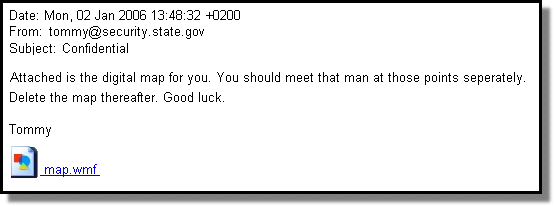 Confidential
Attached is the digital map for you. You should meet that man at those points seperately.
Delete the map thereafter. Good luck.
Tommy" title="From: tommy@security.state.gov
Confidential
Attached is the digital map for you. You should meet that man at those points seperately.
Delete the map thereafter. Good luck.
Tommy">
Oh yeah? And should you get killed, we will disavow any knowledge of your actions. This tape will self-destruct in five seconds...
by mozbe
I tired out the unofficial patch on my home machine without any problems. We will see if I can get approval to deploy this at my company, I don't see any other choice.
SANS - Internet Storm Center - Cooperative Cyber Threat Monitor And Alert System.
Handler's Diary January 1st 2006
Published: 2006-01-03,
Last Updated: 2006-01-03 08:55:06 UTC by Johannes Ullrich (Version: 3(click to highlight changes))
[a few users offered translations of this FAQ into various languages. Obviously, we can not check the translation for accuracy, nor can we update them. So use at your own risk: Deutsch and Deutsch (pdf), Catalan , Espa?ol , Italiana and Italiana, Polski, Suomenkielinen, Danish, Japanese, Slovenian, Chinese, Norwegian and Nederlands (in progress) ]
The WMF vulnerability uses images (WMF images) to execute arbitrary code. It will execute just by viewing the image. In most cases, you don't have click anything. Even images stored on your system may cause the exploit to be triggered if it is indexed by some indexing software. Viewing a directory in Explorer with 'Icon size' images will cause the exploit to be triggered as well.
Internet Explorer will view the image and trigger the exploit without warning. New versions of Firefox will prompt you before opening the image. However, in most environments this offers little protection given that these are images and are thus considered 'safe'.
All. Windows 2000, Windows XP, (SP1 and SP2), Windows 2003. All are affected to some extent. Mac OS-X, Unix or BSD is not affected.
Note: If you're still running on Win98/ME, this is a watershed moment: we believe (untested) that your system is vulnerable and there will be no patch from MS. Your mitigation options are very limited. You really need to upgrade.
To unregister the DLL:
Our current "best practice" recommendation is to both unregister the DLL and to use the unofficial patch.
The wmfhotfix.dll is injected into any process loading user32.dll. The DLL then patches (in memory) gdi32.dll's Escape() function so that it ignores any call using the SETABORTPROC (ie. 0x09) parameter. This should allow Windows programs to display WMF files normally while still blocking the exploit. The version of the patch located here has been carefully checked against the source code provided as well as tested against all known versions of the exploit. It should work on WinXP (SP1 and SP2) and Win2K.
It might help. But it is not foolproof. We want to be very clear on this: we have some very stong indications that simply unregistering the shimgvw.dll isn't always successful. The .dll can be re-registered by malicious processes or other installations, and there may be issues where re-registering the .dll on a running system that has had an exploit run against it allowing the exploit to succeed. In addition it might be possible for there to be other avenues of attack against the Escape() function in gdi32.dll. Until there is a patch available from MS, we recommend using the unofficial patch in addition to un-registering shimgvw.dll.
It might not be a bad idea, but Windows File Protection will probably replace it. You'll need to turn off Windows File Protection first. Also, once an official patch is available you'll need to replace the DLL. (renaming, rather than deleting is probably better so it will still be handy).
This may help, but it is not sufficient. WMF files are recognized by a special header and the extension is not needed. The files could arrive using any extension, or embeded in Word or other documents.
With Windows XP SP2, Microsoft introduced DEP. It protects against a wide range of exploits, by preventing the execution of 'data segements'. However, to work well, it requires hardware support. Some CPUs, like AMD's 64 Bit CPUs, will provide full DEP protection and will prevent the exploit.
At this point, we are aware of versions of the exploit that will not be detected by antivirus engines. We hope they will catch up soon. But it will be a hard battle to catch all versions of the exploit. Up to date AV systems are necessary but likely not sufficient.
There are too many methods to mention them all. E-mail attachments, web sites, instant messaging are probably the most likely sources. Don't forget P2P file sharing and other sources.
No. It helps, but its likely not sufficient. We had at least one widely trusted web site (knoppix-std.org) which was compromissed. As part of the compromise, a frame was added to the site redirecting users to a corrupt WMF file. "Tursted" sites have been used like this in the past.
WMF images are a bit different then most other images. Instead of just containing simple 'this pixel has that color' information, WMF images can call external procedures. One of these procedure calls can be used to execute the code.
By all means yes. Also, do not run as an administrator level users for every day work. However, this will only limit the impact of the exploit, and not prevent it. Also: Web browsing is only one way to trigger the exploit. If the image is left behind on your system, and later viewed by an administrator, you may get 'hit'.
Maybe... do you allow the uploading of images? email? Are these images indexed? Do you sometimes use a web browser on the server? In short: If someone can get a image to your server, and if the vulnerable DLL may look at it, your server may very well be vulnerable.
Not much. A proxy server that strips all images from web sites? Probably wont go over well with your users. At least block .WMF images (see above about extensions...). If your proxy has some kind of virus checker, it may catch it. Same for mail servers. The less you allow your users to initiate outbound connections, the better. Close monitoring of user workstations may provide a hint if a work station is infected.
Most IDS vendors are working on signatures. Contact your vendor for details. Bleedingsnort.org is providing some continuosly improving signatures for snort users.
Not much :-(. It very much depends on the exact exploit you are hit with. Most of them will download additional components. It can be very hard, or even impossible, to find all the pieces. Microsoft offers free support for issues like that at 866-727-2389 (866 PC SAFETY).
http://www.microsoft.com/technet/security/advisory/912840.mspx
But there is no patch at the time of this writing.
http://www.kb.cert.org/vuls/id/181038
http://www.cve.mitre.org/cgi-bin/cvename.cgi?name=CVE-2005-4560
by mozbe
I was wondering about this. The original advisory does only mention XP and Server 2003 being the most vulnerable. However the phrase, “no Windows versions, in their default configuration, have a default association for WMF files”. This is a little bit of a loaded statement, and as F-Secure states below using third party image viewers adds in another variable.
F-Secure : News from the Lab - January of 2006.
| Which platforms can really get hit by WMF? | Posted by Mikko @ 07:29 GMT |
|
|
 Larry Seltzer from eWeek has been doing lots of additional testing against older versions of Windows and bad .WMF files.
He has just blogged his interesting findings:
...in a practical sense, only Windows XP and Windows Server 2003 (in all their service pack levels) are vulnerable to the WMF flaw.
...all versions of Windows back to 3.0 have the vulnerability in GDI32. Except for Windows XP and Windows Server 2003, no Windows versions, in their default configuration, have a default association for WMF files, and none of their Paint programs or any other standard programs installed with them can read WMF files...
So the vulnerability is there on all platforms but it seems that only Windows XP and 2003 are easily exploitable. Unfortunately this still means that majority of Windows computers out there are vulnerable right now. And at least Windows 2000 becomes vulnerable if you're using many of the available third party image handling programs to open image files.
It's still a bit unclear what happens on older platforms when malicious WMF files are renamed to something else than .WMF.
by mozbe
I am sure we all new that this was on the way, too bad all the script kiddies are back in school.
| Brief Description |
 |
|
WMFMaker is a virus constructor, which allows images to be created in WMF (Windows MetaFile) format that exploit a critical vulnerability in the Graphics Rendering Engine on Windows 2003/XP/2000/Me/98 computers. This vulnerability affects the library GDI32.DLL, which is used by the Windows Picture and Fax Viewer, Internet Explorer and Outlook, among other programs. WMFMaker can be used to create images that run any type of malicious code on the affected computer, such as Trojans, worms or any other type of malware. These malicious WMF images are then distributed using several methods: they can be hosted in a malicious website, sent via email, etc. When such a specially crafted WMF image is opened in a vulnerable computer, the code included within is executed, thus compromising the computer.
Currently, Microsoft has not released any security patch regarding the vulnerability, but their Security Advisory 912840 deals with the vulnerability. As temporary measures, it is recommendable to:
|
|
| Visible Symptoms |
|
|
WMFMaker is difficult to recognize, as it does not display any messages or warnings that indicate it has reached the computer. |
by mozbe
********************************************************************
Title: Microsoft Security Advisory Notification
Issued: January 3, 2006
********************************************************************
Security Advisories Updated or Released Today ==============================================
* Security Advisory (912840)
- Title: Vulnerability in Graphics Rendering Engine Could Allow Remote Code Execution.
- Web site: http://go.microsoft.com/fwlink/?LinkId=58452
- Reason For Update: January 2, 2006: Information has been added to the beginning of the advisory as well as the FAQ section to provide updated
information about the state of the investigation. Information has also been added to the FAQ section regarding reports of a third party security update for this
issue.
From the FAQ:
What is the scope of the advisory?
Microsoft is aware of a new vulnerability report affecting the Graphics Rendering Engine in Microsoft Windows. This vulnerability affects the software that is listed in the “Overview” section.
Is this a security vulnerability that requires Microsoft to issue a security update?
Yes, Microsoft has confirmed this vulnerability and will include the fix for this issue in an upcoming security bulletin.
What causes the vulnerability?
A vulnerability exists in the way specially crafted Windows Metafile (WMF) images are handled that could allow arbitrary code to be executed.
What is the Windows Metafile (WMF) image format?
A Windows Metafile (WMF) image is a 16-bit metafile format that can contain both vector information and bitmap information. It is optimized for the Windows operating system.
For more information about image types and formats, see Microsoft Knowledge Base Article 320314. Additional information about these file formats is also available at the MSDN Library Web site.
What might an attacker use the vulnerability to do?
An attacker who successfully exploited this vulnerability could take complete control of the affected system. This issue is not known to be wormable. In a Web-based attack scenario, an attacker would host a Web site that exploits this vulnerability. An attacker would have no way to force users to visit a malicious Web site. Instead, an attacker would have to persuade them to visit the Web site, typically by getting them to click a link that takes them to the attacker's site. It could also be possible to display specially crafted Web content by using banner advertisements or by using other methods to deliver Web content to affected systems.
How could an attacker exploit the vulnerability?
An attacker could host a malicious Web site that is designed to exploit this vulnerability through Internet Explorer and then persuade a user to view the Web site.
I am reading e-mail in plain text, does this help mitigate the vulnerability?
Yes. Reading e-mail in plain text does mitigate this vulnerability where the e-mail vector is concerned although clicking on a link would still put users at risk.
Note In Windows Server 2003, Microsoft Outlook Express uses plain text for reading and sending messages by default. When replying to an e-mail message that is sent in another format, the response is formatted in plain text.
I have DEP enabled on my system, does this help mitigate the vulnerability?
Software based DEP does not mitigate the vulnerability. However, Hardware based DEP may work when enabled. Please consult with your hardware manufacturer for more information on how to enable this feature and whether it can provide mitigation.
Does this vulnerability affect image formats other than Windows Metafile (WMF)?
The only image format affected is the Windows Metafile (WMF) format. It is possible however that an attacker could rename the file extension of a WMF file to that of a different image format. In this situation, it is likely that the Graphic Rendering engine would detect and render the file as a WMF image which could allow exploitation.
Windows Metafile (WMF) images can be embedded in other files such as Word documents. Am I vulnerable to an attack from this vector?
No. While we are investigating the public postings which seek to utilize specially crafted WMF files through IE, we are looking thoroughly at all instances of WMF handling as part of our investigation. While we're not aware of any attempts to embed specially crafted WMF files in, for example Microsoft Word documents, our advice is to accept files only from trusted source would apply to any such attempts.
If I block .wmf files by extension, can this protect me against attempts to exploit this vulnerability?
No. Because the Graphics Rendering Engine determines file type by means other than just looking at the file extensions, it is possible for WMF files with changed extensions to still be rendered in a way that could exploit the vulnerability.
Does the workaround in this advisory protect me from attempts to exploit this vulnerability through WMF files with changed extensions?
Yes. Microsoft has tested and can confirm the workaround in this advisory help protect against WMF files with changed extensions.
It has been reported that malicious files indexed by MSN Desktop Search could lead to exploitation of the vulnerability. Is this true?
We have received reports and are investigating them thoroughly as part of our ongoing investigation. We are not aware at this time of issues around the MSN Desktop Indexer, but we are continuing to investigate.
Is this issue related to Microsoft Security Bulletin MS05-053 - Vulnerabilities in Graphics Rendering Engine Could Allow Code Execution (896424) which was released in November?
No, these are different and separate issues.
Will my anti-virus software protect me from exploitation of this vulnerability?
As of the latest update to this advisory the following members of the Virus Information Alliance have indicated that their anti-virus software provides protection from exploitation of Windows Metafile (WMF) files using the vulnerability discussed in this advisory.
| • | |
| • | |
| • | |
| • | |
| • | |
| • | |
| • | |
| • |
In addition Microsoft is providing heuristic protection against exploitation of this vulnerability through Windows Metafile (WMF) files in our new Windows OneCare Live Beta.
As currently known attacks can change, the level of protection offered by anti-virus vendors at any time may vary. Customers are advised to contact their preferred anti-virus vendor with any questions they may have or to confirm additional information regarding their vendor’s method of protection against exploitation of this vulnerability.
When this security advisory was issued, had Microsoft received any reports that this vulnerability was being exploited?
Yes. When the security advisory was released, Microsoft had received information that this vulnerability was being actively exploited.
What’s Microsoft’s response to the availability of third party patches for the WMF vulnerability?
Microsoft recommends that customers download and deploy the security update for the WMF vulnerability that we are targeting for release on January 10, 2006.
As a general rule, it is a best practice to utilize security updates for software vulnerabilities from the original vendor of the software. With Microsoft software, Microsoft carefully reviews and tests security updates to ensure that they are of high quality and have been evaluated thoroughly for application compatibility. In addition, Microsoft’s security updates are offered in 23 languages for all affected versions of the software simultaneously.
Microsoft cannot provide similar assurance for independent third party security updates.
Why is it taking Microsoft so long to issue a security update?
Creating security updates that effectively fix vulnerabilities is an extensive process. There are many factors that impact the length of time between the discovery of a vulnerability and the release of a security update. When a potential vulnerability is reported, designated product specific security experts investigate the scope and impact of a threat on the affected product. Once the MSRC knows the extent and the severity of the vulnerability, they work to develop an update for every supported version affected. Once the update is built, it must be tested with the different operating systems and applications it affects, then localized for many markets and languages across the globe.
by mozbe
ewwwwww
Symantec Security Response - PWSteal.Bankash.G.
PWSteal.Bankash.G is a Trojan horse program that attempts to steal user names and passwords from the compromised computer and lowers security settings.
It is reported that the Trojan is downloaded by malformed .wmf files that utilize Microsoft Windows Graphics Rendering Engine WMF Format Unspecified Code Execution Vulnerability (As described in BID 16074).
by mozbe
Mark Minasi was contacted and he has verified that he did NOT write the rough comments that are mentioned in Rod’s and my post earlier. I should have checked with Mark before I said anything about the comments to anyone.
Mark, sorry your name got drug through the mud. I will delete the comments as soon as I can.
To whomever it was that really did write these comments. If you want to bash me and this blog, go ahead and fire away. At least have the guts to use your real information, and be a man (or woman, or person etc…) enough stand up for your opinions.
As I have seen from the community support after the comments we brought to light, there are plenty of people out there that disagree with you.
by mozbe
OK, now this is just damn funny…..
SANS - Internet Storm Center - Cooperative Cyber Threat Monitor And Alert System.
Published: 2006-01-03,
Last Updated: 2006-01-03 18:17:57 UTC by Tom Liston (Version: 1)
"Although the issue is serious and malicious attacks are being attempted, Microsoft's intelligence sources indicate that the scope of the attacks are not widespread."
- Microsoft Security Advisory (912840)
"...Microsoft's intelligence sources..."?!?
Go ahead and laugh. I'll wait.
Through? O.K.
While all of the rest of us were sleeping, it appears that the propeller-heads working on Billy Wonka's Official Microsoft Research and Development Team have been hard at work creating a crystal ball capable of foretelling the future. The only problem: it appears that they made it from rose-colored crystal.
In their rosy vision of the future, over the next seven days, nothing bad is going to happen. The fact that there are point-n-click toolz to build malicious WMFs chock full o' whatever badness the kiddiez can cook up doesn't exist in that future. The merry, lil' Redmond Oompa Loompas are chanting "Our patch isn't ready / you have to wait / so keep antivirus / up-to-date" which makes perfectly accurate, current AV signatures appear on every Windows computer - even those with no antivirus software.
The future, according to Microsoft, is a wonderful, safe, chocolaty place.
And why not? Everything just seems to work out for them!
Imagine! You have tons and tons of work to do! Even now, the Oompa Loompas are hard at work out in Redmond, simultaneously regression-testing and translating Microsoft's WMF patch into Swahili and Urdu. And, somehow, as if by magic, all of this work will wind down at precisely the right moment so that the WMF patch doesn't have to be released "out of cycle." How convenient! Especially if you're wanting to avoid all of that nasty "Microsoft Releases Emergency Patch" publicity.
And remember, if something bad does happen to you during the next seven days, Billy Wonka and his Magic Metafiles aren't to blame. You are!
"Customers who follow safe browsing best practices are not likely to be compromised by any exploitation of the WMF vulnerability. Users should take care not to visit unfamiliar or un-trusted Web sites that could potentially host the malicious code."
Why are you visiting places on the web you've never been before? Restrict your browsing to safe places, and everything will be just fine. 'Cause no one could ever put a bad graphic file on a place you trust.
------------------------------------------------------------------------
Tom Liston - Intelguardians Network Intelligence, L.L.C.
by mozbe
OK hackers, you heard Microsoft. No more Trojans\viruses that use this vulnerability until the patch comes out next week. I mean we can give them a break right?? They are working as fast as they can…
Welcome to the Microsoft Security Response Center Blog! : Updated Advisory: WMF Vulnerability.
Updated Advisory: WMF Vulnerability
Hi folks- Kevin Kean here again. We here in the MSRC have been hard at work on this WMF vulnerability and so I wanted to provide you all with an update on the situation.
When the MSRC learned of the attacks on December 27, 2005, we mobilized under what we call the Software Security Incident Response Process (SSIRP) to analyze the attack, assess its scope and determine and the appropriate guidance for customers, as well as to engage with anti-virus partners and law enforcement.
Based on that process, we have finished development of a security update to fix the vulnerability and are testing it to ensure quality and application compatibility. Our goal is to release the update on Tuesday, January 10, 2006, as part of the regular, monthly security update release cycle, although quality is the gating factor. Customers will be able to get the update through all the usual deployment tools: Microsoft Update, Windows Update, Automatic Update, the Download Center and Windows Server Update Services.
As we’ve noted in previous posts, we have been carefully monitoring the attempted exploitation of this vulnerability through our own investigative process as well as partnering the industry and law enforcement. Although the issue is serious and malicious attacks are being attempted, we have found that the scope of the attacks is not widespread. AV companies have also indicated that attacks are being effectively mitigated through up-to-date signatures.
To help protect against any attempted exploitation while the security update is being developed we really want to continue to urge customers not to visit unfamiliar or untrusted Web sites that could potentially host the malicious code. More guidance for consumer customers can be found here http://www.microsoft.com/athome/security/online/browsing_safety.mspx. We also encourage enterprise customers to continue to review the information in the security advisory as well: http://www.microsoft.com/technet/security/advisory/912840.mspx.
Best,
Kevin
*This posting is provided "AS IS" with no warranties, and confers no rights.*
posted on Tuesday, January 03, 2006 3:59 PM by stepto
by mozbe
********************************************************************
Title: Microsoft Security Advisory Notification
Issued: January 3, 2006
********************************************************************Security Advisories Updated or Released Today
==============================================* Security Advisory (912920)
- Title: Systems that are infected with Win32/Sober.Z@mm may download and run malicious files from certain Web domains beginning on January 6, 2006
- Reason For Update: Advisory published
- Web site: http://go.microsoft.com/fwlink/?LinkId=58505
?
by mozbe
*******************************************************************
Title: Microsoft Security Advisory Notification
Issued: January 3, 2006
********************************************************************Security Advisories Updated or Released Today
==============================================* Security Advisory (912840)
- Title: Vulnerability in Graphics Rendering Engine Could Allow Remote Code Execution.
- Web site: http://go.microsoft.com/fwlink/?LinkId=58452
- Reason For Update: Clarifying information added to the Mitigating factors section at the beginning of the advisory. FAQ added to address pre-released Microsoft security update.
by mozbe
Symantec Security Response - Trojan.Satiloler.B.
Trojan.Satiloler.B is a Trojan horse that attempts to steal user names, passwords, and other information from the compromised computer. It also attempts to open a proxy server on a random TCP port.
It has been reported that the Trojan is downloaded by malformed WMF files that utilize the Microsoft Windows Graphics Rendering Engine WMF Format Unspecified Code Execution Vulnerability (as described in BID 16074).
by mozbe
My thoughts go out to all the families that lost loved ones in the coal mine disaster. They all sacrificed their lives to make sure that we could all live our lives the way we are accustomed to, with heat and electricity. Let us hope that their passing will somehow make things safer for everyone else that has that profession.
On another sad note, some of you might remember a post I did a while back about a young man that lived in Memphis that had the same name as I do.
It seems this other Chris Mosby was killed in a car accident over the New Year’s holiday. 17 years old is just too young to go.
Ever since the post that I had mentioned him, I had kind of been keeping an eye on this kid as his football career was looking up and he was making the news on occasion.
I never met this young man, or any of his family, but my thoughts go out to them as well. No parent should ever have to bury their child. Having lost a brother myself almost three years ago to cancer, I can just imagine what they are going through.
by mozbe
| New trojan being distributed via WMF spam | Posted by Mikko @ 12:44 GMT |
|
|
There's a new trojan spam run underway, exploiting again the WMF vulnerability.
The exploit code is taken directly from the last Metasploit distribution. So the Metasploit exploit is assisting botnet herders and spyware distributors to take over the computers of users who still have no Microsoft patch to close the hole.
In this particular case the spammed message was a fake warning from Yale University professor about student vandalism that supposedly happened over the new year:
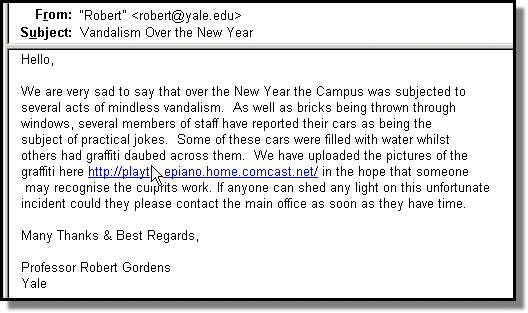
When curious readers follow the link to a web server under comcast.net, they are hit with a WMF file that immediatly downloads a botnet client via tftp and runs it. In case the WMF exploit wouldn't work, the front page of the site also contains an exploit against older versions of Firefox, using the "InstallVersion.compareTo()" flaw. The downloaded client will connect to a botnet hosted via several IRC servers.
F-Secure Anti-Virus detects the WMF exploit in question as Exploit.Win32.IMG-WMF and the downloaded trojan as Breplibot.Q. Abuse reports have been sent about the sites abused in this scam.
Administrators: you might want to block these at your gateways:
http access to playtimepiano[dot]home[dot]comcast[dot]net (do not visit this site)
tftp (ie. UDP) access to 86.135.149.130
IRC access to 140.198.35.85:8080
IRC access to 24.116.12.59:8080
IRC access to 140.198.165.185:8080
IRC access to 129.93.51.80:8080
IRC access to 70.136.88.76:8080
PS. There seems to be no Professor Robert Gordens in Yale.
by mozbe
Published: 2006-01-03,
Last Updated: 2006-01-04 10:47:18 UTC by Swa Frantzen (Version: 1)
We continue to get many questions on the WMF vulnerability, and are trying to explain it a bit more graphically.
Feel free to use the presentations below to explain why you need to use the unofficial patch or how it works on a high level.
For the rest of this post go here: WMF: patches and workarounds explained (NEW)
by mozbe
Looks like I broke the 30,000 mark for unique hits.
Not bad for a blog with no content…..
by mozbe
SANS - Internet Storm Center - Cooperative Cyber Threat Monitor And Alert System.
Handler's Diary January 2nd 2006
Checking for .wmf Vulnerabilities
Published: 2006-01-02,
Last Updated: 2006-01-03 02:44:21 UTC by Marcus Sachs (Version: 1)
As far as we know there are no tools available yet for remote scanning and detection of systems vulnerable to the .wmf issue. Ilfak Guilfanov has a testing tool available on his website, and he cautions users that it only checks for one version of the exploit so it might not detect new variations.
If you want to experiment with another file submitted to us by Kevin Gennuso (thanks, Kevin) you can download it here. The file will open calc.exe and kill explorer.exe on vulnerable systems but otherwise causes no damage as far as we can tell. As always, test this file before using it on a production or enterprise computer. This file is useful for seeing if Ilfak's patch worked for your system.
Reik Bohne sent us a link to a test on heise.de. It's in German but essentially what it does is provides you with a way to check your browser and your email client to see if you are vulnerable. Like the file above, it starts calc.exe on an unpatched system.
by mozbe
Lost of good info here. I know that some believe that there is a lot of "crying wolf" going on over this .wmf thing, but just because we haven't seen something spread world wide that uses this exploit; doesn't mean we WON"T. I won't get into the "use the unofficial patch or not to use the unoffical patch" debate. Each company or individual has to weigh those risks for themselves. I have always gone with the motto “Prepare for the worst, and you won’t be dissapointed”, when it comes to things like this.
Handler's Diary January 4th 2006
Published: 2006-01-04,
Last Updated: 2006-01-04 20:40:11 UTC by Kyle Haugsness (Version: 1)
Are you ready to battle a large virus/worm outbreak? Please don't view this is a prediction that there will be a large event, but let me just say that conditions are right for a big storm (WMF issue and the return
of the Sober worm).
Regarding the WMF issue, you have probably decided to either wait for the official Microsoft patch, or you are rolling out Ilfak's patch. But there is still about 6-10 days of risk here for a major worldwide event.
So here are some recommendations for preparing for the battle. (This is primarily written for system and network admins...)
Read the rest of the post here: SANS - Internet Storm Center - Cooperative Cyber Threat Monitor And Alert System.
by mozbe
Handler's Diary January 4th 2006
Published: 2006-01-04,
Last Updated: 2006-01-04 22:28:20 UTC by Marcus Sachs (Version: 1)
We have a little project for all of the forensic treasure hunters out there. As you all know, the .wmf issue came into public view about a week ago. Since then, we've found that there are infected .wmf files with dates going back several weeks, so this little beauty has been around for a while. What we are looking for are any confirmed intrusions earlier than the first of December 2005 that can be traced to this current vulnerability. By confirmed, we mean that not only is the date of an infected .wmf file on a compromised system earlier than December 1st, but you can also prove that it was installed prior to December 1st and had some type of malicious payload embedded in it. Tell us whatever you can share, and we'll summarize the details for others. There's no prize for the earliest detect, but we are pretty sure that many would be interested in knowing how long this vulnerability has been actively exploited.
SANS - Internet Storm Center - Cooperative Cyber Threat Monitor And Alert System.
by mozbe
NEWS FLASH!! Another WMF vulnerability post.  Hopefully one day this will all be a distant memory.
Handler's Diary January 4th 2006
What do the bad guys do with WMF? (NEW)
Published: 2006-01-04,
Last Updated: 2006-01-05 00:16:31 UTC by Bojan Zdrnja (Version: 1)
With all this confusion about WMF files and various official and unofficial patches, you are probably wondering what the bad guys are doing with this.
We tracked quite a bit of exploits going around. Lately exploits started using Metasploit and we even received a standalone utility (so called WMFMaker, already described by Panda Software) that anyone can use:
$ ./wmfmaker
Have fun
ApacheEatsGnu
---- visit -----
wmfmaker
No wonder that the bad guys started exploiting this more and more.
The main vector that the bad guys use to exploit this is still by posting it on web sites. The golden target would be a banner site or something that is visited frequently, but luckily, so far we didn't see anything widespread as that.
This doesn't mean that there are no exploits. One spam which was published by F-Secure (http://www.f-secure.com/weblog/archives/archive-012006.html#00000768) tried to get the user follow the link about "Vandalism Over the New Year". The site in question is now gone, so this is not a problem anymore, but the typical scenario was: WMF file which drops a downloader, which then subsequently downloads other trojans.
Besides this one, we also received various "Greeting Card" spams. Although the e-mail claimed that the greeting card is on 123greetings.com, the link actually pointed to http://mujeg orda.bita coras.com/REMOVED - this site is still active.
So what do all of these exploits actually drop? The answer is: typical "bad guys" stuff. They are usually dropping various versions of SDBot and similar IRC trojans. This will enable them to herd zombie machines that they use in the future.
One other exploit that we saw (thanks to Juha-Matti) dropped a pretty nasty password stealer/trojan, Trojan.Satiloler.B.
Finally, there was an interesting post by Andreas Marx on Bugtraq. Among various malware that the WMF files drop, they found one with a built-in counter on a "hidden" website. The counter seems to be going up fast - last year it was around 200.000 while today it is over a million. We can't be sure that the counter is correct, but we can be sure that the bad guys are on track with this vulnerability.
We are yet to see if other vectors will be exploited, but I'm afraid that this is more than enough for the bad guys to build a nice "army" of zombie machines.
So practice safe hex and patch/protect your machines as much as you can.
SANS - Internet Storm Center - Cooperative Cyber Threat Monitor And Alert System.
by mozbe
Gee, I almost forgot about this little bugger. Hold on to your hats ladies and gents…
Wednesday, January 4, 2006
Sober.Y reminder Posted by Jarkko @ 14:46 GMT
Just to remind you, Sober.Y update phase starts on 6th day. This means that
all machines infected by Sober.Y try to download and execute code from
certain addresses. If you want block these addresses at your firewall, here
is the list again. The actual filename is left intentionally out from the
addresses.The most likely set of download URLs is:
people.freenet.de/zmnjgmomgbdz/
people.freenet.de/smtmeihf/
people.freenet.de/qisezhin/
people.freenet.de/fseqepagqfphv/
people.freenet.de/urfiqileuq/
people.freenet.de/wjpropqmlpohj/
people.freenet.de/mclvompycem/
scifi.pages.at/zzzvmkituktgr/
home.pages.at/npgwtjgxwthx/
free.pages.at/emcndvwoemn/
home.arcor.de/ocllceclbhs/
home.arcor.de/dixqshv/
home.arcor.de/srvziadzvzr/
home.arcor.de/nhirmvtg/
home.arcor.de/jmqnqgijmng/However, in some circumstances, Sober might try to access some of the
following URLs:
people.freenet.de/mookflolfctm/
people.freenet.de/aohobygi/
people.freenet.de/wlpgskmv/
people.freenet.de/svclxatmlhavj/
people.freenet.de/jpjpoptwql/
people.freenet.de/iohgdhkzfhdzo/
people.freenet.de/eetbuviaebe/
scifi.pages.at/vvvjkhmbgnbbw/
home.pages.at/twfofrfzlugq/
free.pages.at/sfhfksjzsfu/
home.arcor.de/qlqqlbojvii/
home.arcor.de/fulmxct/
home.arcor.de/fowclxccdxn/
home.arcor.de/lnzzlnbk/
home.arcor.de/rprpgbnrppb/
people.freenet.de/iufilfwulmfi/
people.freenet.de/xbqyosoe/
people.freenet.de/nkxlvcob/
people.freenet.de/svclxatmlhavj/
people.freenet.de/bnymomspyo/
people.freenet.de/jbevgezfmegwy/
people.freenet.de/gdvsotuqwsg/
scifi.pages.at/eveocczmthmmq/
home.pages.at/doarauzeraqf/
free.pages.at/hsdszhmoshh/
home.arcor.de/dyddznydqir/
home.arcor.de/iyxegtd/
home.arcor.de/oakmanympnw/
home.arcor.de/riggiymd/
home.arcor.de/jhjhgquqssq/These additional addresses might be produced by the URL algorithm in
certain rare conditions. We are not sure if this is the intention of the
worm author, but it might be a good idea to block all of the above addresses.
by mozbe
The exact activation time for Sober Posted by Mikko @ 11:27 GMT
We've received some questions on when exactly does the Sober activation on January 6th happen.
After all, it already is past the midnight in Auckland! But the Sober date check is not using local time.
The Sober download phase starts globally at the same time: at midnight UTC (aka GMT). All infected machines regularily connect to several NTP servers and synchronize themselves using the "time" protocol.
We don't think much will happen. But if anything happens, it will start happening after midnight in UK, 4pm in San Francisco, 7pm in New York, 2am in Finland and 9am in Tokyo.
F-Secure : News from the Lab - January of 2006.
by mozbe
********************************************************************
Title: Microsoft Security Advisory Notification
Issued: January 5, 2006
********************************************************************
Security Advisories Updated or Released Today ==============================================
* Security Advisory (912840)
- Title: Vulnerability in Graphics Rendering Engine Could
Allow Remote Code Execution.
- Web site: http://go.microsoft.com/fwlink/?LinkId=58452
- Reason For Update: FAQ added with information on Windows 98,
Windows 98 Second Edition and Windows
Millennium. FAQ concerning embedded images
in Office documents updated. Workaround
updated with information about re-registering
the Windows Fax and Image Viewer
(Shimgvw.dll).
Sort by Trending

