Discussion Locked
Chris Mosby at myITforum.com
0 helpful
576 replies
Closed to new repliesThis discussion is closed. It stays readable, but it takes no new replies.
This is page 5 of the discussion. Read the opening post

After Hours
This is page 5 of the discussion. Read the opening post
by mozbe
Well I'll be...
So Microsoft wised up and didnt wait till next Tuesday, here is the patch!
A remote code execution security issue has been identified in the Graphics Rendering Engine that could allow an attacker to remotely compromise your Windows-based system and gain control over it.
A remote code execution security issue has been identified in the Graphics Rendering Engine that could allow an attacker to remotely compromise your Windows-based system and gain control over it. You can help protect your computer by installing this update from Microsoft. After you install this item, you may have to restart your computer.
Security Update for Windows XP (KB912919)
Security Update for Windows XP x64 Edition (KB912919)
Security Update for Windows Server 2003 64-bit Itanium Edition (KB912919)
Security Update for Windows Server x64 Edition (KB912919)
Security Bullitin: MS06-001 (not online yet)
Bink.nu | Microsoft officially now released the WMF security patch early!.
by mozbe
| Sober: So far, so good | Posted by Mikko @ 08:40 GMT |
|
|
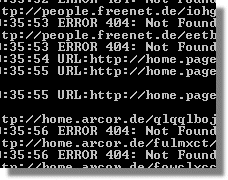 The Sober activation deadline passed around eight hours ago.
We've been monitoring the locations of the files that infected machines are now trying to download. So far none of them have activated.
We hope it stays that way.
by mozbe
Situation calm. For a change. Posted by Mikko @ 05:13 GMT
The Sober download sites are still empty. Great.
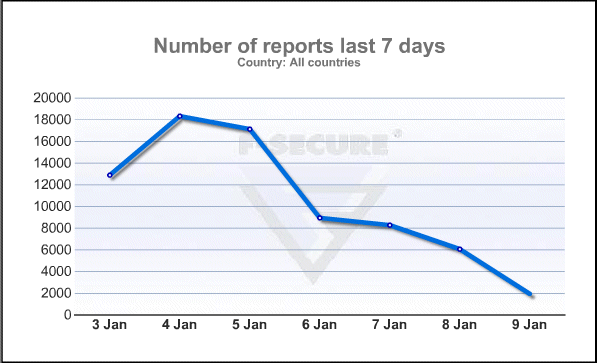
When the Sober.y download deadline passed on January 6th, all infected machines started download attempts from the five different sites. At the same time, the virus stopped emailing itself around.
As a result, the virus that had held #1 position in virus stats since November 2005 just disappeared from the stats.
There still are at least tens of thousands of infected machines out there. They just aren't spreading the virus further: they're just trying to download and run a mystery file - which isn't there to be downloaded.
How to locate and shut down all these infections? ISPs are in key position.
ISPs: we urge you to check your user traffic patterns. Locate the users that produce an unlikely large amount of constant hits to people.freenet.de, scifi.pages.at, home.pages.at, free.pages.at and home.arcor.de. Contact these users and let them know they most likely are infected with Sober and they should clean up their act. If you'd like to do this but don't feel like making tons of phone calls, you can automate processes like these with our Network Control appliance.
F-Secure : News from the Lab - January of 2006.
by mozbe
SANS - Internet Storm Center - Cooperative Cyber Threat Monitor And Alert System.
Handler's Diary January 9th 2006
Another WMF attack vector? (NEW)
Published: 2006-01-09,
Last Updated: 2006-01-09 22:02:13 UTC by William Salusky (Version: 2(click to highlight changes))
We had hoped the chapter on WMF exploits had finally been closed, pending the patching of countless millions of vulnerable workstations of course. However, today we were forwarded a Bugtraq disclosure of two additional functions vulnerable to memory corruption attack within the Microsoft graphics rendering engine. The flaw reportedly affects the 'ExtCreateRegion' and 'ExtEscape' functions and while there has been no current proof of concept exploit/DoS code publicly released we will be watching this issue closely.
reference: http://www.securityfocus.com/bid/16167 (Sorry, you have to cut/paste).
So, is there a new WMF remote code execution threat here?
Microsoft representative response:
"The short answer is no. These are not exploitable bugs (DoS only)"
The SANS handlers have been notified that a Microsoft official response to Today's Bugtraw disclosure will be posted shortly at:
http://blogs.technet.com/msrc/
<resume handler musings> However, Infosec history teaches us that where there is DoS(PoC), there very likely is remote code execution. I myself will wait for smarter folks than myself to prove the statement.
by mozbe
Welcome to the Microsoft Security Response Center Blog! : Information on new WMF Posting.
Information on new WMF Posting
Lennart Wistrand here. I wanted to write a few lines about the public post made over the weekend about a new specially crafted WMF image that could potentially cause the application using the Windows Graphics Rendering Engine to crash. As it turns out, these crashes are not exploitable but are instead Windows performance issues that could cause some WMF applications to unexpectedly exit. These issues do not allow an attacker to run code or crash the operating system. They may cause the WMF application to crash, in which case the user may restart the application and resume activity. We had previously identified these issues as part of our ongoing code maintenance and are evaluating them for inclusion in the next service pack for the affected products.
Just to be clear, the security update accompanying MS06-001 did not include fixes for these performance issues. Security updates sometimes do include other fixes, quite often this is a result of the cumulative nature of development, i.e., it may be that those types of fixes get checked in to the code tree and then picked up when a file is serviced in that code branch. However, in order to keep the code churn in security updates to a minimum we try to avoid, as a general rule, including other code fixes for performance issues such as this. It may seem counter-intuitive to not want to improve the code quality whenever opportunity arises, but the fact is that code churn incurred might have a negative impact on the quality of the update or yield a need for even more testing to ensure that we meet the quality bar for security updates. Service Packs or Update Rollups are typically the preferred method of servicing software. If a fix for an issue cannot wait until the next service pack we do consider other forms of servicing. You can read more about the different servicing mechanisms and our terminology for these in this article: http://support.microsoft.com/kb/824684
Kind regards
/Lennart
by mozbe
Hello boys and girls, welcome to Security Street.
This Security Street post is sponsored by the letters W, M, F and the number 0.
Just when you thought it was safe to look at pictures again, it looks like there are reports of new attack vectors for WMF files.
I already posted about the information from the Internet Storm Center and from Microsoft about this, but now Trend Micro has reported two new Trojans that reportedly exploit this new 0–day vulnerability. So far these are both low risk.
by mozbe
New Bulletins
Microsoft is releasing the following security bulletins for newly discovered vulnerabilities:
Critical MS06-002 Microsoft Windows Remote Code
Execution
Critical MS06-003 Microsoft Office, Microsoft Exchange
Remote Code Execution
Summaries for these new bulletins may be found at the following pages:
* http://www.microsoft.com/technet/security/bulletin/ms06-jan.mspx
Customers are advised to review the information in the bulletins, test and deploy the updates immediately in their environments, if applicable.
Microsoft Windows Malicious Software Removal Tool
Microsoft is releasing an updated version of the Microsoft Windows Malicious Software Removal Tool on Windows Server Update Services (WSUS), Windows Update (WU) and the Download Center. Note that this tool will NOT be distributed using Software Update Services (SUS).
Information on the Microsoft Windows Malicious Software Removal Tool can be located here:
http://go.microsoft.com/fwlink/?LinkId=40573
High-Priority Non-Security Updates on Microsoft Update (MU), Windows Update (WU), Windows Server Update Services (WSUS) and Software Update Services (SUS) Microsoft is today also making the following High-Priority NON-SECURITY updates available on WU, MU, SUS and WSUS:
KB870450 Update Rollup for Exchange 2000 Server MU
KB907747 Update for Intelligent Message Filter MU
Microsoft will host a webcast to address customer questions on these bulletins. For more information on this webcast please see below:
Microsoft will host a webcast to address customer questions on these bulletins. For more information on this webcast please see below:
Information about Microsoft's Security Bulletins
January 11, 2006 11:00 AM (GMT-08:00)
http://msevents.microsoft.com/CUI/WebCastEventDetails.aspx?EventID=10322
87360&EventCategory=4&culture=en-US&CountryCode=US
The on-demand version of the webcast will be available 24 hours after the live webcast at:
http://msevents.microsoft.com/CUI/WebCastEventDetails.aspx?EventID=10322
87360&EventCategory=4&culture=en-US&CountryCode=US
**********************************************************************
MS06-002
Title: Vulnerability in Embedded Web Fonts Could Allow Remote Code Execution (908519)
Affected Software:
* Microsoft Windows 2000 Service Pack 4
* Microsoft Windows XP Service Pack 1 and Microsoft Windows XP
Service Pack 2
* Microsoft Windows XP Professional x64 Edition
* Microsoft Windows Server 2003 and Microsoft Windows Server 2003
Service Pack 1
* Microsoft Windows Server 2003 for Itanium-based Systems and
Microsoft Windows Server 2003 with SP1 for Itanium-based Systems
* Microsoft Windows Server 2003 x64 Edition
* Microsoft Windows 98, Microsoft Windows 98 Second Edition (SE),
and Microsoft Windows Millennium Edition (ME) - Review the FAQ section of the bulletin for details about these operating systems.
Impact of Vulnerability: Remote Code Execution
Maximum Severity Rating: Critical
Restart required: In some cases, this update does not require a restart.
If the required files are being used, this update will require a restart. If this behavior occurs, a message appears that advises you to restart. To help reduce the chance that a reboot will be required, stop all affected services and close all applications that may use the affected files prior to installing the security update. For more information about the reasons why you may be prompted to restart your computer, see Microsoft Knowledge Base Article 887012.
Update can be uninstalled: Yes
More information on this vulnerability is available at:
http://www.microsoft.com/technet/security/bulletin/MS06-002.mspx
**********************************************************************
MS06-003
Title: Vulnerability in TNEF Decoding in Microsoft Outlook and Microsoft Exchange Could Allow Remote Code Execution (902412)
Affected Software:
* Microsoft Office 2000 Service Pack 3
* Microsoft Office 2000 Software:
* Microsoft Outlook 2000
* MultiLanguage Packs
Note Multilingual User Interface Packs are for non- English packages
* Microsoft Office XP Service Pack 3 -
* Microsoft Office XP Software:
* Microsoft Outlook 2002
* Microsoft Office XP Multilingual User Interface Packs
Note Multilingual User Interface Packs are for non- English packages.
* Microsoft Office 2003 Service Pack 1 and Service Pack 2
* Microsoft Office 2003 Software:
* Microsoft Office Outlook 2003
* Microsoft Office 2003 Multilingual User Interface Packs
Note Multilingual User Interface Packs are for non- English packages
* Microsoft Office 2003 Language Interface Packs
* Microsoft Exchange Server 5.0 Service Pack 2
* Microsoft Exchange Server 5.5 Service Pack 4
* Microsoft Exchange 2000 Server Pack 3 with the Exchange 2000
Post-Service Pack 3 Update Rollup of August 2004 Non-Affected Software:
* Microsoft Exchange Server 2003
* Microsoft Exchange Server 2003 Service Pack 1
Impact of Vulnerability: Remote Code Execution
Maximum Severity Rating: Critical
Restart required: In some cases, this update does not require a restart.
If the required files are being used, this update will require a restart. If this behavior occurs, a message appears that advises you to restart. To help reduce the chance that a reboot will be required, stop all affected services and close all applications that may use the affected files prior to installing the security update. For more information about the reasons why you may be prompted to restart your computer, see Microsoft Knowledge Base Article 887012.
by mozbe
MU and WSUS Information about Today's Bulletin Release
Hey folks – Mike Reavey here stepping in for Craig as he continues to work through some last minute issues on this Tuesday’s release. Today we’ve released two Security Bulletins. The first one, MS06-002 resolves a vulnerability in Font processing in Windows and is rated Critical. The second bulletin, MS06-003 is also rated Critical, and applies to Office and Exchange customers, and resolves an issue in Transport Neutral Encapsulation (TNEF). We’re actively working through a delay on getting the MS06-003 updates to propagate through the global servers for Microsoft Update and WSUS. We expect the updates to be on-line and ready by 12:00PM Pacific Time. For folks using the ITMU and SMS, the catalog will be live for the entire release once the issues are resolved. Estimated time is 1:30PM Pacific Time. In the meantime, the updates are available on the Microsoft Download Center and can be accessed from the links with in the Security Bulletin. For folks using Windows Update, SUS, and SMS with MBSA 1.2 there are no delays for any packages.
One question we get when there are delays is “Why not hold everything, until it all goes at the same time, everywhere?” We always aim for that as a goal and when we’re aware of the delays before propagation begins we do work to sync it all up. However, in order to hit a 10AM target through all systems, we have to publish through several independent channels at once, in parallel. In today’s case, pausing the posting of updates to the Download Center and Windows Update to wait for the posting to Microsoft Update would actually have resulted in a delay in these updates appearing on the Download Center and Windows Update as we reset the release process. This means we would then see the updates appear first on Microsoft Update ahead of the Download Center and Windows Update. Based on this, we’ve gone ahead and released the bulletin for MS06-003 so folks would be able to read and understand the issues being resolved in detail while we continued pushing through Microsoft Update.
posted on Tuesday, January 10, 2006 7:16 PM by stepto
by mozbe
Handler's Diary January 10th 2006
previous -
Quicktime patches for Mac and Windows (NEW)
Published: 2006-01-10,
Last Updated: 2006-01-10 20:55:19 UTC by Kyle Haugsness (Version: 1)
Is Apple hiding behind Microsoft's advisories? Seems like Apple has been conveniently releasing security advisories on the same day as Microsoft's. Conspiracy theory? You be the judge.Anyway, Apple released a security update to Quicktime. http://docs.info.apple.com/article.html?artnum=303101
There are multiple vulnerabilities patched. To summarize the advisory: A maliciously-crafted GIF/TIFF/TGA/QTIF image or multimedia file may result in arbitrary code execution. Well that pretty much covers the whole web browsing thing.Given the week we've had, I suppose that everyone should go back to using netcat for surfing the web.
SANS - Internet Storm Center - Cooperative Cyber Threat Monitor And Alert System.
by mozbe
Handler's Diary January 11th 2006
New email virus making the rounds (NEW)
Published: 2006-01-11,
Last Updated: 2006-01-11 22:28:25 UTC by Daniel Wesemann (Version: 1)We are currently analyzing a copy of .. something. Attachment name "message.zip", detection by AV is still thin to nonexistent. When run, the code tries to pull additional files from web servers in Russia, so if you have a chance, you might consider blocking the following TLDs on your proxy / perimeter:
1gb.ru / t35.com / hzs.nm.ru / users.cjb.net / h16.ru
UPDATE 2200UTC: message.zip contains a file named "Secure E-mail File.hta", which is according to current Virustotal output only detected by Panda and Kaspersky, the latter calls it Worm.Win32.Feebs.k . Samples we've seen come in an email with subject "Secure Message from HotMail.com user". The HTA file is nicely obfuscated, it has 2 obfuscation functions, one being easy unescape, while the other one is a bit more complex. Once it is executed by a user, it will run in the local zone, so it can use various ActiveXObjects. It will try to download executables from 5 web sites (domains listed above), all of which are up and working at this moment.
MD5 sums for the original exploit file and the two variants of EXEs it downloads when run:
7eb24b4c7b7933b6a0157e80be74383c Secure E-mail File.hta
9cbd9710087bff6f372b1e3f652d8f7c feebs1.exe983bf330aae51535c7382dc82429364b feebs2.exe
Analysis and write-up by fellow handler Bojan Zdrnja. Thanks! :)
SANS - Internet Storm Center - Cooperative Cyber Threat Monitor And Alert System.
by mozbe
Let's see, wmf flies, web fonts, Quicktime and now Java exploits.
It isn't save to surf the Internet no matter what browser you use. I think I will just go read comics until this all blows over...
Handler's Diary January 13th 2006
Published: 2006-01-13,
Last Updated: 2006-01-13 19:08:06 UTC by Swa Frantzen (Version: 3(click to highlight changes))
US-CERT and AUSCERT warn about a bug in java being exploited. They claim bug was made public in November 2005.
Aside of the obvious patch and turn off java support, the warnings include text as "avoid clicking on any links in emails or instant messages, unless the email was already expected beforehand" and "by only accessing Java applets from known and trusted sources the chances of exploitation are reduced."
To the best of my knowledge the general user population expects email. They use email to communicate with people they never met before. And they will click on anything in it. Similarly they call it "surfing the web", they will click on links that lead to other sites. Telling them not to do that is going to have as much effect as asking them not to laugh at you. There are unfortunately only a very few exceptions where you might have users and applications where you can limit the exposure. But as a general recommendation it is rather worthless IMHO.
So download that latest greatest java environment now if you haven't done so already and upgrade. Better yet: check those browser settings and turn java off for all sites that you either not trust 100% to execute code on your machines or that don't absolutely need it to work.
UPDATE
We have been informed multiple times the hostile java seems to be at a webserver at fullchain [dot] net. Might be interesting to check your logs in a corporate environment. The supposedly hostile code is still there so we won't be providing detailed URLs for now. The class file on that website is not detected as malicious by any anti-virus product participating in virustotal.
Vince told it's also necessary to remove the old java environments, not just get the new ones as an attacker can target the old environments when they are still present.
UPDATE
According to the bulletins you need at least
--
Swa Frantzen
by mozbe
Symantec revealed this week that they have been using a rootkit like method, similar to Sony's BMG rootkit, in Norton SystemWorks 2005 and 2006 to hide a directory involved with protecting items deleted from the Recycle Bin.
The "Norton Protected Recycle Bin" feature that is built in to recent versions of Norton SystemWorks was designed to hide files from the Windows API, just as Sony's BMG Rootkit did; in a directory called "NProtect" that could be used to recover deleted Recycle Bin files. This was supposed to prevent users from accidentally deleting these files while cleaning up their PC.
After being warned by security experts, Mark Russinovich and researchers at antivirus vendor F-Secure, that hiding this directory could give hackers a great hiding place for infected programs, Symantec made an update for this issue that is downloadable from LiveUpdate.
Even though this vulnerability is considered to be low risk, Symantec is "strongly" recommending that SystemWorks users update their product immediately to ensure the greatest protection from threats in the future.
What to do: Even though virus definitions are handled automatically by Symantec LiveUpdate in default configurations of SystemWorks 2005\2006, you have to manually run LiveUpdate to get updates to the product itself. To do this, open Norton SystemWorks — usually found on the desktop or at the of the Start Menu — then open LiveUpdate, and run LiveUpdate until all available Symantec product updates have been installed. These updates might require multiple reboots, depending on how many updates you installation needs.
by mozbe
WMF Vulnerability is an Intentional Backdoor?
Posted by Zonk on Friday January 13, @12:36PM
from the take-with-a-grain-of-salt dept.
An anonymous reader writes "Steve Gibson alleges that the WMF vulnerability in Windows was neither a bug, nor a feature designed without security in mind, but was actually an intentionally placed backdoor. In a more detailed explanation, Gibson explains that the way SetAbortProc works in metafiles does not bear even the slightest resemblance to the way it works when used by a program while printing. Based on the information presented, it really does look like an intentional backdoor." There's a transcript available of the 'Security Now!' podcast where Gibson discusses this.
Slashdot | WMF Vulnerability is an Intentional Backdoor?.
by mozbe
Looking at the WMF issue, how did it get there?
Hi everyone, Stephen Toulouse here. Now that the monthly release has passed and people are deploying the updates I wanted to take a moment to discuss some things related to questions we’ve been receiving on the recent WMF issue. (Which was addressed in MS06-001).
One question we’ve gotten is about SetAbortProc, the function that allows printing jobs to be cancelled. (The link is to the public documentation of the function)
Specifically people are wondering about how the vulnerability was present. Bear with me, I’m going to get rather technical here in the interests of clearly pointing it out. The long story short is that the vulnerability can be triggered with either correct OR incorrect metafile record size values, there seems to have been some confusion on that point.
To detail it a little bit, SetAbortProc functionality was a needed component in the graphics rendering environment for applications to register a callback to cancel printing, before even the WMF file format existed. Remember, those were the days of co-operative multitasking and the only way to allow the user to cancel a print job would be to call back to them, usually via a dialog. Around 1990, WMF support was added to Windows 3.0 as a file-based set of drawing commands for GDI to consume. The SetAbortProc functionality, like all the other drawing commands supported by GDI, was ported over (all in assembly language at this point) by our developers to be recognized when called from a WMF. This was a different time in the security landscape and these metafile records were all completely trusted by the OS. To recap, when it was introduced, the SetAbortProc functionality served an important function.
The vulnerability was introduced when all that GDI functionality was allowed to be called from metafiles. The potential danger of this type of metafile record was recognized and some applications (Internet Explorer, notably) will not process any metafile record of type META_ESCAPE, the overall type of the SetAbortProc record. That restriction is the reason it's not possible to exploit this vulnerability by simply referencing an image directly in HTML. IE just won't process it. How then is Internet Explorer an attack vector for the vulnerability? An example of that is through the Windows Picture and Fax Viewer. That application can convert a raw WMF into a printable EMF record. During this conversion, the application will process the META_ESCAPE record. All the current exploits we’re aware of are based on creating an html construct using an IFRAME. At a high level, the IFRAME passes off content to the Windows shell to display. The shell looks up the registered handler for WMF which is the Windows Picture and Fax Viewer (shimgvw.dll) by default. It can run into the vulnerability when converting a raw WMF to a printable EMF if MS06-001 is not applied to the system.
Now, there’s been some speculation that you can only trigger this by using an incorrect size in your metafile record and that this trigger was somehow intentional. That speculation is wrong on both counts. The vulnerability can be triggered with correct or incorrect size values. If you are seeing that you can only trigger it with an incorrect value, it's probably because your SetAbortProc record is the last record in the metafile. The way this functionality works is by registering the callback to be called after the next metafile record is played. If the SetAbortProc record is the last record in the metafile, it will be more difficult to trigger the vulnerability.
The next question we’ve been getting is around previous operating systems like Windows 98, Windows 98 SE, and Windows Me. Specifically people are wondering why there is no update available for these platforms. Well first off it’s extremely important to note that these products are under an extended support lifecycle. Back in 2004, we made a decision that we would extend support for security updates for updates rated as Critical only through June of 2006 for these older operating systems. We publicly posted the policy at the following location:
http://support.microsoft.com/gp/lifean1
With WMF we want to be very clear: the Windows 9x platform is not vulnerable to any "Critical" attack vector. The reason Windows 9x is not vulnerable to a "Critical" attack vector is because an additional step exists in the Win9x platform: When not printing to a printer, applications will simply never process the SetAbortProc record. Although the vulnerable code does exist in the Win9x platform, all "Critical" attack vectors are blocked by this additional step. The remaining attack vectors that we have identified require extensive user interaction and are not rated "Critical". Again the "Critical" rating refers to code execution attacks that could result in automated attacks requiring little or no user interaction.
I’d like to thank the members of the Secure Windows Initiative team for the supplemental research and history on this.
Once again we urge everyone to deploy MS06-001 for the supported platforms, and thanks for the feedback we’ve been getting!
S.
*This posting is provided "AS IS" with no warranties, and confers no rights.*
posted on Friday, January 13, 2006 11:57 PM by stepto
by mozbe
Apple QuickTime and iTunes continued (NEW)
Published: 2006-01-14,
Last Updated: 2006-01-14 02:11:18 UTC by Swa Frantzen (Version: 1)Apple seems to hit a rough spot in the road with their latest patches.
iTunes
Accusations of the software's main new feature calling home with track and artist names of the files you play. Now of course that's needed to show related albums for you to buy, but there are a number of questions remaining open. Till then, perhaps it's better not to have the call home feature if you value privacy or just have too many mp3s ...
- Apple howto.
QuickTime
I have the original upgrade myself and no problem so far, but aparantly Apple has recalled it. And they also seem to have published it again. Bottom line: I'm confused. Take care with not updating QuickTime to 7.0.4. as it did patch 8 vulnerabilities. Perhaps that silly joke movie can wait a little longer than getting exploited.
Of course if you produce movies quicktime's functionality might be more important than the security of your browser on the Internet and your risks might be different.
- For general users, I would urge not to downgrade as you'll have the vulnerabilities back. Moreover the problems seem to be not that clear. I'm running the initial Quicktime 7.0.4 uprade and it works just fine.
- Still the uninstaller is here should you not be able to continue without the old version.
Before some of our readers think I'm bashing Apple: I'm typing this on a Mac, a Mac I like a lot.
Before some think I love Apple for all they do: I don't, but that's another story.--
Swa FrantzenSANS - Internet Storm Center - Cooperative Cyber Threat Monitor And Alert System.
by mozbe
Published: 2006-01-16,
Last Updated: 2006-01-16 17:14:37 UTC by Tony Carothers (Version: 1)
We received notification last night that a working exploit "MS Windows Metafile (WMF) Remote File Download Exploit Generator" has been released to the public. The code takes advantage of the "Vulnerability in Graphics Rendering Engine Could Allow Remote Code Execution", MS# MS06-001. The exploit code will generate a .wmf that downloads and executes a specified URL. The sad part to this story is that we have a set of 'plug & play' source code for evil-doers to spread their wares with. And only 10 days after a patch has been released.
Additionally, as noted by reader Juha-Matti Laurio, we can expect to see variants coming very soon. The group responsible for this release is well-known for this.
SANS - Internet Storm Center - Cooperative Cyber Threat Monitor And Alert System.
by mozbe
Published: 2006-01-16,
Last Updated: 2006-01-16 23:43:34 UTC by Tony Carothers (Version: 1)
FrSIRT has notified the ISC that a new exploit has been released utilizing the Stack Overflow vulnerability in Veritas Netbackup Enterprise Server. As a reminder, a specifically crafted packet, sent to the Volume Manager via port 13701, will cause a stack overflow, allowing the attacker to run code of her/his choosing. Authentication by the attacker is not needed to take advantage of this vulnerability.
The vulnerability that this exploit takes advantage of is ~60 days old. The downside of this exploit is that, in one pass, an attacker would have the ability to create a disaster, and then destroy a company's ability to recover from said disaster.
The security packs that address this vulnerability, Symantec Advisory #SYM05-024, can be found here.
Thanx again to FrSIRT for providing the update.
SANS - Internet Storm Center - Cooperative Cyber Threat Monitor And Alert System.
by mozbe
WMFishing Posted by Mikko @ 12:48 GMT
The Microsoft patch for the WMF vulnerability has now been out there for more than 10 days. However, we believe that most of the vulnerable Windows machines worldwide have not installed the patch yet. We also believe this vulnerability will continue to be used by various different attackers for months, possibly years.
Today we saw a phishing scam exploiting this vulnerability. This scam works by sending out emails, urging customers of the global HSBC bank to visit a site called www[dot]jhsbc[dot]com. This domain, naturally, has nothing to with the real bank but it sounds close enough.
The site is running on a owned home computer somewhere in Illinois. This machine, connected to the net via a high-speed cable connection, is hosting or has been hosting several other phishing-related domains, including these gems that administrators might want to filter at their gateways: www[dot]i7tgg4rv[dot]com and www[dot]ll67ffgsp[dot]com, www[dot]mrhpd74e[dot]com and www[dot]pph4e32q[dot]com.
The WMF connection comes from the fact that if you visit this site (and please don't), the front page contains an IFRAME that will try to push an exploit file called tr.wmf to your system. When that is executed, it will download a file called update.exe from the same server. This unexpected gift turns out to be a variant of the Trojan-Spy.Win32.Goldun family, which will start to collect information from the system.
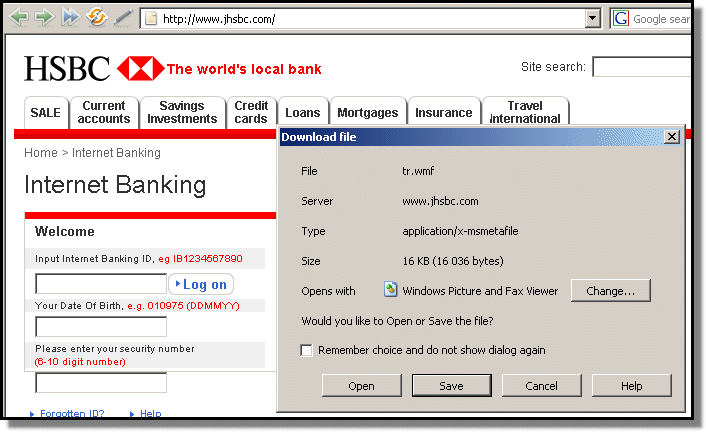
Relevant authorities and the HSBC bank have been informed and work is under progress to get this fraudulent site taken down.
by mozbe
I have been watching this one since yesterday with the bunch on the AntiVirus list. Hopefully the information out there will be clearer now that the AV companies have had time to analyze the virus.
Symantec now has a cleaner for this virus, which can be found here: http://securityresponse.symantec.com/avcenter/venc/data/w32.blackmal@mm.removal.tool.html
McAfee and F-Secure also have descriptions for this virus, with completely different names.
McAfee: W32/MyWife.d@MM
F-Secure: Email-Worm.Win32.VB.bi
Trend Micro is also tracking a WORM_NYXEM.E, that may be another variant of this worm, but no details are available of this writing.
New mass mailer spreading (Blackmal/Grew/Nyxem) (NEW)
Published: 2006-01-18,
Last Updated: 2006-01-18 03:15:12 UTC by Bojan Zdrnja (Version: 1)We got several submissions of new mass mailer worm spreading around. Besides the usual stuff that worms do these days (disable AV programs, scan the local system to find new e-mail addresses) this one is a bit more interesting as the attachment can be either an executable file or a MIME file that contains an executable file.
The sample we received had attachment named Attachments00.HQX - which is actually just an uuencoded file:
begin 664 Attachments,zip .SCR
M35J0``,````$````__\``+@`````````0```````````````````````````
M````````````````````H`````X?N@X`M`G-(;@!3,TA5&AI<R!P<F]G<F%MYou can also see a typical "insert a lot of spaces before the real extension" trick.
Detection of the worm is decent with various AV programs and they remain inconsistent for naming as always (Symantec calls this worm W32.Blackmal.E@mm, Trend Micro calls it WORM_GREW.A, while Sophos calls it W32/Nyxem-D - go figure!).
Seems like we'll have to wait more for CME.
SANS - Internet Storm Center - Cooperative Cyber Threat Monitor And Alert System.
by mozbe
Worldnic ? (NEW)
Published: 2006-01-18,
Last Updated: 2006-01-18 16:43:39 UTC by Swa Frantzen (Version: 1)We got reports that worldnic was not responding and in our preliminary search we found that all the ns?.worldnic.com DNS servers are indeed not responding to requests at this moment.
Similarly we have trouble reaching the network solutions website (redirection loop).
Observations are welcome. We'll post updates here as we know of them.
--
Swa Frantzen
SANS - Internet Storm Center - Cooperative Cyber Threat Monitor And Alert System.
by mozbe
Cisco sgbp DoS (NEW)
Published: 2006-01-18,
Last Updated: 2006-01-18 17:39:18 UTC by Swa Frantzen (Version: 1)Cisco published a report about a DoS condition on some of their routers.
It is situated in the Stack Group Bidding Protocol (sgbp) wich is used to enable bandwidth on demand using Multilink PPP (MLP).
To summarize:
- Not vulnerable if the router does not support sgbp or if it is not configured (so #show sgbp should give no output or a syntax error message).
- Workarounds are listed with ACLs to protect UDP/9900 on the affected routers.
- Upgrade to fix it
- Traffic to UDP/9900 might now be DoS attempts.
--
Swa Frantzen
SANS - Internet Storm Center - Cooperative Cyber Threat Monitor And Alert System.
by mozbe
There are bullys even in cyberspace. It is sad really.
Posted by Mikko @ 18:09 GMT
The Million Dollar homepage gained lots of publicity during new year for making Alex Tew, the 21-year old student behind it a millionaire - by selling pixels! Unfortunately it also gained the attention of a botnet gang, who have launched several DDoS attacks as well as defaced the site at least once.
According to The Times, the attackers (calling themselves the "The Dark Group") sent an extortion e-mail to Mr. Tew on January 7th, demanding $5000. When the ransom was not paid, the site was attacked, as documented on Netcraft.
A week later, Tew received another mail from the attackers, asking for $50000. And this morning, after the ransom was not paid, the whole site was defaced with a note saying "don't come back you sly dog!".
This is an interesting case, as the target is quite unusual. Instead of the usual targets (online shops, credit card merchants, gambling sites), this time the attackers are targeting a private person because they know he has the money.
Alex Tew comments on the developments in his own blog.
by mozbe
Worldnic outage (NEW)
Published: 2006-01-18,
Last Updated: 2006-01-18 19:20:33 UTC by Swa Frantzen (Version: 1)
We got reports that worldnic DNS servers were not responding and in our preliminary search we found that all the ns?.worldnic.com DNS servers were indeed not responding to requests.
For a while we had trouble reaching the network solutions website (redirection loop), next their website spoke of "a widespread outage" without more detailed information. Now it says "At 10:45 a.m. this morning, we experienced a hardware problem that impeded traffic to our hosting and e-mail servers. We experienced technical difficulties with an auto recovery system. At 11:50 a.m. the system was restored. " which would seem to indicate the problems are over.
To the more technical reader it might be clear that the problem that was reported had nothing to do with their email nor their web hosting servers, but with their DNS servers. Or perhaps these servers had issues as well, but that hardly matters to the average user when DNS isn't working as it should.Also remember
this diary about a very similar incident.
--
Swa FrantzenSANS - Internet Storm Center - Cooperative Cyber Threat Monitor And Alert System.
by mozbe
Published: 2006-01-18,
Last Updated: 2006-01-18 21:19:38 UTC by Swa Frantzen (Version: 1)Immediately after the FrSIRT public release of the exploit against Veritas NetBackup scanning for TCP/13701 started to increase dramatically.
Date Sources Targets Records 2006-01-18 156 47350 96176 2006-01-17 319 64840 202750 2006-01-16 173 19805 56116 2006-01-15 8 18 39 2006-01-14 4 3 10 2006-01-13 7 7 24
For a more detailed view:http://isc.sans.org/specialport.php?port=13701
We also provide per autonomous system reports for those managing an AS:
http://isc.sans.org/specialport.php?port=13701&as=[ASN]
SANS - Internet Storm Center - Cooperative Cyber Threat Monitor And Alert System.
by mozbe
Symbian operating system - Nokia series 60 mobile phones - 3 new Trojans
Published: 2006-01-19,
Last Updated: 2006-01-19 20:53:20 UTC by Deborah Hale (Version: 1)
For those of you with the Nokia Series 60 phones I have some bad news. Symantec today has posted 3 new trojans identified that impact your operating system.
SymbOS.Sendtool.A - The Trojan horse drops a hacktool that can be used to send malicious programs, such as variants of the SymbOS.PBStealer family of Trojans, to other mobile devices via Bluetooth.
SymbOS.Pbstealer.D - The Trojan sends the user's contact information database, Notepad, and Calendar To Do list to other Bluetooth-enabled devices.
SymbOS.Bootton.E - A Trojan horse that restarts the mobile device when executed. However, as it also drops corrupted components, the device is unable to restart.
While looking at this information - I discovered that this particular phone OS has been hit several times in the last 2 years by trojan like programs. I can't find anything on the Nokia site that indicates that a patch is available. I wonder if it isn't time for Nokia to take a serious look at fixing the problem? Especially since one of these new ones allows someone with another Bluetooth device to steal the user's information.
What about it Nokia? For those of you that own these devices, what are you doing to protect your phone?
SANS - Internet Storm Center - Cooperative Cyber Threat Monitor And Alert System.
by mozbe
Published: 2006-01-19,
Last Updated: 2006-01-19 21:18:40 UTC by Deborah Hale (Version: 1)F-Secure has issued a critical security bulletin regarding a Code Execution vulnerability that affects all of F-Secure products. The bulletin states that if you have the 2004 to 2006 versions with the Automatic Delivery System that you will be patched automatically.
For older versions or systems that are not automatically updated - the patches are available at:
http://www.f-secure.com/security/fsc-2006-1.shtmlhttp://secunia.com/advisories/18529/
Good work Thierry for discovery of this vulnerability.
SANS - Internet Storm Center - Cooperative Cyber Threat Monitor And Alert System.
by mozbe
More on Blackmal/Grew/Nyxem (file deletion payload) (NEW)
Published: 2006-01-20,
Last Updated: 2006-01-20 17:40:06 UTC by Jim Clausing (Version: 1)Following up on Bojan's story from Wednesday, F-Secure posted a bulletin today with their analysis of the current variant. The interesting (or is it scary?) part of this analysis is the revelation that on the 3rd of the month it will attempt to delete a lot of documents off the user's disks, including Office documents (*.doc, *.xls, *.ppt, *.pps), PDF files, .zip and .rar archives among others. They also report that based on a counter on a web page that the worm updates, there are in excess of 400,000 machines infected at this time.
-----------------
Jim Clausing, jclausing /at/ isc.sans.orgSANS - Internet Storm Center - Cooperative Cyber Threat Monitor And Alert System.
by mozbe
If you grew up in Missouri like I did, some of this just might hit home. :-)
Growing up in Missouri
1. You've never met any celebrities.
2. Everyone you know has been on a "Float Trip,"
3. "Vacation" means driving to Silver Dollar City, Worlds of Fun or Six Flags.
4. You've seen all the biggest bands ten years AFTER they were popular.
5. You measure distance in minutes rather than miles. For example, "Well, Webb City's only 20 minutes away."
6. Down south to you means Arkansas.
7. The phrase "I'm going to the Lake this weekend" only means one thing.
8. You know several people who have hit a deer.
9. You think Missouri is spelled with an "ah" at the end.
10. Your school classes were canceled because of cold.
11. You know what "Party Cove" is.
12. Your school classes were canceled because of heat.
13. You instinctively ask someone you've just met, "What High School did you go to?"
14. You've had to switch from "heat" to "A/C" in the same day.
15. You think ethanol makes your truck "run a lot better."
16. You know what's knee-high by the Fourth of July.
17. You see people wear bib overalls at funerals.
18. You see a car running in the parking lot at the store with no one in it, no matter what time of day.
19. You know in your heart that Mizzou can beat Nebraska in football.
20. You end your sentences with an unnecessary preposition. Example: "Where's my coat at?"
21. All the festivals across the state are named after a fruit, vegetable, or grain.
22. You install security lights on your house and garage and leave both unlocked.
23. You think of the major four food groups as beef, pork, beer, and Jell-O salad with marshmallows.
24. You carry jumper cables in your car and know that everyone else should.
25. You went to skating parties as a kid.
26. You only own three spices: salt, pepper, and ketchup.
27. You design your kid's Halloween costume to fit over a snowsuit.
28. You think sexy lingerie is tube socks and a flannel nightie.
29. The local paper covers national and international headlines on one page, but requires six pages for sports.
30. You think I-44 is spelled and pronounced "farty-far." (St. Louis only.)
31. You'll pay for your kids to go to college unless they want to go to KU.
32. You think that "deer season" is a National Holiday.
33. You know that Concordia is halfway between Kansas City and Columbia, and Columbia is halfway between St. Louis and Kansas City,
and the Warrenton Outlet Mall is halfway between Columbia and St. Louis.
34. You can't think of anything better than sitting on the porch in the middle of the summer during a thunderstorm.
35. You know which leaves make good toilet paper.
36. You've said, "it's not the heat, it's the humidity."
37. You know all four seasons: Almost Summer, Summer, Still Summer and Football.
38. You know if another Missourian is from the Boot-heel, Ozarks, Eastern, Middle or Western Missouri soon as they open their mouth.
39. You know that Harry S Truman, Walt Disney and Mark Twain are all from Missouri.
40. You failed World Geography in school because you thought Cuba, Versailles, California, Nevada, Houston, Cabool, Louisiana,
Springfield, and Mexico were cities in Missouri. (And they are!)
41. You think a traffic jam is ten cars waiting to pass a tractor.
42. You know what "HOME OF THE THROWED ROLL" means.
43. You actually get this and forward it to all your Missouri
friends.
by mozbe
What's the threat? And who is noticing it? Nyxem_e versus CME 508
Published: 2006-01-22,
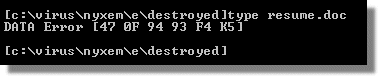
Last Updated: 2006-01-22 20:00:45 UTC by Patrick Nolan (Version: 4(click to highlight changes))CME 508 does not threaten like Nyxem_e, on February 3rd and every third day of the month thereafter Nyxem.E will destroy users work (see F-Secure's blog) when the worm activates and replaces "the content of user's files with a text string "DATA Error [47 0F 94 93 F4 K5]". Among these files are: DOC, XLS, MDB, MDE, PPT, PPS, ZIP, RAR, PDF, PSD and DMP" "on all available drives", and yes, available = shared drives.
fwiw, I look at published email malware statistics daily, both Nyxem_e and CME 508 are approximately the same in volume reports, and nowhere near sober was last year as far as raw numbers go. But Nyxem.E has legs, it's more like a centipede than a worm, and it's not likely to drop off the radar soon, certainly not before the 3rd of February.
The Handlers diary previously referenced Nyxem.E in More on Blackmal/Grew/Nyxem (file deletion payload.
Source info - see the F-Secure Virus Information Pages : Nyxem.EThe vendors below do not mention the destruction of user work, as of the checking I just did, ymmv.
Also Known As:WORM_GREW.{A, B} [Trend Micro],
"It gathers email addresses from files with the following extension names:DMP
DOC
MDB
MDE
PPS
PPT
PSD
RAR
XLS
ZIP".W32.Blackmal.E@mm Symantec
W32/Nyxem-D [Sophos],
W32/MyWife.d@MM [McAfee],
W32/Grew.A!wm (Fortinet),
W32/Small.KI@mm [Norman],
Win32/Blackmal.F [Computer Associates]
Tearec.A Panda
UPDATE
The CME reference is difficult but not impossible to follow. I'm reading CME links which show "Latest CME Identifiers CME-508", however, that last 508 link has english that says the newest CME-ID is "CME-503 - Date Assigned 2006-01-20". In any event I base my comment that "CME-508" is not a threat because I interpret vendor malware write-ups mentioning CME 503 as the "new" threat called CME-508 at cme.mitre.org. The vendors are listing 503, none are using 508 ......SANS - Internet Storm Center - Cooperative Cyber Threat Monitor And Alert System.
by mozbe
More on Nyxem
Published: 2006-01-23,
Last Updated: 2006-01-23 22:13:35 UTC by Bojan Zdrnja (Version: 1)Although Nyxem is comparatively less spread then worms like Sober or Netsky, it's still doing a fair number of rounds.
The graph below is from one of the e-mail gateways with a decent number of e-mails processed daily (around 500.000+). You can see that Nyxem.E is the top malware instance detected in last 24 hours, with more than double the occurences then the next highest occuring worm (Netsky).
This is not strange as the Web counter that the worm visits upon infecting the machine currently shows around 630,000 infections (we can't be sure that this number is correct). Bert Rapp e-mailed us asking about the URL that the worm visits. This can help you in determining if a machine is infected, as it will visit the URL with the counter.
The counter is at:
h tt p:// webstats.web.rcn.net/ [REMOVED] / Count.cgi?df=765247
You can search your web logs for this host name (which looks as a legitimate site).
Other than that, Fortinet released their in-depth analysis of the Nyxem worm with some pretty interesting details (you can find the original analysis here).
The most interesting part, which I haven't seen in other analysis of the worm says:"Additional Registry Changes
- The virus is coded to register the dropped ActiveX control through changes to the system registry. By creating the following registry entries, the control is considered "safe" and digitally signed."
The threat of worms like this will make them much more dangerous in the future. If a worm puts a fake CA certificate on an infected machine, MITM attacks become extremely easy. Of course, we all know that once the machine is infected you can't trust it, but this looks like another (big) problem for the average user out there.
SANS - Internet Storm Center - Cooperative Cyber Threat Monitor And Alert System.
by mozbe
BlackWorm Summary (NEW)
Published: 2006-01-24,
Last Updated: 2006-01-24 17:04:18 UTC by Johannes Ullrich (Version: 1)About BlackWorm
Over the last week, "Blackworm" infected more then 700,000 systems as measured using a counter web site used by the worm to track itself. This worm is different and more serious then other worms for a number of reasons. In particular, it will delete a user's files on February 3rd.
At this point, the worm will be detected by up to date anti virus signatures. In order to protect yourself from data loss on February 3rd, you should use current (Jan 23rd or later) anti virus signatures.
We will try to postmore detailed cleanup instructions later. However, it is likely that you will have to rebuild the system from scratch. Obtaining good backups is critical as a first step.
The first thing you should do is to update your anti virus signatures.
This page will be updated as new information becomes available. Please see the end of the page references to other sites.
Naming
As usual, this worm/virus has collected a number of names from various vendors. It is so far known as: Blackmal, Nyxem, MyWife, Tearec among other names. At this time, a CME ID number is not yet available.
Snort Signatures
Joe Steward (Lurhq.com) provided the following snort signatures based on his analysis of the worm:
- This sig alerts if someone visits any counter at webstats.web.rcn.net without a Referrer: header in their URL. Could be an infected user, could be one of us checking out the counter stats:
alert tcp any any -> any 80 (msg:"webstats.web.rcn.net count.cgi request without referrer (possible BlackWorm infection)";content:"GET /cgi-bin/Count.cgi|3f|"; depth:23; content:"df|3d|";content:"Host|3a 20|webstats.web.rcn.net"; content:!"Referer|3a|";classtype:misc-activity; sid:1000376; rev:1;)- This sig alerts on the specific pattern BlackWorm uses to test connectivity to www.microsoft.com. It's unique in that the request doesn't have a User-agent: header. So this will catch BlackWorm and possibly other automated requests to microsoft (which could happen if someone codes a sloppy app that uses the exact same pattern - but they should probably be flogged anyway)
alert tcp any any -> any 80 (msg:"Agentless HTTP request towww.microsoft.com (possible BlackWorm infection)"; dsize:92;content:"GET / HTTP/1.1|0d0a|Host|3a20|www.microsoft.com|0d0a|Connection|3a20|Keep-Alive|0d0a|Cache-Control|3a20|no-cache|0d0a0d0a|";classtype:misc-activity; sid:1000377; rev:1;)Credits
We would like to thank the members of the BlackWrom task force for analysis and coordination. This task force involves many in the security (anti spam, CERTs, anti virus, academia, ISP's, etc.) community and industry, working together to combat threats to the security of the Internet in cooperation with law enforcement globally.
Links
http://blogs.securityteam.com
Symantec
Trend Micro
Note: some of these links will offer removal tools. We have not tested any of these tools thoroughly enough to recommend them. They should be used as a "first try" tool, but do not substitute for a full analysis and possible rebuild of the infected system. BlackWorm includes the ability to install additional components. These additional components, if installed, will likely be missed. In addition, a virus like BlackWorm is likely an indication of a more fundamental problem in your security posture and multiple infections are likely.
SANS - Internet Storm Center - Cooperative Cyber Threat Monitor And Alert System.
by mozbe
Published: 2006-01-25,
Last Updated: 2006-01-26 17:56:37 UTC by Johannes Ullrich (Version: 1)Blackworm infected machines reported to a 'counter' site the fact that they got infected. The TISF BlackWorm task force obtained the logs from this counter, and is notifying networks represented in the logs. These notifications will use a from address of "handlers@sans.org" or "Randy_Vaughn@Baylor.edu". Please e-mail jullrich\at/sans.org if you would like to obtain a list for your network, and have not received an automated e-mail.
Please include information to support that your e-mail address is associated with administering the respective networks, or a phone number to validate the information.
Update: We are getting A LOT of requests. Please do not forget to include the IP space you are interested in. Quite a number of people responded that these logs helped them identify infected systems and it likely prevented major data loss to these organizations. BIG THANKS to RCN for providing the counter logs in a timely manner. We could not provide this service without their help.
SANS - Internet Storm Center - Cooperative Cyber Threat Monitor And Alert System.
by mozbe
BlackWorm Summary
Published: 2006-01-26,
Last Updated: 2006-01-27 02:01:42 UTC by Johannes Ullrich (Version: 3(click to highlight changes))About BlackWorm
Over the last week, "Blackworm" infected about 300,000 systems based on analysis of logs from the counter web site used by the worm to track itself. This worm is different and more serious than other worms for a number of reasons. In particular, it will overwrite a user's files on February 3rd.
At this point, the worm will be detected by up to date anti virus signatures. In order to protect yourself from data loss on February 3rd, you should use current (Jan 23rd or later) anti virus signatures. Note, however, that the malware attempts to disable/remove any anti-virus software on the system (and does this every hour while the system is up), so if the machine was infected before signatures were deployed, obviously, that anti-virus software can't be expected to clean up the infection for you.
The following file types will be overwritten by the virus: DOC, XLS, MDE, MDB, PPT, PPS, RAR, PDF, PSD, DMP, ZIP. The files are overwritten with an error message( 'DATA Error [47 0F 94 93 F4 K5]').
We will try to post more detailed cleanup instructions later. However, it is likely that you will have to rebuild the system from scratch. Obtaining good backups is critical as a first step.
The first thing you should do is to update your anti virus signatures.
This page will be updated as new information becomes available. Please see the end of the page for references to other sites. Use only this url to link to this page: http://isc.sans.org/blackworm
Naming
As usual, this worm/virus has collected a number of names from various vendors. It is so far known as: Blackmal, Nyxem, MyWife, Tearec among other names. Update: we have been informed that the CME number will be 'CME-24'. cme.mitre.org should shortly list this number.
How would I get infected?
The worm spreads via e-mail attachments or file shares. Once a system in your network is infected, it will try to infect all shared file systems it has access to. You may see a new "zip file" icon on your desktop.
What will BlackWorm do to my system?
It will disable most anti virus products and delete them. The worm will e-mail itself using a variety of extensions and file names. It will add itself to the list of auto-start programs in your registry.
Removal
Anti virus vendors offer removal tools. Microsoft provides detailed instructions for manual removal. However, there are two important reasons to rebuild "from scratch":
- BlackWorm uses the same tricks to install itself as other viruses/worms. It may not be the only one on your system. Antivirus will not detect all viruses, and the removal tool will only remove this specific worm.
- BlackWorm will allow remote access to your system, and additional malware may have been installed via this backdoor.
To read the rest of this post, go here: SANS - Internet Storm Center - Cooperative Cyber Threat Monitor And Alert System.
by mozbe
For even more comprehensive information on this virus go here: http://www.isc.sans.org/blackworm
Microsoft Security Advisory (904420)
Win32/Mywife.E@mm
Published: January 30, 2006
Microsoft wants to make customers aware of the Mywife mass mailing malware variant named Win32/Mywife.E@mm. The mass mailing malware tries to entice users through social engineering efforts into opening an attached file in an e-mail message. If the recipient opens the file, the malware sends itself to all the contacts that are contained in the system’s address book. The malware may also spread over writeable network shares on systems that have blank administrator passwords.
Customers who are using the most recent and updated antivirus software could be at a reduced risk of infection from the Win32/Mywife.E@mm malware. Customers should verify this with their antivirus vendor. Antivirus vendors have assigned different names to this malware but the Common Malware Enumeration (CME) group has assigned it ID CME-24.
On systems that are infected by Win32/Mywife@E.mm, the malware is intended to permanently corrupt a number of common document format files on the third day of every month. February 3, 2006 is the first time this malware is expected to permanently corrupt the content of specific document format files. The malware also modifies or deletes files and registry keys associated with certain computer security-related applications. This prevents these applications from running when Windows starts. For more information, see the Microsoft Virus Encyclopedia.
As with all currently known variants of the Mywife malware, this variant does not make use of a security vulnerability, but is dependant on the user opening an infected file attachment. The malware also attempts to scan the network looking for systems it can connect to and infect It does this in the context of the user. If it fails to connect to one of these systems, it tries again by logging on with "Administrator" as the user name together with a blank password.
Read the rest of this advisory here: Microsoft Security Advisory (904420): Win32/Mywife.E@mm.
by mozbe
Tuesday, January 31, 2006
First reports of Nyxem damage Posted by Mikko @ 16:24 GMT
The destructive deadline of the Nyxem.E worm is based on the clock of the infected machine. So if you're infected and your clock is not set right, things could start to happen at any time - even though the official activation time is the 3rd of the month. We've already received first reports from users who've had files on their system overwritten by the worm.
When Nyxem activates, it will overwrite all of your DOC/XLS/PPT/ZIP/RAR/PDF/MDB files. This is nasty, as this is done on all mounted drives, ie. any drive that has a drive letter. So it might affect your USB thumb drives, external hard drives and network drives! Also, if you're taking daily automatic backups you might end up backing up the corrupted files over good files.
The number of machines that have been hit by this worm is over 300,000. Many of those have been disinfected already, though. But thousands of computers will get their files overwritten on February 3rd - most of them in India, Turkey and Peru.
This worm family has been around since March 2004. The worm is named "Nyxem" because the original Nyxem.A variant launched a DDoS attack against the New York Mercantile Exchange website (www.nymex.com). We don't know why.
We have a free tool available to help disinfect machines before the deadline passes.
by mozbe
Cisco VPN 3000 crafted HTTP attack (NEW)
Published: 2006-02-01,
Last Updated: 2006-02-01 16:59:47 UTC by Adrien de Beaupre (Version: 1)
The Cisco advisory is located at:
http://www.cisco.com/en/US/products/hw/vpndevc/ps2284/products_security_advisory09186a00805f0147.shtmlApparently version 4.7.2(C) resolves this issue.
The workaround is to disable HTTP.This remote exploit involves sending a small stream (less than 50 packets) of tcp/80 traffic to a Cisco VPN 3000 Concentrator appliance running the WebVPN service. After this occurs, all sessions currently accessing the appliance are dropped, and no further communication is possible until the system is powered down and restarted. No authentication or credentials are required to exercise this vulnerability.
By default, the WebVPN Service permits both tcp/80 (HTTP) and tcp/443 (HTTPS) inbound; the appliance performs a redirect from the HTTP query to the HTTPS. The vulnerability exists within the code base responsible for the redirect.
From: http://www.esentire.com/news/vuln-cisco-vpn.html
Cheers,
Adrien
SANS - Internet Storm Center - Cooperative Cyber Threat Monitor And Alert System.
by mozbe
nmap 4.00 released (NEW)
Published: 2006-02-01,
Last Updated: 2006-02-01 18:44:46 UTC by Adrien de Beaupre (Version: 1)
nmap has got to be one of my favourite and oft used tools.
I am using it as I type this :)From nmap-hackers:
Hot on the heels of 3.9999 (you could probably guess this was
coming), I am pleased to announce that Nmap 4.00 is now available!Documentation: http://www.insecure.org/nmap/docs.html
Download: http://www.insecure.org/nmap/download.html
Release Announcement:
http://www.insecure.org/stf/Nmap-4.00-Release.htmlCheers,
Adrien
SANS - Internet Storm Center - Cooperative Cyber Threat Monitor And Alert System.
by mozbe
********************************************************************
Title: Microsoft Security Bulletin Minor Revisions
Issued: February 1, 2006
********************************************************************
Summary
=======
The following bulletins have undergone a minor revision increment.
Please see the appropriate bulletin for more details.
* MS05-054
Bulletin Information:
=====================
* MS05-054
- http://www.microsoft.com/technet/security/bulletin/MS05-054.mspx
- Reason for revision: Bulletin revised to call out that defense-in-depth improvements have also been made to the
kill-bit mechanism.
- Originally posted: December 13, 2005
- Updated: February 1, 2006
- Bulletin Severity Rating: Critical
- Version: 1.1
by mozbe
********************************************************************
Title: Microsoft Security Advisory Notification
Issued: February 1, 2006
********************************************************************
Security Advisories Updated or Released Today ==============================================
* Security Advisory (904420)
- Title: Win32/Mywife.E@mm
- Reason For Update: Additional information about the blank password restriction functionality in Windows XP Service Pack 1,
Windows XP Service Pack 2, Windows Server 2003, and Windows Server 2003 Service Pack 1. Added link to Virus Information
Alliance member Sophos.
- Web site: http://go.microsoft.com/fwlink/?LinkId=50423
by mozbe
Prepraring for Feb 3rd(CME-24) (NEW)
Published: 2006-02-02,
Last Updated: 2006-02-02 16:07:43 UTC by Pedro Bueno (Version: 1)Prepraring for Feb 3rd(CME-24)
We received a lot of suggestions about measures against CME-24. In other words,
how to prepare for Feb 3rd, in despite of the Anti-virus.What follows bellow is a compiled list of those. Some were tested, but some not.
- The rule bellow, made by Per Kristian Johnsen with Telenor Security Center,
is said to detect attempts to copy WINZIP_TMP.exe to shares. According to the author,
they are being able to detect infected machines where the already published
snort/sourcefire rule couldn't:alert tcp any any -> any 135:139 (msg:"Nyxem attempting to copy WINZIP_TMP.exe to shares"; flow:to_server,established; content:"|57 00 49 00 4e 00 5a 00 49 00 50 00 5f 00 54 00 4d 00 50 00 2e 00 65 00 78 00 65|"; reference:url,www.lurhq.com/blackworm.html; classtype:trojan-activity; sid:5000173; rev:1;)
- We had another user that used sms to scan drives files with a size of 95,690 named (Bloggers note: I have been doing this query too, but missed the files size part)
%Windir%\Rundll16.exe
%System%\scanregw.exe
%System%\Winzip.exe
%System%\Update.exe
%System%\WINZIP_TMP.EXE
%System%\SAMPLE.ZIP
%System%\New WinZip File.exe
movies.exe
Zipped Files.exe- A security Dweeb at a large California municipal government agency wrote a batch script that:
"1) looks for the infected file names existence
on %windir% and %sysdir% using simple DIR /B commands. Output is sent to
uniquely named text file (with a non-standard extension). Infected
workstations will show a non-zero file size. Batch file is below; uses
environment vars that are unique to user and computer name.
2) The batch file will be placed in the login script for all
computers.
3) Ensure that verified backups are completed tonight (Wed).Batch file:
@echo off
dir /b %WinDir%\system\\Winzip.exe >> %username%_%computername%.rgh
dir /b %WinDir%\system\Update.exe >> %username%_%computername%.rgh
dir /b %WinDir%\system\scanregw.exe >> %username%_%computername%.rgh
dir /b %WinDir%\Rundll16.exe >> %username%_%computername%.rgh
dir /b %WinDir%\winzip_tmp.exe >> %username%_%computername%.rgh
dir /b c:\winzip_tmp.exe >> %username%_%computername%.rgh
dir /b %Temp%\word.zip .exe >>
%username%_%computername%.rghAlthough dangerous, we think we have a very low chance of a problem.
According to LURQ, there are only 15K computers in US that have
contacted the "counter" site. And we have other protections in place
(blocking of all executables in mail attachments, current anti-virus
updates, etc.)"-----------------------------------------------------------------
Handler on Duty: Pedro Bueno ( pbueno //&&// isc. sans. org )SANS - Internet Storm Center - Cooperative Cyber Threat Monitor And Alert System.
by mozbe
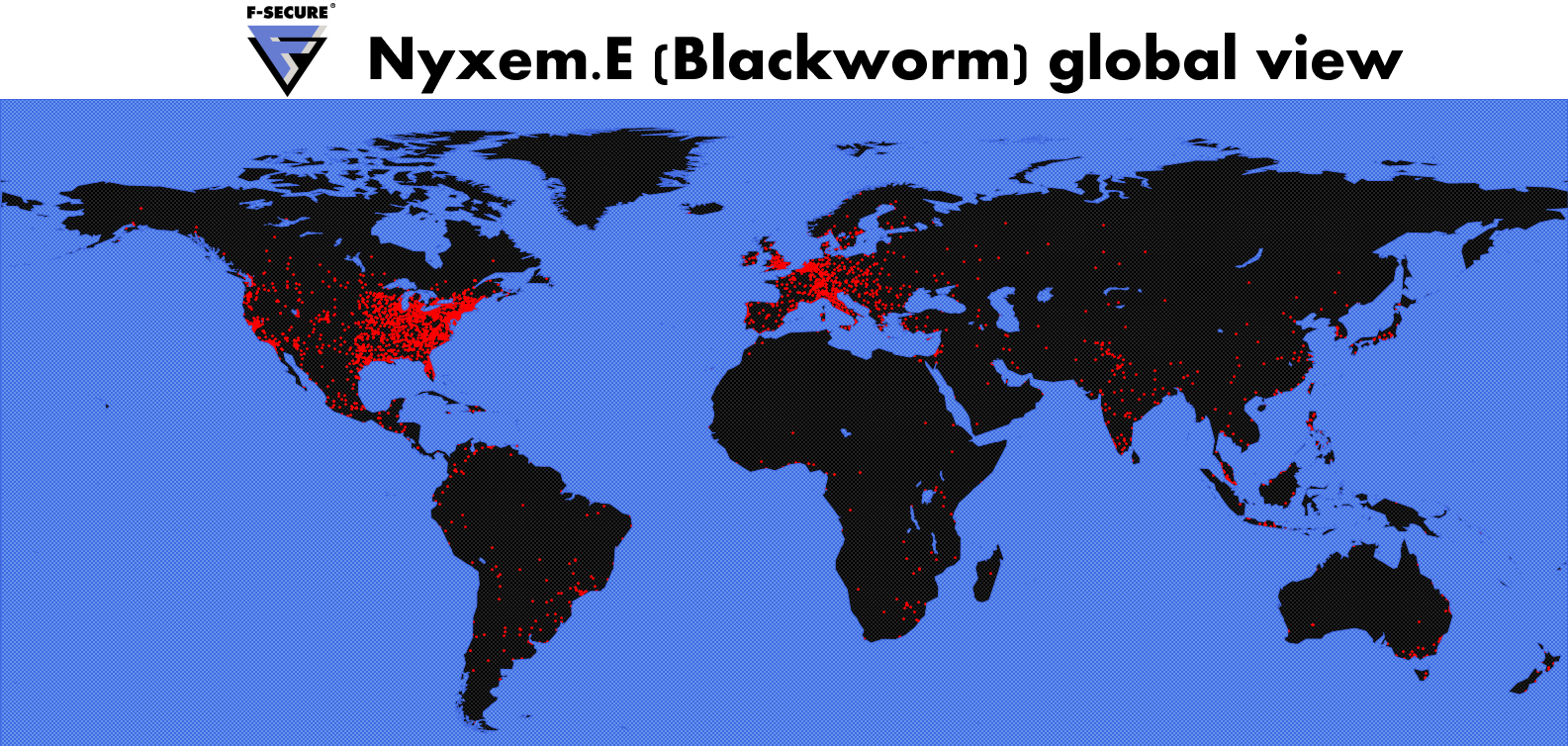
Nyxem on a world map Posted by Mikko @ 14:31 GMT
We have been co-operating with RCN, the company running the counter site that is used by the Nyxem worm. Last night we got the web access statistics, listing all the IP addresses that have accessed the Nyxem counter.
After filtering out the addresses of bots that have been hammering the counter lately, we used our WORLDMAP technology to map the addresses to a map. As a result we have a global view of the machines that will run into trouble unless they are disinfected before tomorrow:
- click the map for a high-resolution version -Nyxem.E starts to overwrite files half an hour after the infected machines are started on the 3rd of the month.
We'd like to thank Jason Nealis and Chris Jackman at RCN for their generous help with this issue.
by mozbe
CME-24 Analysis: The destruction does not appear to spread across Windows network shares (NEW)
Published: 2006-02-02,
Last Updated: 2006-02-02 17:39:40 UTC by Lorna Hutcheson (Version: 1)
I wanted to share some of the results of some long hours spent looking at this malware. When the infection occurs, it immediately places copies of itself locally on each share and on each share/mapped drive that it finds. Based on this behavior, my initial thoughts were that the destructive payload would be carried out via shares and/or mapped drives as well.
I now have changed my initial thoughts on how the destruction would occur. Here are some of my notes from my testing of this concept. Here is the MD5 from the file I was using:
1c66904ecb846da5b1fb2072f9ea6e0e *New WinZip File.exeThe first test I did led me to believe that the destruction would be carried out via the shares and mapped drives. In my intial test, I had two infected systems (one XP and one W2K) with drives mapped to each other. I infected each box, changed the system time to Feb 2 at 11:50pm, launched ethereal, filemon and ran the the first shot using RegShot. After an hour, I stopped the captures and launched my second shot of the hard drive with RegShot. All my data files were now over written, zip files were corrupted, etc. Everything was happening as I thought it would. All my mapped drives had corrupted files. The security logs from each box showed accesses from the other.
For the rest of this in depth analysis, go here: SANS - Internet Storm Center - Cooperative Cyber Threat Monitor And Alert System.
by mozbe
Latest version of Firefox is out which has some security and stability fixes in it. I highly recommend it.
February 1, 2006. Firefox 1.5.0.1 is a stability and security update that is part of our ongoing program to provide a safe Internet experience for our customers. We recommend that all users upgrade to this latest version.
Here's what's new in Firefox 1.5.0.1:
The Burning Edge has more detailed lists of notable bug fixes.
Download it here: http://www.mozilla.com/firefox/
by mozbe
Symantec put a description up for W32.Kiman.A sometime yesterday evening, and it already must be causing some damage since they had a removal tool available by 7PM (central time). That tool can be found here: http://securityresponse.symantec.com/avcenter/venc/data/w32.kiman.removal.tool.html This is definitely a worm to be on the lookout for.
The Internet Storm Center is also looking for samples of this worm, go here for more information: http://www.isc.sans.org/diary.php?storyid=1093
Information from Symantec’s description as follows:
W32.Kiman.A is a worm that has distributed denial of service and back door capabilities. The worm spreads by copying itself to network shares protected by weak passwords or by exploiting computer vulnerabilities.
Note: Virus definitions dated prior to February 2, 2006 may detect this as W32.Spybot.Worm
When W32.Kiman.A is executed, it performs the following actions:
Note: %System% is a variable that refers to the System folder. By default this is C:\Windows\System (Windows 95/98/Me), C:\Winnt\System32 (Windows NT/2000), or C:\Windows\System32 (Windows XP).
"Domain Name Resolve Service" = "dnsresolver.exe"
to the registry subkeys:
HKEY_CURRENT_USER\Software\Microsoft\OLEso that it runs every time Windows starts
in the registry subkey:
HKEY_LOCAL_MACHINE\Software\Microsoft\OLE
to disable DCOM.
"restrictanonymous" = "1"
in the registry subkey:
HKEY_LOCAL_MACHINE\SYSTEM\CurrentControlSet\Control\Lsa
to restrict null sessions.
Note:
"TransportBindName" =" "
to the registry subkey:
HKEY_LOCAL_MACHINE\SYSTEM\CurrentControlSet\Services\NetBT\Parameters
to change the system configuration.
"Start" = "4"
to the registry subkeys:
HKEY_LOCAL_MACHINE\SYSTEM\CurrentControlSet\Services\SharedAccess"EnableRemoteConnect" = "N"
to the registry subkey:
HKEY_LOCAL_MACHINE\SOFTWARE\Microsoft\Oleto change the system configuration.
"Enabled" = "0"
to the registry subkey:
HKEY_LOCAL_MACHINE\SYSTEM\CurrentControlSet\Control\to change the system configuration.
to the registry subkey:
HKEY_LOCAL_MACHINE\SYSTEM\CurrentControlSet\Services\to change the system configuration.
to the registry subkey:
HKEY_LOCAL_MACHINE\SYSTEM\CurrentControlSet\Services\Tcpip\Parametersto change the system configuration.
to the registry subkey:
HKEY_CURRENT_USER\Software\Microsoft\Windows\CurrentVersion\Internet Settingsto change the system configuration.
by mozbe
McAfee has updated their Stinger virus removal tool, but so far I haven’t been able to find out why. Maybe their page will be updated with that info as the day goes on.
Download Stinger here: http://vil.nai.com/vil/stinger/
by mozbe
Harry Waldron has shared some information on one new Bagle variant already, but it appears that another one is already showing up on some antivirus vendor websites.
These variants appear to be identical, except for the e-mails that the variants construct to help it spread. Both will try to do the following:
Here is a rundown of vendor names so far:
Bagle variant that uses subject line of “price” or “February price”
Symantec: W32.Beagle.DL@mm
McAfee: W32/Bagle.dp@MM
Sophos: Troj/BagleDI-BK
Panda: W32/Bagle.GS.worm
Bagle variant that uses subject line of the following:
Symantec: W32.Beagle.DM@mm
McAfee: W32/Bagle.do@MM
Trend Micro: WORM_BAGLE.CL
Panda: W32/Bagle.GR.worm
by mozbe
Man, what a trooper…
MMS 2006
I have been asked a number of times if I will be going to MMS 2006. A new employee started in my dept. He will be going to MMS along with Mosby.
Since there aren't any discounts for MVPs for MMS, and I didn't wanna get trampled by the mad dash of Mosby fanatics, I won't be going.
-JFH
John Hann's MOM-O-RAMA : MMS 2006.
by mozbe
Windows local privilege escalation - Windows access control
Published: 2006-02-03,
Last Updated: 2006-02-03 19:25:20 UTC by Swa Frantzen (Version: 1)
On January 31st 2006, a paper was published by Sudhakar Govindavajhala and Andrew W. Appel at the
Princeton University titled Windows Access Control Demystified. It took the hacker tool developers just a few days to publicly release their first exploit referencing it. The exploit allows local escalation of privileges. On an OS typically used by users who are all administrators that might not be considered the biggest thing ever. Still, it should be fixed by all vendors involved.Now for the average administrator it might seem nearly ridiculous that allowing just one right too many can escalate that user begin able to run an arbitrary executable with all local rights he could wish for. Worse the problem is so obscure that many applications including some made by Microsoft and bundled with Windows XP did have that one too many right in it (uPnP and SSDP). Not only did they goof on it, so did Adobe, AOL, Macromedia and probably a few more.
I cannot help but notice the whole system of access control used in windows is rather complex and that might very well be the core of the problem. KISS is after all a principle that has proven through the years to work best in many cases.
Anyway that document and its implications are mandatory reading if you want to take away local admin rights of any user with any success. The consequence is as well that installing any software for any user needs to be done with extreme caution and security verification. Even is that one user needing the extra software is not your most restricted user, it still needs the full verification.
It is also mandatory for any developer making any application to understand this fully.And as I said, I don't think it's easy to fully comprehend.
--
Swa Frantzen
SANS - Internet Storm Center - Cooperative Cyber Threat Monitor And Alert System.
by mozbe
Here are some great reasons on why the Blackworm virus damage was so light..
Nyxem: nothing happened? Posted by Mikko @ 13:46 GMT
So, Nyxem.E had infected hundreds of thousands of computers over the last two weeks. It activated on Friday, overwriting data. But almost nobody reported any problems. So what happened?
Well, probably several things, including:
- The amount of machines that were really infected still on Friday was much smaller than the total amount of machines that got infected (and cleaned) during the whole outbreak. This number is probably in the tens of thousands. Which is not a lot of computers out of, say, one billion computers in the world.
- Many of the infected machines were not rebooted on Friday. They were simply running all the time. The worm only does damage when you start the machine on the 3rd.
- Many infected home machines were shut down all of Friday, and nothing happened. People went to movies, bars, parties on Friday night instead of surfing.
- The media coverage on the whole incident prompted many people to check their system and clean them up in time.
So, does this mean there weren't any problems reported, anywhere? Well, no. We had some isolated support calls to our country offices from home users who were hit. And a partner company of ours in USA was contacted with a company that had one of their Windows servers hit.
And there were some unconfirmed online reports of problems. You can find examples if you dig online forums and usenet groups. See some examples below:
Newsgroups: microsoft.public.excel.misc
From: "=?Utf-8?B?bXVydWdhbl9oc0B5YWhvby5jb20=?="
Message-ID: <28359196-6432-4491-8D36-7BDFB9B5AA24@microsoft.com>
Subject: data error while opening files
Date: Wed, 18 Jan 2006 22:18:02 -0800
when i open excel or word existing file i getting contents as "DATAError
[47 0F 94 93 F4 K5]" instead of my saved data.
pls help me solving. My all word & excel files are have same problem.
Newsgroups: microsoft.public.excel.misc
From: "saran"
Message-ID: <1138951099.309207.324010@z14g2000cwz.googlegroups.com>
Subject: Re: data error while opening files
Date: 2 Feb 2006 23:18:19 -0800
i am also having the same problem i thing the virus webmal can corrupt
the dat if u got the solution pls send it to me
Newsgroups: Yummypinays
From: Elpidio Garcia
Date: Fri, 3 Feb 2006 05:03:39 +0000 (GMT)
Subject: [YP] HHHHHHHHHHHHelp!!!!!!! anyone...
...i found out that all my files particularly office docs were corrupted
and only shows this message everytime i open my files,
DATA Error [47 0F 94 93 F4 K5]
Newsgroups: microsoft.public.fr.excel
From: aougarferhat
Subject: c'est quoi data error 47 0F 94 93 F4 K5?
Date: Sat, 4 Feb 2006 14:41:45 -0800
......
F-Secure : News from the Lab - February of 2006.
by mozbe
CAIDA Report on Blackworm (NEW)
Published: 2006-02-06,
Last Updated: 2006-02-06 19:08:32 UTC by Marcus Sachs (Version: 1)An analysis by David Moore and Colleen Shannon at CAIDA of the spread of the Nyxem (or Blackworm or Kama Sutra or MyWife or CME 24) Virus in January and early February 2006 is available from their web site. This is a very nice analysis with descriptions, charts, graphs, and figures.
SANS - Internet Storm Center - Cooperative Cyber Threat Monitor And Alert System.
by mozbe
Got this from our TAM this morning…
————————————————————————————————————————————————————————————————————-
This Alert is to advise you that Microsoft Security Advisory (914457), Possible Vulnerability in Windows Services ACL's, has been released on 7 February 2006.
Microsoft is aware of published information and proof-of-concept code that that attempts to exploit overly permissive access controls on third- party (i.e., non-Microsoft) application services. This code also attempts to exploit default services of Windows XP Service Pack 1 and Windows Server 2003. If these attempts were successful, a user who has low user privileges could gain privilege escalation.
Microsoft has investigated these reports and the findings are summarized in the chart below. Microsoft has confirmed that customers who run Windows XP Service Pack 2 and Windows Server 2003 Service Pack 1 are not vulnerable to these issues because security-related changes were made to these service packs as part of our ongoing security improvement process.
Users who run Windows XP Service Pack 1 and Windows Server 2003 Gold may be at risk, but the risk to Windows Server 2003 users is reduced.
Users are encouraged to contact their third-party software vendors whose products require services installation to determine if any non-default Windows services are affected.
Microsoft is not aware of any attacks attempting to use the reported vulnerabilities or of customer impact at this time. Microsoft will continue to investigate the public reports to help provide additional guidance for customers as necessary.
Mitigating Factors:
* The latest Microsoft operating systems, including Windows XP Service Pack2 and Windows Server 2003 Service Pack 1 are not vulnerable to these issues.
* A malicious user who launches an attack based on the finder's report would require at least authenticated user access to the affected operating systems
* Two of the four services identified in the paper (NetBT and SCardSvr) require an attacker to already be running in a privileged security context. Additionally, the two services that do allow an authenticated user to attack are vulnerable only on Windows XP Service Pack 1.
* Firewall best practices and standard default firewall configurations can help protect from attacks that originate outside the enterprise perimeter. Best practices also recommend that personal firewalls be used within a network and that systems connected to the Internet have a minimal number of ports exposed.
More information can be found:
http://www.microsoft.com/technet/security/advisory/914457.mspx
by mozbe
Another one from our TAM. This one involves WMF files again, but older versions of IE.
—————————————————————————————————————————————————
This Alert is to advise you that Microsoft Security Advisory (913333), A vulnerability in Internet Explorer could allow remote code execution, has been released on 7 February 2006.
Microsoft is investigating new public reports of a vulnerability in older versions of Microsoft Internet Explorer. Based on our investigation, this vulnerability could allow an attacker to execute arbitrary code on the user's system in the security context of the logged-on user. The attacker could do this by one or more of the following actions:
* By hosting a specially crafted Windows Metafile (WMF) image on a malicious Web site;
* By convincing a user to open a specially crafted e-mail attachment;
* By convincing a user to click on a link in an e-mail message that takes the user to a malicious Web site; or
* By sending a specially crafted e-mail message to Outlook Express users, which they view in the preview pane.
Note: This is not the same issue as the one addressed by Microsoft Security Bulletin MS06-001 (912919).
The vulnerability exists in:
* Internet Explorer 5.01 Service Pack 4 on Microsoft Windows 2000 Service Pack 4
* Internet Explorer 5.5 Service Pack 2 on Microsoft Windows Millennium.
The vulnerability does not exist in:
* Internet Explorer for Microsoft Windows XP Service Pack 1 and Windows XP Service Pack 2
* Internet Explorer for Microsoft Windows XP Professional x64 Edition
* Internet Explorer for Microsoft Windows Server 2003 and Windows Server 2003 Service Pack 1
* Internet Explorer for Windows Server 2003 for Itanium-based Systems
* Internet Explorer for Windows Server 2003 with Service Pack 1 for Itanium-based Systems
* Internet Explorer for Windows Server 2003 x64 Edition
* Internet Explorer 6 Service Pack 1 on Microsoft Windows 2000 Service Pack 4
* Internet Explorer 6 Service Pack 1 on Microsoft Windows 98
* Internet Explorer 6 Service Pack 1 on Microsoft Windows 98 Second Edition
* Internet Explorer 6 Service Pack 1 on Windows Millennium Edition
Microsoft has determined that an attacker who exploits this vulnerability would have no way to force users to visit a malicious Web site. Instead, an attacker would have to persuade them to visit the Web site, typically by getting them to click a link that takes them to the attacker's Web site. It could also be possible to display specially crafted Web content by using banner advertisements or by using other methods to deliver Web content to affected systems. In an e-mail based attack, customers would have to click a link to the malicious Web site, preview a malicious e-mail message, or open an attachment that exploited the vulnerability. In both Web-based and e-mail based attacks, the code would execute in the security context of the logged-on user. Users whose accounts are configured to have fewer user rights on the system could be less impacted than users who operate with administrative user rights.
Microsoft will continue to investigate these reports and provide additional guidance depending on customer needs.
Upon completion of this investigation, Microsoft will take appropriate action to help protect our customers. This may include providing a security update through our monthly release process or providing an out-of-cycle security update, depending on customer needs. Microsoft encourages users to exercise caution when they open e-mail and links in e-mail from untrusted sources. For more information about Safe Browsing, visit the Trustworthy Computing Web site (http://www.microsoft.com/security/incident/settings.mspx).
We continue to encourage customers to follow our Protect Your PC guidance of enabling a firewall, applying software updates and installing antivirus software. Customers can learn more about these steps at the Protect Your PC Web site (http://www.microsoft.com/protect/).
Mitigating Factors:
* In a Web-based attack scenario, an attacker would have to host a Web site that contains a Web page that is used to exploit this vulnerability. An attacker would have no way to force users to visit a malicious Web site. Instead, an attacker would have to persuade them to visit the Web site, typically by getting them to click a link that takes them to the attacker's Web site.
* In an e-mail based attack of this exploit, customers would have to open a malicious e-mail message, preview a malicious e-mail message in the Outlook Express preview pane, click on a link that would take them to a malicious Web site, or open an attachment that could exploit the vulnerability. Users can disable the preview pane in Outlook Express and delete the suspicious e-mail message without opening the e-mail message.
* In an e-mail based attack of this exploit, customers would have to open a malicious e-mail message, preview a malicious e-mail message in the Outlook preview pane, click on a link that would take them to a malicious Web site, or open an attachment that could exploit the vulnerability. Users can disable the preview pane in Outlook and delete the suspicious e-mail message without opening the e-mail message.
Customers who read e-mail in plain text in Outlook would have to click on a link that would take them to a malicious Web site, or open an attachment to be at risk from this vulnerability.
* An attacker who successfully exploited this vulnerability could gain the same user rights as the local user. Users whose accounts are configured to have fewer user rights on the system could be less impacted than users who operate with administrative user rights.
* Customers who have installed Internet Explorer 6 Service Pack 1 are not affected by this vulnerability.
* Internet Explorer 6 Service Pack 1 is the only supported version for Windows 98 and Windows 98 Second Edition.
* This issue does not affect Windows XP Service Pack 1
(http://www.microsoft.com/windows/ie/downloads/critical/ie6sp1/default.mspx), Windows XP Service Pack 2, Windows XP Professional x64 Edition, Windows Server 2003, Windows Server 2003 Service Pack 1, Windows Server 2003 for Itanium-based Systems, Windows Server 2003 with Service Pack 1 for Itanium-based Systems, or Windows Server 2003 x64 Edition.
More information can be found:
http://www.microsoft.com/technet/security/advisory/913333.mspx
by mozbe
Corrupted Nyxems
Published: 2006-02-07,
Last Updated: 2006-02-07 02:31:31 UTC by Bojan Zdrnja (Version: 1)
The news about Nyxem (CME-24) are slowly ending, but the number of infected messages which are sent around still seems to be pretty high. Besides "normal" e-mails with Nyxem, we had couple of submissions (and noted this on couple of servers as well) about corrupted attachments.
Message bodies in these samples are completely the same as those being sent with working attachments, and the only difference seems to be in corrupted attachments.
If you remember, in some cases Nyxem will send MIME attachments; this was probably an attempt by the author to circumvent various filtering engines which may not expect an uuencoded file embedded in a base64 encoded MIME message part.
Beginning of those encoded files is almost always OK, and after couple of lines it gets corrupted.
The corrupted part will look similar to the one below (first line is from the good version, second from corrupted):M3%!T;T10``!#;U1A<VM-96U&<F5E````1V5T1$,`````````!X;<,@````#V
M3%!T;T10``!#;U1A<VM-96U&<F5E````1V5T1$,`````````````````The letter 'M' at the start of each line indicate the unencoded line length, which in this case should be 60 (77d - 32d = 45d = M; 45 characters were encoded to 60). You can see that the line length in the second example is less than 60, so it is clear that the encoding is damaged.
If you now try to decode this (for example, uudecode will try to decode this and will complain about an error), you'll get a corrupted executable. This file still has a valid header, so if you policy dictates blocking of executables on the e-mail gateway, this will be blocked.
Majority of AV vendors doesn't detect this. Of course, the file is harmless so theoretically there is no reason why they should detect this, but it would probably be nice to add definitions for these corrupted attachments, just so they don't confuse end users.
We've received submission from one of our readers that McAfee detects this as Generic Malware.a!zip.Thanks to Mark Ackermans for a nice analysis of what's going on with the corrupted attachments.
SANS - Internet Storm Center - Cooperative Cyber Threat Monitor And Alert System.
by mozbe
Looks like the CME bunch is really trying to make an effort to make their site a useful resource.
Now that they are adding links to all the vendors, and planning on adding more information about each virus in the future lets hope this site turns out to be what we hope it to be.
The latest addition is CME-328, which is one of the new Bagle variants that I had mentioned in an earlier post.
Here is the info on it. I haven’t check on any of these links yet, so lets hope they are all pointing to the same variant.
| CME-ID | Aliases | Description | Date Assigned |
| CME-328 | Authentium: W32/Bagle.DW@mm | This is a "Bagle" mass-mailer which demonstrates typical "Bagle" behavior: it has a .ZIP file attachment, it contains a simple message subject/body, and it spreads to others. | 2/6/2006 |
| AVIRA: Worm/Bagle.FI | |||
| CA: Win32/Bagle.DR | |||
| ClamAV: Worm.Bagle.CP | |||
| ESET: Win32/Bagle.FA | |||
| Fortinet: W32/Bagle.DW-mm | |||
| F-Secure: W32/Bagle.DW@mm | |||
| Grisoft: I-Worm/Bagle generic | |||
| H+BEDV: Worm/Bagle.FI | |||
| Kaspersky: Email-Worm.Win32.Bagle.fj | |||
| McAfee: W32/Bagle.dp@MM | |||
| Norman: W32/Mitglied.PR | |||
| Panda: W32/Bagle.GS.worm | |||
| Sophos: Troj/BagleDl-BZ | |||
| Symantec: W32.Beagle.DL@mm | |||
| TrendMicro: WORM_BAGLE.CL |
by mozbe
I know Craig and some others don’t care about this, but I know I do!!
It is finally here, the first event of the 2006 NASCAR season, the Bud Shootout.
This race isn’t for points, just price money, so it is always exciting since the drivers aren’t worried about tearing up cars
Here is some more information from NASCAR.com
Format: The 70-lap event is divided into two segments: 20 laps followed by a 10-minute break, then 50 laps. (Teams are allowed to make changes to the car during the break.)
Eligible drivers: Bud pole winners during the previous season, and past Bud Shootout winners.
On TV: Feb. 11 at 8 p.m. ET on TNT
by mozbe
I you are not sure if you are a NASCAR fan or not, here is how you tell.
You know you are a NASCAR fan if.......
1) You teach your pre schooler to count Truex 1,Rusty 2, Earnhardt 32) If at every green light, you yell "GREEN GREEN GREEN!" (or "BOOGITY BOOGITY BOOGITY")
3) If you say "But officer, I wan't tailgating, I was drafting!"
4) When you have an accident, the first thing you do is pull off the steering wheel. The second thing you do.... Is blame Kurt Busch.
5)On an Interstate exit ramp you stay on the outside to keep the RPMs up.
6) If you watch tapes of old rain delays
7) When you pass someone on the highway you refer to it as taking them on the inside.
8) When your buddy is passing someone on the interstate, you're in the passenger seat yelling, "CAR HIGH!!!!.... CLEAR!"
9) Only the driver's side of your windshield gets cleaned
10) You get caught stealing the life-size cut out of your favorite driver from the grocery store.
11) Your mechanic has to remind you to stop referring to him as your "crew chief".
12) The big story at your parties is how you put Kurt Busch into the wall at Talladega in your NASCAR Racing 2 game
13) You think the first car at a stoplight is "on the pole"
14) You have planned out a route to work where you only have to turn left
15) If you suit up in a fire suit and put on racing gloves and a racing helmet just to play NASCAR Racing on the computer
by mozbe
Symantec has updated their W32.Kinman removal tool to clean infections of W32.Kinman.B. This variant is just as nasty as the first variant, which I described in an earlier post.
You can download this tool here: http://securityresponse.symantec.com/avcenter/venc/data/w32.kiman.removal.tool.html
by mozbe
This probably wont be the last we hear of this new variant, Trend Micro has a new Bagle description as well: WORM_BAGLE.EN
New Bagle mass-mailer found Posted by Alexey @ 14:19 GMT
We have received a new Bagle mass-mailer. It spreads in e-mails sometimes pretending to be an antivirus definition file from Symantec. We detect this new mass mailer as W32/Bagle.FM@mm with the 2006-02-09_03 updates.
by mozbe
I was just looking through the list of breakout sessions for MMS that Rod announced and I came across a session that has me a bit confused.
I mean there is this session:
SY03 Upgrading to SMS 2003 SP2 – Overview and Best Practices
Speaker(s): Dan Conley, Mike Cureton
Session Level(s): 300
Track(s): Systems Management
SMS 2003 has just released its newest service pack, SP2. In this session, we'll discuss how to prepare your existing SMS sites for upgrade to SMS 2003 SP2. We'll also discuss what new enhancements are provided in this new service pack.
I knew this was coming, and then you got
SY02 Sneak Peek – SMS v4
Speaker(s): Josh Pointer
Session Level(s): 200
Track(s): Systems Management
You know about SMS 2003 SP2 and SMS 2003 R2. What's next on the horizon in the SMS world? It's SMS v4. Come and see what the next major release of SMS will offer.
and the there you see a hint of it, what the heck is SMS 2003 R2??
Then there is the one that really floored me,
SY04 What’s new in SMS 2003 R2
Speaker(s): Bryan Keller, Quincy Milton
Session Level(s): 300
Track(s): Systems Management
SMS 2003 provides great capabilities for identifying software update compliance for Microsoft Windows, Microsoft Office, and other operating system features. There are also add-ons for hardware specific updates. But what about 3rd party applications or in-house developed applications? In this session, we'll discuss how you can use SMS 2003 R2 as a means to manage software updates for not only Windows and Office, but your other line of business or in-house developed applications.
Where did that come from??
Anyone else heard about this??
by mozbe
Its about time h e got knocked down a notch…
Busch sentenced to community service
The Associated Press
February 8, 2006
04:11 PM EST (21:11 GMT)PHOENIX -- Kurt Busch was ordered Wednesday to perform 50 hours of community service as part of a plea agreement over a reckless driving citation he received near Phoenix International Raceway.
His lawyer, Lee Stein, said his client admitted to speeding, a misdemeanor, and two civil citations: following too closely and passing in a no-passing zone. In exchange, the reckless driving charge was dropped. The community service must be completed within a year, Stein said. Busch also paid $580 in court fines.
Busch was stopped in suburban Tolleson in November after allegedly running a stop sign while speeding. A police report said the deputy smelled alcohol on Busch, and the driver became belligerent. A breath test showed Busch was far below the legal limit for DUI.
Busch said he was returning from dinner with his fiancee.
"You're only doing this because you're a Jeff Gordon fan," Busch was quoted as saying to the officer in a police report.
Busch later apologized for being "disrespectful."
The traffic stop came the night before the Checker Auto Parts 500 at the Phoenix track. As a result of his run-in, Busch was suspended from the final two NASCAR races of the season by his former team.
NASCAR.COM - Busch sentenced to community service - Feb 8, 2006.
by mozbe
A little info from our TAM
This Alert is to advise you that Microsoft Security Advisory (914457), Possible Vulnerability in Windows Services ACL's, has been revised on 8 February 2006.
Specifically, additional information has been added to the FAQ for platforms that are not affected. Also, additional information was added to the FAQ for service start-up type properties.
More information can be found:
http://www.microsoft.com/technet/security/advisory/914457.mspx
Microsoft Security Advisories are located at this location:
http://www.microsoft.com/technet/security/advisory/default.mspx
by mozbe
New Exploit for HTML Help Workshop vulnerability (NEW)
Published: 2006-02-11,
Last Updated: 2006-02-12 05:11:36 UTC by Tony Carothers (Version: 1)Only 5 days after the release of the vulnerability, two exploits are on the street. Both exploits, tested on WINXP SP2, will give the attacker the ability to run code of her or his choosing on the compromised machine. As of this writing, a patch has not been made available, as far as we know.
Windows XP SP2 is not vulnerable in its default configuration. Microsoft noted that the HTML Help Workshop SDK has to be installed in order for the exploit to work. This SDK is a self contained download and at this point we are not aware of anything that would bundle this SDK. Given that is is an issue with this particular application, there is a chance that it may be exploitable on Windows versions other then XP SP2.
Summary:
- Vulnerability in HTML Help Workshop SDK, which is not installed by default.
- Exploit tested on Windows XP SP2.
- Exploit may work on other platforms that have HTML Help Workshop SDK installed, but we haven't tested it yet.Please let us know if you have this SDK installed, in particular if it came bundled with other software.
See this URL for more details:
http://users.pandora.be/bratax/advisories/b008.html
http://msdn.microsoft.com/library/default.asp?url=/library/en-us/htmlhelp/html/vsconhh1start.asp
Tony Carothers
Handler on Duty
SANS - Internet Storm Center - Cooperative Cyber Threat Monitor And Alert System.
by mozbe
Targeted Trojan attacks? (NEW)
Published: 2006-02-12,
Last Updated: 2006-02-12 21:05:27 UTC by Patrick Nolan (Version: 1)You have to love it when malware blows through your ISP's Email gateway AV, hits your desktop, and only 2 vendors flag it. This has been occuring regularly over the last few months. Some of todays email details are below. At this time only F-Secure and Kaspersky catch it, F-Secure says "malware found Trojan-Spy.HTML.Bayfraud.in (virus)".
After Googling the Subject of the email I'm writing about, "eBay Customer Notice: Details Confirmation", I saw a few returns, one was at archives.java.sun.com. Sun has been notified.
That page also references the trojan I was sent, only the image name is different, at the sun site it's named illicit.GIF [image/gif] and there's date/time visible on the page display [Fri, 21 Oct 2005 23:44:45 +0100], who knows how trustworthy that date information is. If it's accurate and based on the Jotti and Virustotal results next, it's a touch troubling.
If you're seeing any of these please drop us a note. Thanks!
illicit.GIF analysis results at Jotti and Virustotal.
Jotti.Org says
File: illicit.GIF
Status: INFECTED/MALWARE
MD5 15492310e33e16810c4d880b8f343f8d
Packers detected: -
Scanner results
AntiVir Found nothing
ArcaVir Found nothing
Avast Found nothing
AVG Antivirus Found nothing
BitDefender Found nothing
ClamAV Found nothing
Dr.Web Found nothing
F-Prot Antivirus Found nothing
Fortinet Found nothing
Kaspersky Anti-Virus Found Trojan-Spy.HTML.Bayfraud.in
NOD32 Found nothing
Norman Virus Control Found nothing
UNA Found nothing
VBA32 Found nothingThis is a report processed by VirusTotal on 02/12/2006 at 20:13:06 (CET) after scanning the file "illicit.GIF" file.
Antivirus Version Update Result
AntiVir 6.33.0.81 02.11.2006 no virus found
Avast 4.6.695.0 02.10.2006 no virus found
AVG 718 02.10.2006 no virus found
Avira 6.33.0.81 02.11.2006 no virus found
BitDefender 7.2 02.12.2006 no virus found
CAT-QuickHeal 8.00 02.11.2006 no virus found
ClamAV devel-20060126 02.12.2006 no virus found
DrWeb 4.33 02.12.2006 no virus found
eTrust-InoculateIT 23.71.74 02.11.2006 no virus found
eTrust-Vet 12.4.2074 02.10.2006 no virus found
Ewido 3.5 02.11.2006 no virus found
Fortinet 2.54.0.0 02.12.2006 no virus found
F-Prot 3.16c 02.09.2006 no virus found
Ikarus 0.2.59.0 02.10.2006 no virus found
Kaspersky 4.0.2.24 02.12.2006 Trojan-Spy.HTML.Bayfraud.in
McAfee 4694 02.10.2006 no virus found
NOD32v2 1.1404 02.11.2006 no virus found
Norman 5.70.10 02.10.2006 no virus found
Panda 9.0.0.4 02.12.2006 no virus found
Sophos 4.02.0 02.11.2006 no virus found
Symantec 8.0 02.12.2006 no virus found
TheHacker 5.9.4.094 02.10.2006 no virus found
UNA 1.83 02.09.2006 no virus found
VBA32 3.10.5 02.11.2006 no virus foundSome Email details;
Return-path: <support_num_3381305590018@ebay.com>
**snip**
Received: from ppp85-141-237-194.pppoe.mtu-net.ru ([85.141.237.194])
by orngca-mx-08.mgw.rr.com with SMTP; Sun, 12 Feb 2006 13:52:34 -0500
Date: Sun, 12 Feb 2006 14:43:23 -0400
From: eBay <support_num_3381305590018@ebay.com>
Subject: eBay Customer Notice: Details Confirmation [Sun, 12 Feb 2006 21:46:23 +0300]
To: pnk@nycap.rr.com
Message-id: <4oomdf$ha2v4r@orngca-mx-08.mgw.rr.com>
MIME-version: 1.0
X-Accept-Language: en-us, en
Fcc: mailbox://support_num_3381305590018@ebay.com/Sent
X-Identity-Key: Id7
X-Virus-Scanned: Symantec AntiVirus Scan Engine <=== Gateway AV
Original-recipient: rfc822;pnolan
Content-Type: multipart/mixed;
boundary="----=_cKusyvfBPGgnaHbQBgKUeaDHKTZHAlKYr"Attachment name patch.GIF
Subject eBay Customer Notice: Details Confirmation
UPDATE I received a different piece of malware five minutes later ( ; ^ ), through the ISP Email Gateway AV undetected. There was no attachment, Subject is "Please Check Your Account !"
SANS - Internet Storm Center - Cooperative Cyber Threat Monitor And Alert System.
by mozbe
Exploit #2 released for for Windows Services Insecure ACLs Local Privilege Escalation (NEW)
Published: 2006-02-12,
Last Updated: 2006-02-12 23:52:05 UTC by Patrick Nolan (Version: 1)Exploit #2 has been released for the Windows Services Insecure ACLs Local Privilege Escalation Vulnerability, described in MS Security Advisory (914457) "Possible Vulnerability in Windows Service ACLs".
SANS - Internet Storm Center - Cooperative Cyber Threat Monitor And Alert System.
by mozbe
We have seen this happen here, glad to know it is being taken care of. Thanks to Roger for alerting me to the blog post
Microsoft's Anti-Spyware program is causing troubles for people who also use Symantec's Norton Anti-Virus software; apparently, a recent update to Microsoft's anti-spyware application flags Norton as a password-stealing program and prompts users to remove it.
According to several different support threads over at Microsoft's user groups forum, the latest definitions file from Microsoft "(version 5805, 5807) detects Symantec Antivirus files as PWS.Bancos.A (Password Stealer)."
When Microsoft Anti-Spyware users remove the flagged Norton file as prompted, Symantec's product gets corrupted and no longer protects the user's machine. The Norton user then has to go through the Windows registry and delete multiple entries (registry editing is always a dicey affair that can quickly hose a system if the user doesn't know what he or she is doing) so that the program can be completely removed and re-installed.
I put in calls to Microsoft and to Symantec on this issue, but am still waiting to hear back from both companies.
Microsoft said it is shipping updates that fix this problem, but judging from the growing number of other threads on this in that forum, this is shaping up to be a pretty big issue for companies that have deployed Microsoft's free anti-spyware product inside their networks. It's a good idea to keep in mind that Microsoft's Anti-Spyware product is in beta mode: The company's product page explicitly says that Microsoft Anti-Spyware should not be deployed in production systems. I'm not apologizing for Redmond in any way; it just seems like too many people ignore warnings about beta products.
Security Fix - Brian Krebs on Computer and Internet Security - (washingtonpost.com).
by mozbe
This don't look good...
Websense Security Labs(TM) has received reports of a new Internet Explorer "zero-day" vulnerability which could allow the launching of code without consent from the end-user. The vulnerability, which was discovered by Matthew Murphy, is similar to the "drag-and-drop" vulnerability that has been exploited in the past.
As the vulnerability outlines, a specially crafted website would have to dupe a user into dragging and dropping an item from one window to the other. Upon releasing the mouse in the newly focused window the code will run without consent.
Although we believe this vulnerability is not as easy to exploit as some in the past, (see WMF vulnerability) a risk still remains. We have experimented with deception scenarios and believe that users could be duped into following the necessary actions to be exploited.
Our honey clients are currently scanning for malicious websites that are using this vulnerability and have not detected any as of yet. Upon discovery additional information will be provided.
Vulnerability details:
Websense® - Security Labs Alert: New I.E. Zero Day.
Here are some notes from the SecuriTeam bulletin listed above:
Vendor response:
Microsoft was informed of this vulnerability on August 3, 2005. Currently, the company has no plans to issue a security update to correct this vulnerability. Fixes for this issue are scheduled to be included in Service Pack 2 of Windows Server 2003 and Service Pack 3 of Windows XP. Of particular note is that Windows 2000 users will *NOT* receive an update to correct this vulnerability.Microsoft's internal risk-assessment concluded that this issue was not sufficiently serious to be fixed in a security bulletin. This conclusion appears fundamentally inconsistent with the way related issues were handled by Microsoft. In particular, the drag-and-drop vulnerability patched by MS05-013 received an "Important" rating.
I disagree with the technical conclusion behind Microsoft's decision and I further find the timeframe of delivery and deployment for maintenance releases to be largely unsuitable for security fixes of any significant magnitude. I find the harm this decision could potentially inflict upon down-level users (most importantly, users of Windows 2000) to be unjustified by the technical concern Microsoft has raised to me. Microsoft also rejected a request that it consider the issue for inclusion in a later security update as a "Moderate" risk issue.
Due to Microsoft's noncommittal and generally unimpressive response to the issue, this advisory is being issued to inform users of this vulnerability such that defensive action may be taken as desired.
by mozbe
Bagle and Olympics Posted by Katrin @ 17:07 GMT
A new Bagle is spreading in messages related to the Olympic games in Torino. It arrives in messages offering a free ticket for the games or to participate in a lottery to win a free ticket.
We added detection of it as Bagle.FY in update version number 2006-02-13_06.
F-Secure : News from the Lab - February of 2006.
by mozbe
New IE 0-Day Drag-N-Drop-N-PopUnder-N-GrabFocus-N-DoTheHokeyPokey Vuln. (NEW)
Published: 2006-02-13,
Last Updated: 2006-02-13 21:58:52 UTC by Tom Liston (Version: 1)Info on a new "0-day" IE Drag-n-Drop vulnerability can be found here. All things considered, it looks to be a might bit "complex" to come off well, but it may very well be usable. However, I would say that it'll probably be sitting near the bottom of the list of most popular attacks as long as we still have machines out there vulnerable to WMF and other, easier to do, nasties.
SANS - Internet Storm Center - Cooperative Cyber Threat Monitor And Alert System.
by mozbe
Information on IE Drag and Drop Issue
Hey – Brian here, As we’re gearing up for release tomorrow I wanted to take a second to discuss a recent posting of a security issue to some mailing lists. Matt Murphy, a well known security researcher posted an alert today regarding a “drag and drop” issue affecting Windows. I actually handled this case and worked with Matt. We’ve been working with Matt for quite some time on this issue, and I want to thank him for working with us. We’ve had some long Instant Messenger sessions and E-mail threads while we worked together to understand the issue.
To provide some insight on this issue, it is different from past drag-and-drop issues like MS05-014. For example, the issue fixed by MS05-014 could be exploited by taking a “drag-and-drop” action within IE, like using the scrollbar. This issue is different. In working with Matt and our internal teams we found this issue has very exact and specific requirements. It is only problematic in specific circumstances that require the user to take a specific action timed very precisely.
The specific configuration consists of having two windows open: one an IE window, and the other a folder to a resource. The specific user action is the user clicking and dragging an object from the IE window over to the folder window. The timing is very exact: when this is happening the windows would flip back and forth visibly at a set interval. The user would have to time it such that they catch the windows as they’re flipping back and forth.
We will update the behavior, but in looking at the severity of the issue and balancing the risk inherent in any fix, we believe a future service pack is the best way to address this issue. Some thoughts on fixing issues in service packs – service pack allow for additional testing, including beta testing, to reduce the risk of quality issues impacting 3rd party applications. This extra testing is especially important for complicated fixes that require extensive behavior changes. That said we work hard to make sure that when we resolve issues found in service packs (as opposed to security updates) these are only for issues that are of a reduced severity, and we continually monitor those issues for a change in status.
I hope this provides some additional insight to this issue, and answers some questions. We’ll continue to work with Matt and others that have questions on this as we continue the investigation.
Published Monday, February 13, 2006 10:48 PM by stepto
Welcome to the Microsoft Security Response Center Blog! : Information on IE Drag and Drop Issue.
by mozbe
Problems with MS patch KB913446 (for the IGMP issue, MS06-007) (NEW)
Published: 2006-02-14,
Last Updated: 2006-02-14 19:58:30 UTC by Jim Clausing (Version: 1)A number of our readers have written in (and some of the handlers have duplicated the issue) to report that when using Microsoft Update or autoupdate the patch (KB913446) downloads, but fails to install with Error Code: 0x80242006. The version located here, however, does not appear to have this issue. Until Microsoft fixes the former, you may want to install that one patch manually. Our summary of all of the bulletins will be posted shortly.
SANS - Internet Storm Center - Cooperative Cyber Threat Monitor And Alert System.
by mozbe
********************************************************************
Title: Microsoft Security Advisory Notification
Issued: February 14, 2006
********************************************************************
Security Advisories Updated or Released Today
==============================================
* Security Advisory (914457)
- Title: Possible Vulnerability in Windows Service ACLs
- Web site: http://go.microsoft.com/fwlink/?LinkId=61165
- Reason For Update: Additional services identified, Windows XP Service Pack 2 and Windows 2000 clarification
* Security Advisory (913333)
- Title: Vulnerability in Internet Explorer Could Allow
Remote Code Execution
- Web site: http://go.microsoft.com/fwlink/?LinkId=57064
- Reason For Update: Advisory updated to direct customers to Security Bulletin MS06-004, "Cumulative Security Update for
Internet Explorer" and to remove all references to Internet Explorer 5.5 Service Pack 2 on Windows Millennium.
by mozbe
Looks like Microsoft fixed that issue with MS06–007 deployment early this morning…
********************************************************************
Title: Microsoft Security Bulletin Minor Revisions
Issued: February 14, 2006
********************************************************************
Summary
=======
The following bulletins have undergone a minor revision increment.
Please see the appropriate bulletin for more details.
* MS06-007
Bulletin Information:
=====================
* MS06-007
- http://www.microsoft.com/technet/security/bulletin/MS06-007.mspx
- Reason for revision: Security Update FAQ Section updated to reflect an issue, now resolved, that affected the deployment of
this update through Automatic Update, Windows Update, Microsoft Update, Windows Server Update Services and Systems Management
Server 2003 when using the Inventory Tool for Microsoft Updates.
- Originally posted: February 14, 2006
- Updated: February 14, 2006
- Bulletin Severity Rating: Important
- Version: 1.1
********************************************************************
by mozbe
Patch'em if you got'em!!
MS06-005 proof of concept exploit released (NEW)
Published: 2006-02-16,
Last Updated: 2006-02-16 04:03:36 UTC by Jason Lam (Version: 1)The proof of concept exploit for MS06-005 has been released. The exploit craft a malicious BMP file to perform buffer overflow in Media Player. Keeping in mind as Microsoft has pointed out that the exploiting factor can include other graphics file as well (such as .wmp), it's a good idea to get it patched ASAP.
------------
Jason Lam
SANS - Internet Storm Center - Cooperative Cyber Threat Monitor And Alert System.
by mozbe
Australia: First WMF mass mailer ItW (phishing Trojan)
Gadi - February 16, 2006 on 1:59 pm | In Web, Commentary, Virus, Phishing |
The first worm (mass mailer) to (ab)use the WMF 0day is now spreading in Australia.
Our initial reports indicate the worm is not massive, however it steals financial information from users (Phishing Trojan from a known group) it infects and is causing quite a buzz in Australian media. We expect it to break as a full-blown media hype this morning, tops tomorrow morning.
The worm *does* do the said damage, but as we said does not seem to be widely spread. No reports outside of Australia have been received as of yet.
The emails themselves do not contain the payload, but rather a URL to sites that will infect users. Both the sites who did this are now down, I expect the next one to be up soon (or the bad guys will just get a new variant out in a few days). Abusing websites is mostly how WMF is exploited, but no much in the way of emails before today.
(almost) All anti virus vendors do not detect this worm (it’s new), a couple detect it heuristically. (almost) All anti virus vendors detect the attachment regardless because of the WMF exploit detection routines.
Hopefully, all AV companies will detect this soon. I know most will.
“Regular Phishing” as we all know it, asking us for information by means of simple email is alive, kickin` and will still be with us 10 years from now. However, it is slowly decreasing in volume while Phishing Trojan attacks are getting more and more common.
If you are in Australia, you already heard about this for sure.. but not clearly. Otherwise, this is it before the media gets their hands on it.
We will update as necessary when we know more. The Australians have done a good job on this.
Gadi Evron,
ge@linuxbox.org..
SecuriTeam Blogs » Australia: First WMF mass mailer ItW (phishing Trojan).
by mozbe
WHERE'S MY RIFLE???
Multiple Exploits Available for MS06-005 and MS06-006 (NEW)
Published: 2006-02-17,
Last Updated: 2006-02-17 13:28:51 UTC by Chris Carboni (Version: 1)
The 'sploit writers have been busy.
In the last 24 hours a total of four exploits have been released - two each for MS06-005 and MS06-006.
MS06-005 - Vulnerability in Windows Media Player Could Allow Remote Code Execution
MS06-006 - Vulnerability in Windows Media Player Plug-in with Non-Microsoft Internet Browsers Could Allow Remote Code Execution
SANS - Internet Storm Center - Cooperative Cyber Threat Monitor And Alert System.
by mozbe
********************************************************************
Title: Microsoft Security Advisory Notification
Issued: February 21, 2006
********************************************************************
Security Advisories Updated or Released Today
==========================================
* Security Advisory (906267)
- Title: A COM Object (Msdds.dll) Could Cause Internet Explorer to Unexpectedly Exit
- Web site: http://go.microsoft.com/fwlink/?LinkId=51466
- Reason For Update: Advisory updated to direct customers to Security Bulletin MS05-052, "Cumulative Security
Update for Internet Explorer".
by mozbe
W32/Feebs again (NEW)
Published: 2006-02-22,
Last Updated: 2006-02-22 10:26:13 UTC by Daniel Wesemann (Version: 1)Looks like a new variant of W32/Feebs is making the rounds. Fellow handler Bojan has spent quite some time with de-obfuscating the JavaScript and VB code, and we're still looking at what it does besides downloading base64 encoded versions of W32/Feebs. You might want to zapp access to *.coconia.net / *.by.ru / *.kazan.bz / *.t35.com / *.freecoolsite.com / *.nm.ru until the AV vendors have the patterns lined up.
If some of these domains sound vaguely familiar.... http://isc.sans.org/diary.php?storyid=1035
Update 1023 UTC: Looks like it spreads as an email with subject "Secure Message from GMail.com user", and contains a ZIP attachment (data.zip in the sample at hand), which in turn contains a file "Encrypted Html File.hta", which contains the heavily obfuscated Javascript exploit code that triggers the W32/Feebs download from the above sites.
SANS - Internet Storm Center - Cooperative Cyber Threat Monitor And Alert System.
by mozbe
Thanks again to Ron for getting the blogs up and running again.
********************************************************************
Title: Microsoft Security Advisory Notification
Issued: February 22, 2006
********************************************************************
Security Advisories Updated or Released Today ===========
* Security Advisory (914457)
- Title: Possible Vulnerability in Windows Service ACLs
- Reason For Update: Added Microsoft Knowledge Base Article 914392
- Web site: http://go.microsoft.com/fwlink/?LinkId=61165
Support:
========
Technical support resources can be found at:
http://go.microsoft.com/fwlink/?LinkId=21131
by mozbe
Winamp buffer overflow
Published: 2006-02-25,
Last Updated: 2006-02-25 15:33:14 UTC by Brian Granier (Version: 1)We have been monitoring a reported flaw with Winamp 5.12 and 5.13. A buffer overflow condition with a playlist containing a long file name can cause the application to crash at best and execute arbitrary code at worst. To date, we are not aware of any POC that uses this vulnerability sucesfully for malicious purposes. This problem is fixed in Winamp 5.2 so users are advised to update. More details about this issue can be found at http://secunia.com/advisories/18848.
SANS - Internet Storm Center - Cooperative Cyber Threat Monitor And Alert System.
by mozbe
The title for this one might confuse you. A Security Advisory for a Non-Security Update? Doesn’t make much sense does it?
Everyone needs to take a good hard look at this one. Installation of this patch is not considered critical or “mandatory” at this point but it appears it may be included in future security updates into IE.
Add into this that Microsoft has been planning this change to browser functionality since Dec. 2005 in an effort to workaround a patent infringement case with Eolas Technologies and the University of California.
I know in my organization, this little patch will more than likely play havoc with our internal intranet applications, since most of them are based on technologies that are effected in this update. Personally I don’t plan on touching this until I absolutely have too, just look at the “Known Issues” from 912945
********************************************************************
Title: Microsoft Security Advisory Notification
Issued: February 28, 2006
********************************************************************
Security Advisories Updated or Released Today
==============================================
* Security Advisory (912945)
- Title: Non-Security Update for Internet Explorer
- Web site: http://go.microsoft.com/fwlink/?LinkId=59550
Support:
========
Technical support resources can be found at:
http://go.microsoft.com/fwlink/?LinkId=21131
| • | Initial logon dialog boxes may reappear and reset to default configurations
This issue occurs if you deploy the hotfix version of this software update on 64-bit systems, such as a 64-bit version of Microsoft Windows Server 2003 with Service Pack 1 or a x64-bit version of Windows XP with Service Pack 2. In this case, the initial logon dialog boxes may appear for applications and for Windows components. Additionally, some settings reset to default. This behavior may cause the following issues:
This is a known issue and is expected to be fixed in the next update for Windows. |
||||||||||
| • | Google Toolbar
You may experience an access violation in the Google Toolbar when you close a window that contains an inactive ActiveX control. Microsoft and Google technical teams have been working together to address this issue. Google is expected to fix this problem by using its automatic "servicing mechanism" for Google Toolbar users. This problem affects Google Toolbar versions before version 3.0.129.2. Visit the following Google Web site to download the latest version: http://toolbar.google.com (http://toolbar.google.com) |
||||||||||
| • | External script technique does not work when the "Disable Script Debugging in Internet Explorer" check box is cleared
Microsoft is investigating this problem and plans to fix it in a future cumulative update. |
||||||||||
| • | ActiveX controls that use Java Platform, Standard Edition 1.3 or 1.4
After you click on an ActiveX applet control in a program that runs the applet control by using Java Platform, Standard Edition (J2SE) 1.3 or J2SE 1.4, the focus does not go to the applet control. You must click the control a second time to establish focus. The focus behavior works correctly in J2SE 1.5. To obtain the latest version of J2SE, visit the following Sun Microsystems, Inc. Web site: http://java.sun.com/j2se (http://java.sun.com/j2se) |
For recommended techniques to make sure that ActiveX controls function without user interaction, visit the following MSDN Web site:
http://msdn.microsoft.com/ieupdate (http://msdn.microsoft.com/ieupdate)
The following issues occur on Web sites that do not use the recommended techniques.
Note All these issues are resolved by using the techniques that are described on the MSDN Web site.
| • | Scrolling When you use the mouse wheel to scroll through a page that contains an interactive control, the control may not be displayed correctly. Microsoft is investigating this issue and plans to fix it in a future cumulative update. |
| • | Abstract Window Toolkit Access violations have been reported with Java programs that use Abstract Window Toolkit (AWT) classes in the user interface. Microsoft is investigating this issue and plans to fix it in a future cumulative update. |
| • | Transparent Flash A full-page ad disappears, but the focus rectangle remains. In this situation, the control is still there, but it is transparent. Therefore, the associated overlay window remains on the page. |
| • | DHTML menus When a DHTML menu is expanded, the menu may appear on top of an ActiveX control. If you click the menu in this situation, you enable the control instead of gaining access to the DHTML menu. The overlay window has the highest z-order. Therefore, this window receives the mouse-click message. |
| • | Controls that prompt before they are loaded When certain controls are loaded on a Web page, the controls are not correctly masked by the functionality of this update. These controls include controls that are used in Macromedia Shockwave Director, in QuickTime Player, and in Virtools Web Player. When Windows determines that a control is inactive, the system prompts the user before the control is loaded. |
| • | CSS attributes on controls Controls that are hidden or that have a display-mode setting of None, but that do have size dimensions, display the focus rectangle when you move the pointer over them. |
by mozbe
Try not to get too happy Rod....
Cingular wireless outage (NEW)
Published: 2006-03-07,
Last Updated: 2006-03-07 16:20:13 UTC by Johannes Ullrich (Version: 1)
Our reader Kevin alerted us that Cingular Wireless is experiencing a widespread outage.
Right now, it looks like the outage effects mostly the north east. One reader mentioned that Cingular links the outage to a worm.
SANS - Internet Storm Center - Cooperative Cyber Threat Monitor And Alert System.
by mozbe
It might be a real good idea to revisit all of the bulletins listed below, two of them mention problems after the update has been installed.
********************************************************************
Title: Microsoft Security Bulletin Minor Revisions
Issued: March 8, 2006
********************************************************************
Summary
=======
The following bulletins have undergone a minor revision increment.
Please see the appropriate bulletin for more details.
* MS06-009
* MS06-005
* MS05-054
* MS05-013
Bulletin Information:
=====================
* MS06-009
- http://www.microsoft.com/technet/security/bulletin/MS06-009.mspx
- Reason for revision: Bulletin revised: Executive Summary updated to clarify the criteria for a successful attack, updated the
workarounds section to provide clarity for TCP port 4125.
- Originally posted: February 14,2006
- Updated: March 8,2006
- Bulletin Severity Rating: Important
- Version: 1.1
* MS06-005
- http://www.microsoft.com/technet/security/bulletin/MS06-005.mspx
- Reason for revision: Bulletin revised: "Caveats" section updated due to new issues discovered with the security update.Users may
experience issues when they try to seek,fast rewind,or fast forward in Windows Media Player 10.
- Originally posted: February 14,2006
- Updated: March 8,2006
- Bulletin Severity Rating: Critical
- Version: 1.2
* MS05-054
- http://www.microsoft.com/technet/security/bulletin/MS05-054.mspx
- Reason for revision: Bulletin revised to add acknowledgment for CAN-2005-1790.
- Originally posted: December 13,2005
- Updated: March 8,2006
- Bulletin Severity Rating: Critical
- Version: 1.2
* MS05-013
- http://www.microsoft.com/technet/security/bulletin/MS05-013.mspx
- Reason for revision: Bulletin revised due to new issues discovered with the security update: "Microsoft Knowledge Base
Article 906216: The Dhtmled.ocx ActiveX control does not work as expected after a program changes the Visible property of the
Dhtmled.ocx control."
- Originally posted: February 8,2005
- Updated: March 8,2006
- Bulletin Severity Rating: Critical
- Version: 1.2
********************************************************************
by mozbe
********************************************************************
Title: Microsoft Security Response Center Bulletin Notification
Issued: March 09, 2006
********************************************************************
Summary
=======
On 14 March 2006 Microsoft is planning to release:
Security Updates
. One Microsoft Security Bulletin affecting Microsoft Office.
The highest Maximum Severity rating for this is Critical. These updates may require a restart. These updates will be detectable using the Microsoft Baseline Security Analyzer and the Enterprise Scanning Tool.
. One Microsoft Security Bulletin affecting Microsoft Windows.
The highest Maximum Severity rating for this is Important. These updates will not require a restart. These updates will be detectable using the Microsoft Baseline Security Analyzer.
Microsoft Windows Malicious Software Removal Tool
. Microsoft will release an updated version of the Microsoft Windows Malicious Software Removal Tool on Windows Update, Microsoft Update, Windows Server Update Services and the Download Center.
Note that this tool will NOT be distributed using Software Update Services (SUS).
Non-security High Priority updates on MU, WU, WSUS and SUS
. Microsoft will not release any NON-SECURITY High-Priority Updates for Windows on Windows Update (WU) and Software Update Services (SUS).
. Microsoft will release one NON-SECURITY High-Priority Updates on Microsoft Update (MU) and Windows Server Update Services (WSUS).
Although we do not anticipate any changes, the number of bulletins, products affected, restart information and severities are subject to change until released.
Microsoft will host a webcast next week to address customer questions on these bulletins. For more information on this webcast please see below:
. TechNet Webcast: Information about Microsoft's Security Bulletins (Level 100)
. Wednesday, 15 March 2006 11:00 AM (GMT-08:00) Pacific Time (US & Canada)
http://msevents.microsoft.com/CUI/WebCastEventDetails.aspx?EventID=1
032290677&EventCategory=4&culture=en-US&CountryCode=US
At this time no additional information on these bulletins such as details regarding severity or details regarding the vulnerability will be made available until 14 March 2006.
by mozbe
TITLE:RealVNC Password Authentication Bypass VulnerabilitySECUNIA ADVISORY ID:SA20107RELEASE DATE:2006-05-15VERIFY ADVISORY:http://secunia.com/advisories/20107/CRITICAL:Highly criticalWHERE:From remoteIMPACT:Security BypassSOFTWARE:RealVNC 4.xDESCRIPTION:Steve Wiseman has reported a vulnerability in RealVNC, which can be exploited by malicious people to bypass certain security restrictions.The vulnerability is caused due to an error within the handling of VNC password authentication requests. This...(read more)
by mozbe
Update now while you still can
RealVNC Exploits, Bleeding Snort Signature (NEW)
Published: 2006-05-16,Last Updated: 2006-05-16 03:44:42 UTC by Kyle Haugsness (Version: 2(click to highlight changes))
Update: Matt Jonkman posted some signatures to bleeding snort that identifies the exploit attempt. Matt reports good success with these so far. I'll do some testing with them tomorrow. http://www.bleedingsnort.com/cgi-bin/viewcvs.cgi/sigs/EXPLOIT/EXPLOIT_RealVNC?view=markupGiven...(read more)
by mozbe
RealVNC exploits in the wild (NEW)
Published: 2006-05-19,Last Updated: 2006-05-19 01:04:16 UTC by Swa Frantzen (Version: 3(click to highlight changes))
Active use of RealVNC to break into systems is being reported anonymously.If you can share more details or just can report attempts, please let us know.If you have any RealVNC exposed, check if you are hacked, and if not take measures immediately. If you want an inherently more secure solution check how to run vnc over ssh on your specific...(read more)
by mozbe
Targeted attack: experience from the trenches (NEW)
Published: 2006-05-19,Last Updated: 2006-05-19 09:32:44 UTC by Chris Carboni (Version: 2(click to highlight changes))
Learning lessons from incidents is a very important part of incident handling. Yet with targeted attacks it is very hard as you need to have a case before you can learn. So learning from others is even more important in this case. Michael reported on an unnamed organization being hit by a limited, targeted attack.Detection...(read more)
by mozbe
Symantec Sues Microsoft to Stop Vista
Company claims Microsoft is wrongfully using its Veritas storage technology in the next version of Windows.
Robert McMillan, IDG News Service
Friday, May 19, 2006
Symantec has asked a U.S. court to order a halt to the development of Windows Vista, claiming that its rival is wrongfully incorporating Veritas storage technology into its next-generation OS.
Symantec sued Microsoft yesterday, seeking unspecified damages and also asking the court...(read more)
by mozbe
Symantec sues Microsoft in contract dispute
All Reuters News
SAN FRANCISCO (Reuters) - Symantec Corp. sued software rival Microsoft Corp. on Thursday, accusing it of misappropriating trade secrets to develop its own competing features and products, including the next version of Windows.
The lawsuit filed in federal court in Seattle charges the world's biggest software maker with misappropriating intellectual property and breach of contract related to a licensing deal with Veritas, which Symantec...(read more)
by mozbe
If you are one of the three or four people that check out my Tales from the Longbox comic book blog, you might have noticed that the site and the rss feed is down right now.
I will be switching hosts soon due to the inability of my current host to keep things up and running and the time it is taking restore things after this last disaster (going on 4 days now, I even had to let THEM know it happend).
Look for more information soon....(read more)
by mozbe
Targeted attack: Word exploit - Update (NEW)
Published: 2006-05-19,Last Updated: 2006-05-19 18:23:37 UTC by Chris Carboni (Version: 1)
In yesterday's diary, Swa reported on a targeted attack that appears to use a previously undiscovered Microsoft Word exploit.What we know so far is that when the exploit is launched, early on in the process, it drops a bot, possibly Rbot or some variant.Once the bot is in place, it begins an extensive recon of the system; installed patches, installed AV, contents...(read more)
by mozbe
Word 0-day, recommended defenses. (NEW)
Published: 2006-05-19,Last Updated: 2006-05-19 22:04:19 UTC by Johannes Ullrich (Version: 1)
The diary about the targeted attacks using a zero-day exploit against Word triggered a lot of questions about how to defend against such an attack. We understand that many organizations can not do without Word documents, so here a few ideas on how to defend against these attacks.Note that this is not a temporary situation that will blow over soon. Microsoft will...(read more)
by mozbe
Well I was finally able to get enough of my comic blog database up and running (with no help from my OLD webhost I might add) from backup to be able to recreate most of what is there. It should look pretty much identical to what it did before it went down five days ago.
You can check it out at its new location: http://www.talesfromthelongbox.com/
...(read more)
by mozbe
Microsoft Word Vulnerability (NEW)
Published: 2006-05-20,Last Updated: 2006-05-21 02:05:23 UTC by Koon Tan (Version: 1)
Most anti-virus vendors have already come out with signatures to detect the malware exploiting MS Word vulnerability. By now, I hope you have got all your AV signatures updated. Although relying on virus scanner is not totally full proof (especially on new variants), but it is better than none (remember defense-in-depth).At your firewall and IDS, you may want to monitor outbound...(read more)
by mozbe
A quick check-in on the Word vulnerability
Hi everyone, Stephen Toulouse here again. I wanted to catch you up on where we’re at with our investigation of the Word vulnerability.
First off on the vulnerability itself: I want to reiterate we’re hard at work on an update. The attack vector here is Word documents attached to an email or otherwise delivered to a user’s computer. The user would have to open it first for anything to happen. ...(read more)
by mozbe
3322, 8866 and others
Posted by Mikko @ 21:02 GMT
There's been quite a lot of buzz about the new 0-day Word vulnerability.
While talking about details of the vulnerability, it's easy to forget what the vulnerability was actually used for.
According to the information we have, a US-based company was targeted with emails that were sent to the company from the outside but were spoofed to look like internal emails.
The emails contained a Word DOC file as an attachment. DOCs are...(read more)
by mozbe
Targeted attack: experience from the trenches
Published: 2006-05-21,Last Updated: 2006-05-21 18:32:42 UTC by Swa Frantzen (Version: 3(click to highlight changes))
LearnLearning lessons from incidents is a very important part of incident handling. Yet with targeted attacks it is very hard as you need to have a case before you can learn. So learning from others is even more important in this case. Michael reported on an unnamed organization being hit by a limited, extremely targeted attack.Detection...(read more)
by mozbe
********************************************************************Title: Microsoft Security Advisory NotificationIssued: May 22, 2006********************************************************************Security Advisories Updated or Released Today==============================================* Microsoft Security Advisory (919637) - Title: Vulnerability in Word Could Allow Remote Code Execution - http://www.microsoft.com/technet/security/advisory/919637.mspx - Revision Note:...(read more)
by mozbe
Update on Word 0-Day Issue (NEW)
Published: 2006-05-23,Last Updated: 2006-05-23 12:19:28 UTC by David Goldsmith (Version: 1)
Microsoft and eEye have each released advisories related to the issue this evening.Microsoft's security advisory can be found here.eEye's advisory can be found here.The information about vulnerable exploits differs a little between the two advisories.Microsoft says the vulnerability only affects Word 2002/XP and Word 2003 and that Word 2000 is not vulnerable. The Microsoft...(read more)
Sort by Trending