Discussion Locked
Harry Waldron
0 helpful
408 replies
Closed to new repliesThis discussion is closed. It stays readable, but it takes no new replies.
blog root

After Hours

CBS News Feature -- P2P Privacy Dangers
A summary of some key risks associated with P2P File sharing:
1. Malware (including some of the most dangerous viruses out there) will be automatically written to openly shared hard drives. While AV protection can help, brand new viruses are created daily and seeded on P2P networks.
2. The exchange of music, CDs, P2P file shares violate Copyright Laws related to intellectual property rights. Individuals may rationalize that participating in P2P is no worse than using TIVO or copying a movie off of a cable station. Still, the "law is the law". Due to current widespread practices the RIAA or DCMA can only make "examples" out of some of the unlucky ones they catch in the process.
3. The greatest danger of all is privacy invasion as illustrated in the article. By sharing your hard drive, ANYONE in the P2P network can potentially access ANYTHING on your hard drive. It could be a tax return, bank account spreadsheet, stored email messages, or other sensitive information.

Virus writers continue to use social engineering techiques to trick folks into opening attachments. Sober.P has spread more successfully than most recent viruses, as it can tempt sports fans into thinking they have won something free. Usually in email, there are no “free lunches” as most of these types of emails are like telemarketing calls -- there's always a catch ... and in this case you'll catch a very advanced virus that is difficult to remove from Windows.
Sober.P - Beware of Free World Cup 2006 Tickets
http://www.google.com/search?hl=en&q=world+cup+sober.p
http://www.viruslist.com/en/weblog
http://www.theregister.com/2005/05/03/world_cup_virus/
http://netscape.com.com/4520-6600_7-6215417-1.html
http://www.webuser.co.uk/news/63573.html
Sober.p, which has caused outbreaks in various western European countries, owes some of its success to social engineering. It arrives as an attachment to infected messages which use a range of subject headers, messages and attachment names in both English and German. Some of the messages appear to promise tickets to the World Cup in 2006 - and who wouldn't want World Cup tickets?
Infected emails pose as ticket confirmation messages from organisers of the football World Cup, due to be held in Germany next year. The worm composes messages with subject lines such as "WM-Ticket-Auslosung" and "Your Password" with attachments such as Fifa_Info-Text.zip containing a .pif payload file. Sober-P only infects Windows machines

http://news.com.com/2061-10789-5697143.html
Quote: Security vendor VeriSign found 66 percent would choose to give up their passwords for a Starbucks coffee, during an informal on-the-street survey conducted Thursday in San Francisco ... Those that revealed their password or gave hints received a $3 gift card for Starbucks--the price of a latte
This study is sponsored by VeriSign (a leader in digital certificate technologies), so I'm confident 66% of folks surveyed would not truly reveal their passwords. The 66% may have provided a false password or more likely clues on their passwords. Most likely, the true number who would reveal their true passwords is probably less than 10%.
Still, individuals should do their utmost to protect all of their passwords. In helping in security issues, I've actually had folks send me their ISP or email account name and password. Sometimes a good strong password is the only lock you have to keep the bad guys out.
This same techique of trying to get users to reveal passwords was used about a year ago.
Would you trade your password for Chocolate?
P.S. Wonder if Starbucks has "Chocolate flavored Coffee"

The release of Service Pack 4 for SQL-Server 2000 was on May 6, 2005. After lab testing, this new Service Pack will be worthwhile to install for improved security and to provide bug fixes for functional issues..
SQL-Server 2000 SP4 - List of Security and Bug Fixes
 This new virus has been declared as MEDIUM RISK by Secunia. TrendLabs has declared a Medium risk alert in order to control this new WORM_MYTOB variant that is currently spreading in Australia and Japan.
It uses a social engineering approach where there appears to be administrative or non-delivery issues associated with email message processing. On all non-delivery messages, it's always important to never open attachments, even if it appears to be from someone you know or yourself.
MyTob.ED - Medium Risk Trend Micro
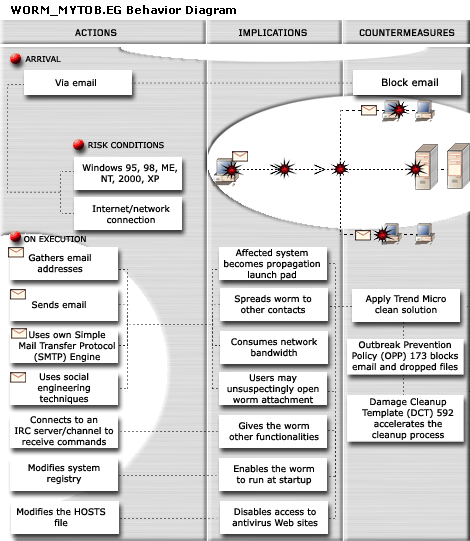
Diagram on how this worm spreads & potential to impact network
Email messages to block or avoid:
Subject: (any of the following)
- *IMPORTANT* Please Validate Your Email Account
- *IMPORTANT* Your Account Has Been Locked
- {random}
- Email Account Suspension
- Notice: **Last Warning**
- Notice:***Your email account will be suspended***
- Security measures
- Your email account access is restricted
- Your Email Account is Suspended For Security Reasons
Message body: (any of the following)
- Account Information Are Attached!
- Once you have completed the form in the attached file , your account records will not be interrupted and will continue as normal.
- please look at attached document.
- To safeguard your email account from possible termination, please see the attached file.
- To unblock your email account acces, please see the attachement.
- We have suspended some of your email services, to resolve the problem you should read the attached document.
- {random}
Attachment: (any of the following file names)
- {random}
- document_full
- email-doc
- email-info
- email-text
- IMPORTANT
- information
- info-text
- your_details
(any of the following extensions)
- BAT
- CMD
- EXE
- PIF
- SCR
- ZIP
 Avoid ZIP based attachments as this one is spreading significantly.
Wurmark.J - MEDIUM RISK by Secunia/Trend
Trend Micro WORM_WURMARK.J Information
quote: As of May 11, 2005 at 4:30 am (Pacific Daylight Time; GMT-7:00) TrendLabs has declared a Medium risk alert in order to control this new WURMARK variant that is currently spreading in France, India, Singapore, and Taiwan.
This memory-resident worm propagates via email messages. Upon execution, it drops a copy of itself in the Windows system folder using a random file name. It also drops a randomly named (Dynamic Link Library) DLL file in the Windows system folder, which is a component of an IESpy, a Spyware program. This worm has a keylogging capability. It saves the logs typed by the user in a dropped random DLL file.
AVOID THE FOLLOWING ATTACHMENTS
Attachment: (any of the following file names)
•details.zip
•girls.zip
•image.zip
•love.zip
•message.zip
•music.zip
•news.zip
•photo.zip
•pic.zip
•readme.zip
•resume.zip
•screensaver.zip
•song.zip
•video.zip
 Mozilla has released version 1.04 of Firefox to address a security security issue and exploit discovered this week. I have installed the new release for Windows 98, 2000, and XP SP2 with no issues so far. While there are no in-the-wild threats or viruses associated with the new exploit, current Firefox users should upgrade to further protect their systems.
Firefox 1.0.4 - Installation Guidelines & Release notes
Firefox 1.04 - Security Changes and other release notes
Security Update to Firefox Now Available
 Firefox 1.04 Free Download (English version 1.04)
Original Advisories on Security Issues
Mozilla Foundation Security Advisory 2005-42
Secunia - Mozilla Firefox Two Critical Vulnerabilities
The cross-site scripting and remote system access flaws were discovered in Firefox version 1.0.3, but other versions may also be affected, said security company Secunia, which issued the ratings Sunday. The two vulnerabilities, when combined, can be exploited, but no known cases have yet emerged where an attacker took advantage of the public exploit code.
One flaw involves "IFRAME" JavaScript URLs, which are not properly protected from being executed in the context of another URL in the history list. "If you visit a malicious Web site, it can steal cookie information from other Web sites you had previously visited," said Thomas Kristensen, Secunia's chief technology officer. The attacker could then use that information to engage in identity theft or gain access to other password-protected sites that the victim visited.
Mozilla issued the following workaround to prevent installing software automatically from web sites. This adds protection for future issues and it enhances security even after upgrading to version 1.04 (and can be toggled on or off as needed).
1. Select the "Options" dialog from the "Tools" menu
2. Select the "Web Features" icon
3. Click the "Allowed Sites" button on the same line as the "Allow web sites to install software" checkbox
4. Click the "Remove All Sites" button
5. Click "OK"

Microsoft Windows One Care - Press release
Windows One Care - Related Article
Windows One Care - Key Features
• Defense against viruses and spyware, as well as two way firewall protection
• Performance and reliability tools including disk cleanup, hard drive defragmentation and file repair.
• Backup and restore capabilities to allow users to automate the backup of their files on to CD or DVD, as well as the ability to restore saved versions of files back onto their PC

This was a neat read in F-Secure's weblog:
Monday, May 9, 2005
In-depth investigation of the "Cabir-in-Cars" myth
http://www.f-secure.com/weblog/
However a mobile worm infecting a car is a thought that one cannot let go easily, and even as we knew that the car cannot be infected, this was something
that just had to be tested for real. So we got a Toyota Prius to test out the myth. Credit has to be given to Toyota for trusting their systems enough to
actually lend the car for us for such testing. According to Toyota, this Prius model had identical in-car Bluetooth systems with the Lexus models, so it
was suitable for our tests.

The new Sober.Q variant is installed automatically from existing infected Sober.P systems. It generates extensive SPAM in German. While these SPAM messages don't contain the virus itself, the URLs most likely point to sites could could contain adware, spyware, or possible viruses.
PLEASE DO NOT CLICK ON ANY URLS in these messages
http://www.f-secure.com/v-descs/sober_q.shtml
Sober.U -- Trend Micro has indepth information
W32.Sober.P@mm - Symantec
http://vil.nai.com/vil/content/v_133684.htm
Sober.Q was found on May 14th, 2005. This Sober variant doesn't spread itself in e-mails. Instead, it mass-mails political statements. Sober.Q is installed to computers infected by Sober.P. Sober.Q is written in Visual Basic.
Like many Sober variants, this variant uses it's own SMTP engine to send spammed messages to email addresses found on the infected system. It can generate several different email messages randomly, in either English or German depending on the version of Windows. Some messages may contain several links inside them.

K-OTic/FrSIRT has released 3 exploits against Firefox 1.03; If you haven't upgraded to 1.04, this is yet another good reason to do so without delay.
Download firefox in a your preferred flavor. For a description of the problems, Mozilla has following URLs:
http://www.mozilla.org/security/announce/mfsa2005-44.html http://www.mozilla.org/security/announce/mfsa2005-43.html

This outline provides an excellent and easy to follow format for securing a wireless network at home. Key approaches include: WPA, turning off unneeded wireless router services, using strong passwords, and reassigning SSIDs. I also recommend using XP SP2 which offers the most up-to-date support for wireless technology by Microsoft.
http://www.komando.com/tips_show.asp?showID=8796
 The next edition of Microsoft Office should become available during 2006. It will offer improved security for server based documents.
Office 12 - Improved server based security on documents
https://www.techrepublic.com.com/2100-10877_11-5717662.html
Federal record-keeping regulations, such as Sarbanes-Oxley and HIPAA, are forcing Microsoft to examine various ways to secure Office documents. With the next version of Office, Microsoft plans to let businesses set rules, enforced by server-based software, to determine how those documents are handled
Office 12 - Some early reported info on new features
https://www.techrepublic.com.com/2100-10877_11-5712784.html
 This is a new malicious attack that's not widespread and provides all the more reason to stay up-to-date with Microsoft Security updates.
MS04-023: PGPCoder Trojan - Encrypts & demands $200 for the key
http://news.zdnet.com/2100-1009_22-5718678.html
http://www.websensesecuritylabs.com/alerts/alert.php?AlertID=194
http://secunia.com/virus_information/18207/pgpcoder/
Researchers at Symantec have seen the malicious program used in the ransom attack. The "Trojan.Pgpcoder" searches a victim's hard disk drive for 15 common file types, including images and Microsoft Office file types. It then encrypts the files, removes the originals and drops a note asking $200 for the encryption key, Friedrichs said.
This memory-resident Trojan arrives via Internet or copied from disks. Upon execution, it encrypts all files on the system having the following extensions:
 A recent study was completed related to the Witty worm, which represents one of the most sophisticated attacks using a few vulnerability in the Black Ice Firewall system. The randomized IP generation and destructive disk algorithms used by Witty are detailed in the Long Version of the Slide show below.
Internet Storm Center
http://isc.sans.org/diary.php?date=2005-05-26
Security Focus Article
http://www.securityfocus.com/news/11235
Article - Outwitting the Witty Worm
http://www.cc.gatech.edu/~akumar/witty.html
Slide Show - Long Version
(esp. pages 11-17, 41-42)
http://www.cc.gatech.edu/%7Eakumar/witty_slides.pdf
Slide Show - Short Version
http://www.cc.gatech.edu/%7Eakumar/wisp.pdf
Reflections on Witty: Analyzing the Attacker
http://www.icsi.berkeley.edu/%7Enweaver/login_witty.txt
 This new threat arrives as a Word document and manipuates unpatched Windows PCs, manipulating the recent MS05-016 patch which was part of the April 2005 updates provided by Microsoft.
This malicious VBScript file takes advantage of the Windows Shell vulnerability, which could allow a remote malicious user to execute arbitrary code on the affected system. For more information about this vulnerability, please refer to the following Microsoft page: Microsoft Security Bulletin MS05-016
It usually arrives on a system as a Microsoft Word document. When executed on a vulnerable machine, it attempts to download and execute a file, which may also be malicious in nature, from the following location: Nnpyf.c{BLOCKED}nn.com. This malicious VBScript file runs on Windows 98, ME, 2000, and XP.
Trend and Secunia have issued MEDIUM RISK alerts for MYTOB.AR. Click these links below for more information:
MYTOB.AR - Secunia alert MEDIUM RISK
quote: As of May 30, 2005 3:08 AM (PDT/GMT-7:00), TrendLabs has declared a MEDIUM risk alert in order to control the spread of WORM_MYTOB.AR. TrendLabs has received several infection reports indicating that this worm is currently spreading in Australia, China, Hongkong, India, Japan, Korea, Philippines, Taiwan, and the United States.
Similar to other MYTOB variants, this memory-resident worm propagates by sending a copy of itself as an attachment (file size is around 29,868 to 29,882 bytes) to an email message, which it sends to target recipients using its own Simple Mail Transfer Protocol (SMTP) engine.
EXAMPLE - Usually an EMAIL delivery or account issue 
EMAIL FORMAT
Subject: (any of the following)
• {Random}
• *DETECTED* Online User Violation
• *IMPORTANT* Please Validate Your Email Account
• *IMPORTANT* Your Account Has Been Locked
• *WARNING* Your Email Account Will Be Closed
• Account Alert
• Email Account Suspension
• Important Notification
• Notice of account limitation
• Notice: **Last Warning**
• Notice:***Your email account will be suspended***
• Security measures
• Your email account access is restricted
• Your Email Account is Suspended For Security Reasons
Attachment: (any combination of the following file names and extension names)
File name:
• {random}
• account-details
• document
• document_full
• email-doc
• email-info
• info
• information
• info-text • instructions
• your_details
Extension name: BAT, CMD, EXE, PIF, SCR, ZIP
 Please select from links below:
Bagle.BO F-Secure - MEDIUM RISK
New Bagle Downloader spreading like wildfire via email
31 May 2005 – MessageLabs is warning computer users to be on their guard against a new variant of the Bagle downloader. MessageLabs has intercepted almost 70,000 copies already. The first copy was intercepted today at 13:24 GMT (14:24 BST). 45,769 copies have been stopped in the last hour (3-4pm BST). The virus appears to have originated from a Yahoo group.
The as yet unnamed Bagle downloader variant drops a trojan that attempts to download Bagle from a vast list of locations. Computer users who activate the file attached in the email invoke the virus, which harvests email addresses it finds on the computer's hard drive. The virus then forwards itself onto the list of email addresses it has discovered in infected computer.
The social engineering, advanced code, attack methods, and the ease in building new variants makes this family among the worst. Users must keep their AV protection updated daily to keep up with new threats.
Mytob.BI - Poses as an IT Administrator
The Mytob.BI variant prevents the infected machine from accessing several antivirus and security Web sites by redirecting the connection to a local machine, the security company added. While prevalence of the worm is still low, the damage potential is high, Trend Micro said. U.K.-based antivirus company Sophos PLC also rated the worm as a concern, due to the severe damage it could cause.
Researchers speculated that the Mytob worm family is popular with hackers because its code base is relatively easy to manipulate to create a new variant. Another version, Mytob.ar, was detected earlier this week, containing added spyware and adware elements.
The worm poses as a message from an IT administrator, warning recipients that their e-mail accounts are about to be suspended, Trend Micro said. Possible subject headers for the worm include "*IMPORTANT* Please Validate Your Email Account" and "Notice: **Last Warning**."
 The Internet Storm Center shares one handlers toolkit recommendations. This toolkit looks like it will provide you with everything you will need to monitor, troubleshoot and maintain you network. Some us might have personal preferences on AV vendors or other items, but it's still a very nice list.
 ISC publishes Scott's Toolkit for Windows
I've created what I call "Security Kits" on both CD-Rs and now the new FlashRAM memory sticks with a lot of these tools on there You never know which neighbor or relative is going to be next on the list to go help out
Antivirus Tools
|-- McAfee Stinger (updated routinely)
|-- Symantec AV Corporate Edition v9 (soon to be v10)
|-- Microsoft Malware Removal Tool (released monthly)
|-- Current Symantec AV Intelligent Updater
Response Kit
|-- NetCat (available now at SecurityFocus)
|-- SysInternals AccessEnum
|-- SysInternals AutoRuns
|-- SysInternals Contig
|-- SysInternals DiskView
|-- SysInternals FileMon
|-- SysInternals ListDLLs
|-- SysInternals Page Defrag
|-- SysInternals ProcessExplorer
|-- SysInternals PS Tools
|-- SysInternals RegMon
|-- SysInternals Rootkit Revealer
|-- SysInternals Sdelete
|-- SysInternals ShareEnum
|-- SysInternals Sync
|-- SysInternals TCPView
|-- SysInternals Miscellaneous tools
|-- Heysoft LADS
|-- myNetWatchman SecCheck
|-- Inetcat.org NBTScan
|-- FoundStone BinText
|-- FoundStone Forensic Toolkit
|-- FoundStone Fport
|-- FoundStone Galleta
|-- FoundStone Pasco
|-- FoundStone Rifuti
|-- FoundStone Vision
|-- FoundStone ShoWin
|-- FoundStone SuperScan
|-- WinDump
|-- Nmap
|-- Tigerteam.se SBD (encrypted netcat)
|-- GNU based unxutils (from unixutils.sourceforge.net)
|-- Good copies of windows binaries (netstat, cmd, ipconfig, nbtstat)
Spyware Tools
|-- AdAware (updated defs in same directory)
|-- CWShredder
|-- Hijack This
|-- MS AntiSpyWare Beta
|-- Spybot Search and Destroy (updated defs in same directory)
|-- BHO Demon
Security Tools (this is my usual place to dump the .zip or .exe installers)
|-- Heysoft LADS (list alternate data streams)
|-- Inetcat.org NBTScan
|-- MS Baseline Security Analyzer
|-- MS IIS Lockdown tool
|-- Sam Spade
|-- SSH Client (SSH.com or Putty)
|-- SysInternals Tools
|-- Foundstone Tools
|-- BlackIce PC Protection
|-- Kerio Personal Firewall
|-- Zone Alarm Personal Firewall
|-- WinPcap
|-- WinDump
|-- Ethereal Installer
|-- Nmap for windows (cli version)
Utilities
|-- Adobe Acrobat Reader Installer
|-- CPU-Z
|-- FireFox Installer
|-- Macromedia Flash and ShockWave Installers
|-- Quicktime Standalone Installer
|-- VNC Installer
|-- Winzip Installer
|-- ISCAlert
Service Packs ( on a 2nd CD )
|-- Windows XP SP2
|-- Windows 2000 SP4 (+rpc/lsass critical patches or SRP when released)
|-- Windows 2003 Server SP1
(Some additional CDs I keep around for the Unix geek in me)
Knoppix CD
Helix CD
Note: Any commercial software above that is not freeware/shareware in the list above should be replaced in your toolkit with your company or campus licensed software.
Trend has declared a MEDIUM RISK due to prevalance
MS04-011: Bobax.P - MEDIUM RISK at Trend
MS04-011: Bobax.Z - Symantec version
W32.Bobax.Z is a mass-mailing worm that lowers security settings and allows a compromised computer to be used as a covert proxy. The worm also sends an email to addresses gathered from the compromised computer.
As of June 3, 2005 1:38 AM (PDT/GMT-7:00), TrendLabs has declared a MEDIUM risk alert in order to control the spread of WORM_BOBAX.P. TrendLabs has received several infection reports indicating that this worm is currently spreading in the United States, Singapore, Ireland, Japan, Peru, Australia and India.
Message body: (any of the following)
------------------------------------------
Attached some pics that i found
Check this out :-)
Hello,
I was going through my album, and look what I found..
Long time! Check this out!
Osama Bin Laden Captured.
Remember this?
Saddam Hussein - Attempted Escape, Shot dead
Secret!
Testing
 Spyware S&D is an excellent spyware removal tool that is free for personal use. The following provide some key links from download.com:
Download.com Review of Spybot - Search & Destroy


The latest version of Spybot - Search & Destroy adds some truly useful features to an already excellent application. The program still checks your system against a comprehensive database of adware and other system invaders, but it works much faster now. It also features several interface improvements, including multiple skins for dressing up its appearance. Scan results now appear arranged by groups in a tree, and a sliding panel lets you instantly view information about a selected item to help you decide whether to kill it or not. The Immunize feature blocks a plethora of uninvited Web-borne flotsam before it reaches your computer. Other useful tools, including Secure Shredder, complement the program's basic functionality for completely destroying files. Hosts File blocks adware servers from your computer, and System Startup lets you review which apps load when you start your computer. The functionality makes Spybot - Search & Destroy a must-have for all Internet users, and this version is a worthwhile upgrade.
 Ad-Aware SE Personal Edition 1.06 is an excellent adware and spyware removal tool that is free for personal use. The following provide some key links from download.com:
Ad-Aware SE Personal Edition 1.06 - Information
Download.com Review of Ad-Aware SE Personal Edition
One of the first applications built to find and remove adware and spyware, Ad-aware SE Personal Edition's excellent reputation is well justified. The sky-blue, skinnable interface features five buttons. The first two, Status and Scan, lead to the core function of the application. These buttons initiate a scan of your files for adware components. After scanning is complete, the program presents a summary of results, followed by a list from which you select exactly which components to remove. Right-clicking an individual entry gives some information about the piece of suspected adware, though we would like more details. Ad-aware SE can alert you to more malignant forms of malware by separating items into critical and negligible categories. The third button, Ad-watch, is nonfunctional in the Standard version. The fourth button, Plug-ins, shows you which Ad-aware plug-ins are installed. The fifth leads to the help files.
Ad-aware SE does an excellent job of quickly finding and removing most adware and spyware components, although you will have to restart and rescan for a seriously infected machine. We were pleased to see an auto-update feature included with the program, keeping Ad-aware up-to-date with the latest adware components. Ad-aware SE should be part of your arsenal for keeping your machine free of adware and spyware components.
Trend/Secunia also declared MEDIUM RISK on Troj Small.AHE, which is different than Bobax.P, but centers on the same theme.
For users, it's essential to AVOID attachments from ANY politically themed email, as that's often a common social engineering threat (like we saw with the German Sober.Q spam)
Secunia Information
http://secunia.com/virus_information/18540/
http://secunia.com/virus_information/18574/
This downloader trojan was mass-spammed on June 2, 2005. It may arrive in an email message as follows (messages vary):
Subject:
God Bless the USA!
Finally!
Captured..
He has captured..
Body:
Xmong. Npos alter. almonsted nocks
Turn on your TV. Osama Bin Laden has been captured. While CNN has no pictures at this point of time, the military channel (PPV) released some pictures. I managed to capture a couple of these pictures off my TV. Ive attached a slideshow containing all the pictures I managed to capture. I apologize for the low quality, its the best I could do at this point of time. Hopefully CNN will have pictures and a video soon. God bless the USA! Stephen Christensen
Attachment: pics.zip, teamster.zip, usurus.zip, toxicology.zip
 Kaspersky's weblog entry of June 5th entitled "Robots,vile robots everywhere!" is a great read
MS04-007: RBOT variant - 1st worm to exploit ASN.1 via Internet
Investigation of the packets revealed a Microsoft ASN.1 exploit, which tries to download and run an executable from the attacking machine via TFTP. We've secured a binary and took a look under the cover. The responsible worm was a Rbot variant, ...
Besides the ASN.1 exploit - and this is the first worm to use it successfully on the Internet - the Rbot variant uses a multitude of other exploits, DCOM, RPC,Veritas Backup Exec, LSASS, MSSQL, password guessing and so on. It also steals registration keys from a good list of popular games, PayPal accounts logins, has an embedded backdoor and of course, DDoS capabilities.
Basically, it's a worm which tries very hard to spread while at the same time, it tries to steal as many valuable data from the victim machine as it is available. It is a highly infectious worm, written for profit. And yes, most of the other worms we're seeing nowadays are no different.
Spybot.PKC - May be a close example of the new RBOT variant
Secunia has issued a moderately critical advisory for Mozilla browsers including Firefox 1.04 for a Frame Injection Vulnerability. This new vulnerability has not been exploited in-the-wild and can only occur while processing a trusted and hostile web site at the same time. Firefox users should look for an upcoming release and always be careful of sites visited and email URL links.
ZdNet Article: Mozilla Frame Injection Vulnerability
A 7-year-old flaw that could let an attacker place malicious content on trusted Web sites has resurfaced in the most recent Firefox browser, Secunia has warned. The flaw, which also affects some other Mozilla Foundation programs, lies in the way the software handles frames, which are a way of showing Web content in separate parts of the browser window.
As a result, an attacker could insert content into a frame on a trusted Web site, Secunia said. Account holders who believe they are interacting with a frame belonging to an online bank could be tricked into giving up personal information or downloading malicious code, for example. Secunia rated the issue "moderately critical." The same "frame injection" vulnerability in Mozilla's browsers was detailed by Secunia in July of last year. At the time, it did not affect the most recent versions of the applications.
For a spoofing attempt to work, a surfer would need to have both the attacker's Web site and a trusted Web site open in different windows. A click on a link on the malicious site would then display the attacker's content in a frame on the trusted Web site, Secunia said. The company advised people not to visit trusted and untrusted Web sites at the same time.
Secunia Advisory - Mozilla Frame Injection Vulnerability
Moderately Critical: 
Description: A seven year old vulnerability has been re-introduced in Mozilla and Firefox, which can be exploited by malicious people to spoof the contents of web sites.
Secunia Browser Frame Injection Vulnerability Test
The vulnerability has been confirmed in Firefox 1.0.4 and Mozilla 1.7.8. Other versions may also be affected.
Solution: Do not browse untrusted web sites while browsing trusted sites.
Mozilla Support Forums Information
The vulnerability has not been exploited, a moderator of a support forum on the Mozilla Web site wrote Monday, in response to the Secunia alert. For protection, the moderator advises people to close all other windows and tabs before accessing a Web site such as a bank or online store that requires them to type in personal data.
 This new variant of the Skulls mobile phone virus appears to be a free “pirated“ copy of F-Secure's Anti-virus product for Mobile phones. Besides the legal and ethical considerations for using pirated copies of software, this new virus will lock the phone permanently until cleaning is accomplished by buying the real product. This social engineering scheme illustrates the dangers of installing free software offered by email, instant messaging, or other sources.
Links related to this new virus are noted below:
Skulls.L - Pretends to be F-Secure's Mobile AV product
F-Secure's Web Log Description
Skulls.L is a variant of SymbOS/Skulls.C trojan. The component files of the trojan are almost identical to Skulls.C. The main difference between Skulls.L and Skulls.C is that Skulls.L pretends to be a pirate copied version of F-Secure Mobile Anti-Virus.
REMOVAL Techniques
Disinfection with two Series 60 phones
Download F-Skulls tool from FTP site or
Download F-Skulls Tool directly with phone
1. Install F-Skulls.sis into infected phones memory card with a clean phone
2. Put the memory card with F-Skulls into infected phone
3. Start up the infected phone, the application menu should work now
4. Go to application manager and uninstall the SIS file in which you installed the Skulls.L
5. Download and install F-Secure Mobile Anti-Virus to remove any Cabirs dropped by the Skulls.L or with mobile itself http://mobile.f-secure.com
6. Remove the F-Skulls with application manager as the phone is now cleaned
 On June 14, 2005, the Microsoft Security Response Center is planning to release:
Security Updates
• 7 Microsoft Security Bulletins affecting Microsoft Windows. The greatest aggregate, maximum severity rating for these security updates is Critical. Some of these updates will require a restart. 5 of these updates will be detectable using the Microsoft Baseline Security Analyzer (MBSA), 2 of these updates will be detectable using the Enterprise Scanning Tool (EST).
• 1 Microsoft Security Bulletin affecting Microsoft Windows and Microsoft Services for UNIX. The greatest aggregate, maximum severity rating for these security updates is Moderate. These updates may require a restart. These updates will be detectable using the Microsoft Baseline Security Analyzer (MBSA) and using the Enterprise Scanning Tool (EST).
• 1 Microsoft Security Bulletin affecting Microsoft Exchange. The greatest aggregate, maximum severity rating for this security update is Important. This update will not require a restart. This update will be detectable using the Microsoft Baseline Security Analyzer (MBSA) and using the Enterprise Scanning Tool (EST).
• 1 Microsoft Security Bulletin affecting Microsoft Internet Security and Acceleration (ISA) Server and Small Business Server. The greatest aggregate, maximum severity rating for these security updates is Moderate. These updates may require a restart. This update will be detectable using the Enterprise Scanning Tool (EST).
Microsoft Windows Malicious Software Removal Tool
• Microsoft will release an updated version of the Microsoft Windows Malicious Software Removal Tool on Windows Update, Microsoft Update, Windows Server Update Services and the Download Center. Note that this tool will NOT be distributed using Software Update Services (SUS).
 This email has no attachment, but if you click on the link a trojan horse can be downloaded on your PC. This downloader attack can open up your PC from a security perspective. MS00-37, which is a five year old Help File security flaw is also used to attack any completely unpatched PCs. While this new threat is not widespread, the media is reporting it on the news this morning.
ZDnet: Hackers use email URL create Jackson rumor
AVOID CLICKING ON THE URL IF YOU RECEIVE THIS EMAIL MESSAGE
News from Neverland -- Last night, while in his Neverland Ranch, Michael Jackson has made a suicidal attempt. They suggest this attempt follows the last claim was made against the king of pop. 46 years old Michael has left pre-suicid note which describes and interpretes some of his sins.
Read http://mega{BLOCKED}buz.com more...
 McAfee has featured a new variant each day in June on average so far. Mytob is one of the most advanced worms that hackers can easily modify. It hides in a stealth like manner and appears as an email message from an administrator (always verify these types of messages before clicking on either links or attachments).
Mytob may be worst virus of 2005
The Mytob worm has to be close to #1, for the worst worm 2005. While Netsky.P is #1 in volume (i.e., it's like the Klez.H worm of old), we can be stop this much older version with current virus defintions. Every day the virus writers easily modify the code and seed fresh copies as AV vendors scramble to cover the latest code derivations and compression techniques. We are most likely averaging one new copy per day.
Some key reasons are:
* Stealth-like, as it can hide for a while on an infected PC and lowers security settings.
* Very well socially engineered (appears like an official admin email message),
* Exploits some unpatched Microsoft security vulnerabilities (MS04-011),
* Technically well crafted also (usually carries a Spybot variant)
13 new versions in 13 days
http://vil.nai.com/VIL/newly-discovered-viruses.asp
W32/Mytob.cv@MM 06/13/2005 Low Low 4513
W32/Mytob.ch@MM 06/11/2005 Low Low 4512
W32/Mytob.cg@MM 06/11/2005 Low Low 4512
W32/Mytob.cc@MM 06/08/2005 Low Low 4510
W32/Mytob.ca@MM 06/08/2005 Low Low 4509
W32/Mytob.bx@MM 06/07/2005 Low Low 4508
W32/Mytob.gen!eml 06/07/2005 Low Low 4508
W32/Mytob.bw@MM 06/06/2005 Low Low 4508
W32/Mytob.bv@MM 06/06/2005 Low Low 4508
W32/Mytob.br@MM 06/05/2005 Low Low 4507
W32/Mytob.bo@MM 06/02/2005 Low Low 4506
W32/Mytob.bl@MM 06/01/2005 Low Low 4505
W32/Mytob.bk@MM 06/01/2005 Low Low 4504
EMAIL messages to avoid
The virus arrives in an email message from a systems administrator as follows:
From: (Spoofed email sender - may choose from the following list)
support
administrator
mail
service
admin
info
register
webmaster
Subject: (Varies, such as)
Your password has been updated
Your password has been successfully updated
You have successfully updated your password
Your new account password is approved
Your Account is Suspended
*DETECTED* Online User Violation
Your Account is Suspended For Security Reasons
Warning Message: Your services near to be closed.
Important Notification
Members Support
Security measures
Email Account Suspension
Notice of account limitation
Extensions: pif, scr, exe, cmd, bad, zip
 IE 7 will provide better protection from Spyware threats
IE7 being developed to resist spyware
http://msn.com.com/2100-1009_22-5745044.html
IE Blog Information
http://blogs.msdn.com/ie/archive/2005/06/09/427410.aspx
 Microsoft Security Updates - June 2005 Bulletin Summary:
http://www.microsoft.com/technet/security/Bulletin/ms05-Jun.mspx
Critical Bulletins:
Cumulative Security Update for Internet Explorer (883939)
http://www.microsoft.com/technet/security/Bulletin/ms05-025.mspx
Vulnerability in HTML Help Could Allow Remote Code Execution (896358)
http://www.microsoft.com/technet/security/Bulletin/ms05-026.mspx
Vulnerability in Server Message Block Could Allow Remote Code Execution
(896422)
http://www.microsoft.com/technet/security/Bulletin/ms05-027.mspx
Important Bulletins:
Vulnerability in Web Client Service Could Allow Remote Code Execution
(896426)
http://www.microsoft.com/technet/security/Bulletin/ms05-028.mspx
Vulnerability in Outlook Web Access for Exchange Server 5.5 Could Allow
Cross-Site Scripting Attacks (895179)
http://www.microsoft.com/technet/security/Bulletin/ms05-029.mspx
Cumulative Security Update in Outlook Express (897715)
http://www.microsoft.com/technet/security/Bulletin/ms05-018.mspx
Cumulative Security Update in Outlook Express (897715)
http://www.microsoft.com/technet/security/Bulletin/ms05-030.mspx
Vulnerability in Step-by-Step Interactive Training Could Allow Remote
Code Execution (898458)
http://www.microsoft.com/technet/security/Bulletin/ms05-031.mspx
Moderate Bulletins:
Vulnerability in Microsoft Agent Could Allow Spoofing (890046)
http://www.microsoft.com/technet/security/Bulletin/ms05-032.mspx
Vulnerability in Telnet Client Could Allow Information Disclosure
(896428)
http://www.microsoft.com/technet/security/Bulletin/ms05-033.mspx
Cumulative Security Update for ISA Server 2000 (899753)
http://www.microsoft.com/technet/security/Bulletin/ms05-034.mspx
Re-Released Bulletins:
SQL Server Installation Process May Leave Passwords on System (Q263968)
http://www.microsoft.com/technet/security/Bulletin/ms02-032.mspx
ASP.NET Path Validation Vulnerability (887219)
http://www.microsoft.com/technet/security/Bulletin/ms05-004.mspx
Vulnerability in Outlook Web Access for Exchange Server 5.5 Could Allow
Cross-Site Scripting Attacks (895179)
http://www.microsoft.com/technet/security/Bulletin/ms05-029.mspx
 ??? Please check your statements carefully during the next few billing cycles as hackers recently obtained key information related to Master Card accounts.??
KEY IMPACTS
*? As many as 40 million cards may have been exposed, making it the largest breach of personal financial data in a string of recent cases.
*? The breach occurred at Card Systems Solutions, Inc., a third-party processor of payment card data who processes transactions on behalf of financial institutions and merchants.
* CardSystems has already taken steps to improve the security of its system, MasterCard said it was giving the company "a limited amount of time" to demonstrate compliance with MasterCard security requirements.
 All new versions of the Bagle/Beagle worm are important to watch as they are technically advanced and disguised well to trick users into opening attachments (use of zip extension).
Beagle.BT - (aka Bagle worm) New Variant
Beagle.BT - new version of Bagle worm
W32.Beagle.BT@mm is a mass-mailing worm that uses its own SMTP engine to send out copies of a Trojan.Tooso variant. The worm also opens a back door on the compromised computer on TCP port 80.
EMAIL FORMAT
From: Spoofed.
Subject: Blank.
Message: "The password is" or "Password:"
Attachment: ZIP ... Multiple Zip files may contain copies of the virus, plus an executable copy of the Trojan.Tooso.
Sharing a quick update on latest discoveries. The primary cause of this exposure is improper storage and use of confidential information on their servers, followed by hackers discovering this due to weak security controls. 
1. A new phishing attack has been launched to capitalize on this
http://www.theregister.co.uk/2005/06/20/mastercard_phishing/
| Quote: |
| From: Master Bank [master@masterbank.com] To: Subject: **Your Mastercard online Confirmation** Dear User, During our regular update and verification of the accounts, we couldn't verify your current information. Either your information has changed or it is incomplete. If the account information is not updated to current information within 5 days then, your access will be restricted. |
2. According to reports, 68,000 MasterCard cardholders have already found fraudulent charges on their accounts.
3. The head of a credit card processing company whose Tucson center was hit by computer hackers says compromised consumer records shouldn't even have been in the data base. Under rules established by Visa and MasterCard, processors aren't supposed to retain cardholder information after handling transactions.
4. CardSystems Solutions C-E-O John Perry tells The New York Times the data was being stored for "research purposes" to determine why some transactions registered as unauthorized or uncompleted.
5. He says that the records known to have been stolen covered roughly 200-thousand of the 40 (m) million compromised credit card accounts. They include Visa, Mastercard and other companies.

QUOTE: Opera Software today released the first Opera 8 update, Opera 8.01, for Windows and Linux. To fine-tune the well-received browser, Opera 8.01 includes security and small bug fixes as well as JavaScript improvements. This update succeeds the release of Opera 8 on April 19, 2005, which has now reached more than five million downloads.
Accompanying the Opera 8.01 release for Windows and Linux is the final version of Opera 8 for Macintosh. Read the press release.
To download Opera 8 visit http://www.opera.com/download/
View the changelog.

Click Here: Microsoft resources to prepare for SQL-Server 2005
quote: Microsoft Learning Resources
Whether you are interested in database administration, database development, or business intelligence, you will find classroom training, books, free skills assessments, and free* e-learning to help you get up to speed on the newest features of the software. The online assessments help you analyze your current skills, and provide you with a learning plan that recommends books, e-learning, classroom training, TechNet and MSDN resources. Our E-Learning courses are an effective way to learn on your own schedule and feature hands-on virtual labs that provide an in-depth, online training experience.

Secunia Research has discovered a vulnerability in various browsers, which can be exploited by malicious web sites to spoof dialog boxes. The problem is that JavaScript dialog boxes do not display or include their origin, which allows a new window to open e.g. a prompt dialog box, which appears to be from a trusted site.
 - |
Mozilla / Firefox / Camino Dialog Origin Spoofing Vulnerability |
| - |
Microsoft Internet Explorer Dialog Origin Spoofing Vulnerability |
| - |
Opera Dialog Origin Spoofing Vulnerability |
If you go to the test page, please make sure no critical applications are open and test cautiously:
Secunia Browser - Dialog Origin Vulnerability Test

Microsoft's Security Guidance Center
 Home Security Protection
Get the information you need to protect your home PC. This site puts valuable tips, tools, and training at your fingertips.
Learn about Computer Security At Home
Security for IT Professionals
Find the tools, training, and updates you need to assist with planning and managing a security strategy for your organization.
Find answers in the TechNet Security Center
Small Business Security Protection
Access important resources for updating software, setting up a firewall, and backing up data in a small business environment.
Visit the Small Business Security Guidance Center
Designing and Developing Secure Applications
Learn how to write more secure code with these developer-focused articles, tools, and security resources.
Get Security Guidance for Developers
The June 2005 TechNet security newletter featured the following security planning guides:
Review the Latest Microsoft Server Security Guides
|
The Services and Service Accounts Security Planning Guide
|
|
The Security Monitoring and Attack Detection Planning Guide
|
|
The Secure Access Using Smart Cards Planning Guide
|
|
The Administrator Accounts Security Planning Guide
|
|
Implementing Quarantine Services with Microsoft Virtual Private Network Planning Guide
|
|
Microsoft Identity and Access Management Series
|

Hopefully, most companies and individuals have up-to-date on Microsoft security patches. This new exploit developed in February could be used in future computer viruses and worms.
MS05-011 - Exploit Code to attack SMB vulnerabilities published
http://isc.sans.org/diary.php?date=2005-06-23
QUOTE: FrSIRT has published exploit code for the recent flaw in Microsoft Server Message Block (SMB). The advisory and patch related to this vulnerability were released on February 8th, 2005. If you still have not patched, you are further urged to do so in light of the release of exploit code.
FfSIRT - Published exploit (be care as POC code is here)
http://www.frsirt.com/exploits/20050623.mssmb_poc.c.php
Hopefully, most companies and individuals are up-to-date on Microsoft security patches. This new exploit has just been developed from the MS05-030 security bulletin published in June. It could be adapted for use in future computer viruses and worms.
MS05-030: Microsoft Outlook Express NNTP Buffer Overflow Exploit
http://www.frsirt.com/exploits/20050624.MS05-030-NNTP.c.php
MS05-030: Cumulative Security Update in Outlook Express (897715)
http://www.microsoft.com/technet/security/Bulletin/MS05-030.mspx
 I've attended two past Tech Ed conferences and they provide highly focused technical training opportunties. Microsoft shares a number of post-conference links and publications as noted below:
http://microsoft.sitestream.com/teched2005/
 The Veritas Backup utility suites offer advanced functionality and some of security controls associated with remote control functionality have been compromised. This includes a new in-the-wild exploit and administrators should review trusted Firewall port settings and move to the latest versions of the software as noted in the advisories below.
http://isc.sans.org/diary.php?date=2005-06-25
QUOTE: We received some reports about spikes on port 10000. The main reason for that is the release of the exploit for Veritas, and used by the Metasploit Framework. ... It seems this exploit is crashing the service listening on port 10000. If sysadmins know they have backup exec installed and they scan the system they will see port 6101 and 10000 normally. After the exploit it will show only the port 6101 still listening."
Veritas Security Bulletins
Veritas Backup Exec/NetBackup Request Packet Denial Of Service Vulnerability
Veritas Backup Exec Server Remote Registry Access Vulnerability
Veritas Backup Exec Remote Agent Null Pointer Dereference Denial Of Service Vulnerability
Veritas Backup Exec Remote Agent for Windows Servers Authentication Buffer Overflow Vulnerability
Veritas Backup Exec Admin Plus Pack Option Remote Heap Overflow Vulnerability
VERITAS Backup Exec Web Administration Console Remote Buffer Overflow Vulnerability
FrSirt - Veritas Backup Exec Agent "CONNECT_CLIENT_AUTH" Request Exploit
http://www.frsirt.com/exploits/20050625.backupexec_agent.pm.php
http://isc.sans.org/diary.php?date=2005-06-28
The FrSIRT published new exploit for MS05-017 vulnerability. The MS05-017 is vulnerability in Message Queuing, the remote attacker can execute command from remote. It's time to patch and filter some unnecessary port.
http://isc.sans.org/diary.php?date=2005-06-29
If you're using the popular phpBB bulletin board package, it's time to upgrade. Version 2.0.16, released earlier this week, fixes a critical security issue that can lead to the compromise of the vulnerable web server. The problem is with the viewtopic.php script, which, according to the FrSIRT advisory, fails to properly validate input when processing the "highlight" parameter. A similar vulnerability was being exploited by the Santy worm to deface web sites about half a year ago, as we reported in the December 21, 2004 diary. Please update your copy of phpBB to help prevent another such worm from gaining steam.
For information about the phpBB 2.0.16 release, see the phpBB Group announcement. You can get the updated package from their downloads page.
ISC Warning -- Be on the Lookout for PHP compromises
| Quote: |
| Be on the Lookout for PHP compromises
This is a call to all the network and system security folks out there ... Please be on the lookout for web-based intrusions happening in your environments. There have recently been major vulnerabilities discovered in phpBB and the XML_RPC libraries, which we have reported in the last two days. It's very likely that these vulnerabilities will be utilized to compromise systems. Try to be vigilant about securing your environment and reviewing your IDS alerts for attacks. |
phpBB 2.0.16 Fixes a Critical Security Issue
Internet Survival Time is measured as the amount of time, a brand new unpatched PC will last before it is compromised with a computer virus. However, XP SP2 provides out-of-the-box protection from all current Internet worms. The 12 minutes are because Internet worms like Blaster (MS03-026) and Sasser (MS04-011) continue to circulate and randomly generate IP addresses to attack, from unpatched versions of W/2000 and XP.
Anti-virus company Sophos published their own statistic regarding internet survival time at 12 minutes. The survival time currently reported by dshield.org is 31 minutes. Their story also has some interesting statistics on the number of viruses in the first half of 2005 compared to last year.
ISC Link - Sophos measures Internet Survival time at 12 Minutes
Sophos Virus Report - First Half of 2005
Sophos - TOP TEN VIRUSES FOR 1ST HALF OF 2005
1 W32/Zafi-D 25.3%
2 W32/Netsky-P 17.5%
3 W32/Sober-N 10.3%
4 W32/Zafi-B 4.7%
5 W32/Netsky-D 3.8%
6 W32/Mytob-BE 2.6%
7 W32/Netsky-Z 2.3%
8 W32/Mytob-AS 2.0%
9 W32/Netsky-B 1.9%
10 W32/Sober-K 1.7%
Others 27.9%
Microsoft is proactively warning of a new flaw in IE that can cause it to unexpectedly exit and execute arbitrary code. No in-the-wild attacks have been reported, but the vulnerability could be used in future virus attacks.
Key protective advice includes:
1. "Think before you click" - Never select untrusted URLs in email or at other websites.
2. Always make sure IE is set to PROMPT for the installation of ActiveX controls from a website in all zones
3. The Security Advisory lists other methods (e.g., removing the Microsoft Java Virtual Machine or unregistering Javaprxy.dll). I'd be careful with this as it could break application packages built around these services.
ZDNet Article: Microsoft warns of unpatched IE flaw
Microsoft Security Advisory (903144)
Microsoft is investigating a new public report of a vulnerability affecting Internet Explorer. We have not been made aware of any attacks attempting to use the reported vulnerability or customer impact at this time," Microsoft said Thursday in its advisory. "But we are aggressively investigating the public report."
A patch for the flaw is not available. As an interim measure, the software giant advises people to set their Internet and local intranet security zone settings to "high" before running ActiveX controls
 The new security rollup for Service Pack 4 is particularly helpful if you need to rebuild a Windows 2000 workstation manually.
Microsoft Security Advisory (891861)
http://www.microsoft.com/technet/security/advisory/891861.mspx
Microsoft Technet Information (891861)
http://support.microsoft.com/kb/891861
Release of Update Rollup 1 for Windows 2000 Service Pack 4 (SP4)
Published: June 28, 2005
Today we are announcing the availability of the Update Rollup 1 for Windows 2000 Service Pack 4 (SP4). The Update Rollup will make it easier for customers to improve security of Windows 2000 systems, keep them up to date, and to build new deployment images.
The Update Rollup contains all security updates produced for Windows 2000 between the time SP4 was released and April 30, 2005, the time when the contents of the Update Rollup were locked down for final testing by Microsoft and by external beta & customer sites. The Update Rollup also contains a number of updates that increase system security, reliability, reduce support costs, and support the current generation of PC hardware.
We encourage Windows 2000 SP4 customers to install this update. For more information about this release, see Microsoft Knowledge Base Article 891861
Usually, the first of every month you can anticipate new variants of: Sober, Bagle, MyDoom, and Mytob to all emerge. The ISC sees 3 potential factors to be EXTRA watchful this week for new threats to emerge:
Internet Storm Center -- Possibility for disaster?
http://isc.sans.org/diary.php?date=2005-07-03
| Quote: |
| At the Internet Storm Center, we sometimes see dark clouds gathering on the horizon. Sometimes it doesn't come to a real storm, sometimes it does. Unlike the real storm centers we don't have mathematical models to help in our predictions just yet. Main problem is that it would mean we'd have to predict human nature.
1. As a first ingredient we have the probing and even at least one worm/botnet on the loose attacking unpatched phpBB installations. 2. As a second ingredient we see the 0-day exploits and the lack of a real patch from Microsoft for the javaprxy.dll . This makes the most popular browser potentially seriously vulnerable as this exploit matures. 3. The final ingredient is timing: in the US it's Independence Day tomorrow, which most probably only leaves a skeleton staff at key places. |
I have installed the latest patch which disables Javaprxy.dll (a DLL service used for Java debugging). It's safe to disable this rarely used facility and I've had zero issues thus far. Microsoft updated their security advisory (903144) of a COM Object (Javaprxy.dll) which can cause Internet Explorer to Unexpectedly Exit. The advisory update with Microsoft Download Center Information for the registry key update that disables Javaprxy.dll in the Explorer. But still workaround and no official patch available.
1. To install this patch, select this link security advisory
2. Then expand the WORKAROUNDS information and select this link
3. Download the specific patch for your version of Internet Explorer (select Help/About if you're unsure which version of IE you are using).
An outbreak of Trojan horse programs is hitting networks around the world, an e-mail security company has warned. MessageLabs said it has blocked 54,000 copies of new Downloader Trojans since 6 p.m. PDT on Wednesday.
 As noted yesterday some corporate users in TVDUG have reported seeing a marked increase in intercepting new trojan horse emails this week. CERT has also issued a special security bulletin to warn of targeted attacks. It is informative and users should be cautious at all times when processing email messages.
http://www.us-cert.gov/cas/techalerts/TA05-189A.html
The United States Computer Emergency Readiness Team (US-CERT) has received reports of an email based technique for spreading trojan horse programs. A trojan horse is an attack method by which malicious or harmful code is contained inside apparently harmless files. Once opened, the malicious code can collect unauthorized information that can be exploited for various purposes, or permit computers to be used surreptitiously for other malicious activity. The emails are sent to specific individuals rather than the random distributions associated with a phishing attack or other trojan activity. (Phishing is the act of sending an email to a user falsely claiming to be an established legitimate enterprise in an attempt to scam the user into surrendering private information that can be used for identity theft.) These attacks appear to target US information for exfiltration. This alert seeks to raise awareness of this kind of attack, highlight the important need for government and critical infrastructure systems owners and operators to take appropriate measures to protect their data, and provide guidance on proper protective measures.
On 12 July 2005 Microsoft is planning to release Windows and Office security updates.
*************************************************
Title: July 2005 Microsoft Security Response Center Bulletin
Issued: July 7, 2005
*************************************************
Security Updates
2 Microsoft Security Bulletins affecting Microsoft Windows The greatest aggregate, maximum severity rating for these bulletin is Critical. Some of these updates will require a restart. These updates will be detectable using the Microsoft Baseline Security Analyzer (MBSA).
1 Microsoft Security Bulletin affecting Microsoft Office. The greatest aggregate, maximum severity rating for this bulletin is Critical. These updates may require a restart. These updates will be detectable using the Microsoft Baseline Security Analyzer (MBSA).
Microsoft Windows Malicious Software Removal Tool- Microsoft will release an updated version of the Microsoft Windows Malicious Software Removal Tool on Windows Update, Microsoft Update, Windows Server Update Services and the Download Center. Note that this tool will NOT be distributed using Software Update Services (SUS).
This is an example of tactics some virus writers will revert to in order to create a system infection. Avoid selecting attachments found in any email message.
This particular attack can be deceptive as it appears to be legitimate as part of an actual CNN webpage is used. Be careful on all emails relating to tragedies or political themes as this is a common social engineering approach.
TROJ_DONBOMB.A - Fake CNN movie circulating on London attacks
Subject: TERROR HITS LONDON
From: "CNN Newsletter" {breakingnews@cnnonline.com}
Message body: {A modified HTML copy of the CNN web page regarding the London Bombing}
Attachment: LondonTerrorMovie.zip (containing the following .ZIP files) London Terror Moovie.avi - multiple spaces
Note: These details may vary since affected systems can become proxy servers.

P.S. On a personal basis, I continue to remember friends and other affected in London in my thoughts & prayers.
Below is a summary of the July Security Bulletins. Be sure to invoke both Windows and Office Updates:
Microsoft Security Bulletins - July 2005
http://www.microsoft.com/technet/security/Bulletin/ms05-Jul.mspx
Vulnerability in Microsoft Word Could Allow Remote Code Execution (903672) CRITICAL
http://www.microsoft.com/technet/security/Bulletin/ms05-035.mspx
Vulnerability in Microsoft Color Management Module Could Allow Remote Code Execution (901214) CRITICAL
http://www.microsoft.com/technet/security/Bulletin/ms05-036.mspx
Vulnerability in JView Profiler Could Allow Remote Code Execution (903235) CRITICAL
http://www.microsoft.com/technet/security/Bulletin/ms05-037.mspx
Re-Released Bulletin:
Vulnerability in Telnet Client Could Allow Information Disclosure (896428) MODERATE
http://www.microsoft.com/technet/security/Bulletin/ms05-033.mspx
Firefox 1.05 has been released to improve security and address past issues. So far, in early testing it's working smoothly for me, as I use it as a complementary browser with IE 6 under XP SP2
Firefox 1.05 Release Notes
http://www.mozilla.org/products/firefox/releases/1.0.5.html
Windows version here
http://www.mozilla.org/
FTP Site - All other builds
http://ftp.mozilla.org/pub/mozilla.org/firefox/releases/
Each month the ISC provides an excellent commentary on each Microsoft security bulletin and the specific potential threats they address:
http://isc.sans.org/diary.php?date=2005-07-12
June 30, 2005 is the expiration date of SP3 and all corporate users should migrate workstations and servers to SP4, as the July security updates only apply to SP4 or higher.
IE team notes this here:
http://blogs.msdn.com/ie/archive/2005/05/27/422721.aspx
Service Pack Life Cycle table
http://support.microsoft.com/gp/lifesupsps
Windows Life Cycle table
http://support.microsoft.com/gp/lifewin
Microsoft has released version 2.0 of their free security analysis tool designed to help small and medium-sized businesses evaluate their security according to Microsoft security recommendations.
Microsoft Baseline Security Analyzer KB Article
Microsoft Baseline Security Analyzer Home Page
Microsoft Baseline Security Analyzer 2.0 FAQ
Microsoft Baseline Security Analyzer 2.0
New Features found in MBSA 2.0:
• Severity Ratings
• Locally and remotely scan for Office XP or later security updates
• Added guidance for locating updates and necessary actions
• CVE-IDs for supported updates
• Improved help content
• Windows Server Update Services compatibility
• Automatic Microsoft Update registration and agent update
• Support for detection of updates on 64bit Windows and Windows XP Embedded
 The remote desktop assistant should be turned off if it is not needed. You can do this by right mouse clicking on My Computer, selecting Properties, and then the Remote tab. From there you can select the option to turn off the Remote Assistant capabilities.
Windows XP SP2 vulnerability - Remote Desktop Assistant
http://isc.sans.org/diary.php?date=2005-07-14
badpack3t announced the discovery of a so far unpatched vulnerability in Windows XP SP2. The vulnerability in due to a flaw in the remote desktop assistant. This service is NOT FIREWALLED in XP SP2's default firewall configuration.
badpack3t was able to cause a blue screen. However, there is a chance that this could be used to execute code remotely.
RDP uses port 3389 TCP. In one MSFT document, 3389 UDP is mentioned, but we could not verify that RDP listens on 3389 UDP.
Our sensors did see a slight increase in port 3389 TCP scanning starting about two weeks ago. The increase is small, and somewhat consistent with a small number of new scanners.
Other references to this issue:
http://secunia.com/advisories/16071/
https://www.immunitysec.com/pipermail/dailydave/2005-July/002185.html
This new emailer/downloader/network worm is sophisticated and starting to spread. F-Secure ranks it as Medium Risk currently.
W32/Reatle@MM Worms - Medium Risk by F-Secure
http://www.f-secure.com/v-descs/lebreat.shtml
http://vil.nai.com/vil/content/v_134885.htm
This detection is for several variants of a mass-mailing worm written in MSVC, and packed with MEW. The worm bears the following characteristics:
1. Contains its own SMTP engine for mailing itself outgoing messages have spoofed From: address
2. Attempts to propagate to remote machines via two old exploits:
3. Attempts to download 2 other binaries. At the time of writing these are detected as W32/Generic.m, and W32/Sdbot.worm.gen.bj with the specified DATs.) The worm attempts to download a binary via a URL hardcoded in its body.
4. In addition the worm opens a backdoor on TCP port 8885.
5. Administrators should block access to the following domain ... Please do not go to this malicious site:
| Code: |
| h t t p : / / j 0 r . b i z |
6. Attachment names in the EMAIL message
The attachment is a copy of the worm, with one of the following filenames:
| Quote: |
| account-report.exe payment.doc (many spaces) .scr about.doc (many spaces) .bat help.doc (many spaces) .exe about.cpl archive.cpl about.scr archive.exe box.bat inbox.cpl box.scr inbox.exe docs.cpl admin.bat docs.scr read.cpl readme.cpl read.exe readme.scr data.scr file.cpl data.bat document.cpl doc.pif document.exe order.cpl order.exe |
Microsoft Advisory - Remote Desktop Vulnerability
Microsoft has released a security advisory on the vulnerability in Remote Desktop Protocol (RDP). Their initail investigation has confirmed the DoS vulnerability. Services that utilize RDP are not enabled by default, but Remote Desktop is enabled by default on Windows XP Media Center Edition. The advisory has provided the following workarounds:
* Block TCP port 3389 at the firewall.
* Disable Terminal Services or the Remote Desktop feature if they are not required.
* Secure Remote Desktop Connections by using an IPsec policy.
* Secure Remote Desktop Connections by employing a Virtual Private Network (VPN) connection.

Symantec is reporting a new Bagle/Beagle variant that should be closely watched.
* This virus can spread rapidly by email
* It can drop a dangerous secondary payload, which is a network based virus (esp. on unpatched and unsecure systems)
* It is a highly polymorphic virus (changes subjects and attachment names randomly).
* Watch for *.ZIP attachments.
Secunia Information - New Beagle/Bagle variant
Privacy.Net has a wide array of security tools and also includes some product evaluations and security articles.
 The link below ranks over 20 leading solutions for adware and spyware removal tools.
Reviews 2005 - Listed in order of rating
#1 Spyware Eliminator
#2 CounterSpy
#3 Spy Sweeper
#4 SpySubtract
#5 AntiSpy
#6 Spyware Doctor
#7 PestPatrol
#8 Ad-aware SE Pro
#9 Spyware BeGone
#10 McAfee AntiSpyware
#11 SpyHunter
#12 SpyRemover
#13 XoftSpy
#14 TrueWatch
#15 Spyware Stormer
#16 Maxion Spy Killer
#17 Spy Killer
#18 SpywareKilla
#19 BPS Spyware Remover
#20 Adware Remover Gold
Trojan.Jevprox is a downloader Trojan that exploits the Microsoft Internet Explorer Javaprxy.DLL COM
Object Instantiation Heap Overflow Vulnerability (described in Microsoft Security Bulletin MS05-037).
 The Wall Street Journal features a lengthy and excellent article of CyberCrime.
Wall Street Journal - Where the Dangers Are
 As the ISC describes, these "PH" based buzzwords are getting interesting ;)
Phlooding - Possible New "Zero Day" Wireless Network Attack
AirMagnet has published a press release describing a new zero-day attack they have discovered that targets wireless networks. The press release describes an attack where several geographically disperse systems launch a flood of authentication attempts against an IEEE 802.1x authentication server (using an EAP type such as PEAP or TTLS). This may cause the authentication server to experience performance degradation, and may cause valid user accounts to be locked out from multiple failed login attempts.
 F-Secure is highlighting a series of stealth-like trojans can hide on PCs and transmit keystrokes for user accounts and passwords.
Banker Trojan Horses - Steals banking password information
Banker is a family of spying trojans that try to steal information that is required to access certain on-line banks' and on-line payment systems' websites. Banker trojans usually steal logins, passwords, PINs, check words and other info related to logging to bank websites.
The stolen information is usually uploaded to a hacker's website using a webform. The most vulnerable are users of on-line banks and payment systems that have logins and passwords that do not change every time a user logs on. That is why many banks are now switching to one-time passwords that expire after being used once.
 The new phpBB 2.0.17 release fixes some security issues due to XSS and provides additional new features
phpBB 2.0.17 - New release provides security updates
Tutorial for heavily moderated boards
 What has changed in this release?
* Added extra checks to the deletion code in privmsg.php
* Fixed XSS issue in IE using the url BBCode
* Fixed admin activation so that you must have administrator rights to activate accounts in this mode
* Fixed get_username returning wrong row for usernames beginning with numerics
* Pass username through phpbb_clean_username within validate_username function
* Fixed PHP error in message_die function
* Fixed incorrect generation of {postrow.SEARCH_IMG} tag in viewtopic.php
* Also fixed above issue in usercp_viewprofile.php
* Fixed incorrect setting of user_level on pending members if a group is granted moderator rights
* Fixed ordering of forums on admin_ug_auth.php to be consistant with other pages
* Correctly set username on posts when deleting a user from the admin panel
This is an excellent article on the analysis of Browser Based Exploits from one of Microsoft's experts in the field:
Analyzing Browser Based Exploitation Incidents
QUOTE: As a security researcher on the Secure Windows Initiative, I frequently analyze malicious web sites to answer the following questions:
If you open an infected Word document with the Sundor-A virus, it will display a greeting from an "alien". It then deletes programs/documents, disables security software, and leaves compromised PCs open to further attack.
Article: Alien greeting harbours Windows malware
Sundor.A - Destructive Word Virus with Alien Greeting

 After October 2005, VISA and American Express will no longer use Card System Solutions as a processing agent due to the major privacy incidents experienced earlier this year.
VISA/AMEX cut ties with Card System Solutions after privacy leak
JULY 20, 2005 (COMPUTERWORLD) - Visa U.S.A. Inc. and American Express Co. are terminating their contracts with a credit card transaction processing company that was hit by hacker attacks, potentially exposing 40 million card numbers to online intruders.
In separate announcements, Visa and American Express said they are ending their relationships with CardSystems Solutions Inc. in Atlanta because the company didn't meet its contractual requirements in providing processing services for merchants that accept the credit cards. The companies will no longer allow CardSystems to process their transactions after October.
Please ensure you are up-to-date on all Microsoft security bulletins as a new exploit based on the July 2005 updates has been discovered in the wild. So far, the new threat will only crash Internet Explorer, but it could be tailored into a more harmful threat that might impact unpatched systems.
ISC Warning: MS05-036: Color Management Exploit Code in Wild
Frsirt: Microsoft Color Management Module Buffer Overflow Exploit (MS05-036) -- Please be careful as actual exploit code is found here
QUOTE: We've received reports that the Color Management Module ICC Profile Buffer Overflow Vulnerability has exploit code available and is being used out in the wild. The vulnerability information from Microsoft is available over at MS Technet. The mitigate this vulnerability, apply the appropriate patch. It appears that this version of the exploit code will only crash the browser, but it wouldn't be difficult to put in code for execution. FrSIRT put out an advisory on the code being in the wild this morning.

Microsoft Press Announcement - Windows Vista
Tech Republic Article - Windows Vista
REDMOND, Wash., July 22, 2005 — Today Microsoft Corp. announced the official name of its next-generation Windows® client operating system, formerly code-named “Longhorn.” Vista's three design goals include better security, new ways to organize information, and seamless connectivity to external devices, the company said.
 A new critical security patch to address buffer overflow vulnerabilities in ZLIB library processing. This update should be processed promptly to ensure applications are properly protected.
MySQL Reference Manual :: D.2.2 Changes in release 4.1.13
Security improvement: Applied a patch that addresses a zlib data vulnerability that could result in a buffer overflow and code execution. (CAN-2005-2096) (Bug #11844)
MySQL Multiple Vulnerabilities
Secunia Advisory: SA16170
Release Date: 2005-07-22
Highly critical
Impact: DoS, System access
Where: From remote
Solution Status: Vendor Patch
Software: MySQL 4.x
CERT Advisory on ZLIB Compression Library Vulnerability
 Kaspersky Labs documents the first return of a classical parasitic file infector virus in about two years. Like the CIH virus, it will attempt to infect as many EXE files as possible on the PC, plus download secondary viruses which can spread rapidly throughout an unpatched network. A single PC can have hundreds or even thousands of copies of this virus as it self replicates on the PC.
Kaspersky Labs - Analyst's Commentary
Kaspersky Labs - Tenga.A Description
Tenga is a good old classic virus, where the main goal is to self-replicate as much as possible. Once your machine is infected, you can end up with hundreds of infected files, all of which will then attempt to download Trojan-Downloader.Win32.Small.bdc
When run, the worm infects .EXE files on the local system, appending itself to host files. 10 threads are created to search for infectable computers on the Internet, SYN packets are sent to random IP addresses on TCP 139 (netbios). The worm then attempts to connect to responding systems via the IPC$ and open shares to parasitically infect files remotely.
 This new Trojan Horse takes advantage of an IE vulnerability patched by Microsoft during April 2005.
MS05-020: Trojan.Helemoo - Symantec Description
Trojan.Helemoo is a back door Trojan that exploits the Microsoft Internet Explorer DHTML Object Race Condition Memory Corruption Vulnerability (described in Microsoft Security Bulletin MS05-020).

As CERT has been a favorite resource for security news and information, this new link discovered provides a summary of key items and is beneficial to bookmark:
http://www.us-cert.gov/current/current_activity.html
 US-Cert has highlighted a number of new vulnerabilities in Oracle and DBAs or system administrators should apply the latest security updates.
US-CERT Oracle Vulnerability Advisories
Red Hat Oracle Security Alerts - Published Oracle Security Alerts
19-jul-2005 - Advisory: Various Cross-Site-Scripting Vulnerabilities in Oracle Report - [Various CSS in Oracle Reports] (Not fixed after 718 days)
19-jul-2005 - Advisory: Read parts of any XML-file on the application server via Oracle Report - [Read parts of any XML file via Oracle Reports](Not fixed after 693 days)
19-jul-2005 - Advisory: Read parts of any file on the application server via Oracle Report - [Read parts of any file via Oracle Reports] (Not fixed after 692 days)
19-jul-2005 - Advisory: Overwrite any file on the application server via Oracle Report - [Overwrite files via Oracle Reports] (Not fixed after 706 days)
19-jul-2005 - Advisory: Run any OS Command via uploaded Oracle Report from any directory- [Run any OS command via Oracle Reports] (Not fixed after 663 days)
19-jul-2005 - Advisory: Run any OS Command via uploaded Oracle Forms from any directory- [Run any OS command via Oracle Forms] (Not fixed after 664 days)
Latest Oracle Security Updates - July 2005

A new variant of the Bagle.BD virus has just emerged and the following email messages should be blocked or avoided.
Bagle.BD Information - Trend Micro
Bagle.BD Information - Secunia
From: {Spoofed email address}
Subject: Foto
Message body: (any of the following)
• Foto
• Pass - {password of the attachment}
• Password - {password of the attachment}
• Password: {password of the attachment}
• The password is {password of the attachment}
Attachment: (any of the following)
• Foto.zip
• fotos.zip
 I've personally used Zone Alarm for years starting with the first version when the company was new. Version 6.0 has been released and I plan to update and test this new version.
Zone Alarm 6.0 - Download Center
Top Vulnerabilities to Windows Systems
Top Vulnerabilities to UNIX Systems

An excellent example of why you should never click on a URL in a spam email message.
Kaspersky Weblog: Why Unsubscribing from spam is not a good idea
QUOTE: Today I ran across an interesting piece of spam. The ending contained an offer to unsubscribe by clicking "here". Naturally, I clicked and landed on a web page (HTML) that supposedly checked my name against a database. The page then showed me the following message: "your address has been removed from the mailing list".
Sounds reasonable, doesn't it? But ... the end of the HTML file contains Exploit.HTML.Mht which uses the MHTML URL Processing Vulnerability to download malware: in my case it was Trojan-Dropper.Win32.Small.gr and Trojan-Spy.Win32.Banker.s.
Good reminder - never, ever unsubscribe from spam. At best you let the spammer know your address is live, and at worst you end up with an infected computer. Read more:
Malware Evolution: January to March 2005
Microsoft Security Bulletin MS04-013
The following link provides publicly announced information by Microsoft on the first beta release for IE 7 which will be oriented for the XP SP2 and Vista Beta platforms.
Internet Explorer 7 Beta 1 - Technology Overview
Version 8.02 of Opera addresses three security advisories as well as providing functional improvements to the browser.
Changelog for Opera 8.02 for Windows
Security Enhancements
Additional Enhancements
 Kaspersky documents a new combined risk of a downloader, adware agent, and file infector all combined into a single attack. It's important to be careful with email and URLs or attachments that might be in untrusted messages.
Downloader.Win32.VB.JL + Parite File Infector
http://www.viruslist.com/en/weblog?calendar=2005-07
QUOTE: A few days ago we got another Trojan-Dropper. When we analyzed it, we found out that it installs 4 files to the system. Nothing out of the ordinary for a dropper. But then we discovered that while one of the files it drops is detected as Trojan-Downloader.Win32.VB.jl, our scanner told us that the other three are infected with Virus.Win32.Parite.b
What's all this about? Someone is trying to spread Parite? We've known about this virus for a number of years, and it's still one of the most widespread classic file viruses found in the wild. But we haven't seen it being deliberately spread for a long time.
The answer was simple, and unexpected. When we cleaned the virus from the infected files, we discovered that underneath the Parite infection, the files were infected with three other Trojan-Downloaders - WinAD.c, IstBar.is and Small.aqt, which Kaspersky Anti-Virus has detected for a long time.
All of these programs are designed to download adware onto the victim machine. So it seems likely that whoever created the original dropper didn't know that the machine he used was infected with Parite. On the other hand, it could just be another attempt on the part of virus writers to prevent their creations being detected by dedicated anti-adware and anti-spyware solutions, which can't detect standard file viruses.
 This site has a number of “free for personal use” and “trial versions” of spyware.
Malek Tips - Spyware and Adware Info and Removal Tips
 PC Magazine provides an in-depth report on the first beta of Windows Vista
http://www.pcmag.com/article2/0,1895,1840816,00.asp


|
 |
table of contents | |
|||
|
|
Hands On with the Next Windows | |
|
|
|
|
• | Introduction | |
|
|
|
• | Vista's New Look | |
|
|
|
• | Performance and Reliability | |
|
|
|
• | Deployment and Management | |
|
|
|
• | Vista as a Platform | |
|
|
|
• | Coulda, Woulda, Shoulda | |
|
|
|
• | Glossary: The Long and Short of It | |
|
|
|
• | Windows Security: This Time for Sure! | |
|
|
|
• | The Beta Program | |
|
|
|
• | Internet Explorer 7 |
 NIST has developed a report on minimum security requirements for federal information systems. This planning study might be valuable for companies to look at for ways and priorities associated with strengthening their security during the coming year.
NIST: Minimum Security Requirements for Federal Information Systems

CERT: CISCO IPv6 vulnerability VU#930892
Cisco Systems devices running IOS that are configured to handle Internet Protocol version 6 (IPv6) traffic may not properly handle a specially-crafted packet sent from the local network segment. This improper packet handling may result in a denial-of-service condition or in the execution of arbitrary code on the device running IOS.
The specific nature of the crafted packets exploiting this vulnerability is not known.
Only devices configured to handle IPv6 traffic are vulnerable to this flaw. Any logical or physical interface that handles the crafted packet is vulnerable to the flaw. In addition, the attacker must send the crafted packet on the local network segment. Packets sent one or more hops away from the device will not affect the vulnerable device in a negative manner.
For details on fixes, updates, and workarounds, please see
Cisco Security Advisory 65783: IPv6 Crafted Packet Vulnerability.
Summary
Affected Products
Details
Impact
Software Versions and Fixes
Obtaining Fixed Software
Workarounds
Exploitation and Public Announcements
Status of This Notice: INTERIM
Distribution
Revision History
Cisco Security Procedures
All new MyDoom variants should be carefully watched. These email messages appear to be official email administrator warnings that should be deleted and not opened.
MyDoom.CH - New Variant (appears to be from email adminstrator)
Subject:
Your password has been updated
Your password has been successfully updated
You have successfully updated your password
Your new account password is approved
Your Account is Suspended
*DETECTED* Online User Violation
Your Account is Suspended For Security Reasons
Warning Message: Your services near to be closed.
Important Notification
Members Support
Security measures
Email Account Suspension
Notice of account limitation
Attachment Name:
updated-password
email-password
new-password
password
approved-password
account-password
accepted-password
important-details
account-details
email-details
account-info
document
readme
account-report
Extension Suffix on Attachment:
.pif
.scr
.exe
.cmd
.bat
TCP/IP BACKDOOR:
Opens a back door by connecting to an IRC server running on a hostile domain on TCP port 6667.
Sort by Trending