Discussion Locked
Harry Waldron
0 helpful
408 replies
Closed to new repliesThis discussion is closed. It stays readable, but it takes no new replies.
This is page 2 of the discussion. Read the opening post

After Hours
This is page 2 of the discussion. Read the opening post
 For years, we all thought JPEGs were safe until MS04-028 taught us to "Never say Never" as one of my favorite weblogs shares in the August 2nd commentary.
A recent MS04-028 attack (i.e., downloader for Backdoor.Win32.Haxdoor.dw) that wasn't properly tested by the virus writers and didn't work properly. However, as Kaspersky analysts noted easy modifications could make JPEGs a more substantialrisk, esp. on unpatched PCs.
It definitely pays to be patched up on MS security updates, AV protection, and the latest Firewall software.
Kaspersky Weblog: Never say Never (JPEG risks) - Aug 2, 2005
http://www.viruslist.com/en/weblog

These MSH based proof-of-concept viruses depend on whether the Monad shell interface will be ultimately included with Vista. Most likely the MSH environment will be further secured as Microsoft progresses in the beta testing process.
F-Secure Weblog: Windows Vista - 1st Proof-of-Concept MSH based Virus
F-Secure: Danom MSH based POC virus description
QUOTE: An Austrian virus writer has published five simple viruses targeting Microsoft MSH in a virus writing magazine. MSH, or Microsoft Command Shell, is a command line interface and scripting language. It's basically a replacement for shells such as CMD.EXE, COMMAND.COM or 4NT.EXE and will ship in 2006. As a command-line front end, MSH resembles many Unix shells quite a bit.
As MSH (codenamed 'Monad') was scheduled to ship as the default shell for Windows Vista (which went to first beta last week), you could argue that these are the first viruses for Windows Vista. However, it has lately been rumoured that MSH might not ship with Vista at all - instead might be part of Microsoft Exchange 2006 or something. We won't know for sure until later.
Core flaw opens Windows 2000 to attack
A serious flaw has been discovered in a core component of Windows 2000, with no possible work-around until it gets fixed, a security company said. The vulnerability in Microsoft's operating system could enable remote intruders to enter a PC via its IP address, Marc Maiffret, chief hacking officer at eEye Digital Security, said on Wednesday. As no action on the part of the computer user is required, the flaw could easily be exploited to create a worm attack, he noted.
What may be particularly problematic with this unpatched security hole is that a work-around is unlikely, he said. "You can't turn this [vulnerable] component off," Maiffret said. "It's always on. You can't disable it. You can't uninstall."
 Lee Holmes, works on the team building the Vista Monad scripting environment. In his blog, he shares a great response on the new Damon "virus" variants (5 so far) designed to interact with the new Vista Monad environment.
This is a good read as it is chockful of great security points (e.g., think before you click, use non-admin accounts, don't use out-of-the-box security defaults, etc).
Lee Holmes Blog - Monad and the "First Vista Virus"
Windows Vista - First Proof-of-Concept MSH based Virus
QUOTES:
It's a misleading title, as it's an issue that affects any vehicle for any executable code on any operating system.
To protect yourself against the point of entry, follow the guidance suggested by Microsoft's Malware FAQ: The best way to stop viruses is to use common sense. If an executable computer program is attached to your e-mail and you are unsure of the source, then it should be deleted immediately. Do not download any applications or executable files from unknown sources, and be careful when trading files with other users.
To limit the amount of damage that the malicious code can do, try to limit the amount of time you run as Administrator / root.
To combat this, Monad has three features to help: not installing a shell association by default, configurable execution policies (along with digitally signing scripts,) and not running scripts from the current directory.
As for not running scripts in the current directory, Monad follows a policy similar to that of Unix shells: we do not run them, unless you explicitly ask us to.

US-CERT is reporting vulnerabilities, public exploits, and increased scans on port 6070 associated with the CA BrightStor ARCserve Backup Agents. Please quickly perform security updates if you use this product.
Computer Associates Advisory and Security Patch Information
US-CERT Advisory - Vulnerability in CA BrightStor ARCserve Backup Agents
US-CERT Advisory - Increased Scanning in Port 6070 used by CA BrightStor ARCserve Backup Agents
QUOTE: Computer Associates BrightStor ARCserve Backup system contains a buffer overflow vulnerability that may allow remote attackers to execute arbitrary code or cause a denial of service condition. The vulnerability exists in several BrightStor ARCserve Backup Agents, such as BrightStor ARCserve Backup Agent for Microsoft SQL server, and is due to improper bounds checking performed on data sent to ports 6070 and 6050. Remote attackers can exploit this vulnerability to either crash the agent or to overflow the buffer and execute arbitrary code with SYSTEM privileges.
 Just like we should never click on attachments, the same principle goes for untrusted URLs. SANs is building an inventory site of these through their new submission site, allowing contributions from the general public. This might be a valuable future research tool, as I favor shutting hostile sites down.
SANS - Malicious URL Inventory Project
While the primary focus of network protection is on botnets, these tips are essential best practices to ensure the privacy and confidentially of corporate information is protected.
ISC - Protecting your corporate assets and network
Centralize network egress -- If you haven't already consolidated your access to the Internet, fighting the botnet fight will be that much harder if your networks have many paths to the public Internet at large.
Employ Egress filtering -- Block everything going out to the world that is unnecessary for business. Policies are a good candidate for a new bullet point, so if you don't have them currently in place develop them. Do you connect to windows fileshares on the net? Block outbound access. Do you tftp gets and puts to the net? Block outbound access. Better yet, start from scratch and block everything, Establish your minimum outbound networking requirements, allow just that, and require all new connectivity to navigate an access request process. Force web traffic through restrictive proxy servers, arbitrary outbound TCP port 80 and 443 is a nightmare waiting to happen, or maybe just waiting for you to discover.
Centralize your logging -- Without easy access to logging from Firewalls, VPN concentrators and other network devices finding the threat from within becomes unnecessarily complicated.
Deploy Intrusion Sensors -- Finding the traditional IRC based botnet with intrusion sensor technology is easy and unending fun. Really. Unending fun. HTTP and UDP based bots get a bit trickier but are not impossible to detect
DNS - Blackholes, Poisoning and Reporting -- If you have control of your DNS infrastructure you can protect your networks by intentionally poisoning "your" internal resolvers. You can establish zone files for known malicious botnet controller hostnames that would effectively prevent botnet herding miscreants from gaining control of any botted hosts on your network through the update of DNS records which could evade your null route on any previously known botnet controller
Microsoft Security Bulletins - August 2005
CRITICAL: Cumulative Security Update for Internet Explorer (896727)
CRITICAL: Vulnerability in Print Spooler Service Could Allow Remote Code Execution (896423)
IMPORTANT: Vulnerability in Telephony Service Could Allow Remote Code Execution (893756)
MODERATE: Vulnerability in Remote Desktop Protocol Could Allow Denial of Service (899591)
RELEASED: Vulnerabilities in Microsoft Word May Lead to Remote Code Execution (890169)
RELEASED: Vulnerability in Microsoft Agent Could Allow Spoofing (890046)
The Internet Storm Center provides a comprehensive analysis of Microsoft Security Updates each month. This update should be installed as soon as possible, as some vulnerabilities could be reverse engineered into exploits.
Internet Storm Center - Analysis of Microsoft August 2005 Security Updates
The new Microsoft Update provides for all Windows, Office, and other Microsoft based updates to be managed through a single update facility.
Select the link below to try this new facility:

Microsoft Update offers you everything you get through Windows Update, plus updates for Office and other Microsoft applications, all in one place. The Automatic Update feature is included in Microsoft Update so there is no more guesswork. Keep your computer more secure, up-to-date, and performing at its best with Microsoft Update
 Below are brand new Proof of Concept exploits from the August 2005 updates. These were reverse engineered during the first day security patches for MS05-038 and MS05-041 were published by Microsoft.
FrSirt - MS05-038 Proof of Concept Exploit
FrSirt - MS05-041 Proof of Concept Exploit
 QUOTE: FrSIRT has released an advisory containing what they call "Veritas Backup Exec Windows Agent Remote File Access Exploit (0day)" The ISC has already seen an increase in scans for port 10000, and advise any users of Backup Exec deny access to that port from all untrusted networks.
ISC Veritas Backup - Zero day exploit in wild
FRSIRT - BackupExec Exploit
FRSIRT - Veritas Backup - Zero day Advisory

Key Safeguard: Restrict access to port 10000.
 As noted, in F-Secure's weblog belong, the author of the Bagle virus family has been active in the past week or so. This new variant uses a theme of "increases in taxes" in it's social engineering approach. F-Secure ranks this as 2 of 3 (Medium Risk)
F-Secure - Bagle.CF Information
Computer Associates - Bagle.BQ
Symantec - Beagle.CE Description
F-Secure Log (Aug 12): Two certain things in life: Bagle and taxes
Kaspersky Log (Aug 11): Bagle Author back from vacation
Another new Bagle variant - Bagle.CF has been found on August 11th, 2005. This variant is very similair to previous variant, Bagle.BY. Bagle.CF comes inside a RAR archive containing file 'Taxes.exe'. The name of the RAR archive can vary, but is somehow Tax-related, for example 'Increase_in_the_tax.rar'. Instead of picture icon, Bagle.CF uses text file icon.
E-mail Format
From: <spoofed>
Subject: Blank
Message Body: Blank
The Attachment name is selected from the following list:
Taxes.zip
The_taxation.zip
The_reporting_of_taxes.zip
Work and taxes.zip
Increase_in_the_tax.zip
To_reduce_the_tax.zip
The ZIP attachment contains: Taxes.exe
At least five separate exploits have been developed so far. In particular the MS05-039 exploits could represent serious threats and everyone is urged to update their systems to the latest levels of protection as soon as possible.
 This impacts corporate users and so far there are no reports of any exploits in-the-wild
McAfee ePO Local Privilege Escalation Vulnerability
http://www.frsirt.com/english/advisories/2005/1402
A vulnerability was identified in McAfee ePolicy Orchestrator, which may be exploited by local attackers to obtain elevated privileges. This flaw is due to an access validation error where the default document root directory for the ePolicy Orchestrator Agent Web server is installed with "Everyone/Full Control" privileges, which could be exploited by local attackers to create directory symbolic links and gain SYSTEM access, via the ePolicy Orchestrator Agent Web server, to the contents of arbitrary files and directories located in the same partition as the affected directory.
The ISC is promoting awareness and the need to quickly patch up, by moving to the rare yellow condition. The Bagle attacks, the Veritas zero day exploit, and at least six August Windows exploits are signs we are indeed in an ACTIVE cycle.
Internet Storm Center - Moves to Yellow alert status
QUOTE: Infocon: Yellow -- Due to a number of very well working Windows exploits for this weeks patch set, and the zero-day Veritas exploit, we decided to turn the infocon to yellow.
Advice: Use the weekend to patch ALL WINDOWS SYSTEMS. It may be worthwhile to consider accelerated deployment of the patches even to critical systems if the weekend is slow anyway. Backup Exec should be firewalled or disabled at this point.
Note: Consider unprotected internet facing machines infected at this point if they do not have this weeks patches applied. Patch and handle them with extra care.

We are currently tracking a significant new threat. The impact is either unknown or expected to be minor to the infrastructure. However, local impact could be significant. Users are adviced to take immediate specific action to contain the impact. Example: 'MSBlaster' worm outbreak.
 The Mytob worm has been modified to include MS05-039 exploitation. F-Secure gives this a MEDIUM RISK rating (2 of 3 on the Radar scale).
KEY LINKS
MS05-039: Zotob.A Worm - F-Secure (MEDIUM RISK)
MS05-039: Zotob.A Worm - F-Secure WEBLOG
MS05-039: Zotob.A Worm - F-Secure (MEDIUM RISK)
Zotob.A is a Mytob clone that spreads using a vulnerability in Windows Plug and Play service (MS05-039). Spreading using Plug and Play service vulnerability
The worm scans for systems vulnerable to Microsoft Windows Plug and Play service (MS05-039) through TCP/445. If the attack is successful, the worm instructs the remote computer to download and execute the worm from the attacker computer using FTP. The FTP server listens on port 33333 on all infected computers with the purpose of serving out the worm for other hosts that are being infected. The downloaded file is saved as 'haha.exe' on disk.urity/Bulletin/MS05-039.mspx
 A new “B“ variant has been developed and other new derivations are most likely on the way. Applying the latest Microsoft updates provides complete protection, as AV vendors could have difficulty keeping up.
 Zotob.B - New Variant (minor differences from “A“ version
W32.Zotob.B is a worm that spreads using the vulnerability in Microsoft Windows Plug and Play Service (as described in Microsoft Security Bulletin MS05-039).
 FrSIRT High Risk Alert and info for Zotob worm
 The same MS05-039 exploit code has been found in at least two Spybot variants in addition to the two new Zotob variants launched today.
MS05-039: New Spybot Variants are also using new exploit
McAfee information on two new Spybot variants
W32.Spybot.UBH is a worm that has distributed denial of service and back door capabilities. The worm spreads by using the vulnerability in Microsoft Windows Plug and Play Service (as described in Microsoft Security Bulletin MS05-039).
A new “B“ variant has been developed and other new derivations are most likely on the way. Applying the latest Microsoft updates provides complete protection, as AV vendors could have difficulty keeping up.
Zotob.B - New Variant (minor differences from “A“ version
W32.Zotob.B is a worm that spreads using the vulnerability in Microsoft Windows Plug and Play Service (as described in Microsoft Security Bulletin MS05-039).
FrSIRT High Risk Alert and info for Zotob worm
A new “B“ variant has been developed and other new derivations are most likely on the way. Applying the latest Microsoft updates provides complete protection, as AV vendors could have difficulty keeping up.
Zotob.B - New Variant (minor differences from “A“ version
W32.Zotob.B is a worm that spreads using the vulnerability in Microsoft Windows Plug and Play Service (as described in Microsoft Security Bulletin MS05-039).
FrSIRT High Risk Alert and info for Zotob worm
A new “B“ variant has been developed and other new derivations are most likely on the way. Applying the latest Microsoft updates provides complete protection, as AV vendors could have difficulty keeping up.
Zotob.B - New Variant (minor differences from “A“ version
W32.Zotob.B is a worm that spreads using the vulnerability in Microsoft Windows Plug and Play Service (as described in Microsoft Security Bulletin MS05-039).
FrSIRT High Risk Alert and info for Zotob worm
A new “B“ variant has been developed and other new derivations are most likely on the way. Applying the latest Microsoft updates provides complete protection, as AV vendors could have difficulty keeping up.
Zotob.B - New Variant (minor differences from “A“ version
W32.Zotob.B is a worm that spreads using the vulnerability in Microsoft Windows Plug and Play Service (as described in Microsoft Security Bulletin MS05-039).
FrSIRT High Risk Alert and info for Zotob worm
A new “B“ variant has been developed and other new derivations are most likely on the way. Applying the latest Microsoft updates provides complete protection, as AV vendors could have difficulty keeping up.
Zotob.B - New Variant (minor differences from “A“ version
W32.Zotob.B is a worm that spreads using the vulnerability in Microsoft Windows Plug and Play Service (as described in Microsoft Security Bulletin MS05-039).
FrSIRT High Risk Alert and info for Zotob worm
A new “B“ variant has been developed and other new derivations are most likely on the way. Applying the latest Microsoft updates provides complete protection, as AV vendors could have difficulty keeping up.
Zotob.B - New Variant (minor differences from “A“ version
W32.Zotob.B is a worm that spreads using the vulnerability in Microsoft Windows Plug and Play Service (as described in Microsoft Security Bulletin MS05-039).
FrSIRT High Risk Alert and info for Zotob worm

eEye's Free Retina UMPNP Scanner - limited to 16 IP addresses
Retina UMPNP Scanner - The Retina UMPNP Scanner is a single audit scanning tool offered free of charge by eEye Digital Security. This tool will scan up to 16 IP addresses at once to determine if any are vulnerable to the Plug and Play Service vulnerability (MS05-039) released by Microsoft in August, 2005.
 As noted in one of my favorite security blogs
MS05-039: FREE REMOVAL TOOL for Zotob Internet worm - Symantec
A new “B“ variant has been developed and other new derivations are most likely on the way. Applying the latest Microsoft updates provides complete protection, as AV vendors could have difficulty keeping up.
Zotob.B - New Variant (minor differences from “A“ version
W32.Zotob.B is a worm that spreads using the vulnerability in Microsoft Windows Plug and Play Service (as described in Microsoft Security Bulletin MS05-039).
FrSIRT High Risk Alert and info for Zotob worm
A new “B“ variant has been developed and other new derivations are most likely on the way. Applying the latest Microsoft updates provides complete protection, as AV vendors could have difficulty keeping up.
Zotob.B - New Variant (minor differences from “A“ version
W32.Zotob.B is a worm that spreads using the vulnerability in Microsoft Windows Plug and Play Service (as described in Microsoft Security Bulletin MS05-039).
FrSIRT High Risk Alert and info for Zotob worm
A new “B“ variant has been developed and other new derivations are most likely on the way. Applying the latest Microsoft updates provides complete protection, as AV vendors could have difficulty keeping up.
Zotob.B - New Variant (minor differences from “A“ version
W32.Zotob.B is a worm that spreads using the vulnerability in Microsoft Windows Plug and Play Service (as described in Microsoft Security Bulletin MS05-039).
FrSIRT High Risk Alert and info for Zotob worm
A new “B“ variant has been developed and other new derivations are most likely on the way. Applying the latest Microsoft updates provides complete protection, as AV vendors could have difficulty keeping up.
Zotob.B - New Variant (minor differences from “A“ version
W32.Zotob.B is a worm that spreads using the vulnerability in Microsoft Windows Plug and Play Service (as described in Microsoft Security Bulletin MS05-039).
FrSIRT High Risk Alert and info for Zotob worm
A new “B“ variant has been developed and other new derivations are most likely on the way. Applying the latest Microsoft updates provides complete protection, as AV vendors could have difficulty keeping up.
Zotob.B - New Variant (minor differences from “A“ version
W32.Zotob.B is a worm that spreads using the vulnerability in Microsoft Windows Plug and Play Service (as described in Microsoft Security Bulletin MS05-039).
FrSIRT High Risk Alert and info for Zotob worm
A new “B“ variant has been developed and other new derivations are most likely on the way.? Applying the latest Microsoft updates provides complete protection, as AV vendors could have difficulty keeping up.
?Zotob.B - New Variant (minor differences from “A“ version
W32.Zotob.B is a worm that spreads using the vulnerability in Microsoft Windows Plug and Play Service (as described in Microsoft Security Bulletin MS05-039).
FrSIRT High Risk Alert and info for Zotob worm
The malware writers are unfortunately making improvements in the mechanisms to spread MS05-039 exploits, as Zotob "D" just went MEDIUM RISK
MS05-039: Zotob "D" variant - MEDIUM RISK at Trend & Secunia
http://secunia.com/virus_information/20725/zotob.d/
http://vil.mcafeesecurity.com/vil/content/v_135491.htm
This detection is for?an Internet Relay Chat (IRC)?bot?worm which includes the ability to spread by exploiting systems which are not yet patched for the MS05-039 vulnerability .?
This worm is designed to contact?a remote IRC server and wait for further instructions.
|
If you think that you may be infected with W32/IRCbot.worm!MS05-039, and are unsure how to check your system, you may download the Stinger tool to scan your system and remove the virus if present.? This is not required for McAfee users as McAfee products are capable of detecting and removing the virus with the latest update. (see the removal instructions below for more information). |
CNN: Zotob Worm strikes down Windows 2000 systems
WASHINGTON (CNN) -- A fast-moving computer worm Tuesday attacked computer systems using Microsoft operating systems, shutting down computers in the United States, Germany and Asia. Among those hit were offices on Capitol Hill, which is in the midst of August recess, and media organizations, including CNN, ABC and The New York Times. The Caterpillar Co. in Peoria, Illinois, reportedly also had problems.
 Below are the recommended general cleaning techniques for MS05-039 infections associated with the Windows 2000 environment. The key steps are to remove the current virus with a standalone removal tool, get Windows 2000 to Service Pack 4, and then apply the MS05-039 patch so you system is bullet-proof from current and future infections based on this specific security exposure.
1. IF NEEDED: Download Windows 2000 Service Pack 4 plus the MS04-011 patch. (this step can be skipped if user has these)
2. Download MS05-039 patch from Microsoft
3. Download McAfee's Stinger standalone cleaning tool (which handles all major Zobot and other MS05-039 threats). Other AV and MS based standalone cleaners can be used also.
note - in steps 1-3, you may need to use another uninfected PC if they have the continuous reboot issue; also AV and Firewall protection may be gone as these worms clobber most of the popular ones. You can copy to and from a CD or USB memory stick to capture these repair tools. Stinger should fit on a diskette
4. Run McAfee's Stinger cleaning tool (or other standalone AV or MS cleaning
tools) to remove worm infection
5. IF NEEDED: Apply Windows 2000 SP4 and then reboot. Then apply the MS04-011 which provides protection against Sasser.
6. Apply the MS05-039 patch from Microsoft and reboot
7. Connect back to the Internet and run Windows Update Then update your Antivirus software. Update or add a firewall system if you need one.
8. From a lessons learned standpoint - always check at least once per month on every 2nd Tuesday for MS updates and apply them right away 
The Internet Storm Center went to yellow alert for a 24 hour period to highlight the need for administrators and others to take precautions and preventative actions. Vulernable versions might be found in Office versions earlier than Office 2003, or other older Microsoft products.
The MSDSS.DLL version must be higher than 7.0.9064.9112 to be considered safe. To test this, find MSDDS.DLL and check the File PROPERTIES and then check the VERSION information As I'm using Office XP, I've personally tested the ISC Killbit solution and so far so good.
IE Zero Day Exploit - Internet Storm Center returns to Yellow
Microsoft Security Advisory for MSDDS.DLL Issue
Internet Storm Center - Kill Bit for MSDDS Solution
About a year ago, the authors of Netsky/Bagle/MyDoom virus variants were engaged in a “virus war“ where they deleted existing copies of competing viruses when infecting a suseptible PC. Similarly, the virus writers who have created Zobot, Bozori, IRCBot, and other MS05-039 variants have in a competitive effort to be the top worm creating MS05-039 based infections.
F-Secure Weblog: August 17, 2005 "This is not a viruswar, this is a botwar!"
QUOTE: Here is a status update on the malware using the Plug-and-Play vulnerability (MS05-039). For the last four days we got 11 different samples of malware using this vulnerability. Currently there are three Zotob variants (.A, .B and .C), one Rbot (.YK), one Sdbot (.ADB), one CodBot, three IRCbots (.ES, .ET and .EX) and two variants of Bozori (.A, .B).
Variants from both IRCBot and Bozori families are deleting competing PnP bots. It seems there are two groups that are fighting: IRCBot and Bozori vs Zotobs and the other Bots.
See our high-tech illustration for details.

Dominic White's blog entry provides an excellent summary of MS05-039 developments:
MS05-039 and the Zotob summary
 F-Secure provides an updated list of links related to the MSDDS exploit.
The Msdds.dll component is not installed by default with Windows, but might come with several other Microsoft applications. A vulnerability on it allows for malicious exploitation upon visiting a website.
The following links provide extended information:
Internet Storm Center
Secunia
FrSIRT
SecurityFocus
SecurityTracker
ISS
US-CERT
Microsoft advisory

Microsoft is initiating a new campaign to search for malicious websites with it's new HoneyMonkey project.
QUOTE: Strider HoneyMonkey is a Microsoft Research project to detect and analyze Web sites hosting malicious code. The intent is to help stop attacks that use Web servers to exploit unpatched browser vulnerabilities and install malware on the PCs of unsuspecting users. Such attacks have become one of the most vexing issues confronting Internet security experts. Strider HoneyMonkey is a project of the Cybersecurity and Systems Management group in Microsoft Research.

Apple released it's seventh security update for the OS/X operating system last week. This update protects the operating system and supporting products. This update provides protection from buffer overflows, arbitrary code execution, and other security vulnerabilities. Macintosh users should quickly patch their systems to ensure the greatest level of protection.
Apple OS X patches released last week
http://isc.sans.org/diary.php?date=2005-08-18
Apple OS X - Security Update 2005-007
http://docs.info.apple.com/article.html?artnum=302163
Macintosh OS X - Home Page
http://www.apple.com/macosx/
 That was a fascinating read, as I also learned more about the "dark side of the force". It's clear that it's still too easy to get credit on a fraudulent basis. It also affirms that ads promoting work-at-home opportunities should be carefully reviewed.
CyberMules -- Crooks lure citizens into international crime
Microsoft has issued a new advisory that Windows XP SP1 PCs with lowered security settings are also vulnerable to MS05-039 worm attacks similar to the ones that hit Windows 2000 systems. The Forced Guest account and open file sharing increase security risks anyway and they allow the worm to infect XP systems which were thought to be safe from this W/2000 based attack. Microsoft noted that these particular settings are not often used.
Microsoft Security Advisory (906574) - Clarification of Simple File Sharing and ForceGuest
 Microsoft has issued this Security Advisory to clarify information of the issue addressed in Security Bulletin MS05-039 for non-default configurations of Windows XP Service Pack 1. This feature is known as “Simple File Sharing and ForceGuest.”
If you are using Windows XP Service Pack 2, enabling Simple File Sharing and ForceGuest does not increase your level of exposure to the MS05-039 security vulnerability. Also, customers that have applied the security update included with MS05-039 are not impacted by this issue.
We recommend that customers continue to follow our Protect Your PC guidance of enabling a firewall, getting software updates and installing ant-virus software. Customers can learn more about these steps by visiting the Protect Your PC Web site.

The MS05-039 based Bozori worm impacted a number of major businesses yet it didn't impact Internet users as extensively as the Blaster and Sasser worm did in 2003 and 2004 respectively. This most likely is due to the vulnerability being in W/2000 and the random IP generation design which might make it spread faster on the inside of the network. Kaspersky in this article discusses the potential for virus writers to target vulnerable businesses who may have difficulty keeping up each month with security patches.
MS05-039 Bozori worm - Rise of the business worm?
QUOTES: There's no question that this worm is spreading. However, it seems to be confined to localized 'explosions' inside large corporations. These organizations, typically made up of 'small internets' behind heavily defended Internet gateways, have experienced infection.
The Bozori incident suggests that we're on the threshold of a new era, in which 'business worms' will cause 'local network outbreaks' in large corporations, but will have little effect on the Internet as a whole.
 This is an awesome resource for understanding the technical architecture of the IPSec environment from a very talented Microsoft MVP.
Unixwiz.net Tech Tip: An Illustrated Guide to IPSec
QUOTE: IPSec is a suite of protocols for securing network connections, but the details and many variations quickly become overwhelming. This is particularly the case when trying to interoperate between disparate systems, causing more than one engineer to just mindlessly turn the knobs when attempting to bring up a new connection.
A neat "behind the scenes" of what MSRC was doing during the MS05-039 worm attacks:
MSRC: Inside Microsoft's Zotob Situation Room
QUOTE: In the wee hours of Sunday morning, an enterprise customer contacted the MSRC with the first positive identification of what would become the Zotob attack. Toulouse declined to name the customer.
"They came to us with a sample of a new attack that they believed was exploiting the Plug and Play vulnerability," he said. "We took the code and started our own investigation. We also passed it to our VIA [Virus Information Alliance] partners to make sure everyone can get their signatures updated to provide protection."
The MSRC's investigation confirmed that an actual attack exploiting MS05-039 was under way and would only get worse.
"Early Sunday morning, our investigators tell us to get started on our process. We weren't seeing a widespread attack, and the anti-virus vendors weren't seeing anything major yet. But, with everything we knew, we decided to activate our security response process."
By 10 a.m. Sunday, pagers started buzzing. The Situation Room was set up in Building 27 at Microsoft's Redmond campus.
....
For the past 2 days, the Internet Storm Center (ISC) shared a warning on long registry key values that can be made hidden from REGEDIT by malware making removal more complicated than in the past.
The ISC is offering a free Registry Search Tool. This neat new tool will locate the registry key values greater than 255 characters in length.
Windows Registry - Nasty Games of Hide & Seek
http://isc.sans.org/diary.php?date=2005-08-24
http://isc.sans.org/diary.php?date=2005-08-25
ISC Registry Search tool -- locates long key values
http://isc.sans.org/LVNSearch.exe
QUOTE: We have started to see some possible reports of malware which utilizes this concealment technique in the wild. Products that have been reported to be able to query/report/delete/etc these keys:
AppSense Environment Manager
HiJackThis v1.99.1 (SCAN function)
HiJackThis v1.99.2 (in development)
Stillsecure SafeAccess
Sysinternals Autoruns (mixed reports)
Regedt32 (Win2k)
 The attached article discusses the potential for microcode based viruses that could potentially flash the BIOS and make the PC completely unusable. This type of attack occurred on a limited basis in 1998 with the CIH virus and here's hoping this type of highly destructive attack won't be forthcoming.
Article: Potential for Destructive PC Microcode or BIOS Virus
Awaiting the PC Killers
AUGUST 22, 2005 (COMPUTERWORLD) - The malicious code enters your network undetected, rapidly infecting more than 100 machines. But this is no ordinary virus. Your antivirus and disk recovery tools can't help, because the disk drives won't spin up at all. The drives are toast. The PCs are completely inoperable. The era of microcode attacks has begun.
Could viruses really attack the low-level microcode that makes disk drives run? It's entirely possible, disk technology experts say. Dimitri Postrigan knows how such a virus might be created -- but he's not telling. Postrigan reverse-engineers and programs hard disk drives at ActionFront Data Recovery Labs.
He says each disk drive has its own internal operating system that enables the device to start up. The operating system microcode resides in a special system area of the disk. "A virus could be written which would destroy the whole system area on a drive. This will make the drive and data almost unrecoverable," Postrigan says.
 Viruses are new to mobile phone technology and they are some circulating in-the-wild. To date most infections have been with single individuals becoming infected. F-Secure briefly documents how a company's address book is most likely used to spread this to dozens of individuals in a company. At least 20 true infections resulted that required cleaning and removal of the mobile phone virus.
F-Secure reports 1st Medium-scale phone virus infection
Commwarrior incident - F-Secure Weblog
August 27, 2005 -- We've now seen the first medium-scale internal infection of a company that was caused by a mobile virus. On Wednesday this week, we were working on a case where a single company had a serious run-in with the Commwarrior.B virus. Several dozens of employees of the company received Bluetooth or MMS transmission of the virus during the day-long outbreak and over twenty of them actually opened the message on their phones and got infected with it.
 Since 2000, I've been using Yahoo's free email facilities, as they offer integrated Norton Anti-virus and excellent SPAM protection controls to complement my use of corporate McAfee VS 8.0i. I recieve a number of virus infected emails, phishing attacks, and spam daily.
Today, I received a large number of repetitive phishing messages that appear to be from PayPal, requesting that I update and verify my account information, even though I don't have an account established. It's always important to pay attention to email messages as they can appear legitimate and you can enter information that may be used for identity theft or fraud.
update@paypal.com - Update and Verify Your PayPal account*** Wed 08/31 8k
update@paypal.com - Update and Verify Your PayPal account*** Wed 08/31 8k
update@paypal.com - Update and Verify Your PayPal account*** Wed 08/31 8k
update@paypal.com - Update and Verify Your PayPal account*** Wed 08/31 8k
update@paypal.com - Update and Verify Your PayPal account*** Wed 08/31 8k
update@paypal.com - Update and Verify Your PayPal account*** Wed 08/31 8k
update@paypal.com - Update and Verify Your PayPal account*** Wed 08/31 8k
update@paypal.com - Update and Verify Your PayPal account*** Wed 08/31 8k
update@paypal.com - Update and Verify Your PayPal account*** Wed 08/31 8k
 Please donate carefully through trusted sources such as the Red Cross, church organizations, or other reputable agencies. There are a number of fake emails and websites that have surfaced which capture your credit card information and transfer funds, but to criminals and not the intended victims. Additionally, information shared in these untrusted websites could be used for identity theft purposes.
ISC Warning: Please give carefully to Hurricane Katrina relief funds
Google: Katrina Phishing Scam Warnings
QUOTE: We decided to start a new diary today, regarding the fake domains for donations to the Katrina Hurricanes victims. We updated yesterday´s diary with the information of fake emails and domains being used to get donations for the Katrina Hurricane and Brian Krebs just updated the Security Fix blog, with new informations about these fake domains. Some that we strongly suspect so far are katrinahelp.com , katrinarelief.com and katrinacleanup.com.
Please donate to only trusted sites where you have assurances your contributions will go toward helping victims of this major trajegdy . Below is a link to the American Red Cross.

 Be careful with website links in email messages. It's a best practice to never click on a URL even to opt out of spam unless you are sure it can be trusted. This breaking news story from an email message spammed to numerous individuals contains a hostile link that will download malware from the website to PCs that visit it.
Katrina Malware - Trojan-Downloader.JS.Small.bq is at this website
F-Secure - September 1st Weblog identifies this new downloader trojan horse
Subject: Re: Katrina killed as many as 80 people.
Just before daybreak Tuesday, Katrina, now a tropical storm, was 35 miles northeast of Tupelo, Miss., moving north-northeast with winds of 50 mph. Forecasters at the National Hurricane Center said the amount of rainfall has been adjusted downward Monday. Mississippi Gov. Haley Barbour said Tuesday that Hurricane Katrina killed as many as 80 people in his state and burst levees in Louisiana flooded New Orleans. Read More
The Read More.. links to “nextermest . com” [DO NOT VISIT THIS SITE as Trojan-Downloader.JS.Small.bq is at this website]. It uses obfuscated javascript to download what looks like a .hta exploit.
 Corporate Users of the Dameware remote control facility should patch their systems expediently as a new vulnerability and proof-of-concept code were published at the end of August.
Dameware Remote Control - Buffer Overflow Expoit Warning
Dameware Remote Control - Proof of Concept Exploit (be careful as actual code for the exploit is published here)
Solution: Upgrade to DameWare Mini Remote Control version 4.9.2.4
QUOTE: A vulnerability was identified in DameWare Mini Remote Control Server, which could be exploited by remote attackers to execute arbitrary commands. This flaw is due to a buffer overflow error in the authentication procedure that does not properly handle an overly long "username" parameter (port 6129), which could be exploited by unauthenticated remote attackers to compromise a vulnerable system.
By default (DameWare Remote Control Server) DWRCS listens on port 6129 TCP. An attacker can construct a specialy crafted packet and exploit this vulnerability. The vulnerability is caused by insecure calls to the lstrcpyA function when checking the username.
http://isc.sans.org/diary.php?date=2005-09-02
There is a hoax e-mail making the rounds about a gas shortage. Don't run out and create a shortage. And now, we have reports from one of our readers (thanx, Rikki) who is seeing e-mails about a gas shortage floating around. The facts are, yes, there have been gas stations that have run out of gasoline. That is mostly because people have flocked to them to fill up fearing a shortage (can you say self-fulfilling prophecy?). Yes, some refining capacity in the US has been impacted by the hurricane, but we won't know the impact of that for some time yet. In the meantime, there is gasoline available in the US, and stations are still getting deliveries. Yes, the prices have gone up and conserving would be a good idea, but there is no evidence of an imminent widespread shortage outside of the areas that suffered direct infrastructure damage earlier this week. Remain calm.
 Microsoft has released a new update. This update applies to Microsoft Windows XP Service Pack 2 (SP2) or Microsoft Windows Server 2003 Service Pack 1 (SP1). This patch fixes a condition where an exception may not show up in the Windows Firewall GUI, if this exception is created by modifying the registry directly. In order to do this, administrative priveleges are required on the box. The danger in this flaw is that a hacker could open a backdoor that would not be shown in the GUI Firewall ruleset.
Windows XP SP2 - Windows Firewall update available
 A new variant of Spybot has emerged which exploits four unpatched Microsoft vulnerabilities which must be patched on all PCs to ensure the best levels of protection.
W32.Spybot.WOE is a worm with back door capabilities that can be used to launch a distributed denial of service attack. The worm spreads by exploiting numerous vulnerabilities, including the Microsoft Windows Plug and Play Buffer Overflow Vulnerability (as described in Microsoft Security Bulletin MS05-039).
Firewall protection: The following are TCP ports that should be protected in the firewall for the PC or server: 139, 445, 1427, 4654, 65528, 65529.
Microsoft Security Exploits: Spreads by scanning TCP ports 139 and 445, and exploiting the following vulnerabilities:
 Kaspersky Labs documents a freshly launched fraud attack where the scammers use low monetary values in an attempt to go unnoticed.
Are you $9.95 out of pocket? - September 7, 2005 weblog entry
http://www.viruslist.com/en/weblog?calendar=2005-09
QUOTE: Next to the more or less daily scams mentioned in the previous post, we're seeing a resurgence in another scamming tactic. Over the last couple of weeks more people are reporting charges of $9.95 to their credit cards - for no reason whatsoever. About a year ago we saw a similar trend and now it has been picked up again.
The scammers hope that because the amount of money is so small, the charge will go unnoticed. They're also using names which closely resemble real company names to make the charges look (at first glance) more legitimate. So be sure to check your accounts for odd charges on a regular basis.
Here's hoping the bad guys can't reengineer the critical bulletin that's forthcoming in September as we need a break after MS05-039 in August
|
Title: September 2005 Microsoft Security Response Center Bulletin Notification Issued: September 8, 2005 On 13 September 2005 Microsoft is planning to release: Security Updates - One Microsoft Security Bulletin affecting Microsoft Windows. The highest Maximum Severity rating for this is critical. These updates may require a restart. These updates will be detectable using the Microsoft Baseline Security Analyzer (MBSA). Microsoft Windows Malicious Software Removal Tool - Microsoft will release an updated version of the Microsoft Windows Malicious Software Removal Tool on Windows Update, Microsoft Update, Windows Server Update Services and the Download Center. Non-security High Priority updates on MU, WU, WSUS and SUS - Microsoft will release one NON-SECURITY High-Priority Updates for Windows on Microsoft Update (MU), Windows Update (WU), Windows Server Update Services (WSUS) and Software Update Services (SUS). Although we do not anticipate any changes, the number of bulletins, products affected, restart information and severities are subject to change until released. |
 Users should avoid links in unsolicited email messages and untrusted URLs regardless of which browser they use. Based on past experience, the Mozilla foundation has a priority on security, so I'm certain this will be addressed soon with a new release of Firefox.
Firefox/Deerpark all versions - Critical Security Warning
http://news.zdnet.com/2100-3513_22-5856201.html
https://www.techrepublic.com.com/2100-1009_11-5856201.html
http://secunia.com/advisories/16764/
http://security-protocols.com/advisory/sp-x17-advisory.txt
Tom Ferris has discovered a vulnerability in Firefox, which can be exploited by malicious people to cause a DoS (Denial of Service) or potentially to compromise a user's system. The vulnerability is caused due to an error in the handling of an URL that contains the 0xAD character in its domain name. This can be exploited to cause a heap-based buffer overflow.
Successful exploitation crashes Firefox and may potentially allow code execution but requires that the user is tricked into visiting a malicious web site or open a specially crafted HTML file. The vulnerability has been confirmed in version 1.0.6, and is reported to affect versions prior to 1.0.6, and version 1.5 Beta 1.
One day after public disclosure of the vulnerability, an XPI patch was provided that deactivates IDN processing. This tested out well for me
Mozilla Firefox - IDN Patch corrects critical vulnerabilities
https://addons.mozilla.org/messages/307259.html
On September 9, the Mozilla team released a configuration change which, as a temporary measure to work around this problem, disables IDN in the browser. IDN functionality will be restored in a future product update. The fix is either a manual configuration change or a small download which will make this configuration change for the user.
 This new variant was massively spammed via email and while the downloader component doesn't appear to be working, this new variant can deactivate existing AV or FW software installed on the PC. The CPL extensions are typically found inside of a zipped archieve. This modified variant bypasses detectability in most AV products and users should be cautious in handling email messages.
McAfee information on this massively spammed variant
http://vil.nai.com/vil/content/v_129588.htm
Trend information
http://secunia.com/virus_information/21411/trojbagle.cz/
Sophos information
http://www.sophos.com/virusinfo/analyses/trojdropperbc.html
ISC information
http://isc.sans.org/diary.php?storyid=665
Multiple new variants of this threat were recently mass spammed. Filenames include 1.cpl and price.cpl and may arrive in a ZIP file named newprice.zip , price_09.zip, price some number.zip , etc. The variants seen thus far are non functional, and deemed a low risk. The first such variant drops a corrupt file (ceeweewe.exe) to the %windir%. The corrupt file is detected as W32/Bagle.dam. Detection will be enhanced in the 4580 DAT release to detect and delete these newly discovered damaged variants. This is a generic detection covering many variants of the W32/Bagle@MM virus when sent in "CPL" format.

W32.Iberio is a worm with back door capabilities that spreads by exploiting the Microsoft Windows Plug and Play Buffer Overflow Vulnerability -- as described in Microsoft Security Bulletin MS05-039
This new variant seems to closely ressemble other variants, and it is packaged in a way that they require new signature files by most AV vendors
Bagle.CI - McAfee Information (DAT 4584 required)
http://vil.nai.com/vil/content/v_135995.htm
Bagle.CJ - McAfee Information (DAT 4585 required)
http://vil.nai.com/vil/content/v_135996.htm
Bagle.BI -- New Bagle Variant (Medium Risk by F-Secure)
http://secunia.com/virus_information/21638/bagle.bi/
http://secunia.com/virus_information/21640/trojbagle.da/
http://secunia.com/virus_information/21639/bagledl-u/
Bagle.BI -- Internet Storm Center article
http://isc.sans.org/diary.php?storyid=682
Attachments arrive as:
09_price.zip
newprice.zip
new_price.zip
price2.zip
price.zip
price_new.zip
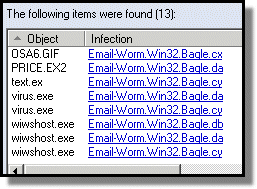
Earlier this week, the Bagle malware authors used an approach of creating a number of new viruses and spamming them massively in the wild. Each new wave of infected emails contained a different variation of the virus which was designed to elude detection by AV vendors. F-Secure set an all-time record will 11 releases in one day
Excellent Writeup by F-Secure on September 20th
Email-Worm.Win32.Bagle.cy (aka Bagle.BI)
Email-Worm.Win32.Bagle.cz
Email-Worm.Win32.Bagle.da
Email-Worm.Win32.Bagle.db
Email-Worm.Win32.Bagle.dc
Email-Worm.Win32.Bagle.dd
Email-Worm.Win32.Bagle.de
Email-Worm.Win32.Bagle.df

The folks at the Internet Storm Center have an interesting series that illustrates the dangerous of advanced spyware threats. This one is dedicated to the James Bond fans and provides an interesting account of the dangers in using the Internet without proper safeguards or precautions.
Follow the Bouncing Malware IX: eGOLDFINGER
 Opera 8.50 was recently improved to remove the adbar on the free version. So far the new version is working well and presents no conflicts with IE 6 SP2 or Mozilla Firefox 1.5.
This release is a recommended security upgrade.
Download Link for version 8.50:
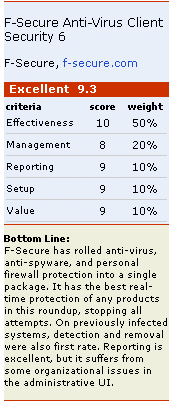
 F-Secure was the top corporate choice, based on it's real-time effectiveness in stopping a broad range of spyware and adware infections.
InfoWorld - Corporate Spyware Product Evaluations
F-Secure selected as top corporate Spyware product overall
QUOTE: F-Secure Anti-Virus Client Security has one of the best, most comprehensive security bundles available, although it suffers a bit from a disjointed administration user interface. One of three anti-spyware solutions in this review that includes anti-virus capabilities in the same package, Anti-Virus Client Security’s real-time protection stopped all attempts to infect my test clients. Reporting is browser-based and provides ample predefined templates. Because of its awesome real-time protection and overall performance, Anti-Virus Client Security 6 received the highest score of the ten products reviewed.
 A new virus ressembling the social engineering approach of the Love Letter virus in May 2000 has emerged. This one is easy to block and more of a threat to home users.
McAfee information
http://vil.nai.com/vil/content/v_136187.htm
Trend and Symantec information
http://secunia.com/virus_information/21881/suclove.a/
Payload: Opens a back door that allows a remote attacker to have unauthorized access to the compromised computer.
Large scale e-mailing: Uses MS Outlook to send a copy of the worm to all users in the Outlook address book.
Degrades performance: Creates a mass-mailing of itself, which may impact performance.
Releases confidential info: Attempts to steal confidential system information.
EMAIL TO AVOID
Subject: Love, for Forgiveness :->
Body: I love u please forgive me!...
Attachment: LoveLetter.doc.exe
Subject: Read my letter for you
Body: this was created from the deep inside my heart.
Attachment: LoveLetter.doc.exe
 Please be careful with all email messages containing Microsoft Access attachments. This new exploit capitalizes on an unpatched MS Jet Engine vulnerability that creates a compromise to system security until the Trojan Horse is removed.
While this new zero day attack is very rare, it could could surprise individuals if we were massively spammed in the wild, Microsoft Access data base email attachments are usually thought of as being safe to open. Thus we should always be cautious on ANY attachment type and the best practice is to never open attachments regardless of whether they appear safe or not.
Backdoor.Hesive - Zero Day MS Jet Engine Exploit
http://secunia.com/virus_information/21954/hesive/
Backdoor.Hesive is a Trojan horse that opens a back door on the compromised computer and allows a remote attacker unauthorized access. The Trojan may arrive as a Microsoft Access file that exploits the Microsoft Jet Database Engine Malformed Database File Buffer Overflow Vulnerability (described in Bugtraq ID 12960).
Microsoft Jet Database Engine Malformed Database File Buffer Overflow Vulnerability
http://www.securityfocus.com/bid/12960/info
Solution: Currently we are not aware of any vendor-supplied patches for this issue
Allows the remote attacker the ability to perform the following actions:
List active ports
List processes, services, and threads
Download and execute remote files
Upload files
Run a system shell
Modify registry values
End processes
Get system information
Get network information
Post collected data to hostile web site
 Several Microsoft service packs were released for the Office 2003 product family.
Microsoft Office 2003 SP2 Released
http://support.microsoft.com/kb/887616
Security bulletins that are associated with the service pack
MS05-023/KB890169: Vulnerabilities in Microsoft Word could lead to remote code execution
MS04-027/KB884933: Vulnerability in WordPerfect converter could allow code execution
MS04-028/KB833987: Buffer overrun in JPEG processing (GDI+) could allow code execution
Microsoft Visio 2003 SP2 Released
http://support.microsoft.com/kb/887622
Security bulletins that are associated with the service pack
MS04-028/KB833987: Buffer overrun in JPEG processing (GDI+) could allow code execution
Microsoft Outlook 2003 Junk Email Filter Update
http://support.microsoft.com/kb/904631
This update should improve your junk mail filtering accuracy.
This new version of Spybot has to be one of the most comprehensive attacks I've seen today for this large family of viruses. It attacks weak passwords, uses existing backdoor infections, plus attacks through some of the most prominent security vulnerabilities if a system is unpatched.
Spybot.YCL - Attacks 7 major unpatched vulnerabilities or other weak security vulnerabilities
1. Attacks several major security vulnerabilities in unpatched Microsoft, Dameware, and Veritas software:
2. Spreads over network shares and Microsoft SQL server using weak usernames and passwords
3. Spreads to compromised computers by using back doors left behind by other malware such as:
The Sober virus family is always one to watch. This one is spreading rapidly and McAfee has declared Medium Risk. It is also very difficult to clean until enhanced cleaning capabilities are provided by AV companies.
Sober.R - MEDIUM RISK by McAfee
http://vil.nai.com/vil/content/v_136390.htm
Other AV companies
http://secunia.com/virus_information/22225/sober.s/
EMAIL TO AVOID - English & German variants
| Subject: Your new Password Body: Your password was successfully changed! Please see the attached file for detailed information. |
This mass-mailing email virus arrives in an email message with one of the following attachment names: KlassenFoto.zip, pword_change.zip
SPECIAL INSTRUCTIONS FOR INFECTED PCs
Cleaning this new variant is difficult as some new techniques used by the virus writer lock down security of infected files, (blocks access to files using special registry settings), so that you have to clean in SAFE MODE until McAfee releases it's next DAT file (which will reset file access permissions in the registry to allow direct cleaning).
| Quote: |
|
Due to the nature in which this virus operates once a machine is successfully infected, read-access to its file may be denied. The AV scanner will not be able to detect the file in this case. Because of this, if a machine is suspected to be infected, users are recommended to follow the procedure below: Reboot the system into Safe Mode (hit the F8 key as soon as the Starting Windows text is displayed, choose Safe Mode.
|
 The following 3-part review was featured by Tech Republic on the enhancements that will be forthcoming in Windows Vista, which is Microsoft's next generation operating system for client workstations.
http://www.winsupersite.com/reviews/winvista_beta1_01.asp
http://www.winsupersite.com/reviews/winvista_beta1_02.asp
http://www.winsupersite.com/reviews/winvista_beta1_02.asp
 CERT provides one of the best websites related to computer security. They have recently addressed a major issue among anti-virus companies, where common naming conventions don't exist due to the competitive nature of being first many times. Also, some AV products can handle several variants with a single defiition, where other AV vendors must specifically define a new variant each time a new compression or packing technique is used on the executable.
Chris Mosby, a very talented security modertor in My IT Forums commented on this need in an “Open Letter to Anti-Virus Software Companies” in November 2004. This new system won't be perfect, but it's a step in the right direction. It'll help companies like the one I work for which uses corporate McAfee VS 8.0i on the desktop and SAV for email filtering.
Common Malware Enumeration (CME) - Home Page
http://cme.mitre.org/
Common Malware Enumeration (CME) - FAQ
http://cme.mitre.org/about/faqs.html
Common Malware Enumeration (CME) - Current List
http://cme.mitre.org/data/list.html
Common Malware Enumeration (CME) - How it Works
http://cme.mitre.org/cme/process.html
Common Malware Enumeration (CME) - Press Release
http://cme.mitre.org/about/docs.html
Zafi.F is spreading via email in English, Italian, Spanish, Russian, Swedish and several other languages. This new HTML based variant is authentic in appearance, from a social engineering perspective.

SECUNIA
http://secunia.com/virus_information/22349/zafi.f/
F-SECURE
http://www.f-secure.com/v-descs/zafi_f.shtml
McAfee
http://vil.nai.com/vil/content/v_136426.htm
DO NOT OPEN ATTACHMENTS ENDING WITH: pif, cmd, bat, com or zip file.
 Microsoft Security Release - October 2005
The following provides an overview of several important updates.
Microsoft Security Release - October 2005
http://www.microsoft.com/technet/security/Bulletin/ms05-Oct.mspx
Internet Storm Center - Excellent Technical Analysis
http://isc.sans.org/diary.php?date=2005-10-11
Vulnerability in DirectShow Could Allow Remote Code Execution (904706) - Critical
http://www.microsoft.com/technet/security/Bulletin/ms05-050.mspx
Vulnerabilities in MSDTC and COM+ Could Allow Remote Code Execution (902400) - Critical
http://www.microsoft.com/technet/security/Bulletin/ms05-051.mspx
Cumulative Security Update for Internet Explorer (896688) - Critical
http://www.microsoft.com/technet/security/Bulletin/ms05-052.mspx
Vulnerability in the Client Services for Netware Could Allow Remote Code Execution (899589) - Important
http://www.microsoft.com/technet/security/Bulletin/ms05-046.mspx
Vulnerability in Plug and Play Could Allow Remote Code Execution and Local Elevation of Privilege (905749) - Important
http://www.microsoft.com/technet/security/Bulletin/ms05-047.mspx
Vulnerability in the Microsoft Collaboration Objects Could Allow Remote Code Execution (907245) - Important
http://www.microsoft.com/technet/security/Bulletin/ms05-048.mspx
Vulnerabilities in Windows Shell Could Allow Remote Code Execution (900725) - Important
http://www.microsoft.com/technet/security/Bulletin/ms05-049.mspx
Vulnerability in the Windows FTP Client Could Allow File Transfer
Location and Tampering (905495) - Moderate
http://www.microsoft.com/technet/security/Bulletin/ms05-044.mspx
Vulnerability in Network Connection Manager Could Allow Denial Service (905414) - Important
http://www.microsoft.com/technet/security/Bulletin/ms05-045.mspx
 Microsoft's Technet Security team is introducting a new Learning Paths website that features resources on security threats and appropriate controls. Each month new articles and training materials will be featured to provide on-going training for security professionals.
http://www.microsoft.com/technet/security/learning/default.mspx
Internal Threats: Mitigate the Risks in Your Environment
Today's IT Professionals work in a challenging environment where there's a constant effort to protect resources and vital information from internal misuse. Attend this series and learn about the risks, business challenges and recommendations for protecting your network from internal threats. We will cover topics such as Security risk management, assessment, and implementation as well as steps for meeting your business needs of operating in a more secure environment
 In the November 2005 issue of PC World magazine, 11 different products are evaluated. Webroot Spysweeper continues to score near the top in all evaluations. The MSAS beta release also had a positive review and scored as one of the best free products. It's always best to look at more than one evaluation, as the review team can rank categories differently.
PC World - Evaluation of 11 Anti-Spyware Products
PC World - Evaluation of 11 Anti-Spyware Product Grid
 So far, there are no published reports for MS05-051 which some security firms feel has the potential to be crafted into a possible Internet worm, that could especially impact Windows 2000 based PCs and Servers. At least 3 proof-of-concept exploits were developed within a couple of days of the October 11th updates, so companies should carefully test their applications and patch expediently. All users should stay as up-to-date as possible on any security patches that are released.
» 2005-10-13 : Microsoft Collaboration Data Objects Buffer Overflow PoC Exploit (MS05-048)
» 2005-10-13 : Microsoft Windows Network Connection Manager Local DoS Exploit (MS05-045)
» 2005-10-13 : Microsoft Windows FTP Client File Location Tampering Exploit (MS05-044)
 All Netscape 8.0x users should update to the latest version to stay protected as recent improvements in security have been released
http://browser.netscape.com/ns8/security/alerts.jsp
Fixed in Netscape Browser 8.0.4
• MFSA 2005-58 Firefox 1.0.7 / Mozilla Suite 1.7.12 Vulnerability Fixes
• MFSA 2005-57 IDN heap overrun using soft-hyphens
 During October, Oracle released several critical security patches that companies should quickly test and apply to safeguard information in these data base repositories.
2005-10-19 : Oracle Products Buffer Overflow and SQL Injection Vulnerabilities
Multiple vulnerabilities were identified in various Oracle products, which may be exploited by remote or local attackers to cause a denial of service, execute arbitrary commands, conduct SQL injection attacks and cross site scripting attacks, or bypass certain security restrictions. These flaws are due to unspecified errors in Oracle Database Server, Application Server, Collaboration Suite, E-Business Suite, Applications, Enterprise Manager, PeopleSoft Enterprise, and JD Edwards EnterpriseOne. No further details have been disclosed.
 A new attack based on October's security bulletin MS05-047 surfaced overnight. This new threat remains at low risk currently.
MS05-047 -- Mocbot IRC Worm in the wild
http://secunia.com/virus_information/22746/irc-mocbot/
http://www.f-secure.com/v-descs/mocbot.shtml
http://vil.nai.com/vil/content/v_136637.htm
This botnet client was spread using the MS05-047 vulnerability in October 2005. This threat appears to be the first of its kind to exploit the recent MS05-047 Microsoft Windows vulnerability.
This trojan installs itself in the WINDOWS SYSTEM directory as wudpcom.exe. It creates a service called "wudpcom". Once instructed, the bot scans the class A subnet addresses, sending SYN packets via TCP 139 (netbios), and 445 (microsoft-ds).
SYMPTOMS
1. Heavy netbois and microsoft-ds network traffic
2. Presense of the file wudpcom.exe in the WINDOWS SYSTEM directory
3. TCP 18067 connections to hostile websites
FrSIRT has also published POC code for ms05-047 exploit
A new attack based on August's security bulletin MS05-039 surfaced overnight. This new threat remains at low risk currently. This was initially reported as an MS05-047 exploit, but after further analysis McAfee has confirmed that while MS05-047 code was present, the MS05-039 exploit was used as the key method to infect unpatched PCs.
MS05-039 -- Mocbot IRC Worm in the wild
http://secunia.com/virus_information/22746/irc-mocbot/
http://www.f-secure.com/v-descs/mocbot.shtml
http://vil.nai.com/vil/content/v_136637.htm
This botnet client was spread using the MS05-039 vulnerability in October 2005. This trojan installs itself in the WINDOWS SYSTEM directory as wudpcom.exe. It creates a service called "wudpcom". Once instructed, the bot scans the class A subnet addresses, sending SYN packets via TCP 139 (netbios), and 445 (microsoft-ds).
SYMPTOMS
1. Heavy netbois and microsoft-ds network traffic
2. Presense of the file wudpcom.exe in the WINDOWS SYSTEM directory
3. TCP 18067 connections to hostile websites
-- AVERT / McAfee Update Oct 23, 2005 -- After further analysis, AVERT has confirmed that this threat does not exploit MS05-047, but rather MS05-039. Initial analysis suggested the MS05-047 was being exploited due to similarities between those exploits (including overlapping code between publicly available source code), field infection reports where administrators incorrectly stated that machines were patched from MS05-039, and similarities between an earlier MS05-039 exploiting bot, where the only significant change was the exploit code being used.
Additionally, AVERT has confirmed that automated propagation has/had been configured on remote IRC servers, such that infected systems that are able to connect to the remote IRC server are immediately instructed to seek out vulnerable systems to infect them. This threat exploits the MS05-039 Microsoft Windows vulnerability.
Two more new exploits have developed as malicious individuals work to reverse engineer the changes and discover code weaknesses in unpatched systems. These new potential attacks are based on the MS05-047 Microsoft Security Bulletin issued in October. It's always a best practice to patch as soon as Microsoft performs a release which is usually the second Tuesday of each month.
2005-10-24 : Microsoft Windows Plug and Play "Umpnpmgr.dll" DoS Exploit (MS05-047)
2005-10-21 : Microsoft Windows Plug and Play "Umpnpmgr.dll" Remote Exploit (MS05-047)
? A new attack based on August's security bulletin MS05-039 surfaced overnight. This new threat remains at low risk currently.? This was initially reported as an MS05-047 exploit, but after further analysis McAfee has confirmed that while MS05-047 code was present, the MS05-039 exploit was used as the key method to infect unpatched PCs.
MS05-039 -- Mocbot IRC Worm in the wild
http://secunia.com/virus_information/22746/irc-mocbot/
http://www.f-secure.com/v-descs/mocbot.shtml
http://vil.nai.com/vil/content/v_136637.htm
This botnet client was spread using the MS05-039 vulnerability in October 2005. This trojan installs itself in the WINDOWS SYSTEM directory as wudpcom.exe. It creates a service called "wudpcom". Once instructed, the bot scans the class A subnet addresses, sending SYN packets via TCP 139 (netbios), and 445 (microsoft-ds).
SYMPTOMS
1. Heavy netbois and microsoft-ds network traffic
2. Presense of the file wudpcom.exe in the WINDOWS SYSTEM directory
3. TCP 18067 connections to hostile websites
-- AVERT / McAfee Update Oct 23, 2005 -- After further analysis, AVERT has confirmed that this threat does not exploit MS05-047, but rather MS05-039. Initial analysis suggested the MS05-047 was being exploited due to similarities between those exploits (including overlapping code between publicly available source code), field infection reports where administrators incorrectly stated that machines were patched from MS05-039, and similarities between an earlier MS05-039 exploiting bot, where the only significant change was the exploit code being used.
Additionally, AVERT has confirmed that automated propagation has/had been configured on remote IRC servers, such that infected systems that are able to connect to the remote IRC server are immediately instructed to seek out vulnerable systems to infect them. This threat exploits the MS05-039 Microsoft Windows vulnerability.

Microsoft has just updated the Windows XP security guide and this free resource can be found through the following link:
Any IT environment is only as secure as its weakest link. Unfortunately, client operating systems are often overlooked during security projects. As your organization plans to implement Microsoft® Windows® XP Professional with Service Pack 2 (SP2), ensure that security is an integral part of your deployment plans.
Although the default installation of Windows XP is quite secure, it is important to remember the trade-offs that exist between security, usability, and functionality of the client computers in your environment. A thorough understanding of these trade-offs places your organization in a position to maximize the security of your Windows XP deployment.
The guide provides specific recommendations about how to harden computers that run Windows XP with SP2 in three distinct environments:
| • |
Enterprise Client (EC). Client computers in this environment are located in an Active Directory® directory service domain and only need to communicate with systems that run Windows 2000 or later versions of the Windows operating system. |
| • |
Stand-Alone (SA). Client computers in this environment are not members of an Active Directory domain and may need to communicate with systems that run Windows NT® 4.0. |
|
• |
Specialized Security – Limited Functionality (SSLF). Concern for security in this environment is so great that a significant loss of functionality and manageability is acceptable. For example, military and intelligence agency computers operate in this type of environment. |
This new Instant Messenger (IM) threat should be closely watched as it contains a security backdoor and other sophisticated capabilities.
http://secunia.com/virus_information/22890/virkel.a/
Virkel is a backdoor with IM (Instant Messenger) spreading capabilities. It was first found on October 26th, 2005. The backdoor can provide a hacker with information about a system, work as a proxy, update itself, perform a Denial of Service (DoS) attack, open remote shell, download files. It also kills processes of anti-virus and security software and blocks access to many different sites that belong to anti-virus and security software vendors.
 As noted in this Tech Republic Article, Internet Explorer version 7 will support a more robust protocol for encrypting user data and securing online transactions.
http://blogs.msdn.com/ie/archive/2005/10/22/483795.aspx
QUOTE: In a posting on the Microsoft Internet Explorer blog, IE program manager Eric Lawrence said that IE7 would support the Transport Layer Security (TLS) protocol by default.
Lawrence also explained how IE7 will behave differently from earlier versions when it encounters potential security problems.
"Whenever IE6 encountered a problem with a HTTPS-delivered Web page, the user was informed via a modal dialog box and was asked to make a security decision. IE7 follows the XPSP2 'secure by default' paradigm by defaulting to the secure behavior," said Lawrence.
IE7 will not give users the option of seeing both secure and insecure items within an HTTPS page. With IE6, this option appears when the browser encounters an HTTPS page that includes some HTTP content. But in IE7, only the secure content will be rendered by default, forcing the user to choose to access the rest via the information bar.
"This is an important change because very few users (or web developers) fully understand the security risks of rendering HTTP-delivered content within a HTTPS page," Lawrence claimed.
 Data base Administrators should watch for further developments as this weakness will most likely be corrected in the future.
Article: Oracle password system comes under fire
QUOTE: Attackers could easily uncover Oracle database users'passwords because of a weak protection mechanism, putting corporate data at risk of exposure, experts have warned.
The technique Oracle uses to store and encrypt user passwords doesn't provide sufficient security, said Joshua Wright of the SANS Institute and Carlos Sid of Royal Holloway college, University of London.
 I don't think this one is widespread, but based on the stealth-like nature of rootkits, it's probably both difficult to detect and remove.
http://news.zdnet.com/2100-1009_22-5920403.html
A worm found spreading via America Online's Instant Messenger is carrying a nastier punch than usual, a security company has warned. The unnamed worm delivers a cocktail of unwanted software, including a so-called rootkit, security experts at FaceTime Communications said Friday. A rootkit is a tool designed to go undetected by the security software used to lock down control of a computer after an initial hack.
 Forum Administrators should move to the latest versions of phpBB, as security improvements continue to be made to this highly flexible and functional environment.
http://www.phpbb.com/phpBB/viewtopic.php?t=336756
The phpBB Group is pleased to announce the release of phpBB 2.0.18, "The Halloween Special" release. This is a major update to the 2.0.x codebase and includes fixes for numerous bugs reported by users to our Bug Tracker, as well as updates to those issues identified by the recent security audit of the code and a couple of security issues reported to us. In addition we have backported a further feature from our "Olympus" codebase to change the way automatic logins are handled.
 Apple Computers has issued some important security updates that should be applied promptly to ensure a more secure computing environment.
http://isc.sans.org/diary.php?storyid=811
Apple has released security updates for OS X, the new version 10.4.3 addresses issues in Finder, Software Update, memberd, Keychain and Kernel. It's time for the Mac folks to patch the boxes....
OS X 10.4.3 can be downloaded from http://www.apple.com/support/downloads/
 Usually, early in the month the Bagle author launches the next generation of variants. McAfee has just published preliminary information on this.
Bagle DL/DK - Two New November Variants
http://secunia.com/virus_information/23094/bagle.dl/
http://secunia.com/virus_information/23093/bagle.dk/
QUOTE: This is a downloader trojan. However, like previous Bagle variants, it is likely that in the near future, the author(s) will post an accompanying EXE file on a remote server, which SPAMs new versions of Bagle (not to addresses harvested on the local system, but to addresses specified in spam lists also on remote web servers). This trojan was mass-spammed in a ZIP attachment and may use any one of the following filenames:
The_new_prices.zip
Info_Prices.zip
Health_and_knowledge.zip
sms_text.zip
max.zip
Business.zip
Business_dealing.zip
Spybot is used commonly by hackers as it represents it tries multiple approaches to find weaknesses in the security defenses, including both Microsoft and non-Microsoft vulnerabilities. Thus, it's important to patch everything, including CISCO routers as this new variant has the potential to report vulnerable ones back to these malicious groups of individuals.
Spybot.ZIF - Internet Storm Center Link
W32.Spybot.ZIF is a network-aware worm that opens a back door on the compromised computer. It spreads by exploiting common system vulnerabilities.
METHODS OF INFECTION
The Microsoft Windows DCOM RPC Interface Buffer Overrun Vulnerability (described in Microsoft Security Bulletin MS03-026).
The Microsoft Windows Local Security Authority Service Remote Buffer Overflow (as described in Microsoft Security Bulletin MS04-011).
The Microsoft Windows ntdll.dll Buffer Overflow Vulnerability (described in Microsoft Security Bulletin MS03-007).
The Microsoft ASN.1 Library Bit String Processing Variant Heap Corruption (described in Microsoft Security Bulletin MS04-007).
The Workstation Service Buffer Overrun vulnerability (as described in Microsoft Security Bulletin MS03-049).
The Microsoft Windows Plug and Play Buffer Overflow Vulnerability (described in Microsoft Security Bulletin MS05-039).
The DameWare Mini Remote Control Server Pre-Authentication Buffer Overflow vulnerability (as described in Bugtraq ID 9213).
The VERITAS Backup Exec Agent Browser Remote Buffer Overflow Vulnerability (as described here).
EXISTING BACKDOORS: Spreads to computers compromised by the following threats: Backdoor.SubSeven, Backdoor.NetDevil, W32.MyDoom, W32.Beagle, Backdoor.Optix
Exploits weak username/passwords to spread over network shares and to the Microsoft SQL server environment
SYMPTOMS & ATTACK METHODS
Opens a back door by contacting an IRC server on the domain scv.unixirc.de, through TCP port 6667. This back door allows a remote attacker to perform the following actions on the compromised computer:
Start and stop threads and processes:
Start a SOCKS4 server
Start an HTTP server
Start an FTP server
Retrieve clipboard data
Sniff local network traffic
Run shell commands
Change IE start page
Flush DNS/ARP cache
Steal passwords from protected storage
Open and delete files
Download and execute files
Perform a denial of service (DOS) attack
View and delete registry keys
Obtain computer information such as CPU type, OS version, RAM, etc
Scan a specified network range for Cisco routers that may have vulnerable Telnet or HTTP servers running and report results back to IRC.
 Microsoft offers much improved security in XP SP2 for Internet Explorer and applying the latest tightening of controls can break some applications and web pages that may not be following the best practices. This manual regedit based fix can help resolve these issues.
SYMPTOMS
After you install cumulative security update 896688, a Web page that contains an ActiveX control does not load as expected in the products that are listed in the "Applies to" section. You may also receive an error message that is similar to the following when you try to open Add/Remove Programs in Control Panel:
Object doesn't support this property or method
RESOLUTION
To resolve this issue, add the required subkeys to the registry. To do this, follow these steps:
1. Click Start, click Run, type Notepad.exe, and then click OK.
2. Paste the following text in the Notepad document:
Windows Registry Editor Version 5.00
[HKEY_CLASSES_ROOT\CLSID\{0000031A-0000-0000-C000-000000000046}]
@="ClassMoniker"
[HKEY_CLASSES_ROOT\CLSID\{0000031A-0000-0000-C000-000000000046}\InprocServer32]
@="ole32.dll"
[HKEY_CLASSES_ROOT\CLSID\{0000031A-0000-0000-C000-000000000046}\ProgID]
@="clsid"
[HKEY_LOCAL_MACHINE\SOFTWARE\Classes\CLSID\CLSID]
@="{0000031A-0000-0000-C000-000000000046}"
3. Click File, and then click Save.
4. In the Save in box, click Desktop.
5. In the File name box, type KB909889.reg.
6. In the Save as type box, click All Files, and then click Save.
7. Click File, and then click Exit.
8. On the desktop, double-click KB909889.reg, and then click Yes to add the information to the registry.
9. Click OK to confirm that the information in the KB909889.reg file has been added to the registry.
10. Restart the computer.
Important: This article contains information that shows you how to help lower security settings or how to turn off security features on a computer. You can make these changes to work around a specific problem. Before you make these changes, we recommend that you evaluate the risks that are associated with implementing this workaround in your particular environment. If you implement this workaround, take any appropriate additional steps to help protect your system.
Sort by Trending


