


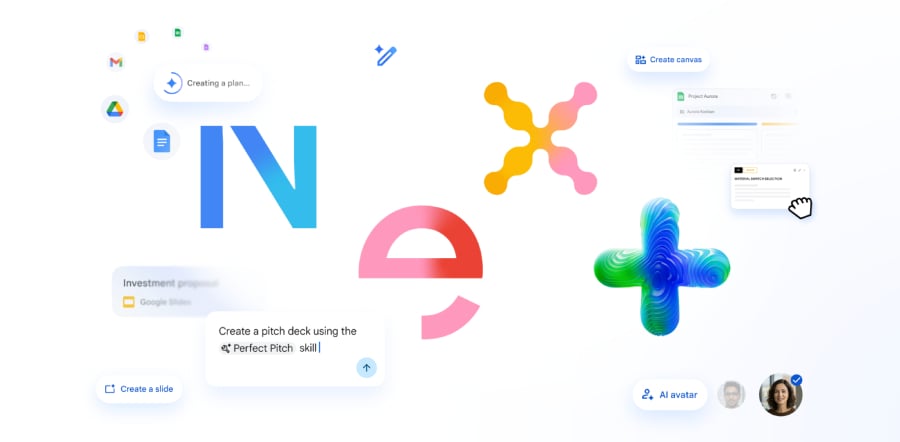
The smallest updates may have the biggest impact on daily work at Google Cloud Next 2026.
At Google Cloud Next 2026, Google announced new Gemini AI features across Workspace, including conversational data analysis in Sheets, expanded meeting notes, reusable automation skills, and faster migration tools for companies moving from Microsoft 365.
The bigger shift is practical: Google wants Gemini to become less of a chatbot and more of an assistant that can work across the apps businesses already use every day.
Key Google Workspace AI updates at Cloud Next 2026
Google’s latest changes focus on making Gemini more agentic, meaning it can take action across apps rather than generate content.
“Gemini Enterprise enables every customer and employee to build, use, deploy, and manage cutting-edge AI agents,” the company said in its official blog.
The update includes several areas, including conversational data analysis in Sheets, expanded AI-generated meeting summaries, workflow automation through reusable skills, and faster migration tools for organizations moving from Microsoft 365.
Sheets, Meet, and automation see practical improvements
Google is putting more of Gemini’s capabilities directly into everyday tools. In Sheets, users can now analyze data using natural language and create dashboards, heat maps, and interactive views without relying on complex formulas.
“To help you understand and take action from your data, you can now create and share custom and interactive visualizations,” Google highlighted in a product announcement.
Meeting notes are also getting an upgrade. The “Take Notes For Me” feature, now used by more than 110 million people in a month, can capture summaries and action items beyond Google Meet. It works for in-person meetings and calls on platforms like Zoom and Microsoft Teams.
According to TechRadar, Gemini is shifting from generating new content to an agentic assistant that interacts with your documents and acts autonomously.
More Google coverage
- New Google Search AI Mode is ‘Total Reimagining,’ Says CEO Sundar Pichai
- In Major Ruling, Judge Finds Google ‘Willfully Acquired and Maintained Monopoly Power’ Over Digital Ad Market
- Google’s Big Bet on Nuclear Energy: ‘The Race to Power AI-Driven Data Centers is Accelerating’
- Computer History Museum Releases Original AlexNet Code: Why It Matters
Workspace Intelligence connects data and context
Google also introduced Workspace Intelligence, a layer that connects data across Docs, Gmail, Drive, and other apps. The goal is to give Gemini more context, enabling more relevant results.
Canvas Mode in Gemini Enterprise builds on these updates by letting users generate full documents and presentations from internal data and web sources. The results remain editable, so teams can refine content without starting from scratch.
Google is also expanding how Workspace integrates with other systems. A new MCP server lets developers integrate Workspace capabilities into third-party AI applications, enabling actions across tools like Gmail, Drive, and Calendar without switching environments.
Migration tools target Microsoft 365 users
Google is also focusing on organizations considering a move from Microsoft 365. The company said that migration to Workspace can now be up to five times faster, thanks to improvements in data import and interoperability.
These updates include an AI-powered Office macro converter that helps translate legacy workflows, along with features like Office file editing in Gmail and redlining in Docs to improve cross-platform collaboration.
Overall, these updates show Google’s approach. Rather than focusing on major feature launches, Google is launching features that make everyday tasks easier, from data analysis to document collaboration and platform migration.
Read more: Google is expanding its push into AI agents as it competes with rivals like OpenAI and Anthropic in a rapidly evolving market.