


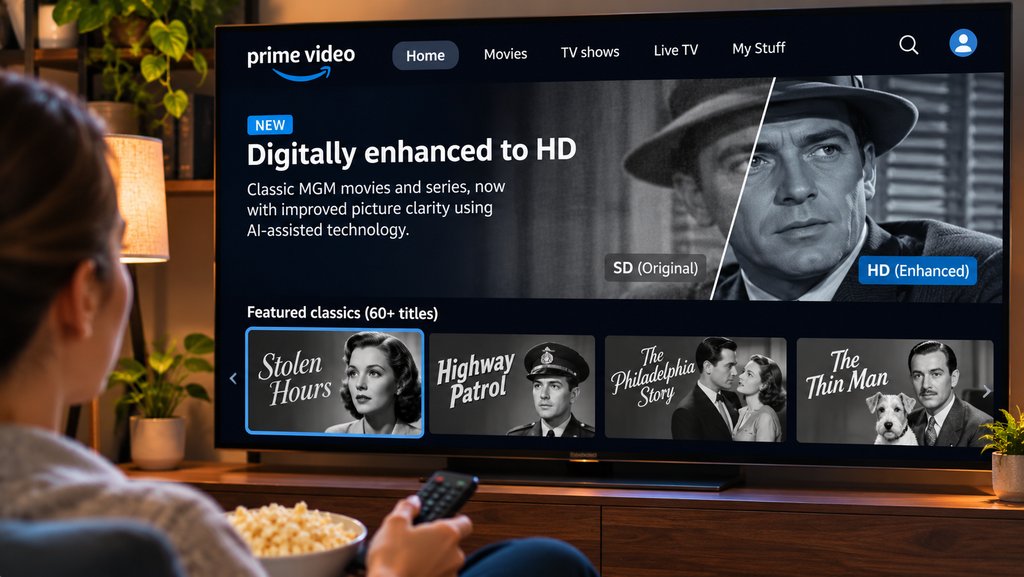
Older movies and television shows weren’t made for today’s enormous, ultra-sharp screens. Even a beloved classic can look noticeably blurry when its standard-definition picture is stretched across a modern 4K television.
Amazon is trying to improve that experience. Starting Nov. 25, Prime Video began offering more than 60 MGM movies and series in AI-enhanced HD, including the 1963 film Stolen Hours and episodes of the 1950s crime series Highway Patrol.
The upgraded titles are available to Prime Video customers worldwide. US viewers can find them in a new “Digitally enhanced to HD” carousel on the service’s home page.
The company says every enhanced title undergoes human review before release, and more films and shows will receive the same treatment in 2027.
How Prime Video’s AI upscaling works
According to Amazon’s announcement, Prime Video trained several AI models using Amazon Web Services (AWS), assigning different models to specific image-enhancement tasks.
The process involves four stages:
- Cleanup: Software removes common visual defects found in older footage.
- AI upscaling: One model sharpens the low-resolution image, while another refines textures and fine details.
- Preserving the original look: The system aims to maintain each production’s original colors and visual style.
- Film grain restoration: Natural-looking film grain is added back, with adjustments informed by studio specialists.
The final stage is particularly interesting.
Film grain is part of the appearance of many older productions. Removing too much can leave faces, clothing, and backgrounds looking unnaturally smooth.
Amazon says its process is designed to retain the original viewing experience while making the picture clearer.
However, AI upscaling isn’t the same as restoring a movie from its original film negatives.
A high-resolution scan of original film can recover photographic information that may be missing from an older video master. AI upscaling instead processes the image it’s given, using learned patterns to improve its appearance.
Amazon hasn’t specified whether its enhancements began with existing SD masters, original film elements, or other source materials.
That leaves an important question unanswered: How much of the improvement comes from the original source, and how much is reconstructed through AI?
The technology also differs from AI upscaling for live broadcasts, where processing must happen quickly enough to support real-time video.
Prime Video is enhancing existing movies and shows before making them available to viewers.
What viewers can expect from the enhanced movies
For people watching these titles on larger televisions, the intended benefits are straightforward: sharper images, clearer textures, and less of the softness associated with standard-definition video.
But HD doesn’t mean 4K.
Amazon has announced high-definition upgrades, not native 4K restorations. It also hasn’t specified the exact output resolution, bitrates, or technical standards used for each title.
The company says Prime Video video specialists review every enhanced movie and series for accuracy, consistency, and faithfulness to the original.
BA Winston, Prime Video’s vice president of technology, said the goal is to give older titles new life on modern screens while preserving their original character.
The announcement doesn’t explain how reviewers identify defects, whether titles undergo multiple rounds of correction, or how their results compare with versions restored through traditional methods.
Those details could help viewers understand how consistently the process works across different productions.
Why AI enhancement can be controversial
AI-assisted remastering has already faced criticism when the technology changes how familiar shows look.
In March 2025, Gizmodo criticized AI-upscaled versions of Roseanne and A Different World, describing distorted facial features, unstable details, and text that became difficult to read.
Those versions came from a separate remastering effort, not Amazon’s newly announced MGM process.
Still, the criticism illustrates what can happen when image enhancement introduces details that weren’t present in the original footage.
AI-based image reconstruction is also being used in other entertainment technologies, including graphics upscaling on PlayStation, although enhancing video game graphics and restoring archived television footage involve different technical challenges.
Viewers comparing Prime Video’s enhanced versions with older releases should pay attention to several details:
- Faces and movement: Do facial features remain natural and consistent between frames?
- Background details: Are textures clearer, or do they look artificially reconstructed?
- Text and signs: Are letters and small objects preserved accurately?
- Colors and film grain: Does the enhanced picture still resemble the original production?
These are potential issues to check, not defects Amazon has confirmed in its upgraded titles.
Unlike AI-generated video clips, which create new visual sequences, Prime Video’s technology is intended to improve footage from existing productions.
That makes fidelity to the original material especially important.
More AI-enhanced classics are coming in 2027
Amazon plans to expand the collection next year, although it hasn’t identified the additional titles or provided a release schedule.
The first batch is already available, giving customers an opportunity to judge the results themselves.
For viewers, the most immediate benefit is access to clearer versions of older movies and television series without needing a new television or additional hardware.
For studios and streaming services, the technology offers another potential way to modernize large back catalogs. However, Amazon hasn’t disclosed the cost of processing each title or compared its approach with traditional restoration methods.
The success of the rollout will ultimately depend on whether the enhanced versions look better without losing the visual character that made these productions recognizable.
Also read: Personal streaming libraries offer another option for movie collectors who prefer maintaining their own content rather than relying entirely on subscription catalogs.