


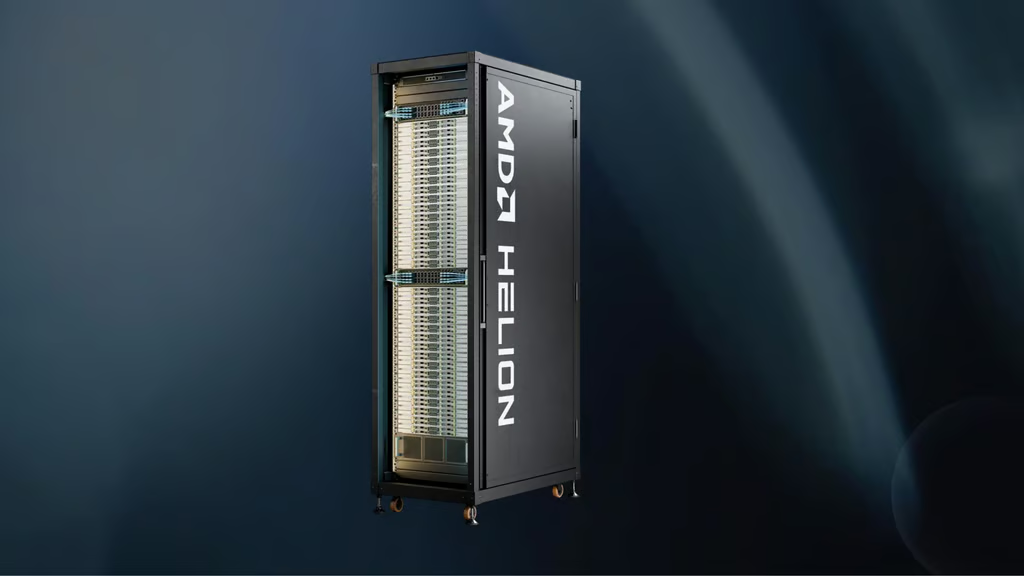
Agentic AI workloads vary from tool calling to multi-step workflows, each with different compute requirements. AMD is proposing an open rack design to accommodate these different demands through CPU-only configurations for agent execution and CPU-GPU systems for workloads that need accelerated computing.
AMD introduced Helion on Oct. 12 at the Open Compute Project (OCP) Global Summit 2026. The rack-scale reference design uses open hardware and software to let partners tailor infrastructure to different agentic AI workloads.
For IT teams, the practical question is where agents will execute tasks and where their models will run. Those choices should guide hardware sizing, network planning, and deployment budgets.
Dan McNamara, senior vice president and general manager, Compute and Enterprise AI at AMD, said: “With AMD Helion, we are bringing AMD EPYC performance, open software and flexible rack designs together so our partners can build systems around customer needs and make efficient use of available power.”
AMD says Helion rack configurations are under development with ecosystem partners, with availability planned for November 2026.
What AMD Helion brings
AMD Helion supports two configurations that serve different workload requirements: CPU-only and CPU-GPU rack configurations. CPU-only systems can handle agent orchestration, tool calling, and code execution, while CPU-GPU configurations support workloads that benefit from accelerated computing, including AI inference.
AMD positions the integrated CPU-GPU configuration for enterprises seeking agent execution and inference in one rack. Its CPU-only configuration targets hyperscalers that already operate separate accelerated infrastructure for model inference.
For buyers, a CPU-only rack therefore does not remove the need to plan for model inference elsewhere. IT teams should assess the network connections, latency, and operating costs of accessing those models alongside the rack’s own capacity.
AMD says Helion uses OCP’s Open Rack v3 (ORv3) standard. Intel also showcased Xeon-based rack designs at the summit, many using ORv3.
AMD outlines two deployment configurations, with flexibility to mix CPU blades within a rack and add GPU blades in the enterprise configuration. It also describes air-cooled and liquid-cooled versions, giving buyers another deployment choice to assess against their facilities.
What IT teams should assess before deployment
Using OCP’s ORv3 standard gives AMD Helion a common hardware foundation for rack-scale deployments. This matters for enterprises that want to customize their AI infrastructure rather than depend entirely on a vendor-defined system.
“As agentic AI moves into production, customers need flexibility in how and where they deploy it. That’s at the core of the Lenovo Hybrid AI Advantage, and AMD Helion will give added versatility to meet customers where they are and support the workloads they want to run,” said Scott Patti, VP, Infrastructure Solutions Group at Lenovo.
An open rack design gives buyers flexibility in selecting and integrating components that meet their deployment needs. However, adopting an open standard does not automatically guarantee interoperability between components or eliminate vendor dependencies. Enterprises will still need to assess system compatibility, power and cooling requirements, and the complexity of managing different hardware and software components.
Before committing, IT teams should ask suppliers for validated hardware configurations, supported software, and clear responsibility for system support. Test representative workflows against latency, throughput, reliability, and total operating cost targets, including any external inference services.
The announcement does not establish that Helion will reduce costs, improve utilization, or outperform competing systems. AMD’s planned November availability is the next milestone to watch, but purchasing decisions should depend on the capabilities and support of the specific partner system.
Read more: As you budget for agentic AI infrastructure, consider how Micron’s warning of memory shortages through 2028 could affect server costs and hardware planning.