


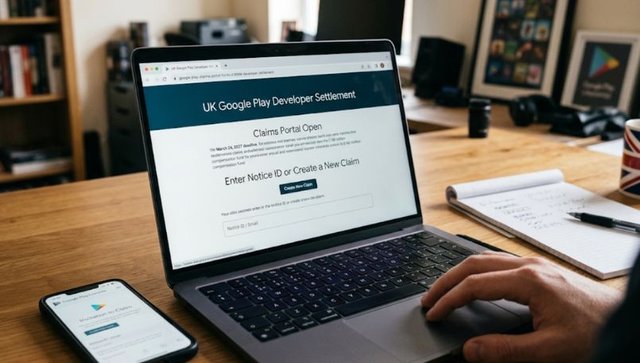
A paid app you stopped maintaining years ago could still count toward a Google Play settlement claim.
The claims portal for the £260 million UK Google Play developer settlement is now open. Eligible developers have until March 24, 2027, to apply for a share of the £160 million set aside for compensation. The administrator says payments start at £200, but applying does not mean the money will arrive right away.
The first thing to check isn’t whether your app is still in the store. It’s whether you made a qualifying sale, paid more than the settlement’s commission benchmark on at least one transaction, and met the UK domicile rules.
Who can claim a payment?
The tribunal’s settlement notice covers UK-domiciled third-party app developers who made at least one qualifying sale from Aug. 22, 2018, through July 31, 2026, and did not opt out. A paid app download, a one-time in-app purchase, or a recurring subscription can count if Google charged a commission. Free downloads alone do not qualify, nor do sales of physical goods or services.
The administrator’s detailed eligibility rules add two important checks:
- UK domicile: If your first qualifying sale came before Aug. 23, 2024, you must have existed and been UK-domiciled on May 23, 2025. If your first qualifying sale came from Aug. 23, 2024, through July 31, 2026, the domicile date is July 31, 2026.
- Commission: The effective rate you paid must have exceeded the settlement’s benchmark on at least one qualifying transaction. The actual benchmark is confidential. Paying some commission is not enough on its own.
The official claim site says both individual developers and businesses can apply. This is a developer settlement, not a refund program for people who bought apps. The settlement resolves a case over Google’s app store commissions, which TechRepublic covered in August. Google admitted no liability.
How to apply, even without an invitation
If the administrator sent you an invitation, start with the email address associated with your Google Play developer account. Use it to sign in through the official claims site, enter the Notice ID from your invitation, review the proposed award, and verify your identity before submitting.
If you didn’t receive an invitation, select Create a new claim on the portal. The administrator will review your eligibility. Start from the official settlement website rather than a link in an unfamiliar email, and don’t pay anyone to file. The administrator says claiming is free.
That identity check is for the settlement. It’s separate from Android developer verification, which affects how apps are distributed. Completing one process does not complete the other.
When claims close and when payments could arrive
| Jan. 18, 2027 | Deadline to opt out of the settlement. Opting out means giving up eligibility for a payment under this deal. |
| March 24, 2027 | Deadline to apply for a payment. This is not the opt-out deadline. |
| Mid-2027 | When payments are expected, after claims close and if the tribunal approves the distribution. |
The settlement timetable doesn’t promise a payment date. The administrator says developers with more than £7,500 in Play Store sales can receive more than the £200 minimum. That figure isn’t an eligibility threshold. Check the award shown in the portal instead of estimating it from your total revenue.
More Google coverage
- New Google Search AI Mode is ‘Total Reimagining,’ Says CEO Sundar Pichai
- In Major Ruling, Judge Finds Google ‘Willfully Acquired and Maintained Monopoly Power’ Over Digital Ad Market
- Google’s Big Bet on Nuclear Energy: ‘The Race to Power AI-Driven Data Centers is Accelerating’
- Computer History Museum Releases Original AlexNet Code: Why It Matters
What to pull from your records before you apply
- If you run a studio: Identify the entity that made the qualifying sales and the email address tied to its developer account. If your company changed names or acquired an app, have those records handy before asking the administrator how to proceed.
- If you published an app on your own: Check old Play Store sales records, not just whether the app is live today. A retired app is worth looking up if you remember charging for it or selling an in-app subscription.
- If you handle studio finances: Save the claim confirmation and keep the proposed award separate from money already received. The amount shown when you apply and the date you can plan to receive it are two different things.
Treat this as a potential payment for past sales, not a change to what you’ll pay to distribute an app next year. Changes to Android app distribution are a separate story. For now, the useful step is to confirm who can file for the account and submit through the official portal before March 24.
Related reading: See what Google Play’s April 2027 foldable deadline means for Android apps.