
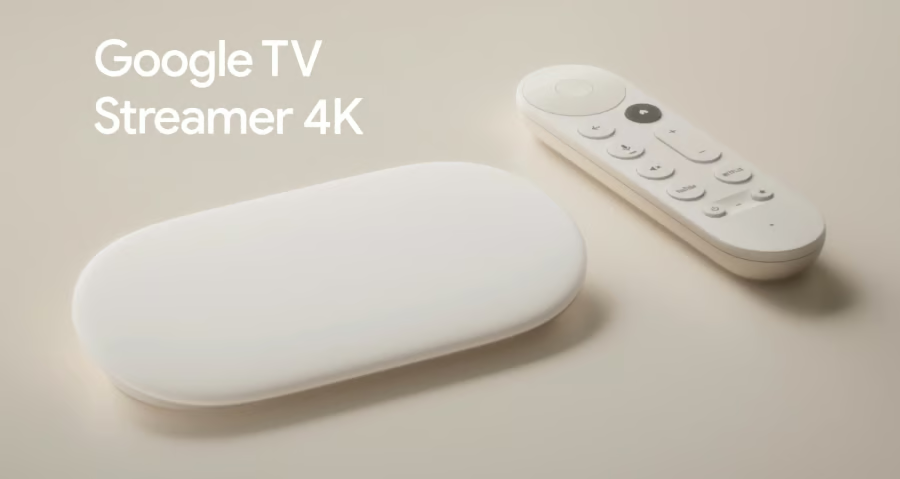


Google has turned its $100 streaming box into a $150 purchase, making the Google TV Streamer the latest piece of consumer tech caught in the rising cost of hardware.
The Google TV Streamer now sells for $149.99 at the Google Store and Best Buy, up from its $99.99 launch price in 2024. The device replaced Chromecast and has generally been positioned as Google’s higher-end streaming option.
Amazon and some other retailers were still listing the 4K streamer for around $100 as of Aug. 31, meaning shoppers may have a brief chance to buy existing inventory at the old price.
Google did not announce the increase ahead of time. In a statement to 9to5Google, the company said: “Due to rising component costs, we are adjusting the U.S. pricing of select Google Nest cameras, doorbells and Google TV streamer 4K, effective August 31.” Google added that it remains committed to providing “industry-leading smart home security and continuous feature updates.”
The $150 price changes the competition
At $100, the Google TV Streamer was an easy recommendation for buyers who wanted Google’s TV platform with more storage and memory than older Chromecast hardware. At $150, the calculation is less straightforward.
The 2024 Roku Ultra is also priced at $149.99 and supports 4K at 60 frames per second, Dolby Vision, HDR10+, Dolby Atmos and Wi-Fi 6. The Google TV Streamer supports the same major video and audio formats but uses Wi-Fi 5. It counters with 32GB of storage, 4GB of RAM and built-in Matter and Thread support for smart-home devices.
Amazon’s Fire TV Cube costs more at $200 but adds built-in microphones for Alexa and Wi-Fi 6E, along with tighter integration with Amazon’s smart-home ecosystem. Meanwhile, Walmart’s Onn 4K Pro costs about $60 and runs Google TV with 32GB of storage and 3GB of RAM.
More Google coverage
- New Google Search AI Mode is ‘Total Reimagining,’ Says CEO Sundar Pichai
- In Major Ruling, Judge Finds Google ‘Willfully Acquired and Maintained Monopoly Power’ Over Digital Ad Market
- Google’s Big Bet on Nuclear Energy: ‘The Race to Power AI-Driven Data Centers is Accelerating’
- Computer History Museum Releases Original AlexNet Code: Why It Matters
Why the increase matters
Google says component costs are behind the change, while several reports point to rising memory prices as a possible factor. The Streamer contains 4GB of RAM, making rising memory prices one possible contributor, although Google has blamed component costs broadly rather than RAM specifically.
The move also comes as other streaming hardware becomes more expensive. Amazon recently raised the Fire TV Stick 4K Max to $84.99, while Apple’s Apple TV 4K now starts at $199 for the 64GB model.
The Streamer is part of a wider round of Google hardware increases. According to 9to5Google, Google also raised prices by $20 to $50 on five Nest products: three cameras and two doorbells.
The changes took effect Aug. 31, suggesting the Streamer’s price increase is less about a product refresh and more about Google’s response to higher component costs. For shoppers, remaining $100 inventory may still offer strong value. At $149.99, however, buyers should compare the Streamer’s Google TV and smart-home features against the Roku Ultra’s Wi-Fi 6 and premium remote before purchasing.
Read more: Amazon’s slimmer Fire TV Stick HD offers Wi-Fi 6, Alexa+ and portable streaming for $34.99, giving buyers a substantially cheaper alternative to premium streaming boxes.