


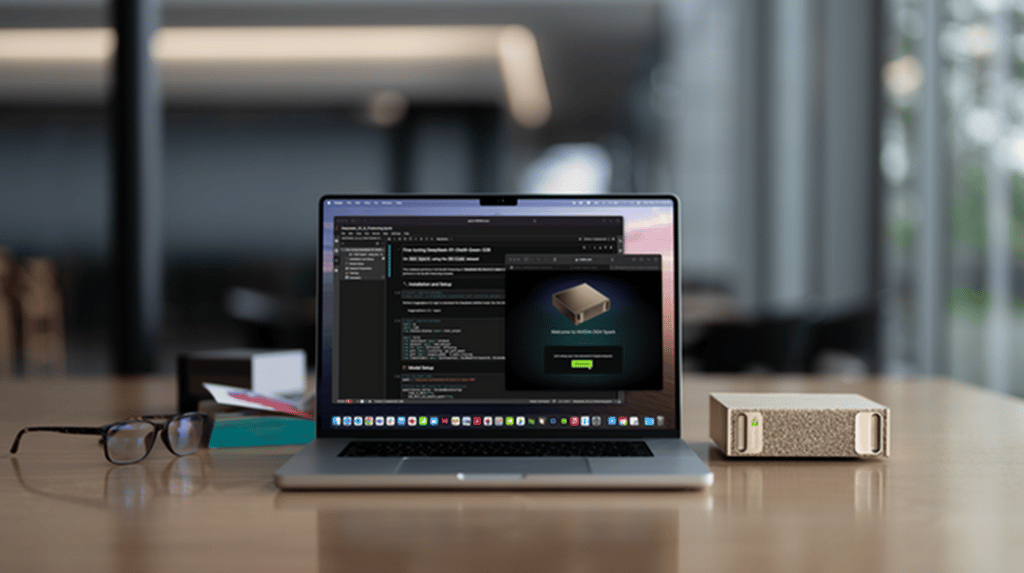
Nvidia has big news to share with the launch of its DGX Spark, “the world’s smallest AI supercomputer.”
The tech firm reckons AI workloads are quickly outgrowing the memory and software capabilities of the PCs, workstations, and laptops millions of developers rely on — forcing teams to shift work to the cloud or local data centers.
As a new class of computer, DGX Spark delivers a petaflop of AI performance and 128GB of unified memory in a compact desktop form factor, giving developers the power to run inference on AI models with up to 200 billion parameters and fine-tune models of up to 70 billion parameters locally. In addition, DGX Spark lets developers create AI agents and run advanced software stacks locally.
“In 2016, we built DGX-1 to give AI researchers their own supercomputer. I hand-delivered the first system to Elon at a small startup called OpenAI — and from it came ChatGPT, kickstarting the AI revolution,” said Jensen Huang, founder and CEO of Nvidia in the announcement. “DGX-1 launched the era of AI supercomputers and unlocked the scaling laws that drive modern AI. With DGX Spark, we return to that mission — placing an AI computer in the hands of every developer to ignite the next wave of breakthroughs.”
Evolution of AI computing
DGX Spark brings together the Nvidia AI platform — including GPUs, CPUs, networking, CUDA libraries, and the AI software stack — into a system small enough for a lab or an office, yet powerful enough for agentic and physical AI development.
DGX Spark systems deliver up to 1 petaflop of AI performance, accelerated by an Nvidia GB10 Grace Blackwell Superchip, Nvidia ConnectX-7 200 Gb/s networking, and Nvidia NVLink-C2C technology, providing 5x the bandwidth of fifth-generation PCIe with 128GB of CPU-GPU coherent memory.
The company’s AI software stack is preinstalled to enable developers to start working on AI projects out of the box. With DGX Spark, developers can access Nvidia AI ecosystem tools including models, libraries, and Nvidia NIM microservices, enabling local workflows such as customizing Black Forest Labs’ FLUX.1 models to refine image generation, creating a vision search and summarization agent using the Nvidia Cosmos Reason vision language model, or building an AI chatbot using Qwen3 that is optimized for DGX Spark.
To “celebrate DGX Spark shipping worldwide”, Huang hand-delivered one of the first units of DGX Spark to Elon Musk, “chief engineer at SpaceX”, in Starbase, Texas. The exchange was a connection to the supercomputer’s origins, as Musk was among the team that received the first Nvidia DGX-1 supercomputer from Huang in 2016.
Other early recipients of DGX Spark, including Anaconda, Cadence, ComfyUI, Docker, Google, Hugging Face, JetBrains, LM Studio, Meta, Microsoft, Ollama and Roboflow, are testing, validating, and optimizing their tools, software, and models for DGX Spark.
Research organizations around the world, including the NYU Global Frontier Lab, previewed DGX Spark.
Spark-s flew in this latest development, and they also did last month when Nvidia and OpenAI inked a letter of intent for a deal worth up to $100 billion.