


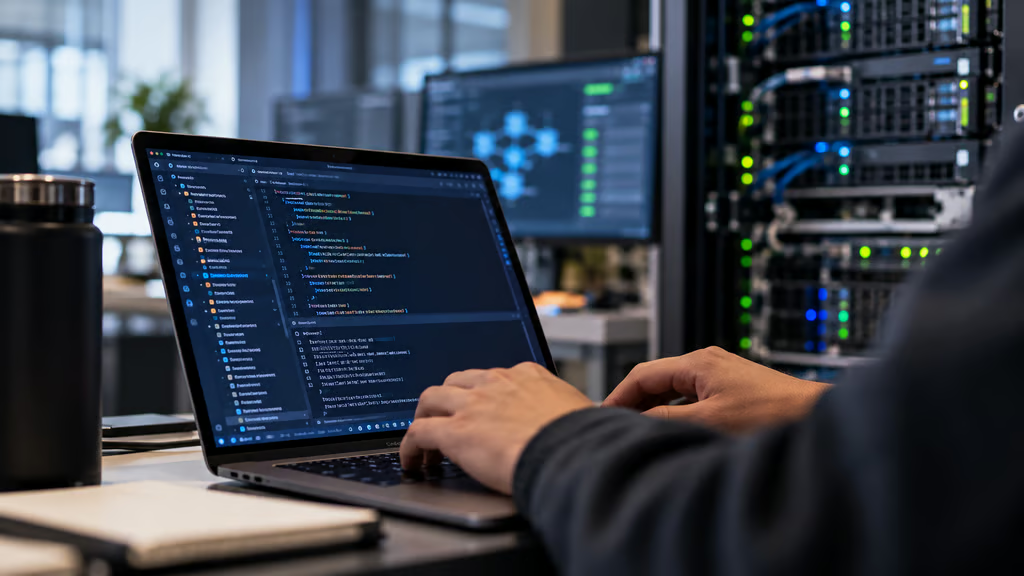
Nvidia made its full Run platform open source on Oct. 13, 2026, giving organizations free access to GPU scheduling, resource management, and AI workload orchestration for Kubernetes. Teams can deploy the software in production without buying a Run subscription.
The release includes the self-hosted control plane, not just individual scheduling components. Enterprise support remains a paid option, while organizations using the free version must manage their own infrastructure, upgrades, and operational issues.
According to Nvidia’s announcement, Run is now part of the Nvidia DSX AI Factory platform, allowing developers and infrastructure providers to adopt the complete platform or individual components.
What Nvidia Run makes available for free
Nvidia has published the full Run codebase under the Apache 2.0 license, allowing organizations to inspect, modify, and build on the software. Teams should still review individual component licenses and third-party dependencies before redistributing their own versions.
The release follows Nvidia’s acquisition of Run, which received European regulatory clearance in December 2024.
Four modular components are available alongside the main platform:
- KAI Scheduler: Kubernetes-native GPU scheduling, including resource sharing, workload placement, and prioritization.
- GPU Fractioning Operator: Enables multiple workloads to share GPU capacity using CUDA-native memory limits.
- KAI Resource Management: Controls GPU allocation across projects, departments, and teams through quotas and organizational policies.
- Workload Map: Provides a consistent way to manage different AI workloads, including training, inference, and batch processing.
KAI Scheduler was previously released under Apache 2.0 and contributed to the Cloud Native Computing Foundation as a Sandbox project.
GPU Fractioning Operator replaces Run’s earlier proprietary GPU fractioning implementation with a CUDA 13.4-native approach.
Nvidia also distributes the integrated platform through its NGC open-source collection, including Helm charts for installation.
The artifacts do not require an NGC account, subscription, or API key. Nvidia’s packaged software remains subject to applicable distribution terms, which organizations should review before deployment.
Run free vs paid: what’s the difference?
The primary distinction is support rather than access to the platform’s core functionality.
Nvidia’s October 2026 documentation identifies two deployment options:
- Open Source: The complete self-hosted platform, available for development and production use with community support.
- Support-Entitled Release: The same underlying platform, with Nvidia enterprise support, service-level commitments, and associated entitlements.
Nvidia also offers supported Run deployments through Nvidia AI Enterprise, Nvidia Mission Control, NCP software offerings, cloud service provider marketplaces, and standalone Run arrangements.
These are different commercial purchasing routes, not evidence that the free edition lacks the full control plane.
According to Nvidia’s installation documentation, open-source installations can retrieve container images and Helm charts without authentication, while support-entitled deployments require an NGC API key.
The company has not published one universal price covering every supported Run configuration.
Nvidia AI Enterprise, for example, uses per-GPU licensing, with subscription, perpetual, and cloud consumption options. Its commercial terms and support coverage should not be assumed to apply automatically to a free Run installation.
What IT teams still have to pay for
Removing the software subscription does not eliminate the cost of operating GPU infrastructure.
Organizations must still provide Kubernetes clusters, compatible GPUs, storage, networking, monitoring, and administrators capable of maintaining the platform.
That distinction becomes increasingly important as companies invest in larger AI hardware deployments. Nvidia’s Rubin NVL72 infrastructure targets increasingly demanding AI workloads, while AMD’s Helion rack design addresses the processing requirements of agentic systems.
Run manages how compatible GPU resources are allocated and used. It does not supply those resources for free.
KAI Resource Management can help teams enforce allocation policies. For example, administrators could reserve a percentage of shared cluster capacity for one department while limiting how much another team can consume.
Those controls may improve utilization, but Nvidia has not provided a universal cost-saving figure that applies across customer environments.
For self-managed deployments, platform teams also remain responsible for software upgrades, incident response, security monitoring, and compatibility checks.
Nvidia’s Run 3.0 documentation describes a 12-month support lifecycle for supported releases, including nine months of full support and three months of extended support. That schedule should not be mistaken for an enterprise support entitlement included with the free edition.
What about the paid Run Control Plane Service?
Nvidia also maintains published terms for a separate Run Control Plane Service.
Those service-specific terms, last updated May 6, 2025, describe a paid, per-GPU subscription and authorize collection of configuration information, logs, software inventories, and performance data to operate the service.
However, those terms predate the October 2026 open-source release.
They do not establish that customers must purchase a control plane subscription to operate the newly released self-hosted platform. Nvidia explicitly offers that control plane free as part of the open-source distribution.
Organizations considering a managed or commercially supported arrangement should confirm which current terms apply, what operational data is collected, and whether support is purchased directly or through a partner.
Which Run option should IT teams choose?
Organizations with experienced Kubernetes administrators and established GPU monitoring, upgrade, and incident-response processes may be able to operate Run without a commercial support agreement.
Teams with production workloads requiring guaranteed response times or vendor-backed troubleshooting should evaluate a support-entitled offering.
Before choosing, procurement and platform teams should verify the following:
- The applicable software licenses and third-party dependencies.
- Supported Kubernetes, GPU, and CUDA configurations.
- Ownership of upgrades, security patches, and incident response.
- The support provider, service-level agreement, and total subscription cost.
- Any data collection associated with a managed deployment.
The free release gives organizations access to the complete Run platform. Whether it reduces total operating costs depends on existing infrastructure, staffing, and support requirements.
Also read: Intel’s new AI rack designs introduce another approach to configuring infrastructure for enterprise AI workloads.