



Scammers can spend days building trust through messages. Google and Singapore want to spot the deception without sending private conversations to the cloud.
Google DeepMind and Singapore’s Government Technology Agency (GovTech) announced October 14 that they have developed an AI scam detection model built on Google’s lightweight Gemma technology. It analyzes conversations directly on smartphones, potentially warning users before they transfer money or share sensitive information.
The project targets fraud that develops across multiple exchanges rather than a single suspicious message. Deployment will be phased, but Google has not announced when the public can use the detector or which messaging apps will support it.
How the on-device scam detector works
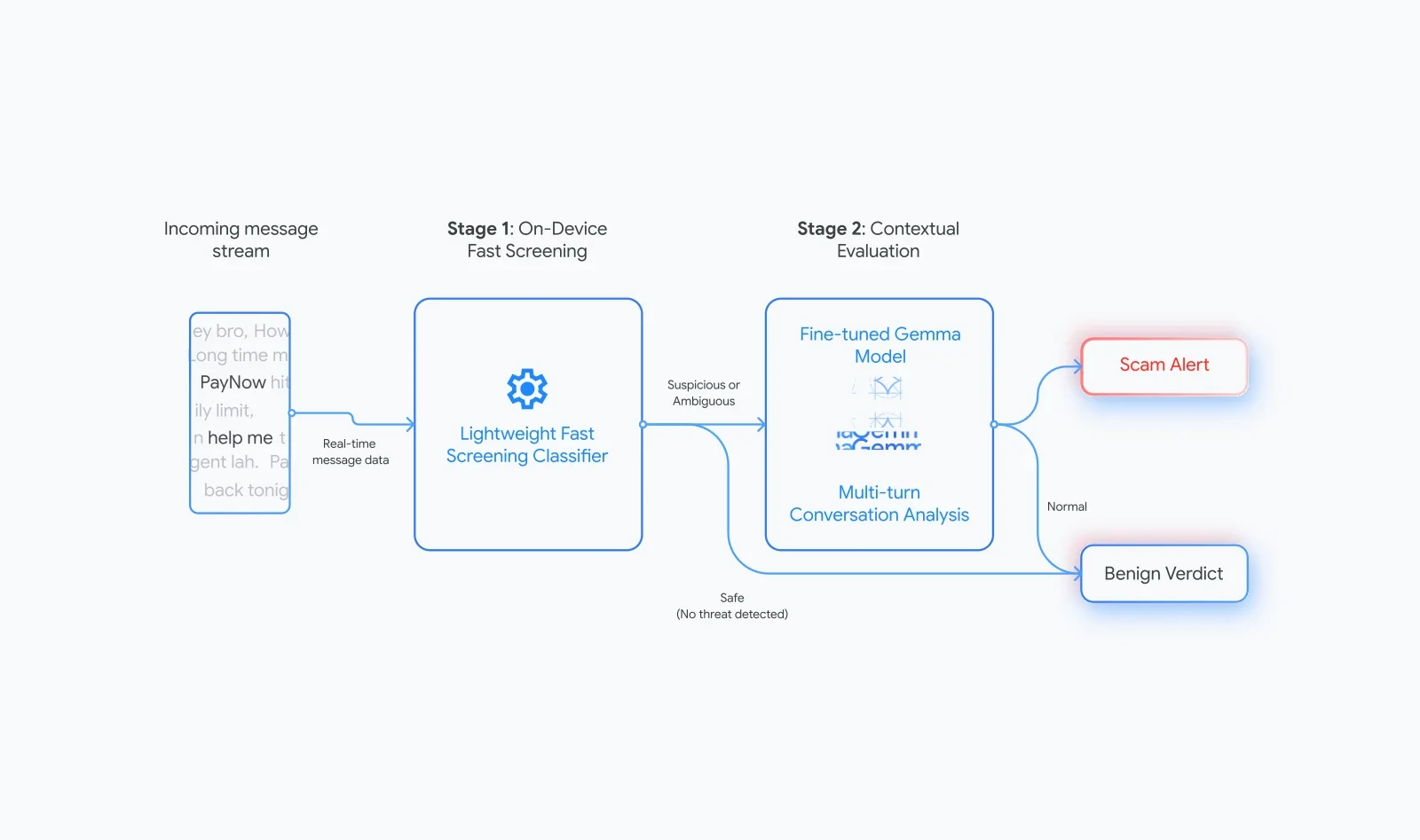
In its October 14 announcement, Google DeepMind outlined a two-stage system designed to detect suspicious conversations while limiting battery consumption.
A lightweight classifier first screens incoming messages. Suspicious exchanges then undergo deeper analysis by a fine-tuned Gemma model, which examines more of the conversation before determining whether to issue a warning.
The technology targets manipulation that develops gradually, including impersonation and investment scams. Google is also testing protections against call-forwarding scams, although those address a different method of fraud.
The model was fine-tuned using anonymized Singapore-specific scam material, including examples involving banks, government institutions and local figures. Google says development occurred in GovTech’s managed Google Cloud environment, excluding private or personally identifiable information.
Although cloud infrastructure supported training, the detector is designed to process conversations locally. Google says applications using the detector will require user consent before accessing conversations. Because analysis runs on-device, neither Google nor Singapore’s government will have access to those conversations through the detector.
This approach could help encrypted messaging services identify fraud without transferring conversation content to external servers. Supported applications and integration methods remain unannounced.
Singapore’s scam losses drive local AI protection
Singapore recorded 16,821 scam cases and S$410.6 million (approximately US$320 million) in losses during the first half of 2026, according to Singapore Police Force figures released August 26.
Cases declined 14.4% and losses fell 17.9% from the same period in 2025. Despite the improvement, scams remain costly, particularly when victims are manipulated into authorizing payments themselves.
Singapore-specific fraud patterns shaped the model, while GovTech managed its training environment.
The partnership builds on previous Google security initiatives. Singapore was among the first markets selected for Android developer verification enforcement, which was scheduled to begin September 30, 2026, to strengthen safeguards around app installation.
The new Gemma detector addresses conversational fraud instead. It also reflects growing interest in running AI models locally to protect sensitive information, although local processing alone does not establish a system’s overall security.
For enterprises, the technology could eventually complement employee verification procedures against messaging-based impersonation and payment fraud. Google has not disclosed supported devices, enterprise management controls or model-specific detection accuracy and false-positive rates.
Similar deployments elsewhere remain under consideration, with no confirmed expansion schedule. Singapore’s next milestone will be identifying which applications can use the detector and how reliably it performs outside testing.
Read more: Google’s 24-hour waiting period for sideloaded Android apps adds another barrier against scams that pressure users into installing malicious software.