


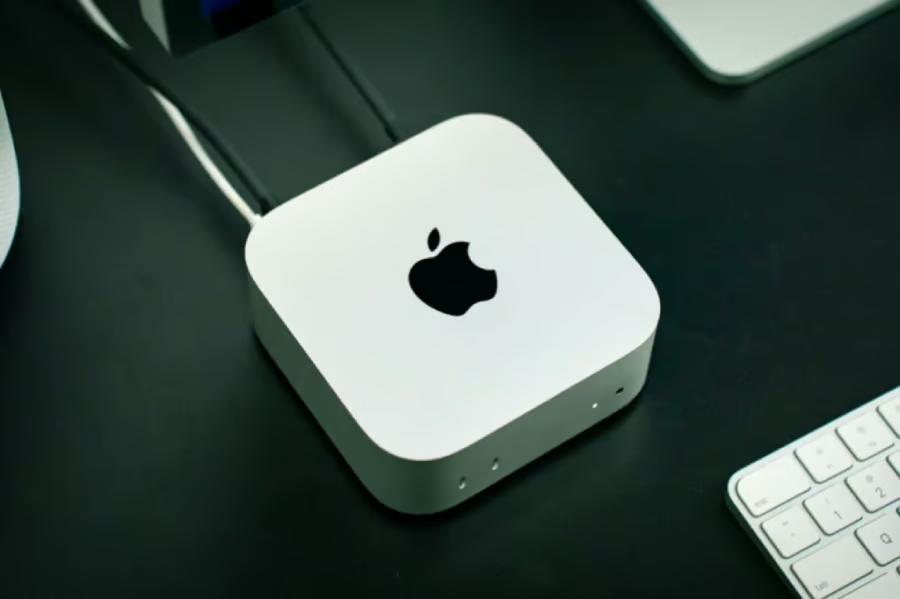
The Mac mini and Mac Studio, once beloved by video editors and coders, have become the unlikely workhorses of Silicon Valley’s most advanced artificial intelligence labs.
OpenAI has purchased tens of thousands of Mac mini and Mac Studio computers in recent months, according to The Information, with the machines being used for reinforcement learning and training computer-use agents. The reported purchases focus on Macs without displays or keyboards, allowing them to operate as dedicated machines inside OpenAI’s infrastructure.
Computer-use agents are designed to interact with software much like a person would. They can navigate interfaces, edit and test code, organize emails, and complete other multi-step tasks. Reinforcement learning allows these systems to improve through repeated actions, feedback, and mistakes.
Anthropic is reportedly pursuing a similar approach, although it is renting Mac mini capacity through Amazon Web Services rather than buying the machines outright. The Information did not disclose how many Macs Anthropic is using or exactly which workloads they support.
Apple’s memory advantage
The appeal of Apple’s hardware comes largely from its unified memory architecture. Unlike conventional systems that separate system memory from GPU memory, Apple silicon allows the CPU and GPU to access the same memory pool.
That can be useful for workloads that repeatedly move between an AI model and a computer’s operating system. Mac mini and Mac Studio also have active cooling, making them better suited than laptops for sustained workloads running for long periods.
This does not mean Apple is replacing Nvidia’s massive GPU clusters. Large-scale foundation model training remains a distinct and much more compute-intensive problem. Instead, Macs appear to be filling a narrower role in which memory capacity, operating-system access, and the ability to run isolated computer environments are particularly valuable.
A supply problem for Apple
The reported buying spree comes as Apple is already struggling to keep up with demand for higher-memory Mac configurations.
Apple’s Mac business generated about $10.4 billion in its latest quarter, up 29% from a year earlier, according to figures cited by MLQ.ai. The growth shows how strong Mac demand has become, although Apple has not attributed that increase specifically to OpenAI or other AI labs.
The Information also reported that unexpectedly strong enterprise demand helped prompt Apple to announce new Mac mini and Mac Studio models earlier than its usual fall schedule. The refreshed machines place greater emphasis on running AI models locally and integrating multiple systems.
Why it matters: Apple finds itself in an unexpected race
The more important development may not be OpenAI buying Macs, but what the purchases reveal about how AI infrastructure is changing.
As AI agents move beyond generating text and begin operating computers, companies need environments where those agents can repeatedly see screens, interact with applications and recover from mistakes. That creates demand for machines optimized for sustained, memory-heavy interaction rather than simply maximum GPU throughput.
Nvidia reportedly views Apple as a major competitor in local AI, while its DGX Spark targets developers seeking compact systems with Nvidia’s software ecosystem. ASUS and MSI have reportedly already exhausted their initial RTX Spark allocations and are seeking additional supply, according to a Taiwan Economic Daily report cited by WCCFTech.
For Apple, the opportunity is substantial but comes with a catch: the company appears to have stumbled into enterprise AI demand without the infrastructure or dedicated enterprise strategy needed to fully capitalize on it.
That creates an unusual situation. AI companies are treating Macs as compute infrastructure, while Apple still largely sells them as desktops. If agentic AI continues creating demand for thousands of machines at a time, Apple’s ability to supply, support, and scale that unexpected market could become just as important as the chips inside the Macs.
Also read: See why Apple’s next Mac mini could arrive with major upgrades aimed at increasingly demanding local AI workloads.