


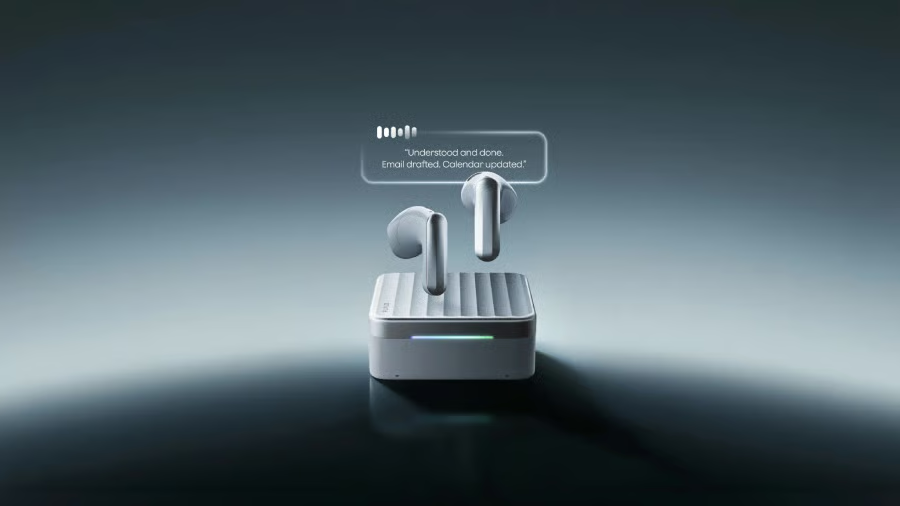
Plaud wants its new AI earbuds to record and process workplace conversations without relying on a nearby smartphone.
The company’s new Plaud One Explorer Edition pairs wireless earbuds with a charging case that includes an eSIM and 4G LTE connectivity, allowing recordings to be uploaded to Plaud’s AI services without relying on a nearby smartphone or Wi-Fi.
Plaud says the case can capture in-person conversations, while the earbuds can record phone calls and online meetings. Plaud Intelligence then transcribes and summarizes the audio. From there, Plaud Agent is designed to use that context across connected services such as Gmail, Google Calendar, Notion, and Slack, turning conversations into follow-up emails and documents.
How Plaud’s AI earbuds work
Plaud One combines two familiar pieces of hardware — a pair of wireless earbuds and a charging case — with microphones specifically designed to capture speech.
According to Plaud, the earbuds have a recording range of up to 2 meters and can record in-person conversations for up to 6 hours.
Plaud says the case has four microphones, a pickup range of up to 5 meters, and enough battery life for as much as 25 hours of continuous recording, allowing it to capture in-person discussions without the earbuds.
The more unusual part is the case’s eSIM and 4G LTE connectivity, which lets the system send captured audio to Plaud’s cloud services without relying on a nearby smartphone or Wi-Fi connection. Once uploaded, Plaud’s AI can transcribe and summarize the recording, turning a conversation into structured information that its AI features can later use.
The important distinction is that Plaud isn’t treating the earbuds primarily as an audio accessory, but rather a hands-free input device for its AI system. That effectively makes it an AI-first device.
Agentic AI is Plaud’s biggest ambition
Plaud’s bigger bet is turning those recordings into actions, not just summaries.
Plaud says its Agent features will eventually use recorded context to draft emails, create documents and presentations, and work across services such as Gmail, Google Calendar, Notion, and Slack. Broader agent functions and integrations based on MCP are expected through later software updates.
AI earbuds move beyond audio
Plaud is not alone in putting AI at the center of earbuds.
Timekettle’s W4 Pro AI Interpreter Earbuds, for instance, use AI for real-time two-way translation, phone-call translation, and online-meeting translation.
Apple appears to be pushing the idea further, with reports pointing to camera-equipped AirPods that could feed visual information to Visual Intelligence, letting Siri understand and respond to objects in the wearer’s surroundings.
Taken together, these products suggest earbuds are expanding beyond AI-assisted audio into devices that can capture, interpret, and act on information from a wearer’s surroundings.
More must-read AI coverage
- SS&C Intralinks DealCentre AI vs. Datasite: Which platform is built for the future of dealmaking?
- SS&C Intralinks FundCentre AI vs. Juniper Square: Which platform better supports modern private markets fund managers?
- Why Data, Not Models, Determines AI Success
- The Rise of the AI-Native Factory: How Physical AI Is Transforming Manufacturing
How to get the Plaud One
The Plaud One Explorer Edition is available for preorder in selected markets for $249.99, with shipping expected to begin in the fourth quarter of 2026.
Plaud’s free Starter plan includes 300 transcription minutes per month. Customers who need more can upgrade to a paid plan; TechCrunch lists the Pro plan at the equivalent of $8.33 per month when billed annually. Pricing and allowances may vary by region.
The privacy implications of Plaud One
Plaud’s biggest challenge may not be getting people to see the value in AI earbuds, but getting everyone around the wearer to accept them as well.
Plaud told TechRadar that recording must be started manually and that users are responsible for following applicable consent laws. Higher-impact agent actions, such as sending emails or editing files, will require user approval.
But the privacy concern is bigger than Plaud.
Meta has faced frequent scrutiny over recording through its AI glasses, while reported camera-equipped AirPods are already drawing similar privacy questions before Apple has even announced them.
And that raises a bigger question for AI wearables: if people and regulators are increasingly uncomfortable with devices that can capture their surroundings, why do companies keep putting them into everyday objects? The answer may be that the convenience is strong enough to sustain demand, but the industry still has to convince everyone around the user that these devices are trustworthy.
Plaud plans to release the Plaud One in limited quantities, according to TechCrunch. Prospective buyers should remember that the device has not yet shipped and that several advertised agent capabilities depend on future software updates. For businesses, its value will depend not only on how accurately it records meetings, but also on whether Plaud can provide sufficient privacy controls, predictable AI costs, and reliable integrations.