


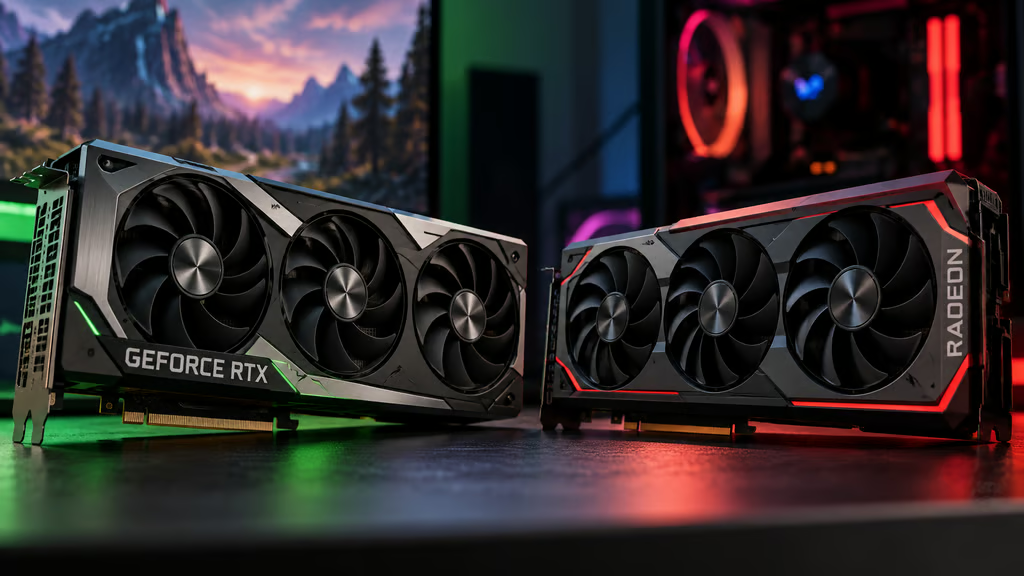
The Nvidia GeForce RTX 5070 Ti and AMD Radeon RX 9070 XT are closely matched choices for high-end 1440p and 4K gaming in 2026. Updated testing puts their average gaming performance much closer than launch-era benchmarks suggested.
The bigger differences are price, ray tracing, AI-powered rendering, and efficiency. The RTX 5070 Ti has the stronger feature set for demanding ray-traced games, while the RX 9070 XT can deliver similar average performance for considerably less money in many markets.
- RTX 5070 Ti vs RX 9070 XT at a glance
- How we compared the RTX 5070 Ti vs Radeon RX 9070 XT
- Gaming performance is nearly tied in 2026
- Ray tracing and AI features favor Nvidia
- Both GPUs have 16GB, but Nvidia has more bandwidth
- Power efficiency favors the RTX 5070 Ti
- RX 9070 XT pricing gives AMD the value advantage
- Which GPU should you choose?
RTX 5070 Ti vs RX 9070 XT at a glance
| Specification | Nvidia GeForce RTX 5070 Ti | AMD Radeon RX 9070 XT |
|---|---|---|
| Architecture | Blackwell | RDNA 4 |
| Launch MSRP | $749 | $599 |
| VRAM | 16GB GDDR7 | 16GB GDDR6 |
| Memory interface | 256-bit | 256-bit |
| Memory bandwidth | 896 GB/s | Up to 640 GB/s |
| Rated graphics power | 300W | 304W |
| Recommended PSU | 750W | 750W |
| Current rendering suite | DLSS 5 | FSR “Redstone” |
| 2026 52-game average at 1440p | About 1.4% faster | About 1.4% slower |
| 2026 52-game average at 4K | About 4% faster | About 4% slower |
Nvidia introduced the 5070 Ti as part of its RTX 50-series lineup at $749. AMD followed with the Radeon RX 9070 XT at $599.
Retail prices can differ substantially from launch MSRP depending on region, stock, and board-partner model.
How we compared the RTX 5070 Ti vs Radeon RX 9070 XT
We compared the two GPUs across the areas that affect a PC upgrade most: 1440p and 4K gaming performance, ray tracing, VRAM and memory bandwidth, upscaling and frame-generation features, power consumption, pricing, and overall value.
Official Nvidia and AMD specifications are used for hardware features and rated power. Gaming performance comes from TechSpot’s May 2026 52-game benchmark, which tested both GPUs on the same system across 1440p and native 4K settings, including rasterized and ray-traced workloads.
Value is based on launch pricing plus TechSpot’s September 2026 regional pricing analysis. Board-partner prices, cooling, dimensions, and factory overclocks vary, so buyers should compare equivalent retail models rather than assuming every RTX 5070 Ti or RX 9070 XT performs and costs exactly the same.
Gaming performance is nearly tied in 2026
The performance gap has narrowed substantially since the cards launched.
Across TechSpot’s updated 52-game suite, the RTX 5070 Ti averaged only about 1.4% more performance at 1440p. Average 1% lows were similarly close at 108 fps for Nvidia and 107 fps for AMD.
At native 4K, Nvidia pulled slightly farther ahead. The RTX 5070 Ti averaged 84 fps against 81 fps for the RX 9070 XT, giving it roughly a 4% advantage.
Individual games can swing much farther in either direction. The RX 9070 XT performed particularly well in titles including Call of Duty: Black Ops 7, Final Fantasy XVI, Ghost of Tsushima, and several PlayStation ports. Nvidia had stronger results in games including Stalker 2: Heart of Chornobyl, Dying Light: The Beast, and other workloads that favored its architecture.
For conventional rasterized gaming, neither card has a decisive average-performance advantage. The games you actually play can create a larger difference than the overall 52-game result.
Ray tracing and AI features favor Nvidia
Heavy ray tracing creates a clearer separation.
In demanding path-traced workloads, TechSpot recorded much larger leads for the RTX 5070 Ti. In Doom with path tracing enabled at 1440p, for example, Nvidia’s card was 63% faster, although neither GPU produced especially high native frame rates under those settings.
AMD can still compete in lighter ray-traced workloads. The RX 9070 XT tied or beat the RTX 5070 Ti in some tested games with ray tracing enabled, including Pragmata, Resident Evil Requiem, and Monster Hunter Wilds.
Nvidia also has the broader neural-rendering ecosystem. The RTX 5070 Ti supports DLSS 5, including 3D-Guided Neural Rendering on RTX 50-series GPUs, alongside Super Resolution, Ray Reconstruction, and Multi Frame Generation.
AMD’s current FSR “Redstone” suite brings ML-based upscaling, frame generation, ray regeneration, and radiance caching to RDNA 4 hardware. Support still varies by game, so buyers should check which technologies are available in the titles they play most often.
Both GPUs have 16GB, but Nvidia has more bandwidth
Both cards include 16GB of VRAM on a 256-bit interface, which gives either one enough memory for demanding modern games at 1440p and 4K.
The memory technology differs. Nvidia specifies 16GB of GDDR7 and 896 GB/s of bandwidth for the RTX 5070 Ti.
AMD lists 16GB of GDDR6 with up to 640 GB/s for the RX 9070 XT.
Nvidia’s additional bandwidth helps explain some of its advantage at 4K, but memory specifications alone do not predict gaming performance. The 2026 benchmark average still leaves the two GPUs only a few percentage points apart.
Power efficiency favors the RTX 5070 Ti
Their official power ratings are almost identical. Nvidia rates the RTX 5070 Ti at 300W total graphics power, while AMD lists a 304W typical board power for the RX 9070 XT. Both manufacturers recommend a 750W power supply.
Measured gaming consumption creates a wider difference.
TechSpot found the RX 9070 XT typically consumed about 20% more power than the RTX 5070 Ti during gaming, making Nvidia the more efficient option despite the similar official ratings.
Actual temperatures, noise, dimensions, and connector layouts depend heavily on the board-partner model. PC builders should verify case clearance, PSU compatibility, and the exact power connector requirements before buying.
RX 9070 XT pricing gives AMD the value advantage
AMD started with a $150 MSRP advantage: $599 for the RX 9070 XT against $749 for the RTX 5070 Ti.
Current market pricing has widened that value difference in several regions.
TechSpot’s September 2026 analysis found the RX 9070 XT offered 27% lower cost per frame than the RTX 5070 Ti in the US. The difference exceeded 30% in several other markets, although regional pricing varied considerably.
The broader memory shortage is also putting pressure on PC component pricing, making current retailer prices more useful than launch MSRP for an upgrade decision.
The RTX 5070 Ti becomes more attractive as the price gap shrinks because it combines similar overall performance with better heavy ray tracing, lower measured gaming power consumption, and Nvidia’s DLSS ecosystem.
When the Radeon is substantially cheaper, those advantages become harder to justify for buyers mainly interested in conventional 1440p or 4K gaming.
Which GPU should you choose?
Choose the Radeon RX 9070 XT if gaming performance per dollar is the priority. Updated 2026 testing puts it within a few percentage points of the RTX 5070 Ti overall, while current pricing can make it substantially cheaper.
Choose the GeForce RTX 5070 Ti if heavy ray tracing, DLSS features, or power efficiency carry more weight in your build. Its biggest advantages show up in demanding ray-traced and path-traced games rather than the overall rasterized average.
Before buying either card, compare current prices for equivalent board-partner models and check benchmarks for the games you play most often. A large Radeon discount favors the RX 9070 XT, while a much smaller price difference strengthens the case for the RTX 5070 Ti.
Also read: Nvidia’s DLSS 5 launch sparked debate over how much generative AI should change the look of game graphics.