


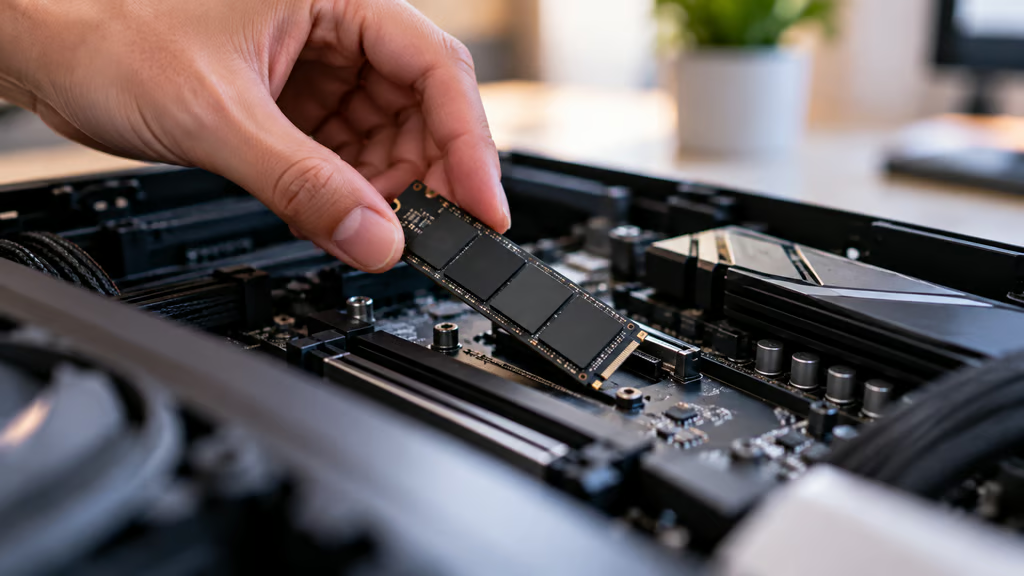
The Samsung 9100 Pro and WD Black SN8100 are two of the fastest consumer PCIe 5.0 SSDs available, with sequential read speeds approaching the practical limits of a four-lane Gen 5 interface.
The WD Black SN8100 is the stronger performance pick overall. Independent testing gives it an advantage in sustained writes, random reads, system-drive workloads, and most gaming tests. Samsung’s 9100 Pro remains extremely fast, runs slightly cooler under matched testing, and can become the better value when retailer pricing swings in its favor.
Samsung 9100 Pro vs WD Black SN8100 at a glance
| Feature | Samsung 9100 Pro 2TB | WD Black SN8100 2TB |
|---|---|---|
| Interface | PCIe 5.0 x4, NVMe 2.0 | PCIe 5.0 x4, NVMe 2.0 |
| Rated sequential read | Up to 14,800 MB/s | Up to 14,900 MB/s |
| Rated sequential write | Up to 13,400 MB/s | Up to 14,000 MB/s |
| Rated random read | Up to 2.2M IOPS | Up to 2.3M IOPS |
| Rated random write | Up to 2.6M IOPS | Up to 2.4M IOPS |
| Endurance | 1,200 TBW | 1,200 TBW |
| Warranty | 5 years | 5 years |
| Capacities | 1TB, 2TB, 4TB, 8TB | 1TB, 2TB, 4TB, 8TB |
| Heatsink version | ✔ | ✔ |
| Current 2TB retail price | $399.99 | $419 |
Prices were checked Oct. 8, 2026. Retailer prices may differ.
How we compared
This comparison uses the 2TB versions of both drives to keep capacity consistent.
Official Samsung 9100 Pro and WD Black SN8100 specifications were used for rated speeds, capacity, endurance, interface, and warranty information.
Independent performance evidence comes primarily from PCGamesN’s matched testing of both 2TB drives and Tom’s Hardware’s separate reviews using the same SSD test platform and sustained-write methodology.
We focused on:
- Real-world performance: system-drive, file-transfer, and gaming workloads rather than manufacturer maximums alone.
- Sustained writes: performance after the fast SLC cache fills.
- Random performance: small-file and low-latency behavior that affects everyday responsiveness.
- Thermals and efficiency: heat output and performance per watt.
- Compatibility: PCIe generation, M.2 slot requirements, and cooling.
- Price and value: current pricing for the exact 2TB models.
Sequential and real-world performance
On paper, the WD Black SN8100 has the faster sequential specifications: 14,900 MB/s read and 14,000 MB/s write versus Samsung’s 14,800 MB/s and 13,400 MB/s.
The independent results generally favor WD as well.
In PCGamesN’s matched testing, the 2TB SN8100 reached 14,897 MB/s sequential read speed. The Samsung 9100 Pro 2TB was 252 MB/s behind in the same test.
WD’s sequential write advantage was larger. The SN8100 exceeded its own rating at 14,088 MB/s, while the outlet recorded lower results from the 9100 Pro.
That difference is more useful for buyers moving large files than for normal desktop use. Both drives are so fast that peak sequential performance is unlikely to create an obvious difference when opening ordinary applications or booting Windows.
PCMark 10 gives WD a smaller but more practical lead. The SN8100 averaged 650 MB/s in PCGamesN’s full-system-drive test, 13 MB/s ahead of the 9100 Pro.
Random reads also favored WD in that test suite. In AS-SSD, the SN8100 reached 1,168,126 random-read IOPS compared with 976,640 for Samsung.
Sustained writes favor the WD Black SN8100
Large transfers expose a bigger difference between these drives.
Tom’s Hardware measured the 2TB SN8100 writing at more than 13.2 GB/s while operating inside its fast pseudo-SLC cache.
Once that cache was exhausted and the drive was writing directly to TLC flash, performance settled at about 3.9 GB/s before eventually entering a slower cache-recovery state.
The 9100 Pro started at roughly 12.9 GB/s in its SLC cache but dropped to just under 1.9 GB/s in native TLC mode.
That gives WD a substantial advantage for prolonged writes such as large video projects, workstation datasets, VM images, or repeated multi-hundred-gigabyte transfers.
Samsung’s behavior is still consistent, and 1.9 GB/s after cache exhaustion is faster than many lower-end SSDs. It simply cannot match the SN8100 once both drives move beyond their fastest cache.
Gaming performance is close
The SN8100 also won more of PCGamesN’s gaming tests, but the margins varied.
Its Battlefield V result reached 1,591 MB/s and led the test group. It also finished ahead of Samsung when installing and saving The Outer Worlds.
Samsung did win one of the outlet’s game-loading tests, edging WD by 10 MB/s in Overwatch.
That mixed result is useful context. Buying either PCIe 5.0 drive purely to reduce game-load times is difficult to justify if you already own a strong PCIe 4.0 SSD. The larger advantages appear in heavier storage workloads.
If portable storage is more useful than internal peak speed, TechRepublic’s best external SSDs cover USB, USB4, and Thunderbolt options built for moving files between systems.
Thermals, efficiency, and cooling
Both drives benefit from a heatsink in a performance-focused desktop.
Using the same MSI X870E motherboard heatsink, PCGamesN measured a 73-degree Celsius peak from the WD Black SN8100 during repeated sequential testing. The Samsung 9100 Pro peaked at 70 degrees Celsius under the same setup.
Neither throttled in that test, but Samsung has a small thermal advantage.
Tom’s Hardware gives WD the clearer efficiency advantage. Its testing found the SN8100 exceptionally strong in performance per watt, while the 9100 Pro was efficient for a high-end Gen 5 drive but did not lead its class.
A motherboard with a substantial M.2 heatsink is therefore preferable for either drive. Buyers using one of TechRepublic’s recent AM5 motherboard picks should also check which M.2 slot connects at PCIe 5.0 x4 and whether populating it changes lane allocation elsewhere.
Case airflow can matter during sustained workloads as well. A well-ventilated PC case gives motherboard SSD heatsinks a better chance of moving heat away from the drive.
Compatibility and capacity
Both drives use the standard M.2 2280 form factor and a PCIe 5.0 x4 NVMe interface.
A PCIe 5.0 slot is necessary to reach their full rated throughput. They can operate in slower compatible M.2 configurations, but paying for a flagship Gen 5 drive makes less sense if the system limits it to Gen 4 bandwidth.
Both Samsung and SanDisk now offer 1TB, 2TB, 4TB, and 8TB versions, correcting one of the major gaps in the original research. Both companies also offer heatsink-equipped variants.
At 2TB, both drives carry a 1,200 TBW endurance rating and a five-year limited warranty, so neither has a meaningful durability advantage on the published specifications.
Samsung provides Magician software for firmware updates, drive health, benchmarking, migration, and performance controls. SanDisk provides its Dashboard software for firmware, health monitoring, performance information, and drive settings.
Price and value
Pricing has changed dramatically since both drives launched.
Samsung originally announced a $299.99 MSRP for the bare 2TB 9100 Pro, while SanDisk launched the bare 2TB SN8100 at $279.99.
Those launch prices no longer describe the October 2026 market.
At the time of our Oct. 8 check, Newegg listed the exact Samsung 9100 Pro 2TB at $399.99 and the WD Black SN8100 2TB at $419.
That reverses the original MSRP relationship and makes Samsung the cheaper drive in this particular snapshot.
SSD prices have been unusually volatile in 2026, so the value verdict can move quickly. Check both exact SKUs immediately before ordering rather than assuming either brand remains cheaper.
Which PCIe 5.0 SSD should you buy?
The WD Black SN8100 is the better performance choice.
It leads in most of the matched independent benchmarks, offers much stronger sustained TLC write performance once the cache fills, and combines that speed with excellent power efficiency. For large file transfers, workstation use, demanding content creation, or buyers simply chasing the fastest drive of the two, WD has the stronger case.
The Samsung 9100 Pro is the better value when it is meaningfully cheaper. It remains extremely fast, ran slightly cooler in matched testing, has the same five-year warranty and 1,200 TBW endurance at 2TB, and comes with Samsung’s mature Magician software.
At the prices checked for this article, the gap was only $19. That is small enough that the SN8100’s performance advantage is worth paying for if sustained writes or maximum storage performance are priorities.
For gaming and general desktop use, either drive is arguably excessive. A less expensive PCIe 4.0 SSD can deliver a very similar everyday experience.
Also read: A high-end storage upgrade is only one part of a balanced PC build, so compare our best DDR5 RAM for 2026 before finalizing the rest of the system.