
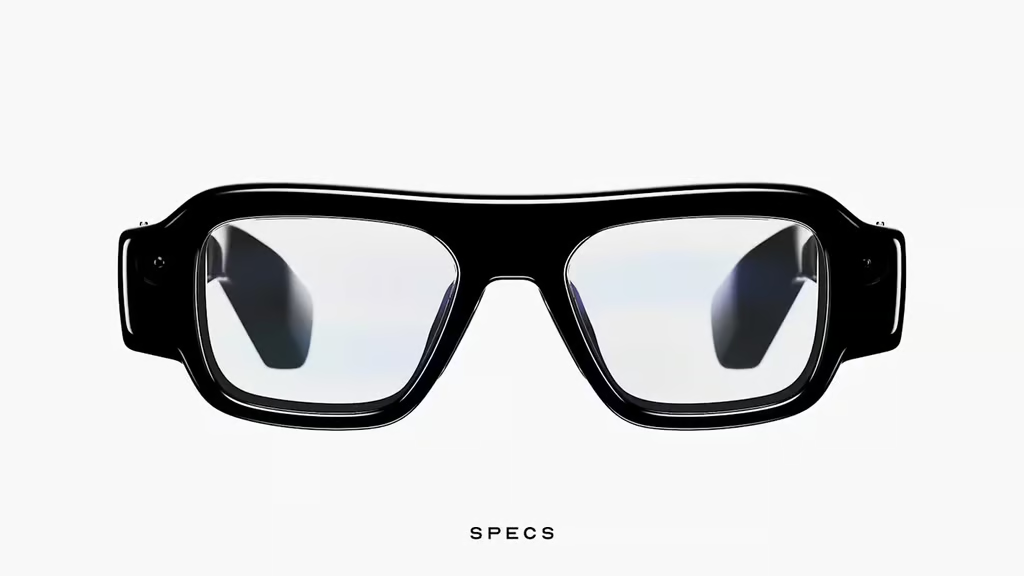


Snapchat owner Snap Inc. wants to graduate from filters to full-blown life management.
The social media firm launched Specs Intelligence on Wednesday, a cross-platform “anticipatory AI service” designed to proactively assist users across iPhone, Mac, and the company’s newly redesigned augmented reality glasses, SPECS.
Rather than sitting idle until a user enters a prompt, the system connects directly to third-party digital accounts to anticipate tasks, surface meeting preparation, and coordinate travel details.
“Computers should fit into our lives, not the other way around,” Evan Spiegel, co-founder and chief executive officer of Snap, said in an announcement. “SPECS Intelligence is designed to help you spend less time managing your life and more time living it.”
Anticipating the day across screens
Specs Intelligence groups information into “Corners” — such as family and work — and tracks long-term targets through a dedicated “Goals” feature.
While the software runs on personal computers and phones, it integrates directly with Snap’s $2,195 standalone AR hardware, which begins shipping this fall. When wearing the glasses, users can issue a “Hey SPECS” voice command to project daily schedule overviews, flight numbers, and reservations straight into their visual field.
To power the service, Snap relies on “a proprietary combination of open-source models hosted in the US alongside local LLMs,” company spokesperson Cassie Bumgarner told The Verge, adding that the firm regularly updates the model mixture.
Snap released an iOS preview Wednesday for U.S. users 18 and older, allowing them to connect Google Calendar and Gmail to review personal insights. However, the preview lacks the active anticipatory features, and full early access remains limited to an invitation-only waitlist on Mac.
By establishing Specs Intelligence across mainstream iPhones and Macs well before shipping its costly wearable, Snap is attempting to solve the classic hardware adoption trap.
Most consumers will not immediately purchase a four-figure headset weighing more than 130 grams. By allowing users to configure accounts, log their goals, and experience cross-device context on regular screens, Snap can establish digital utility first. The physical glasses then become an optional visual accessory for an ecosystem the customer already uses, rather than a demanding hardware bet that must justify itself on day one.
What Specs Intelligence means for users and IT teams
Specs Intelligence ultimately asks users to make a trade-off: give an AI assistant access to more personal context in exchange for managing fewer tasks themselves.
Snap says personnel cannot view user data, that connected information will not be used to train its AI models or to target advertising, and that the service combines on-device processing with secure cloud infrastructure. Those protections will matter because the product becomes more useful as users connect more of their digital lives to it. An assistant that can see a calendar and inbox can potentially provide much richer help than one working from isolated prompts, but it also requires users to decide how much access they are comfortable granting.
For businesses, that calculation could become more complicated. If employees eventually want to connect managed email, calendars, or other workplace accounts, IT teams may need to evaluate Specs Intelligence alongside other third-party AI applications. Access permissions, corporate data policies, account controls, and the separation between personal and business information could all influence whether organizations allow the service into managed environments.
The launch also signals a broader shift in how AI companies want people to interact with their assistants. Chatbots largely trained users to open an app, type a request, and wait for an answer. Snap is betting that the next step is software that already understands enough about a user’s schedule, goals, communications, and surroundings to act before a prompt is necessary.
That makes the rollout of Specs Intelligence arguably as important as the SPECS glasses themselves. Snap can introduce users to the software on devices they already own, then position its $2,195 glasses as another way to access that intelligence rather than requiring the hardware to carry the entire experience.
For now, however, much of that vision remains ahead of the product. The iOS preview does not yet include the full anticipatory experience; Mac access remains limited; pricing has not been finalized; and the glasses have yet to reach customers.
The real test will come when Specs Intelligence begins doing what its name promises: deciding what information users need before they ask for it. At that point, convenience will depend not only on how smart the AI is, but on whether users and businesses trust it with enough context to make that intelligence useful.
Meanwhile, Meta is reportedly taking a different approach to wearable AI with camera-free smart glasses built around voice AI as it tries to ease some of the privacy concerns surrounding the technology.