


Rust entered the TIOBE Index top 10 in July. Python remains far ahead, C++ widens its lead over Java, and the index marked its 25th anniversary with several longtime leaders still near the top.
Rust’s arrival is the defining change, but the anniversary adds a longer view. C, C++, and Java were already among the leading languages when TIOBE began publishing its rankings.
The TIOBE Programming Community Index tracks programming language popularity using search engine activity.
Rust enters the top 10 for the first time
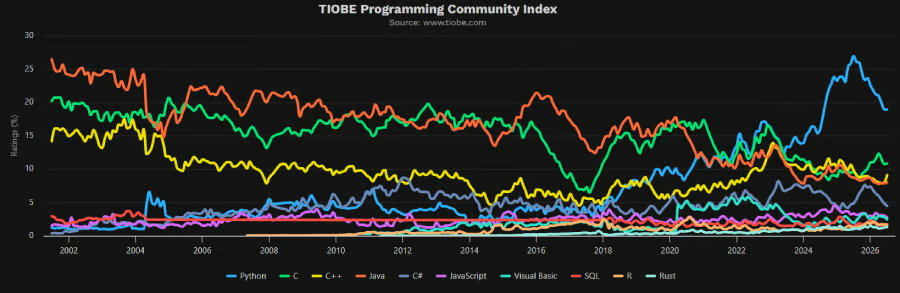
Rust reaches No. 10 at 1.34%, its first appearance in the TIOBE top 10. The language ranked No. 18 a year ago, giving its climb added weight. Delphi/Object Pascal exits the group to make room.
TIOBE CEO Paul Jansen credited Rust’s rise to its ability to prevent many memory-related errors without sacrificing execution speed. Rust’s design made it a direct competitor to C and C++, where explicit memory management can introduce safety risks. Both communities are developing safer approaches, but Rust now has enough support to join them among the index’s leading languages.
Python stays near 19% as C++ pulls further ahead
Python leads in July at 18.94%, maintaining an advantage of more than eight percentage points over C. The gap leaves little doubt about the top position, despite Python’s lower rating compared with a year ago.
C places second at 10.86%. C++ reaches 9.12% in third, while Java records 8.03% in fourth. The 1.09-point difference gives C++ more breathing room after the two languages traded places earlier this year.
Must-read developer coverage
- What Powers Your Databases? Take This DZone Survey Today!
- Microsoft’s Historic 6502 BASIC Code is Now Open Source
- TIOBE Index: Top 10 Most Popular Programming Languages
- TechRepublic Exclusive: AWS Says Entry-Level Workers Need ‘Curiosity’ In the Age of AI
The middle rankings keep the same order
C# takes fifth at 4.49%, followed by JavaScript at 2.72% and Visual Basic at 2.48%. Their ratings are lower, but none of the three changed position.
SQL and R also kept their places at No. 8 and No. 9. Only 0.02 percentage points separate SQL’s 1.71% from R’s 1.69%, leaving the pair nearly level above the newest member of the top 10.
TIOBE reaches its 25th anniversary
July also marks 25 years since the TIOBE Index began. Three of today’s top five languages, C, C++, and Java, were already among the leaders at the time. Python entered the top five roughly a decade ago, while C# joined about 15 years ago.
Longevity remains a defining feature of the upper ranks. Rust’s entry stands out because it brings a much younger language into a top 10 still dominated by technologies with decades of history, showing how difficult it is for newer entrants to displace established ecosystems.
More News: Claude Code is facing fresh scrutiny in China after officials warned of alleged backdoor risks.