


The TIOBE Index is a monthly indicator of programming-language popularity based on factors including skilled engineers, courses, and third-party vendors. The October 2026 rankings show a largely stable top 10, with R overtaking SQL and Julia returning to the top 20 for the first time in three years.
Python remains No. 1, followed by C, C++, Java, C#, and JavaScript, while Rust holds its No. 10 position. Outside the top 10, Julia climbs from No. 21 to No. 18, and TIOBE introduces Mandarin Chinese search terms into its methodology to broaden the index’s geographic representation.
- Top 10 programming languages in October 2026
- Notable movements in the top 10 list in October 2026
- Top 10 programming languages in September 2026
- Top 10 programming languages in August 2026
- Top 10 programming languages in July 2026
- Top 10 programming languages in June 2026
- Top 10 programming languages in May 2026
- What is the TIOBE Index?
Top 10 programming languages in October 2026
According to the TIOBE Programming Community Index, the following are the top 10 programming languages in October 2026.
- Python: A general-purpose, high-level language used across web development, data science, machine learning, and automation. Python remains firmly in the No. 1 position with a 19.23% rating.
- C: A foundational procedural language used in operating systems, embedded systems, and systems programming. C remains No. 2 at 11.33%.
- C++: An extension of C used in embedded systems, game development, and financial trading software. C++ remains No. 3 with an 8.87% rating.
- Java: A platform-independent, object-oriented language used for enterprise applications and large-scale back-end systems. Java holds No. 4 at 8.41%.
- C#: A Microsoft-developed, object-oriented language used for Windows application development, game development via Unity, and enterprise software on the .NET platform. C# remains No. 5 at 3.79%.
- JavaScript: The primary language of the web, running natively in browsers and, via Node.js, on the server side. JavaScript remains No. 6 with a 2.77% rating.
- Visual Basic: A Microsoft programming language used for building .NET and Windows applications. Visual Basic holds No. 7 at 2.20%.
- R: A language and environment for statistical computing and graphics, used heavily in academia, research, and fields such as epidemiology and biostatistics. R climbs to No. 8 with a 2.06% rating, overtaking SQL.
- SQL: Structured Query Language is the standard language for managing and querying relational databases. SQL slips to No. 9 with a 1.97% rating after holding eighth place in September.
- Rust: A systems programming language focused on memory safety and performance without garbage collection. Rust remains No. 10 with a 1.44% rating after entering the top 10 for the first time in July.
Must-read developer coverage
- What Powers Your Databases? Take This DZone Survey Today!
- Microsoft’s Historic 6502 BASIC Code is Now Open Source
- TIOBE Index: Top 10 Most Popular Programming Languages
- TechRepublic Exclusive: AWS Says Entry-Level Workers Need ‘Curiosity’ In the Age of AI
Notable movements in the top 10 list in October 2026
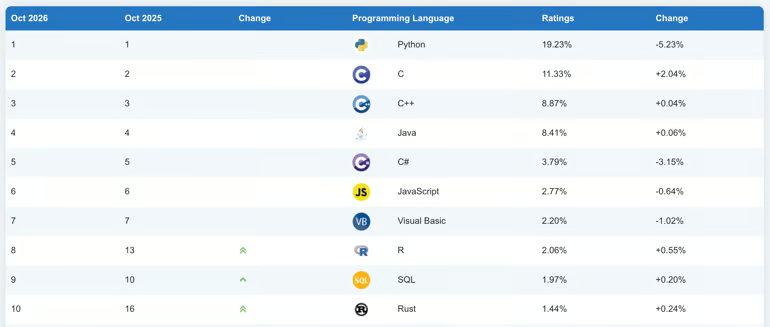
The top seven languages retained their positions from September to October. Python strengthened its lead as its rating rose from 17.76% to 19.23%, while C increased from 10.28% to 11.33%. C++ edged up from 8.67% to 8.87%, and Rust held No. 10 as its rating climbed from 1.34% to 1.44%. R moved ahead of SQL, taking eighth place with a 2.06% rating.
The biggest development came outside the top 10. Julia rose from No. 21 to No. 18 with a 0.88% rating, returning to the top 20 after three years. TIOBE CEO Paul Jansen attributed its renewed popularity to demand for languages combining high performance with ease of learning, particularly in numerical computing. Dart jumped from No. 41 to No. 27, while OCaml climbed from No. 38 to No. 26. TIOBE also began incorporating Mandarin Chinese search terms to better represent Chinese-speaking programming communities, a methodology change worth considering when comparing monthly ratings.
Top 10 programming languages in September 2026
- Python
- C
- C++
- Java
- C#
- JavaScript
- Visual Basic
- SQL
- R
- Rust
Top 10 programming languages in August 2026
- Python
- C
- C++
- Java
- C#
- JavaScript
- Visual Basic
- SQL
- R
- Rust
Top 10 programming languages in July 2026
- Python
- C
- C++
- Java
- C#
- JavaScript
- Visual Basic
- SQL
- R
- Rust
Top 10 programming languages in June 2026
- Python
- C
- C++
- Java
- C#
- JavaScript
- Visual Basic
- SQL
- R
- Delphi/Object Pascal
Top 10 programming languages in May 2026
- Python
- C
- Java
- C++
- C#
- JavaScript
- Visual Basic
- R
- SQL
- Delphi/Object Pascal
What is the TIOBE Index?
The TIOBE Index’s proprietor, TIOBE Software CEO Paul Jansen, notes that the index is not a prize for the “best” programming language or a list of programming languages with the most code written. Instead, TIOBE uses popular search engines and websites to calculate programming-language popularity based on factors including skilled engineers, courses, and third-party vendors.
Read more: Julia’s return to the top 20 follows months of movement in the rankings. See how Julia neared the top 20 as Python fell below 18% in September 2026.