


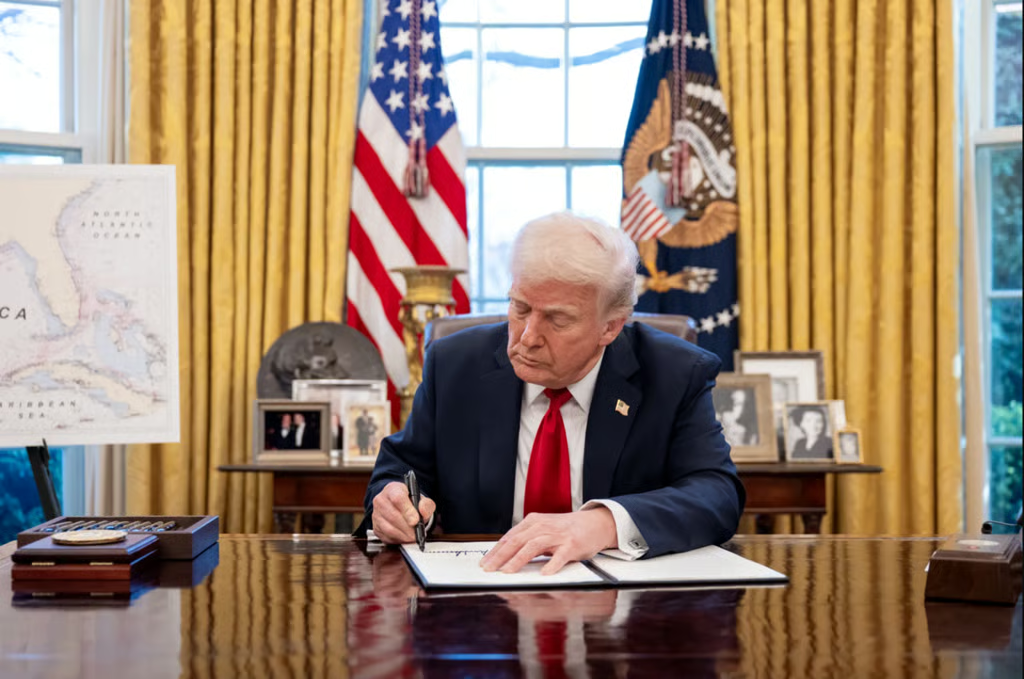
President Trump has signed a sweeping executive order imposing new tariffs on more than 80 countries and territories that have not finalized trade agreements with the US. The White House cited persistent trade imbalances as a driving factor behind the move.
The order outlines penalties for nations that have failed to align with US economic and security priorities, applying new duties to a broad range of foreign imports.
Tariff rates set between 10% and 41%
The new tariff schedule spans a wide spectrum, with rates assigned based on each country’s economic alignment and trade relationship with the United States. While most nations fall into the 15%–25% range, the highest penalties are reserved for those the administration considers least cooperative.
At the top of the list: Syria (41%), Myanmar, and Laos (both 40%) face the steepest duties. Switzerland follows closely at 39%, with Serbia (35%), Iraq (35%), South Africa (30%), and Algeria (30%) rounding out the highest tariff bracket.
Several major economies are hit with mid-tier rates, including India (25%), Indonesia (19%), Malaysia (19%), and Vietnam (20%). Other nations in this range include Tunisia, Kazakhstan, and Bangladesh. US allies such as Israel, Japan, and South Korea are each assigned a 15% tariff, as are many African and Latin American countries including Ghana, Cameroon, Ecuador, and Costa Rica.
Brazil and the United Kingdom fall into the lower bracket, each receiving a 10% tariff. Countries not specifically listed in the order will be charged a default 10% tariff under the same framework.
European Union goods are treated separately under a tiered formula. Items with existing tariff rates below 15% will be bumped up to that threshold, while goods already at 15% or higher won’t see additional duties.
These rates will remain in place unless superseded by a future agreement or presidential order.
Separate tracks for China, Canada, and Mexico
China is not included in the updated list, as its imports remain subject to a separate 10% tariff under Executive Order 14298, issued in May as part of a temporary pause tied to trade negotiations.
Meanwhile, Canada, previously at 25%, has been assigned a new 35% tariff on non-USMCA goods, according to a letter Trump sent to Canadian President Mark Carney.
Mexico has been given a 90-day extension to negotiate a trade deal and sidestep a proposed 30% tariff, though a 25% duty still applies to exports outside USMCA coverage, linked to US concerns over drug trafficking and border security.
No talks, no deal, no way around the tariffs
Nations that failed to negotiate or align with US trade and security priorities are now facing the highest tariffs under the new order. Those that didn’t engage or offered weak terms have been hit hardest, with rates climbing as high as 41%.
The order also includes sharp penalties for transshipment, or the practice of rerouting goods through third countries to evade duties. Any article determined by US Customs and Border Protection to have been transshipped will be subject to a 40% tariff, along with potential fines and forfeiture. The administration plans to publish a rolling list of countries and facilities involved in these schemes to support enforcement and due diligence.
With penalties set and enforcement on deck, the tariff regime is finally crossing from policy into practice.
A proposed artificial intelligence center in Wyoming is drawing scrutiny for its anticipated electricity usage, which may exceed the total residential consumption of the entire state.