


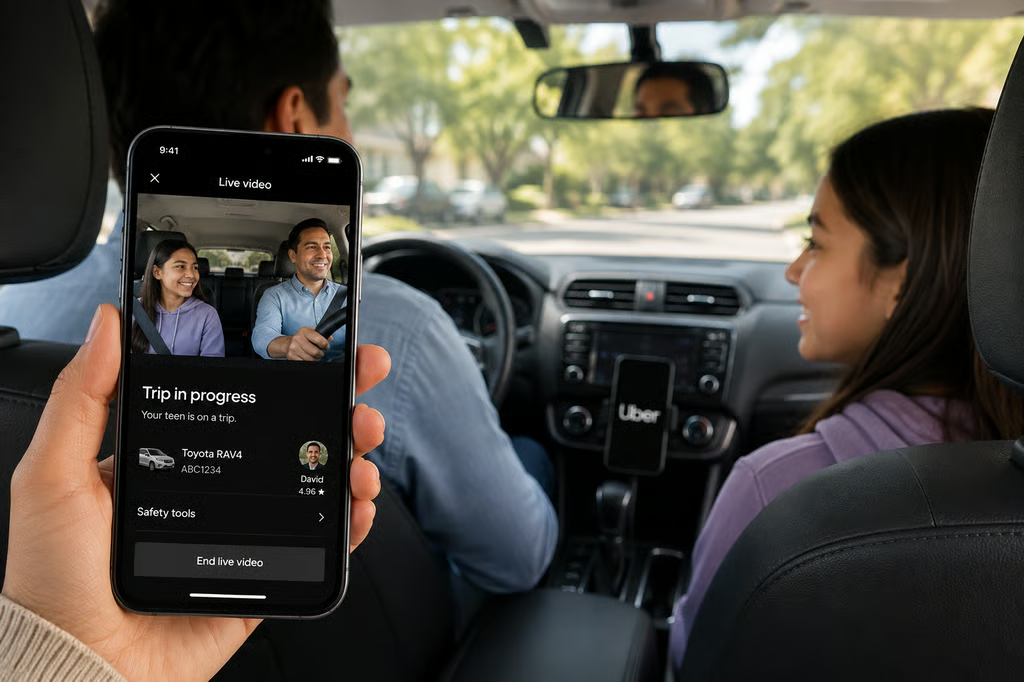
Uber switched on a live video feature for Teen Accounts this week that lets a linked parent or guardian watch a teen’s ride through the driver’s front-facing phone camera.
The feature began rolling out on August 25, 2026, in nine US markets, timed to the start of back-to-school season.
Three conditions have to line up before a stream appears: a guardian must be linked to the Teen Account, a trip must be active, and the driver must have enabled live video. When those conditions are met, the guardian receives a notification and can decide whether to watch.
Uber’s Teen Accounts launched in the US in 2023 for riders ages 13 to 17 and now operate in more than 50 countries. Uber says teen riders are matched only with highly rated, experienced drivers who undergo background checks and annual rescreening.
The company has framed the accounts as a way to give teens some independence while still handing parents monitoring tools. Live video adds an in-cabin picture to existing features such as location tracking, trip alerts, PIN verification, and RideCheck.
How guardians access Uber teen ride live video
The video comes from the selfie camera built into the driver’s smartphone and can show both the teen and driver inside the vehicle in real time, according to ABC News.
Viewing isn’t automatic. Once a trip starts, the linked guardian gets a push notification if a stream is available, then taps it to open the feed inside the Uber app.
Both the teen and driver are notified the moment a guardian starts watching. Ashu Manohar, Uber’s director of product management, told ABC News that the driver’s in-app alert does not interrupt turn-by-turn navigation or other Uber notifications the driver may need during the trip.
Participating drivers receive onboarding that covers how to position their phones for the camera, and they can preview their own angle through the app’s Safety Toolkit when they aren’t actively on a trip.
The stream shuts off automatically when the trip ends.
This slots into a stack of teen safety safeguards Uber already had in place. Teens have to give their driver a PIN before a ride can start, RideCheck can flag unexpected stops or route deviations, and an opt-in audio-recording feature lets riders and drivers capture sound from a trip.
Live video is the first of those Uber Teen tools to give a guardian an actual picture of the ride instead of only location and trip-status information.
What happens to the video after the ride
Uber distinguishes between live viewing and the encrypted recording it stores after the trip. During the ride, Uber says it cannot access the live feed itself, and only the linked guardian can view it.
After the trip ends, Uber stores an encrypted recording of the feed on its servers for 14 days before automatically deleting it. The driver, teen, and guardian lose access when the ride is over and cannot go back and watch it later.
Uber’s own access is narrow but not zero. Manohar told ABC News that Uber may access the decryption key to investigate a safety incident.
If a recording is connected to a safety report, the 14-day auto-delete no longer applies. Uber says those files are instead retained under its broader data-retention policies, but it has not specified a fixed retention period for those recordings.
What Uber has not clarified is whether the live stream itself uses end-to-end encryption, which would prevent the service provider from accessing the unencrypted stream. TechCrunch asked Uber directly about that distinction, but a spokesperson did not answer.
That leaves an important distinction for parents: Uber says the live feed is encrypted and inaccessible to the company while the trip is underway, while the stored recording can be decrypted by Uber for a safety investigation.
There is also a consent question involving additional passengers. If someone else rides along with the teen, that person can appear in the live feed, and TechCrunch reported that there is no separate way for a guest rider to opt out of appearing.
As of this week, the feature is live in Atlanta, Phoenix, Orlando, Raleigh-Durham, Portland, Oregon, San Antonio, Cleveland, Rhode Island, and El Paso. Uber says it plans to expand live video nationwide over the coming weeks but has not announced a fixed date.
The remaining privacy questions are narrower than whether the video is encrypted at all. Uber has not clarified whether the live stream uses end-to-end encryption or how long recordings connected to safety reports may ultimately be retained.
Also read: Uber faces a $966 million privacy fine in the Netherlands over automated driver suspensions and allegations involving data processing and human oversight.