


Python was more popular than ever compared to other programming languages on the TIOBE Index in March 2024. Meanwhile, Rust continued its ascent through TIOBE’s top 20, and Scratch rejoined the top 10 in spot #9. The TIOBE Programming Community Index shows year-over-year trends in programming languages based on search engine volume.
Python’s popularity continues
“There is an incredible need for new programmers at the moment,” said TIOBE Software CEO Paul Jansen in an email to TechRepublic. “In such a situation the languages with gentle learning curves will become more popular.”
Python is both relatively easy to learn and has a wide number of possible use cases, making it a good choice for beginning programmers who want to keep their options open in terms of specializations.
According to the March TIOBE Index, Python is ahead of all other programming languages by 4.5% points, the furthest ahead it has ever been. Python’s popularity grew 0.80% between March 2023 and March 2024, according to TIOBE’s proprietary ranking system.
Figure A
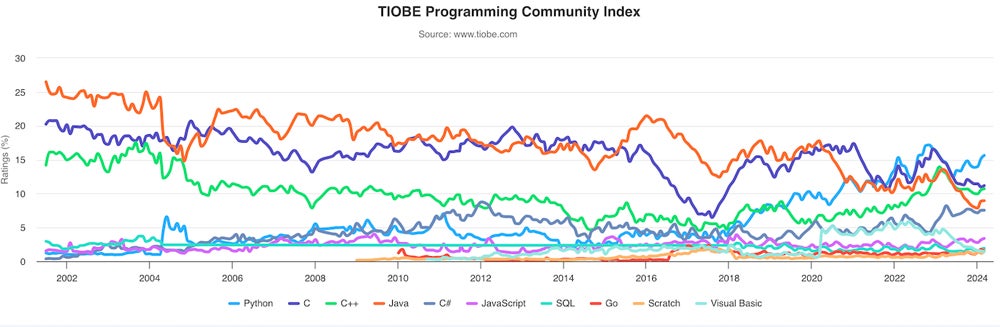
As Scratch is a programming language designed for children, it’s possible that Scratch’s rise in the TIOBE Index is also due to more beginners starting to learn it.
Rust may be on its way to the top 10
The programming language Rust rose from position 17 to position 19 over the last year, and Jansen said Rust is “a serious contender” for the top 10.
“Last month there was good news for Rust,” Jansen told TechRepublic. “The U.S. White House National Cyber Director’s Office (ONCD) urged programmers to stop using C and C++ and switch to languages such as … Rust. This will certainly result in a boost of popularity for Rust.”
On March 4, ONCD recommended memory-safe programming languages in order to better secure software and hardware. ONCD specifically called out that Rust meets its three criteria for use in space systems, as well as being memory safe:
- Rust allows code to be close to the kernel, tightly interlacing it with software and hardware.
- It supports determinism, making sure the timing of the outputs are consistent.
- It does not have or can override the “garbage collector,” a function that automatically reclaims unused memory.
However, ONCD cautioned that Rust “has not yet been proven in space systems.” Still, Rust has plenty of other applications for which being memory-safe may be an advantage.
Does generative AI have an impact on which programming languages are popular?
With generative AI fueling a lot of work in the largest software organizations today, we asked Jansen if it has any impact on what languages programmers are seeking out and learning. He replied, “Generative AI has not (had) that much impact on the tech world as propagated. There has (been) hardly any business-critical software written in this way (with AI) yet and certainly no safety-critical software.”