


I reviewed five self-hosted photo and video gallery options based on ease of setup, media management features, sharing tools, privacy controls, mobile support, and overall fit for personal or small-team use.
SEE: The definition of open source can be controversial, with some commercial models claiming the title.
NextCloud
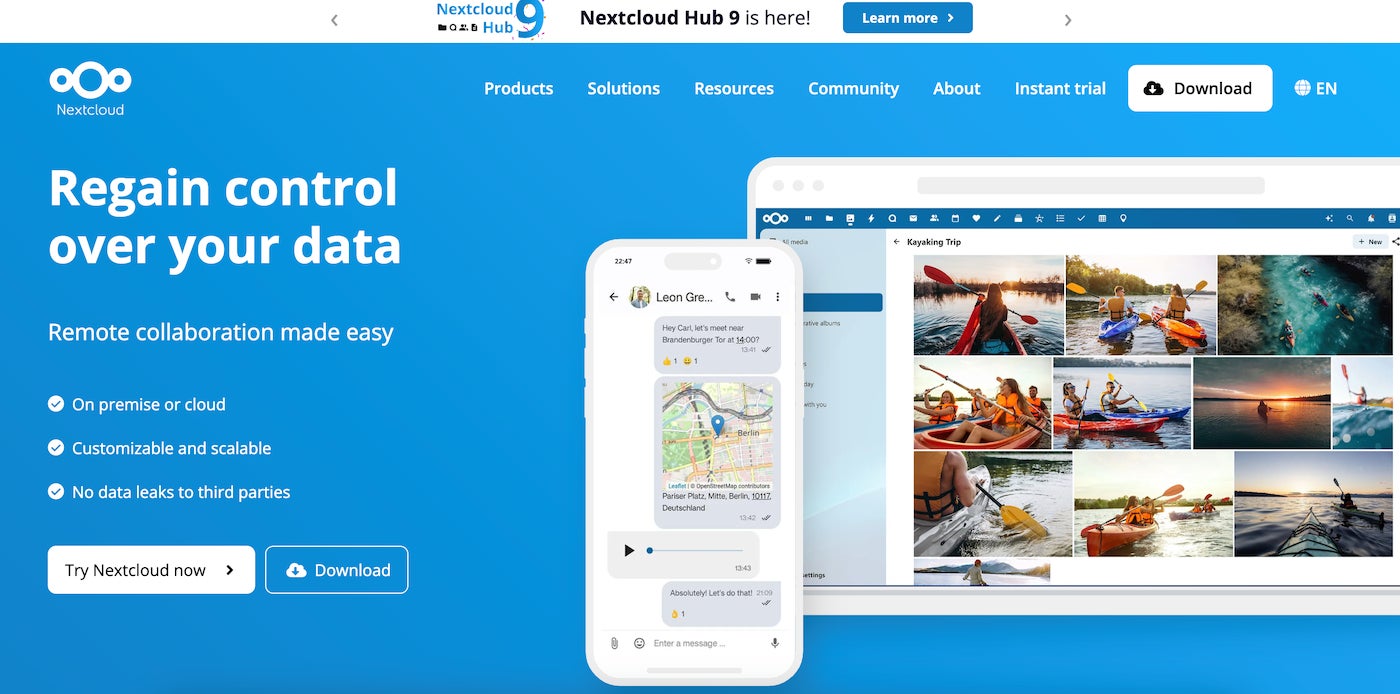
Nextcloud is an open-source content collaboration platform that can function as a self-hosted photo and video storage option alongside files, documents, chat, office tools, automation, and other collaboration features. For media libraries, Nextcloud Files provides self-hosted storage, syncing, sharing, and access across desktop, mobile, and web apps, making it a good fit for users who want photo and video management as part of a broader private cloud setup.
Why I chose Nextcloud
I chose Nextcloud because it offers the most complete self-hosted ecosystem on this list. While dedicated gallery tools may provide a more focused photo-browsing experience, Nextcloud stands out for its file syncing, access controls, mobile apps, sharing features, and ability to support more than just media storage.
Pricing
Nextcloud’s open-source self-hosted software is free to use, though you will need to provide your own server, storage, backups, and maintenance. Enterprise plans with professional support are also available, with pricing starting at €71.29 per user per year for 100 users.
Photoprism
PhotoPrism is an AI-powered, self-hosted photo app for organizing and searching large media libraries. It can run at home, on a private server, or in the cloud, and it supports browsing photos and videos, detecting duplicates, handling RAW files, searching with filters, viewing location maps, playing Live Photos, recognizing faces, and automatically classifying images by content and location. Its privacy-first approach also makes it appealing for users who want modern photo management features without handing their media library to a major cloud provider.

Why I chose PhotoPrism
I chose PhotoPrism because it offers one of the strongest photo-focused experiences among self-hosted options. Its AI tagging, search, facial recognition, maps, RAW support, and duplicate handling make it a good fit for users who want smarter photo organization while still keeping control over where their files are stored.
Pricing
PhotoPrism Community is free for self-hosting. Paid self-hosted plans start at €2 per month for Essentials and € per month for Plus.
Piwigo
Piwigo is an open-source photo management platform for organizing, managing, and sharing photo libraries on the web. It is designed for individuals, teams, and organizations, and it is especially strong for large collections with thousands or even hundreds of thousands of images. Users can self-host Piwigo for free, choose cloud hosting, and extend the platform with plugins and themes.

Why I chose Piwigo
I chose Piwigo because it is one of the most established self-hosted photo management tools available. It has been around since 2002, supports high-volume photo libraries, and offers open-source flexibility through plugins and themes, making it a strong choice for users who need a mature, scalable photo gallery platform.
Pricing
Piwigo is free for self-hosting. Paid support plans for self-hosted deployments start at €39 per month for Light, €79 per month for Standard, and €150 per month for Premium, billed annually and excluding VAT.
Lychee
Lychee is a free, open-source photo management tool that runs on your own server or web space. It lets users upload, organize, rename, describe, search, view, and share photos from a browser-based interface, with support for albums, password-protected sharing, full-screen viewing, batch editing, and EXIF and IPTC metadata. Lychee is a strong fit for users who want a fast, simple, and privacy-friendly self-hosted photo library without storage limits, compression, or unnecessary complexity.

Why I chose Lychee
I chose Lychee because it is one of the simplest self-hosted photo gallery options to set up and use. Its clean interface, browser-based management tools, album sharing, metadata support, and password-protected galleries make it a good choice for photographers and casual users who want control over their photo library without a more complex collaboration platform.
Pricing
Lychee is free and open source for self-hosting.
LibrePhotos
LibrePhotos is a free, open-source, self-hosted photo management service for storing, organizing, and accessing your photo library across devices and operating systems. It supports major file formats, including RAW images, HEIC, HEIF, and videos, and includes AI-powered features for users who want smarter photo organization without giving up control of their personal data.

Why I chose LibrePhotos
I chose LibrePhotos because it offers a privacy-friendly, open-source alternative to commercial photo management services. Its broad file format support, self-hosted setup, and AI-powered organization features make it a good fit for users who want more control over their media library without paying software subscription fees.
Pricing
LibrePhotos is free and open source for self-hosting, though you will need to cover your own hardware, VPS, storage, backup, and maintenance costs.
How I chose the best self-hosted photo storage options
I selected these self-hosted photo storage options based on ease of setup, photo and video management features, privacy controls, sharing tools, file format support, platform maturity, and overall value for individuals, families, small teams, and organizations. I also considered whether each tool served a clear use case, such as full private cloud storage, AI-powered photo organization, high-volume photo libraries, simple album sharing, or open-source photo management.
The goal was to include options that give users more control over where their media is stored without losing the features people expect from cloud photo services. Strong self-hosted photo storage tools should make it easier to upload, organize, browse, search, and share photos and videos while still giving users ownership over their files, storage setup, and privacy.
Bottom line: Self-hosted storage gives you more control over your media
Self-hosted photo storage can give you many of the same tools as cloud photo services, including albums, sharing, search, and facial recognition, while giving you more control over where your photos and videos are stored. If you already have the server space, storage, and willingness to handle setup and maintenance, self-hosting can be a practical way to manage your media library without relying entirely on a third-party cloud provider.
FAQs
What is a self-hosted photo and video gallery?
A self-hosted photo and video gallery allows users to store and share media on their own hardware or virtual server. It provides an alternative to smartphone photo apps or social media.
What are the system requirements for hosting my photo gallery?
Different self-hosted photo galleries have different requirements. Most services will have documentation available.
Nextcloud, for instance, offers cloud hosting as part of some of its plans. Photo hosting generally doesn’t require a lot of RAM — PhotoPrism can be installed on a Raspberry Pi 4 with 4 GB of RAM. LibrePhotos requires 10 GB of HDD Space to operate through Docker Compose.
Is self-hosted photo storage better than cloud photo storage?
Self-hosted photo storage is better if you want more control over your media, privacy, storage setup, and long-term costs. It can also be a good fit if you already have a home server, NAS, or VPS and are comfortable handling setup and maintenance.
Cloud photo storage is usually easier for casual users because the provider handles backups, syncing, mobile apps, and infrastructure. If convenience matters more than control, a cloud service may still be the better choice.
Looking for broader cloud storage options? Compare the best Dropbox alternatives for 2026, including free storage, security, collaboration features, pricing, and business file-sharing tools.
Megan Crouse updated this article.