

Gone are the days when contact center managers or supervisors had to listen in on calls to identify trends and issues. To gain deeper and more actionable insights into agent performance and customer sentiment, contact centers have started leveraging artificial intelligence (AI) voice analytics.
Instead of reviewing all call logs and interactions, which takes a significant amount of time, this solution analyzes a caller’s tone and sentiment using AI. As a result, companies make informed decisions more quickly, improving overall performance and enhancing the customer experience.
What is AI voice analytics, and how does it work?
AI voice analytics is a technology that utilizes artificial intelligence to analyze calls in real time. It combines automatic speech recognition (ASR), natural language processing (NLP), paralinguistic signal processing, and machine learning to extract insights from phone calls.
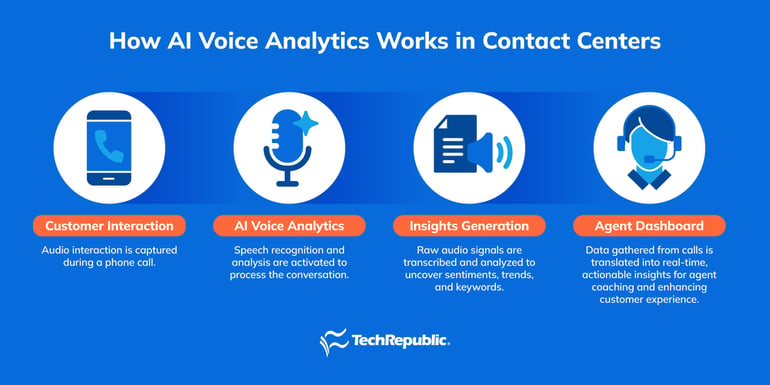
The process starts with a phone call interaction. When AI voice analytics is activated, it can process raw audio signals and turn them into real-time and post-call insights, which will be visible on your dashboard.
From the dashboard, agents can view caller sentiment in visual cues (e.g., color-coded or icons), conversation quality indicators (such as interruptions or long silences), and reminders about missed scripts or compliance statements. Agents can also access trend analysis and identify recurring issues, as well as scorecards to summarize call outcomes.
Benefits of AI voice analytics in contact centers
According to HubSpot’s “The State of AI” report, 98% of organizations plan to maintain or increase their AI investment. This is a testament to the growing adoption of AI, including in contact centers where customers’ needs continue to grow as well. With AI voice analytics, companies are better equipped to meet the demands and expectations of their customers, enhancing overall performance and productivity levels.
Enhance customer experience
AI voice analytics allows agents to gauge customer sentiment (e.g., tone and pace) in real time, enabling them to adjust their approach during the call. This ensures callers receive tailored assistance and their concerns are addressed with urgency. Agents can also access recommended actions, such as relevant resources or steps for de-escalation, to deliver better customer service.
Improve agent coaching and performance
In traditional contact center workflows, supervisors listen in on random calls to assess quality and performance. With AI voice analytics, they can monitor not just a small percentage of calls but all of them, as the tool consolidates a complete view of agent performance into a single dashboard.
Supervisors can review the data and analysis and provide more detailed feedback that highlights areas of improvement, as well as the agents’ strengths.
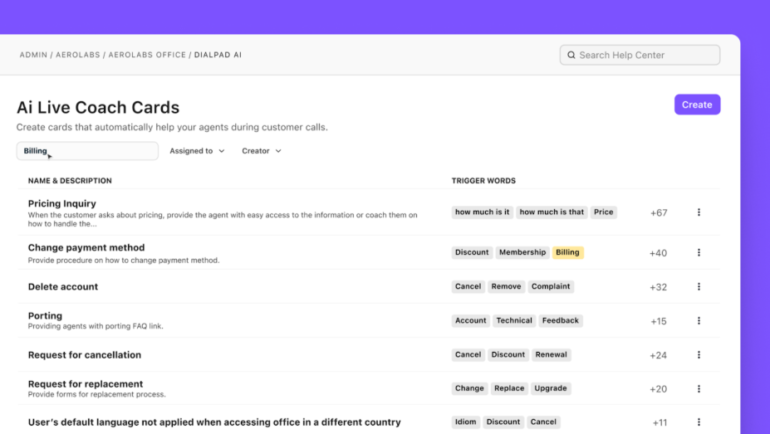
In the example above, Dialpad offers AI Live Coach Cards, wherein a card pops up on an agent’s screen when pre-identified trigger words are mentioned in the call. The card contains talking points and relevant notes to help the agent explain a specific service, product, or query.
Increase operational efficiency
Implementing AI voice analytics helps reduce operational costs in several ways, such as minimizing time spent reviewing case notes and streamlining the quality assurance process.
This technology also boosts efficiency by lowering the average handle time (AHT), as it helps agents focus on the real issue instead of spending time probing. Agents also get real-time data and recommendations, enabling better decision-making even during live calls.
Ensure compliance with regulations
AI voice analytics can automatically screen calls for strict policy and standard adherence, particularly for organizations in the finance and healthcare industries. This AI solution can send real-time notifications alerting agents if they missed required disclaimers or statements. A supervisor can likewise gain visibility of calls that may impact compliance.
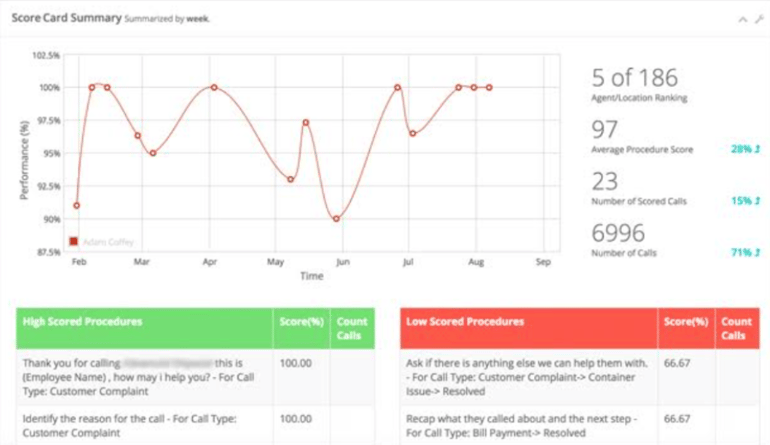
RingCentral, one of the leading voice-over-internet protocol (VoIP) phone systems, offers AI speech analytics that enable users to gather and access data related to the caller’s tone, language, pacing, and even emotions. It allows users to analyze customer interactions, understand specific needs, identify areas for improvement, and track operational trends. Check out what it can do to boost your team’s efficiency by signing up for a demo.
How are AI voice analytics used in various industries?
Now that you’ve explored the benefits of contact center speech analytics, let’s look at how they are applied across different industries.
1. Banking and financial services (BFS)
When configured, AI voice analytics can flag inconsistent responses and detect stress patterns during authentication, preventing potential fraud cases. In fact, according to a report from Global Finance, there’s a 24% industry-wide projected budget increase to accelerate AI investments within financial institutions. These organizations are allocating more funds to AI to serve their customers better and protect their systems from cyberattacks.
According to another research study from HFS, in partnership with Infosys, the top reason BFS firms use AI is to analyze data and enable functions. The next one is marketing, followed by process automation to drive efficiency and productivity. These data points demonstrate that AI has been a priority in banking and financial services, resulting in a more effective system.
2. Insurance
Similar to BFS, AI voice analytics is being used by insurance firms to prevent fraud. Aside from this, it also assists with claims handling, analyzing client tone and sentiment to detect frustration or need to re-route to senior adjusters.
AI voice analytics can also help agents adhere to compliance and disclosure requirements by sending reminders and notes during calls.
3. Healthcare
A study published by Grady Andersen & MoldStud showed that the implementation of advanced analytical methods in health management systems led to a reduction of up to 30% in readmission rates. This is mainly because AI voice analytics has the capability not only to offer patient support but also to triage cases, identify urgent cases, and facilitate quick escalation.
This technology also works for billing-related queries, as the solution can determine in real time common frustrations and issues, which in turn enable users to streamline responses and the next course of action.
4. Retail
In retail, speech analytics can identify recurring product concerns raised by customers via phone calls. These insights are automatically gathered and summarized in the dashboard for easy access.
Through this solution, companies can identify opportunities to upsell or cross-sell, driving more sales by analyzing purchase intent, all within the same call.
5. Telecommunications
AI voice analytics is widely used in the telecom industry to gather and analyze feedback on billing requests, network outages, and the general service quality. This technology can provide teams with the data they need to approach their retention efforts effectively.
With AI voice analytics, it’s now easier for telecom companies to identify the most common complaints (e.g., intermittent internet connection) and address them more quickly.
Challenges in implementing AI voice analytics in contact centers
While the benefits of AI voice analytics are promising, it comes with limitations. Below are some of the most common challenges businesses face when implementing AI voice analytics, with tips on how to avoid them or manage their impact.
Privacy and data security concerns
Data protection laws cover the analysis of voice interactions and customer consent. Hence, companies should comply with existing regulations, such as the Health Insurance Portability and Accountability Act (HIPAA), System and Organization Controls 2 (SOC 2), and General Data Protection Regulation (GDPR), to avoid penalties and violations. This particularly applies to healthcare institutions handling confidential patient records and financial institutions that manage sensitive data such as credit card details and other personal information.
Before subscribing to an AI voice analytics solution, ensure that the provider is compliant with the mandatory certifications mentioned above or in your respective industries. Invest in a high-quality contact center provider that regularly updates its certifications to ensure ongoing compliance with industry standards.
Biases in configuring AI models
Speech recognition technologies have limitations when it comes to non-standard accents or dialects. This challenge may lead to inaccurate transcriptions and translations. Another potential issue you may encounter involves emotional misinterpretations, which can be influenced by cultural differences and varying speech patterns. For example, what sounds heavy or angry in one culture may not be true in another.
To combat this bias, your contact center speech analytics provider should test and train models using diverse and multilingual datasets.
Cost implications
Deploying AI voice analytics has corresponding expenses, which include licensing fees, cloud infrastructure installation and maintenance, and other software integration costs. Maintaining AI models requires ongoing updates, monitoring, and training, which also add to the overall cost.
To ensure a successful rollout of AI voice analytics, create a plan with clear timelines and allocate sufficient budget, whether you opt for a month-to-month subscription or a usage-based payment model.
Related read: 7 Problems Contact Center Analytics Can Solve Right Now
Frequently asked questions (FAQs)
Is voice analytics legal?
Yes, provided that the software solution complies with data privacy laws. It is also crucial to obtain consent from your callers or customers. Before subscribing to a contact center AI voice analytics provider, verify that it’s compliant with relevant regulations such as HIPAA or GDPR.
How much does voice analytics cost?
Costs vary by provider and usage model. For instance, per-minute pricing can cost anywhere between $0.07 and $0.25 per minute of audio analyzed or higher. Per-agent subscriptions can range from $30 to $500 per agent, per month, depending on the plan tier and features.
What is the difference between speech analytics and voice analytics?
Speech analytics transcribes conversations, analyzing keywords, intent, and content to provide valuable insights. On the other hand, voice analytics evaluates the way callers sound, including their tone, pitch, pace, and emotions.
Combining the two provides contact centers with a comprehensive view of customer interactions, enabling leaders to make more informed decisions and allowing supervisors to tailor agent coaching accordingly.