

The quest for customer obsession is arduous — littered with obstacles that impede progress. Maturing customer experience and improving business agility are the primary drivers for operating model transformations. Forrester’s research shows that less than 45% of transformations achieve these goals, however.
Why is this? At a high level, it is because tech executives do not methodically design and then continuously improve their IT operating model, preferring to reorganize their organization chart and redistribute workloads or outsource the problem to third parties. These tech executives focus on speed and change but often fall short of their goals.
SEE: Hiring kit: Data scientist (TechRepublic Premium)
Successful tech leaders design an IT operating model that can adapt to continual disruption while enabling dynamic business demand that delivers superior customer and employee experiences.
The secrets to designing a high-performing future fit IT operating model
Many tech executives remain solution- or service-focused and largely ignore the primary mission of IT: to enable external customers and/or internal employees to achieve their desired outcomes leveraging technology. Therefore, customers and employees should be at the center of your IT operating model. Those tech executives that design a high-performing future fit IT operating model always start with customers before moving to outcomes and value delivery and finally focusing on operations.
Must-read leadership coverage
- Shark Tank’s Mr. Wonderful is Building the World’s Largest AI Data Center in Canada
- Why It’s Time to Rethink Your Device Strategy for the AI-Powered Workplace
- Why Snapdragon is Built for the Next Enterprise Frontier
- Sustainability Goals Are Set—So Why Aren’t They Being Met? Closing the IT Operations Gap
If you are considering an IT operating model transformation and want to improve your chances of success, focus on three key areas: define a formal operating model design process, reimagine IT governance and drive culture change.
Define a formal operating model design process
Tech executives continue to be heavily influenced by frameworks. Forrester’s research shows that DevOps (43%), in-house frameworks (43%) and X-as-a-service platforms like Nexus (41%) are the primary influencers of IT operating model design.
In a word, tech executives are ignoring their internal maturity, competencies, context and business needs to adopt and comply with a model that has worked elsewhere. Tech executives can and should be smarter. Tech executives should consider the creation of an iterative IT operating model design framework comprising the following steps (Figure A).
Figure A
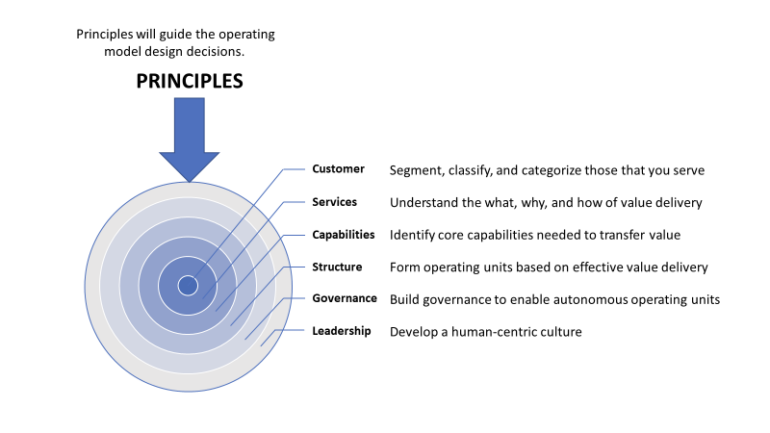
- Agree on design principles (foundation layer): Tech executives should get broad agreement on how they want the IT operating model to perform in the future. These principles will guide the operating model design decisions.
- Understand who you serve (customer layer): Tech executives should segment, classify and categorize those they serve rather than adopt a one-size-fits-all approach.
- Recognize how you create value (services layer): Tech executives must understand the what, why and how of value delivery to ensure stakeholders get an optimized experience.
- Identify capabilities needed to deliver value (capabilities layer): Tech executives must ensure they invest in the core capabilities that deliver value to those they serve and protect the technology assets of the organization.
- Determine the best structure to execute capabilities (structure layer): Tech executives must form operating units based on effective value delivery rather than siloed IT domains, services or products.
- Provide governance that facilitates delivery and operations (governance layer): Tech executives must reimagine their governance approach to enable autonomous operating units without compromising on regulatory or policy controls.
- Reimagine IT leadership (leadership layer): Tech executives should develop a human-centric culture that optimizes value delivery while engaging its employees.
In adopting a process like this, tech executives can understand their current and future context and then determine the right operating model configurations that will help them meet both their and their organization’s goals.
Reimagine your IT governance to focus on empowered decision-making
In assessing IT operating model effectiveness in delivering organizational goals over the past five years, Forrester has found that governance is by far the biggest barrier to an organization achieving its agility goals. Historically, tech executives have adopted command-and-control IT governance frameworks that become decision-making bottlenecks rather than enablers of effective IT operations and delivery.
Organizations that achieve high levels of agility have built a trusted and empowered governance framework that allows employees closest to the work to make decisions. This type of governance framework comprises four key elements:
- Decision catalogs that provide clarity and rationale for decisions
- Role accountability based on the appropriate decision-maker, not seniority
- Individual-based controls to guide behaviors and decision-making
- Transparency of decisions across the organizations, rather than on a need-to-know basis
Empowered and trusted governance can fail when senior executives do not release control of decisions — that is, they override decisions made by appropriate employees or when appropriate employees will not commit to making decisions.
Drive culture to align behaviors with value delivery
IT organizations that can adapt to disruptions often exhibit certain behaviors. They also have a certain culture that is embedded in the design of the operating model.
But, Forrester’s research shows that few organizations have yet built future fit cultures. When it comes to organization culture, only 29% of organizations support empowerment, 31% support shared values, 33% encourage employees to spend time on innovation and 35% enable collaboration.
To succeed, tech executives must invoke the commitment and ambition to change by following three steps in a culture change process:
- Build a shared language around what “culture” means in your organization and agree on why culture change is needed.
- Identify the behaviors aligned with the future culture that exist in pockets, and determine how to build them into the culture system.
- Repeat behaviors to ritualize the culture you wish to build.
Let your context guide the design of your operating model
Attempting to copy and paste another organization’s IT operating model is likely to hinder your efforts to effectively enable and support your organization in achieving its goals and objectives.
Be bold, be smart and design an operating model collaboratively with the people who will ultimately perform the work and receive value from your services. Focus on how best to execute work to deliver value, rather than focusing on IT domains, functions, systems or products. Instead, think customer, think employee and think value.
To learn more about how technology executives can evolve their operating model for transformation, visit here.

Gordon Barnett is a principal analyst at Forrester who focuses on best practices for business, technology and enterprise architecture transformation. Prior to Forrester, Gordon served in various roles, including CIO, CTO, chief architect and business unit general manager. He has a PhD in business administration (specializing in consumer behavior in e-commerce) from Northcentral University; an MBA from Huron University; an MA in finance (specializing in M&A) from London Business School; and a BA (first-class honors) from Kingston University in the UK.