

- Best overall Google Voice alternative: Dialpad
- Best for apps and automation: OpenPhone
- Best for agent support: CallHippo
- Best for business messaging: Grasshopper
- Best for small businesses: Zoom Phone
While Google Voice is a low-cost option for business phone systems with simple call routing, other options are available on the market if it doesn’t match your exact needs. For those on the lookout for Google Voice alternatives, many platforms offer features like AI-powered transcription, shared team numbers, CRM integrations, and toll-free calling.
To learn more about the top Google Voice competitors, see the list below to understand each platform and the best use cases for their unified communication tools and business phone plans.
Google Voice alternatives at a glance
(per month) | |||
|---|---|---|---|
|
|||
|
|||
|
|||
|
|||
|
Dialpad: Best overall Google Voice alternative

My rating: 4.94 out of 5
Why I chose Dialpad
Dialpad ranks as the top Google Voice alternative thanks to its AI-powered calling features and unified communication (UC) tools. Like Google Voice, users can make unlimited inbound and outbound domestic calls and host video conferences with up to 150 participants. Additionally, Dialpad integrates with Google Workspace for teams seeking a more comprehensive call management system that supports collaboration across platforms.
However, Dialpad offers limited features on its basic plans. Many of Dialpad’s add-ons are also included in other Google Voice alternatives, such as internet fax and meeting transcriptions. If you need more of these traditional office phone features, consider Zoom Phone, which provides a suite of tools that are useful for small businesses and remote workers.
Pricing
Dialpad has multiple subscriptions for business communication, AI contact centers, and outbound sales, but for this guide, I focused on the business phone plans. To learn more about the other plans, check out our Dialpad review.
Dialpad connect
- Standard: $27/user/month billed monthly; $15/user/month billed annually
- Pro: $35/user/month billed monthly; $25/user/month billed annually
- Enterprise: Contact sales for pricing.
Visit Dialpad
Dialpad pros and cons
| Pros | Cons |
|---|---|
| UC platform with video conferencing and team collaboration features | More expensive than other providers on this list |
| AI and analytics features are available on every plan | Internet fax is a $10/month add-on |
| Offers HIPAA-compliant voice and video calls | Extensions are only available on the enterprise plan |
Features
- Unlimited inbound and outbound calls in the US & Canada
- AI-powered voicemail transcription
- Real-time analytics and quality of service reporting
- Multilevel auto attendant with custom call routing
- SMS, MMS, and team messaging with file sharing and audio chat rooms
OpenPhone: Best for apps and automation

My rating: 4.9 out of 5
Why I chose OpenPhone
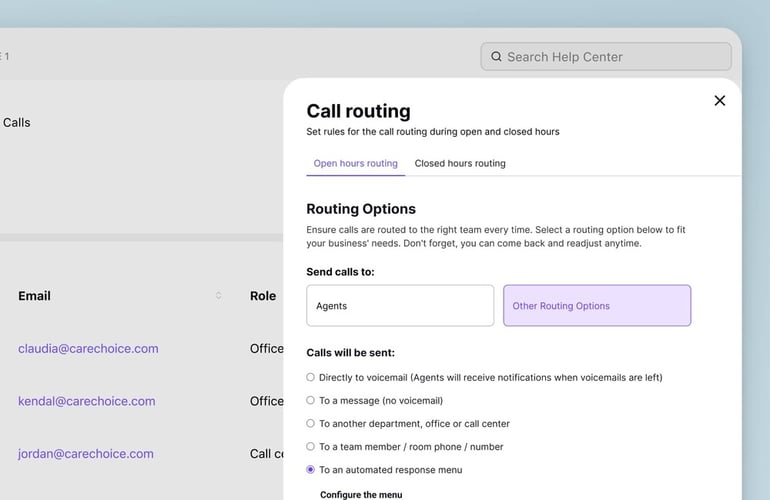
Although Google Voice offers AI features with Google Gemini, OpenPhone stands out for its use of apps and AI for call management and workflow automation. As a Google Voice alternative, OpenPhone offers API documentation that can be used to automate messaging, sync contacts or customer information from a CRM, and build custom integrations to support your current tech stack.
At the same time, while Google Voice offers 24/7 support across plans, OpenPhone only offers priority support on the highest tier plans, with limited access to support channels like live chat. If you need more hands-on customer support, consider a provider like Dialpad, offering 24/7 live support, a robust knowledge base, and multilingual web chat.
Pricing
OpenPhone offers three business phone plans with options for workflow automation and integrations with third-party apps. To learn more about the features on each plan, visit our OpenPhone review.
- Starter: $19/user/month billed monthly; $15/user/month billed annually
- Business: $33/user/month billed monthly; $23/user/month billed annually
- Scale: $47/user/month billed monthly; $35/user/month billed annually
Visit OpenPhone
OpenPhone pros and cons
| Pros | Cons |
|---|---|
| Automate messaging and workflows with the OpenPhone APIs | International calling and messaging are add-on features |
| Build custom integrations with Zapier to support cross-platform communication | Automatic call recording isn’t available on the Starter plan |
| Summarize and transcribe call recordings with artificial intelligence | Priority support is only available on the highest-tier plans |
Features
- Sync information with CRM integrations, like HubSpot and Salesforce
- Set business hours to automatically route calls based on time of day
- Number porting from other phone carriers, with access to additional phone numbers
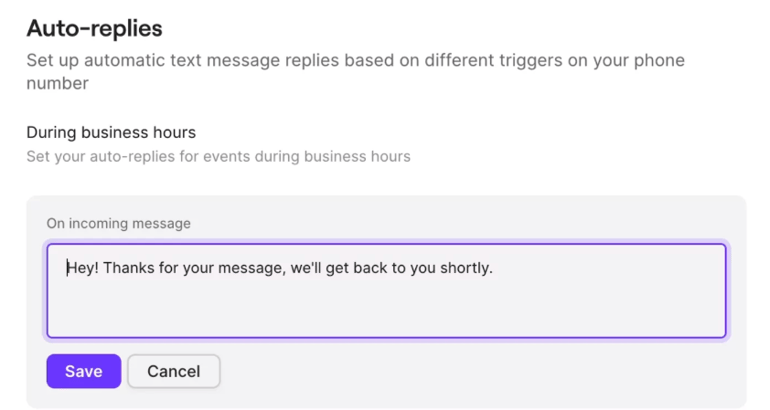
- Auto-replies and scheduled messaging for managing customer communications
- The Sona AI agent can be added to answer calls 24/7
CallHippo: Best for agent support

My rating: 4.84 out of 5
Why I chose CallHippo
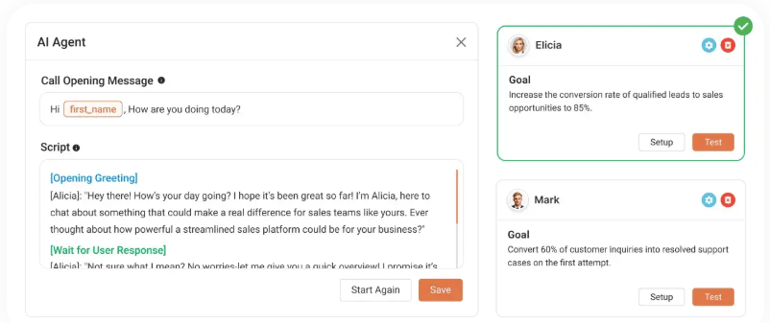
While Google Voice offers many AI features, it lacks automation through AI agents. This feature is becoming increasingly popular for businesses that want to manage high call volumes or provide 24/7 customer support, and CallHippo stands out for its variety of business phone and AI agent plans. Additionally, while most providers on this list only offer paid plans, CallHippo provides a basic business phone system and AI agents for free, which is beneficial for solopreneurs or small teams.
Even with access to a variety of AI voice and chat agents, CallHippo’s scalability means that many of the plans offer limited features. For example, the base plans don’t provide custom integrations, requiring users to upgrade to access those features. To customize integrations across plans and create a workspace that fits your business needs, consider OpenPhone.
Pricing
CallHippo offers several subscription tiers, with distinct plans for each category that offer business phone systems, AI agents, and smart dialers.
AI Business Phone System
Essential
- Basic: Free
- Starter: $25/user/month billed monthly; $32/user/month billed annually
- Professional: $40/user/month billed monthly; $40/user/month billed annually
- Ultimate: $55/user/month billed monthly; $48/user/month billed annually
Pro Suite
- Bronze: $40/user/month billed monthly; $18/user/month billed annually
- Silver: $50/user/month billed monthly; $18/user/month billed annually
- Platinum: $60/user/month billed monthly; $18/user/month billed annually
- Enterprise: Contact sales for pricing
CallHippo AI
AI Voice Agent
- AI Core Agent: Free
- AI Pro Agent: $399/month
- AI Max Agent: $799/month
- AI Ultra Pro Max Agent: $1,199/month
AI Chat Agent
- Basic: Free for three users
- Bronze: $25/user/month billed monthly; $20/user/month billed annually
- Silver: $35/user/month billed monthly; $28/user/month billed annually
- Gold: Contact sales for pricing
AI Copilot
- Pilot plans: $10/user/month
Parallel Dialer
- Basic: $25/user/month
- Ultimate: $200/user/month
Visit CallHippo
CallHippo pros and cons
| Pros | Cons |
|---|---|
| Access to a free AI agent and messages for 24/7 responses to customers | Custom integrations aren’t available on the base plans |
| Call logs for monitoring and evaluating team performance | Limited SMS messaging on the Essential plans, with the highest tier capped at 1000 messages |
| Scalable plans for solopreneurs and call center teams | 24/7 support is only available on the highest-tier plans |
Features
- Cloud-based business phone system with IVRs for advanced call routing
- AI voice and chat agents to respond to customer inquiries
- Automated workflows through simultaneous ring and smart switching
- Real-time analytics and performance tracking with custom reports
- Call center plans for teams with high call volumes or multiple agents
Grasshopper: Best for business messaging

My rating: 4.71 out of 5
Why I chose Grasshopper
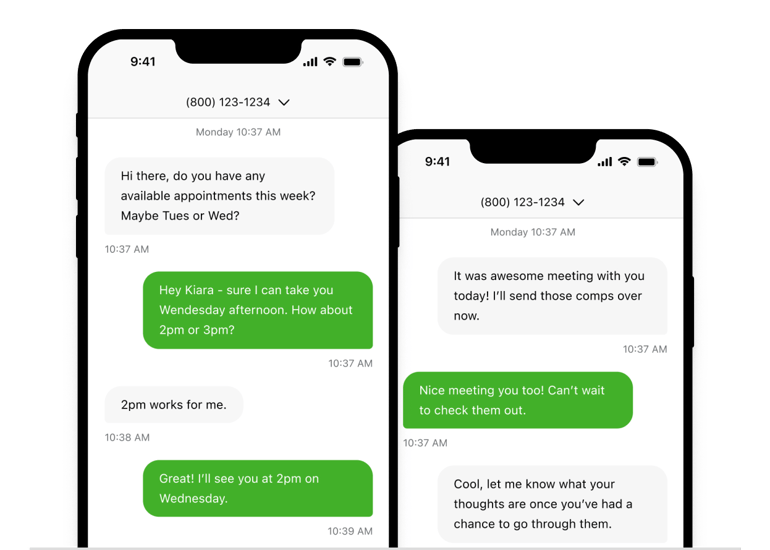
Grasshopper is always my preferred platform for messaging and business phone numbers. While many providers on this list offer text messaging, Grasshopper is one of the few that offer unlimited business messaging across plans at an affordable rate. Each plan also includes simple and straightforward call routing features, such as forwarding and transfers to your selected extensions.
At the same time, while Google Voice offers integrations with Workspace and Google Meet for video conferencing, Grasshopper doesn’t provide video conferencing to its users. For a provider with more comprehensive unified communication tools, I recommend Zoom Phone, which combines meeting software with metered or unlimited calling plans.
Pricing
Grasshopper offers three distinct business phone plans, each geared towards solopreneurs and small teams.
- True Solo: $18/month billed monthly; $14/month billed annually
- Solo Plus: $32/month billed monthly; $25/month billed annually
- Small Business: $70/month billed monthly; $55/month billed annually
Visit Grasshopper
Grasshopper pros and cons
| Pros | Cons |
|---|---|
| Unlimited domestic calling and business texting across plans | Doesn’t provide video conferencing software |
| Offers live answering services with Ruby Receptionists | Call recording isn’t available on the base plan |
| Incoming call control with custom scheduling and filtering | Additional phone numbers are priced at $9/month |
Features
- Offers local, toll-free, and vanity business phone numbers
- 24/7 phone, email, chat, and social media support
- Record and upload custom greetings to welcome incoming callers
- Use an auto-attendant or live receptionist to answer calls
- Mobile and desktop apps with instant response messaging
Zoom Phone: Best for small businesses
Visit Zoom Phone
My rating: 4.68 out of 5
Why I chose Zoom Phone
Among all Google Voice alternatives, Zoom Phone is the best option for small businesses, starting at the same low monthly rate as Google Voice — $10 per month. However, this price includes metered calling, with various additional plans available for businesses that need unlimited domestic or international calling, or access to Zoom’s workplace features. These plans offer enhanced team collaboration tools, such as video meetings lasting up to 30 hours and unlimited whiteboards, ideal for small remote teams.
While Zoom Phone provides SMS and MMS messaging, there are restrictions on the types of media that can be sent via chat, and users cannot share video files through the messaging feature. If you need to send video files to team members or potential clients, I recommend Dialpad, which offers more extensive file-sharing options.
Pricing
Zoom Phone provides both metered and unlimited calling plans, with options to enhance each plan with international calling or advanced analytics and reporting features. Additionally, the Plus plans include a combination of Zoom Phone and Workplace plans to access more robust team collaboration features. To learn more, read our Zoom Phone review.
- US & Canada Metered: $10/license/month
- Regional Unlimited: $15/license/month
- Global Select: $20/license/month
- Pro Plus: $21.99/user/month billed monthly; $18.33/user/month billed annually
- Business Plus: $26.99/user/month billed monthly; $22.49/user/month billed annually
Zoom Phone pros and cons
| Pros | Cons |
|---|---|
| Access to metered and unlimited calling plans | SMS and MMS messaging do not accommodate sharing video files |
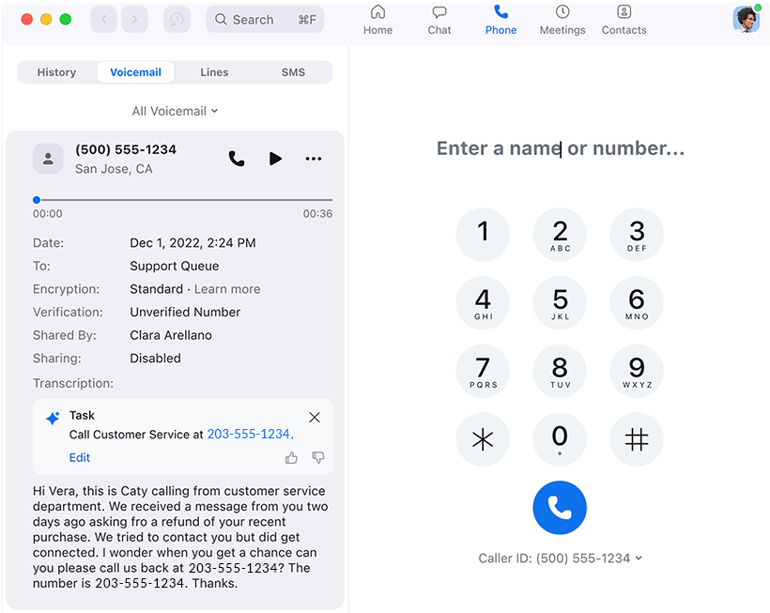
| AI companion available for all plans with post-call summaries, voicemail prioritization, and task extraction | Online fax isn’t available on the global calling plan |
| Bring your own carrier support with hybrid integrations to PBX systems | Team messaging summaries are only available with the Zoom Power Pak add-on |
Features
- Unlimited auto attendants and IVR
- The global select plan provides domestic calling to over 40 countries
- Automatic and manual call recording with transcriptions
- AI companion with post-call summaries and voicemail extraction
- Integrations with contact center providers, like Five9, Talkdesk, and Twilio
What to look for in a Google Voice alternative
When selecting an alternative to Google Voice, it’s important to consider several key features based on your business phone system needs. Below, I’ve listed some essential standard features to keep in mind:
- Scalable pricing: One of the standout features of Google Voice is its affordable pricing, with access to a free business phone number for Google account holders and paid plans starting at only $10 a month.
- Call handling: Google Voice offers basic call management features, such as call forwarding and transfers. Therefore, you should look for alternatives that provide these basic call handling features as well as more advanced features, like smart routing and virtual receptionists.
- Domestic and international calling: With unlimited calling to the United States, Canada, and most European countries, the best Google Voice competitors often offer unlimited domestic calling as well as access to international calling plans.
- Voicemail transcription: Google Voice lets you convert audio into text, making it simpler to track messages while on the move. Alternatives to the platform often provide AI-powered transcriptions for quicker and more accurate messaging.
- SMS messaging: Along with unlimited domestic calling, Google Voice also offers unlimited text messaging to its users, so consider alternatives that provide some form of business messaging as well.
- Integrations: Although Google Voice integrates with other Google Workspace apps, it has fewer connections with third-party apps. So, if you rely on a wide range of workspace tools, consider one of the many Google alternatives listed above.
- Video conferencing: As part of its integration with Google Meet, Google Voice also provides video conferencing with AI features to promote better team collaboration. If remote work or in-person meetings are important to you, this is a key feature to consider when selecting an alternative.
- Customer support: Google Voice offers 24/7 customer support, which is a must for individuals and teams that need more hands-on support.
When to choose a Google Voice alternative
While Google Voice is well known for its team collaboration tools and budget-friendly business phone plans, it lacks features like toll-free numbers, advanced call monitoring, and detailed analytics. For users who need toll-free numbers and require heavy text support, Grasshopper excels in business SMS automation, while CallHippo offers notable AI agents and call center options.
Although Google incorporates AI features, small teams and solopreneurs may benefit more from the AI features and workflow automation available with Zoom Phone or OpenPhone. As the top overall Google alternative, Dialpad offers an all-in-one platform with unique team collaboration tools like audio chat rooms. But, ultimately, choosing the right option depends on your need for integrations, team size, and budget.
To find the best fit for your business, review the provider matrix below.
(Monthly price ranked lowest to highest) |
|||
|---|---|---|---|
 Google Voice | |||
 Zoom Phone | |||
 Grasshopper | |||
 OpenPhone | |||
 CallHippo | |||
 Dialpad | |||
Methodology
To identify the best alternatives to Google Voice, I created a list of top business phone providers recognized for their features and affordability. Each provider was evaluated based on a six-point criteria. For more information on the evaluation criteria, feel free to take a look at the list below:
- General features: It is essential to evaluate the standard features that are expected from tools in this category, making this the criterion with the most weight at 35% of the total score.
- Pricing: A comparison of the pricing for each product helps assess its overall value for business owners and IT teams. This criterion carries a weight of 25% of the total score.
- Ease of use: The intuitiveness of each platform and app, including their ease of download and use, was also considered during the evaluation. This component accounts for 15% of the total score.
- Customer service, experience, and reputation: Analyzing the capacity and quality of user support is essential. This involves assessing customer service features, community forums, and the accessibility of the knowledge base. This component also accounts for 15% of the total score.
- Expert score: Finally, I leveraged my knowledge and experience with similar tools to create a comprehensive evaluation of each product’s usability, value, and suitability for a variety of use cases. Therefore, this criterion was 10% of the total score for each provider.
Frequently asked questions (FAQs)
Are there free or low-cost Google Voice alternatives available?
There are several free and affordable alternatives to Google Voice. One such option is CallHippo, which offers a Basic plan that is completely free at $0 per month for basic call handling and agent support, while Zoom Phone offers metered calling at only $10 per month.
Which Google Voice competitors are ideal for remote and hybrid teams?
When considering alternatives to Google Voice for remote or hybrid teams, it’s important to look for services that provide comprehensive unified communication solutions. Platforms like Dialpad and Zoom Phone stand out as strong Google Voice competitors, offering features such as video conferencing, team messaging, and effective call flow management.
Why switch from Google Voice?
Businesses may explore alternatives to Google Voice when they seek phone systems that offer greater scalability, call center subscription options, enhanced agent support, and AI integrations. These factors can significantly improve communication efficiency and operational capabilities.