

SAP SuccessFactors and Workday are two leading human capital management platforms, but they are best suited to different enterprise environments. Workday is the stronger overall choice for organizations prioritizing unified workforce analytics, planning, and a cohesive platform experience. SAP SuccessFactors is better for multinational companies that need extensive payroll localization or already operate within the SAP ecosystem.
In my SAP SuccessFactors vs. Workday comparison, I evaluated pricing, core HR functionality, advanced and global capabilities, ease of use, integrations, and overall platform value. Overall, Workday earned 4.49 out of 5, narrowly exceeding SAP SuccessFactors’ score of 4.47.
- SAP SuccessFactors vs. Workday: At a glance
- Methodology: How I evaluated SAP SuccessFactors vs. Workday
- Why you can trust TechRepublic
- SAP SuccessFactors vs. Workday Pricing
- SAP SuccessFactors vs. Workday: Core HCM features
- SAP SuccessFactors vs. Workday advanced capabilities
- Ease of use and integrations
- Alternatives to SAP SuccessFactors and Workday
- SAP SuccessFactors vs. Workday: Which is better overall?
- Frequently asked questions (FAQs)
SAP SuccessFactors vs. Workday: At a glance
| My rating | ||
| Best for | ||
| Pricing | ||
| Payroll | ||
| Recruiting and onboarding | ||
| Talent management | ||
| Workforce planning | ||
| AI capabilities | ||
| Employee listening | ||
| Contingent workforce management |
In my evaluation, Workday stood out for how closely it connects HR operations with workforce planning and business reporting. Its shared data environment gives leaders a more unified view of employees, organizational performance, and financial priorities without making each HR function feel like a separate system.
SAP SuccessFactors impressed me more for its international depth and compatibility with the broader SAP ecosystem. I found it particularly well-suited to multinational organizations that need localized HR and payroll processes or want employee data integrated with existing SAP finance and operational systems.
These strengths make both platforms credible enterprise options, but they also make the buying decision highly dependent on an organization’s existing technology and global requirements. Businesses considering additional platforms can compare our selections of the best HCM software.
Methodology: How I evaluated SAP SuccessFactors vs. Workday
I compared Workday and SAP SuccessFactors using a rubric with five weighted categories and more than 30 individual data points. My assessment draws from current vendor documentation, product demonstrations, integration resources, and third-party user feedback.
- Pricing (15%): I evaluated pricing transparency, packaging flexibility, demo and trial access, contract requirements, and overall enterprise value.
- Core HCM features (30%): I compared core HR, payroll, time tracking, benefits, recruiting, onboarding, performance management, compensation, learning, employee experience, and reporting.
- Advanced and global capabilities (25%): I assessed workforce planning, analytics, AI, skills intelligence, payroll localization, employee listening, and contingent workforce management.
- Ease of use and integrations (20%): I considered interface design, mobile access, implementation, administration, native ecosystem compatibility, APIs, third-party integrations, and support resources.
- Expert score (10%): I evaluated feature cohesion, scalability, buyer fit, user feedback, and the value each platform provides relative to its implementation requirements.
Each platform received a score from 1 to 5 for every data point. I multiplied those scores by their corresponding criterion and category weights to calculate the final ratings.
Pro tip: Workday and SAP SuccessFactors are both HCM platforms, meaning their capabilities extend beyond payroll and employee recordkeeping into talent development, workforce planning, compensation, and other strategic HR functions. Use our comparison of HRIS, ERP, payroll, and HCM software to help determine whether your organization needs a platform this comprehensive.
Why you can trust TechRepublic
I evaluate business software by connecting product capabilities to the operational decisions buyers must make. For this comparison, I reviewed both platforms under the same scoring criteria and prioritized current product documentation over broad marketing claims.
Because neither vendor publishes enough standardized pricing to calculate a representative total cost, I did not include pricing estimates or treat custom quotes as equivalent. I also distinguished between native capabilities and functions delivered through connected products or partners, particularly when evaluating global payroll and contingent workforce management.
SAP SuccessFactors vs. Workday Pricing
Winner: SAP SuccessFactors
I scored SAP SuccessFactors 3.34 out of 5 for pricing, slightly above Workday’s 3.28. I gave SAP the advantage because of its packaging flexibility, not because I found evidence that it costs less.
A direct price comparison was not possible because neither vendor publishes a complete, standardized price list. In my assessment, I considered factors likely to affect an enterprise quote, including workforce size, geographic coverage, and selected modules. Implementation and integration requirements can further change the total cost.
I found that both vendors give buyers considerable control over how they assemble their systems. Workday customers can begin with core HCM and add products for payroll, talent management, or workforce planning. SAP takes a similarly modular approach through Employee Central and complementary products for payroll, talent development, and workforce analytics.
Because the final price depends on each organization’s configuration, I would compare proposals using the same countries, employee populations, and required capabilities. Without that consistency, a lower quote may simply represent a narrower implementation.
Request comparable proposals from both vendors using the same employee populations, countries, modules, integrations, implementation scope, support services, and contract period. Include implementation, migration, training, testing, and internal staffing when calculating the total cost of ownership. Otherwise, a lower initial quote may simply exclude capabilities or services included in the competing proposal.
SAP SuccessFactors vs. Workday: Core HCM features
Winner: SAP SuccessFactors
I scored SAP SuccessFactors 4.89 out of 5 for core HCM features, compared with Workday’s 4.84. Both platforms impressed me with their ability to support complex HR operations, but SAP’s international localization and payroll coverage gave it the advantage for globally distributed workforces.
An HCM platform can serve as the central system for employee data, payroll, talent development, and workforce administration. Companies with less complex requirements may find that narrower employee management software provides sufficient functionality without the implementation demands of Workday or SAP SuccessFactors.
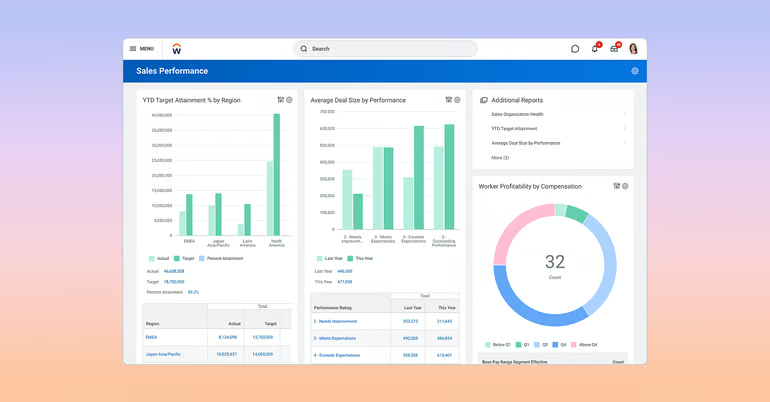
Workday connects employee records with compensation, benefits, and absence management through a shared data foundation. It also supports payroll and time tracking, while its talent tools cover recruiting, performance management, and employee learning. Because these functions use the same underlying data, HR teams can connect transactions and reports across different workforce processes.
SAP SuccessFactors provides comparable core HR and talent-management capabilities with more extensive international localization. SAP says Employee Central supports localized HR requirements in more than 100 countries and territories. Employee Central Payroll provides payroll localization in 60 countries, giving SAP an advantage for organizations managing multiple regulatory and employment environments.
The platforms also approach employee development differently. Workday connects performance and skills information with Workday Learning powered by Sana. SAP SuccessFactors combines learning with career development, succession planning, and internal mobility. Its AI tools can recommend development activities, identify possible career paths, and help managers prepare for performance conversations.
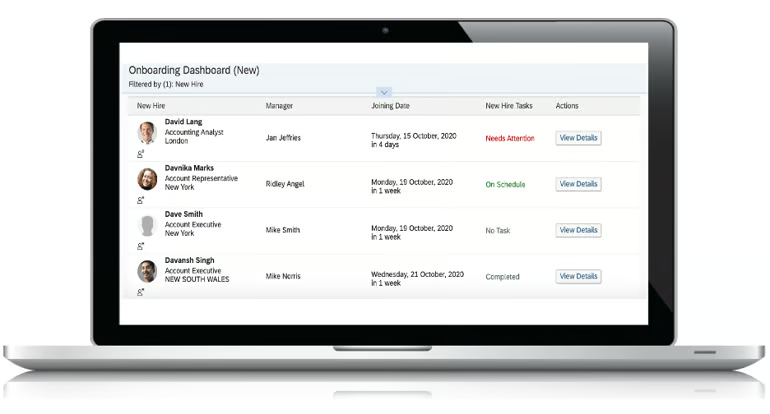
But overall, SAP wins this category because its localization and international payroll capabilities support a wider range of global core-HR needs. Workday remains closely matched and may be the better option for organizations prioritizing a more unified platform experience.
SAP SuccessFactors vs. Workday advanced capabilities
Winner: Workday
I gave Workday 4.85 out of 5 for advanced and global capabilities, compared with 4.76 for SAP SuccessFactors. Workday earned the higher score because I found its workforce planning, analytics, and employee-listening capabilities more cohesive, while SAP remained stronger for global payroll localization.
Workday’s principal advantage is the connection between workforce data, HR analytics software, financial information, and planning. Organizations can use Workday Adaptive Planning to model headcount, compensation, capacity, skills, and organizational changes while accounting for their potential financial effects.
Its broader HCM environment also includes Workday Peakon Employee Voice for employee listening, Workday VNDLY for contingent workforce management, and Workday Extend for creating applications and workflows on the Workday platform. These products give organizations ways to analyze and manage the entire workforce rather than treating individual HR processes as separate functions.
SAP SuccessFactors also provides workforce analytics, skills intelligence, succession planning, employee experience management, and AI-supported talent decisions. Joule helps employees and managers retrieve information and complete HR tasks, while specialized assistants support payroll, career development, and performance-management workflows.
That said, SAP has the stronger native global-payroll footprint. Workday extends its international reach through certified integrations with global and local payroll providers. Workday says these integrations can connect payroll and HR data across more than 180 countries, but the actual payroll service may be provided by a partner.
However, Workday wins the broader category because its planning, analytics, employee listening, and total workforce capabilities operate within a more cohesive data environment. SAP remains the better option when payroll localization is the organization’s most important advanced requirement.
Ease of use and integrations
Winner: Workday
I gave Workday 4.35 out of 5 for ease of use and integrations, compared with 4.29 for SAP SuccessFactors. Although neither platform offers a lightweight implementation, Workday’s more consistent interface and shared architecture gave it a slight advantage.
When evaluating these systems, I considered more than how their dashboards look. An enterprise HCM implementation requires process discovery, data preparation, and security configuration before teams can begin testing and training employees. Integration requirements and change management can add further complexity. For that reason, I recommend evaluating the complete implementation experience rather than judging either platform from a short product demonstration.
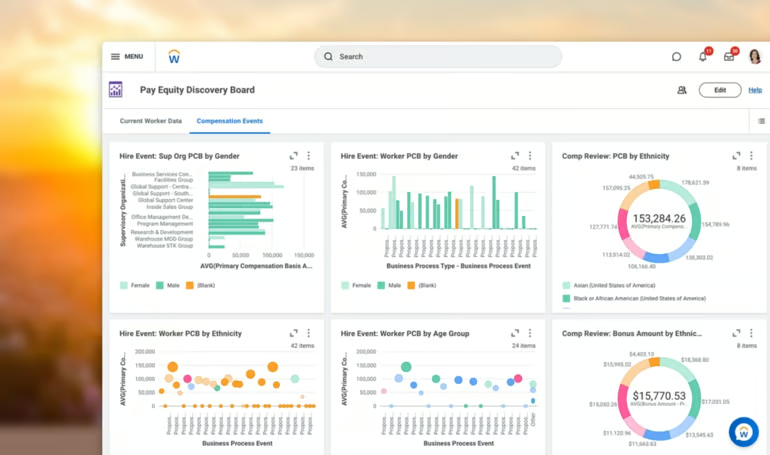
What stood out to me about Workday was the consistency of its experience across different HCM functions. Employees and managers can access HR tasks, pay information, and learning resources through its web and mobile applications. Administrators also benefit from business processes and reports operating on a shared platform.
SAP SuccessFactors provides strong employee self-service, mobile access, and administrative controls. However, I found it more difficult to assess the overall experience because a deployment may span several SuccessFactors modules and other SAP products. The resulting usability will depend partly on how those components are configured and governed.
SAP has a clear integration advantage for companies already using its business applications. If an organization relies on SAP for ERP, finance, or procurement, I would not treat Workday’s higher category score as an automatic reason to switch ecosystems. Existing SAP expertise, implementation partners, and established data models may make SuccessFactors the more practical choice.
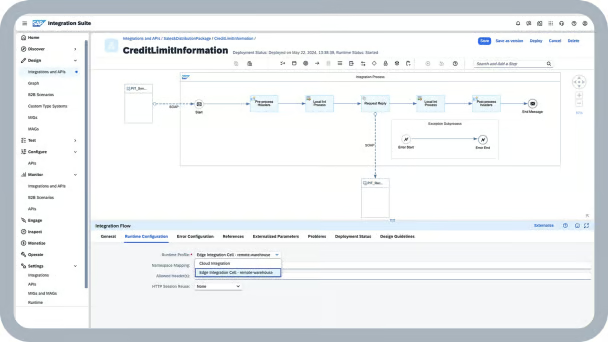
Workday offers the same ecosystem benefit for organizations using Workday Financial Management or Adaptive Planning. Its Extend and Orchestrate tools also provide options for creating applications, automating processes, and connecting external systems.
I selected Workday as the category winner because its interface and unified architecture create a more cohesive experience across HR functions. However, the narrow scoring difference matters: SAP SuccessFactors may require less organizational change for a company already standardized on SAP.
Alternatives to SAP SuccessFactors and Workday
Workday and SAP SuccessFactors are designed for complex midsize and large organizations. If your business needs more transparent pricing, a lighter implementation, stronger workforce management, or compatibility with another enterprise ecosystem, consider the following alternatives.
Organizations primarily evaluating payroll can review TechRepublic’s guide to the best payroll software. Businesses that place greater emphasis on recruiting can also compare the best free applicant tracking systems.
SAP SuccessFactors vs. Workday: Which is better overall?
Workday is the better overall HCM platform because its unified data foundation strengthens workforce analytics, planning, reporting, and employee experiences. It earned 4.49 out of 5 in my evaluation, compared with 4.47 for SAP SuccessFactors.
- Choose Workday if: You want workforce planning, analytics, financial data, employee listening, and talent management connected through a more cohesive platform.
- Choose SAP SuccessFactors if: You process payroll across many countries, rely on other SAP applications, or need extensive HR and payroll localization.
- Consider an alternative if: You need transparent pricing, faster implementation, or a simpler system for payroll and basic HR administration.
The small difference in overall scores reflects how closely matched these platforms are. Workday is my general recommendation, but SAP SuccessFactors may be the stronger strategic choice for a multinational enterprise with an established SAP environment.
Frequently asked questions (FAQs)
Is Workday or SAP SuccessFactors better for global payroll?
SAP SuccessFactors is generally better for organizations prioritizing native payroll localization. SAP says Employee Central Payroll supports payroll localization in 60 countries. Workday combines native payroll products with certified integrations and partner services to support a wider international footprint.
Is Workday easier to use than SAP SuccessFactors?
Workday earned a slightly higher ease-of-use score because its shared architecture supports a more consistent experience across HR, analytics, and planning. However, both platforms require extensive implementation, configuration, testing, and training.
Does Workday integrate with SAP?
Workday can integrate with SAP applications, although the required connectors, data flows, implementation effort, and ownership model depend on the products and business processes involved.
Are Workday and SAP SuccessFactors suitable for small businesses?
Both platforms can support midsize organizations, but their custom pricing, extensive functionality, and implementation requirements generally make them better suited to midsize and large enterprises. A small business may receive better value from a simpler HR and payroll platform.